

CRDB vs NMB: Two Banking Models, One Financial System
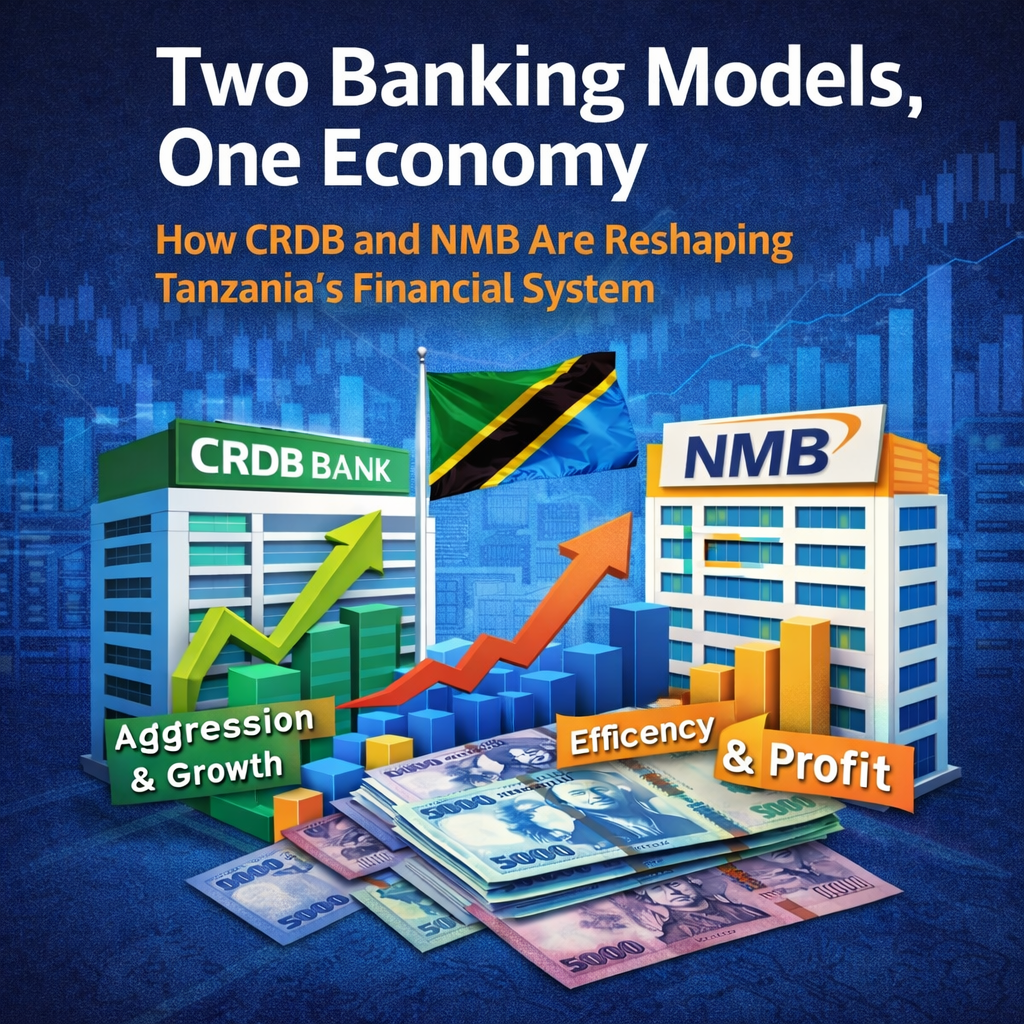
Tanzania’s two largest banks are no longer following the same playbook. One is expanding aggressively to shape credit and sectoral growth, while the other is optimizing efficiency to anchor stability and cash returns. This analysis explains how their divergent strategies are restructuring risk, competition, and capital allocation in the financial system.
Tanzania’s banking sector is entering a new structural phase. What once looked like competition between similar institutions is now revealing itself as a contest between two fundamentally different financial models. At the center of this shift stand CRDB Bank and NMB Bank. Their 2025 performance does more than show who made more profit. It exposes how Tanzania’s financial system is being pulled in two strategic directions at once.
One direction prioritizes expansion. The other prioritizes efficiency. Together, they are redefining how capital is mobilized, how risk is distributed, and how economic power is exercised through banking.
CRDB’s strategy is scale-driven. Its asset base and loan book have expanded at rates exceeding 30 percent year on year, a pace far above that of the broader economy. This signals a deliberate attempt to entrench itself as the primary intermediary between savings and investment. Rather than optimizing an existing balance sheet, CRDB is building a larger one. It is embedding itself more deeply into agriculture, trade, construction, and infrastructure-linked sectors. This is not merely profit-seeking behavior. It is positioning behavior. In macro terms, CRDB is constructing a banking version of economic infrastructure.
NMB’s strategy is structurally different. Growth is steadier, but operational discipline is sharper. A significantly lower cost-to-income ratio indicates that the bank extracts more profit from each unit of revenue. Instead of maximizing size, it maximizes yield per transaction. This resembles a utility model of banking, where repeat activity, standardized products, and margin protection dominate.
The economic implication is that Tanzania is no longer being intermediated by a single banking logic. It is being intermediated by two competing financial philosophies. One emphasizes credit expansion and sectoral reach. The other emphasizes margin efficiency and cash generation. Expansion-led banking increases the availability of credit and can accelerate investment and output. Efficiency-led banking strengthens dividend flows, retained earnings, and capital buffers, which support household income and financial stability.
This dual structure affects capital allocation. Firms seeking aggressive growth are more likely to align with banks willing to increase exposure quickly. Savers and income-focused investors benefit more from institutions that preserve margins and return profits. Over time, this can segment the market. One institution increasingly shapes production. The other increasingly shapes financial returns. Because both institutions are system-scale actors, this segmentation becomes macroeconomically relevant.
Profit figures alone obscure this divergence. NMB reports slightly higher absolute net income and runs one of the leanest large-bank operations in the region. Its low cost-to-income ratio means only a small share of revenue is absorbed by operations. Profit here is a product of organizational design as much as business volume.
CRDB, by contrast, generates a higher return on equity. It earns more profit per shilling of shareholder capital employed, despite having higher operating costs. This reflects a strategy of capital leverage. Expenses are higher because the institution is funding branch networks, workforce growth, and international positioning. It is trading short-term efficiency for long-term reach.
These profiles create different kinds of resilience. Efficiency protects margins when revenue growth slows. Scale protects relevance when competition intensifies. Tanzania’s banking market is now large enough to support both strategies, but it also means that performance rankings depend on which metric is prioritized: absolute earnings or earnings quality.
This divergence is not neutral for the rest of the sector. Smaller banks are pressured from both ends. They cannot easily match the balance-sheet scale of the expansion-led model, nor the cost discipline of the efficiency-led one. This pushes them toward niche specialization or eventual consolidation. The market structure shifts from many mid-sized competitors toward a system dominated by two distinct giants with different economic functions.
The most consequential implication lies in credit growth and risk concentration. CRDB’s loan book is expanding far faster than that of its closest rival. At the same time, its operating cash flow has turned negative, reflecting capital being absorbed into lending rather than generated through operations. In financial terms, funds are being converted into long-duration, risk-bearing assets.
NMB presents the opposite posture. Loan growth is moderate. Operating cash flow remains positive. Provisioning is stronger relative to non-performing loans. Its balance sheet behaves more like a buffer than an engine. One institution is pushing credit into the economy. The other is consolidating liquidity and stability.
This creates an asymmetry in where systemic risk accumulates. When credit growth is evenly distributed across many banks, shocks are diffused. When growth is concentrated, shocks become localized. If key sectors weaken, the institution carrying the largest share of incremental credit becomes the transmission channel for stress.
This does not imply that aggressive growth is reckless. It implies that the system’s marginal exposure is becoming concentrated in one place. As loan growth continues to outpace GDP growth, asset quality becomes more sensitive to macroeconomic conditions. A slowdown in trade, agriculture, or real estate would disproportionately affect the bank that has absorbed the most new risk.
There is also a structural policy dimension. Market forces are allowing credit creation to cluster around a small number of balance sheets. The question is whether this is an efficient outcome or a latent vulnerability. Competition allocates capital to the most successful institutions. Prudence suggests dispersion of risk. Tanzania’s financial architecture is now balancing these two principles in real time.
For the economy, the meaning is subtle but profound. Credit expansion fuels growth. Efficiency preserves stability. But the way these functions are divided between institutions shapes how future crises would propagate. Under the current trajectory, financial stress would most likely travel through the fastest-growing lender rather than the most efficient one.
The deeper story, therefore, is not about which bank “wins.” It is about what kind of financial system is emerging. Tanzania is moving from a landscape of broadly similar banks to one dominated by two specialized giants. One is becoming the engine of credit. The other is becoming the anchor of efficiency and cash generation.
This is a structural transformation, not a cyclical one. Banking scale is intersecting directly with economic power. Lending decisions increasingly shape which sectors expand. Cost structures increasingly shape where surplus flows. The financial system is no longer just reflecting the economy. It is beginning to shape it.
In this sense, Tanzania now operates with two banking logics inside one economy. Expansion and efficiency. Risk and stability. Production and surplus. How these forces interact will determine not only future profits, but the future pattern of growth and vulnerability in the Tanzanian economy.
