
Aliko Dangote, World's Richest Black Man, Met President Samia at State House Dar es Salaam. A USD 17 Billion Refinery and a Fertiliser Partnership Are on the Table.
Ready
Tanzania's State House has officially confirmed that President Samia Suluhu Hassan met Dangote Group Chairman Aliko Dangote at State House Dar es Salaam on 16 May 2026, with discussions covering energy, industry, ports, gas, fertiliser, infrastructure, and a proposed USD 17 billion crude oil refinery project that would serve East African countries and Ethiopia and create opportunities for other East African countries to participate through equity ownership. Dangote thanked President Samia for personally resolving challenges at the Mtwara Cement Plant, said the factory expects to produce approximately 2.8 million tonnes in 2026 against a target of 3.2 million tonnes, and announced plans to introduce 400 natural gas-powered trucks for cement distribution. President Samia invited Dangote Group to invest in fertiliser production in Tanzania, noting that domestic demand remains significantly higher than current production capacity. The refinery project, if implemented, would be one of the largest foreign direct investments in Tanzanian economic history, reducing East Africa's dependence on petroleum product imports and shielding the region from global price volatility. This article reports the confirmed details, situates the refinery and fertiliser announcements within Tanzania's energy and industrial development trajectory, and identifies what the partnership would mean for East and Central Africa's energy economics.This is no longer speculation. The USD 17 billion refinery is officially on the table between Tanzania's president and Africa's most consequential industrialist. What happens next depends on terms, financing, and the political will that Saturday's meeting demonstrated is present on both sides.
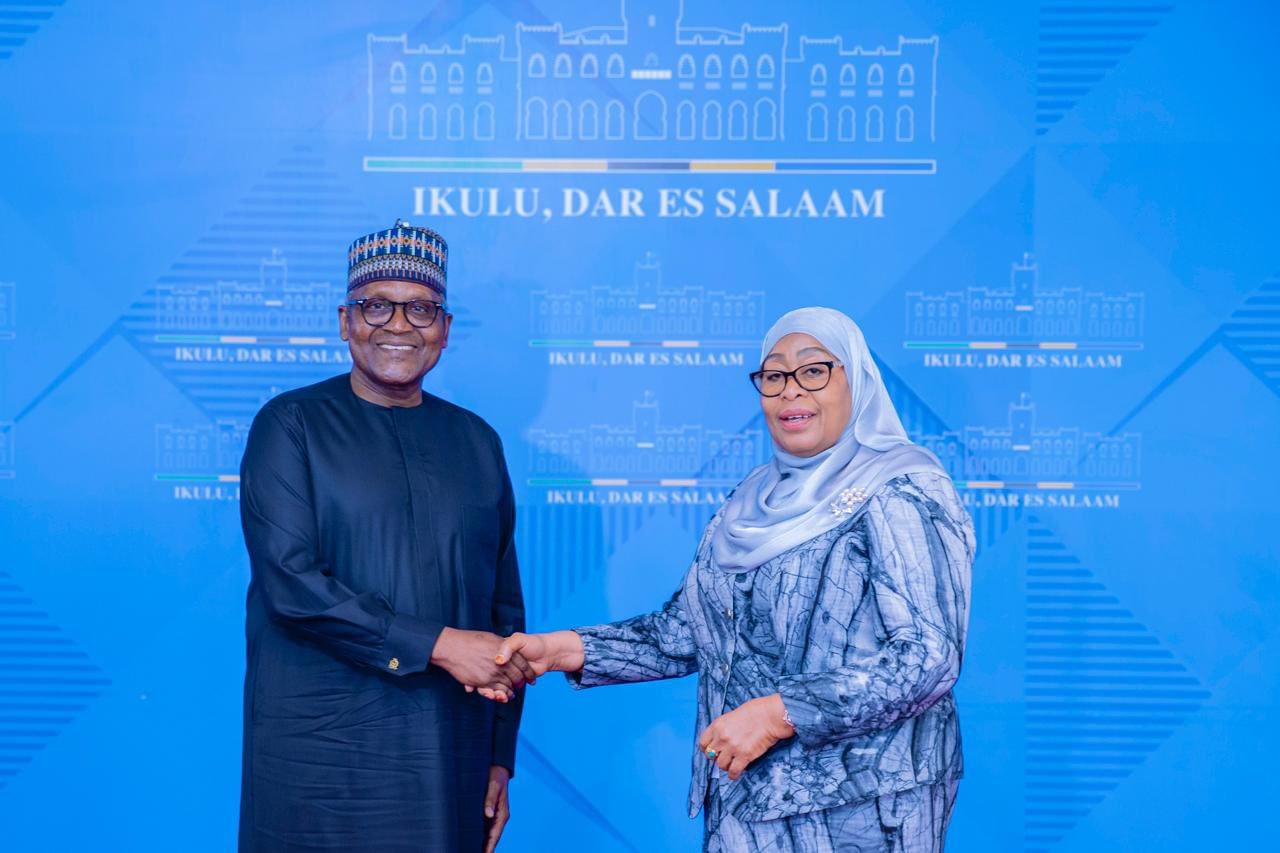
DAR ES SALAAM — President Samia Suluhu Hassan held discussions with Dangote Group Chairman and Chief Executive Officer Aliko Dangote at State House in Dar es Salaam on Saturday 16 May 2026, Tanzania's State House confirmed in an official statement issued by the Tanzania's State House.
The discussions focused on strengthening cooperation between the government and Dangote companies in energy, industry, ports, gas, fertiliser, and infrastructure. The meeting also covered the possibility of the Dangote Group partnering with the government of Tanzania in the implementation of a crude oil refinery project estimated to cost approximately USD 17 billion that would serve East African countries and Ethiopia.
Dangote commended President Samia's leadership directly. "I would like to sincerely thank you for personally intervening in many of the challenges facing our investment at the Mtwara Cement Plant. When we raised the issues, there were many difficulties, but as you promised, every challenge has now been addressed satisfactorily," he said according to the State House statement.
What was confirmed on the refinery
The official State House statement confirms that discussions covered the possibility of Dangote Group partnering with the government of Tanzania in implementing the crude oil refinery project, estimated at approximately USD 17 billion. Dangote stated that the project could create opportunities for other East African countries to participate through equity ownership, framing the facility as a regional capacity-building initiative in oil refining and petroleum product manufacturing rather than a purely bilateral Tanzania-Dangote commercial transaction.
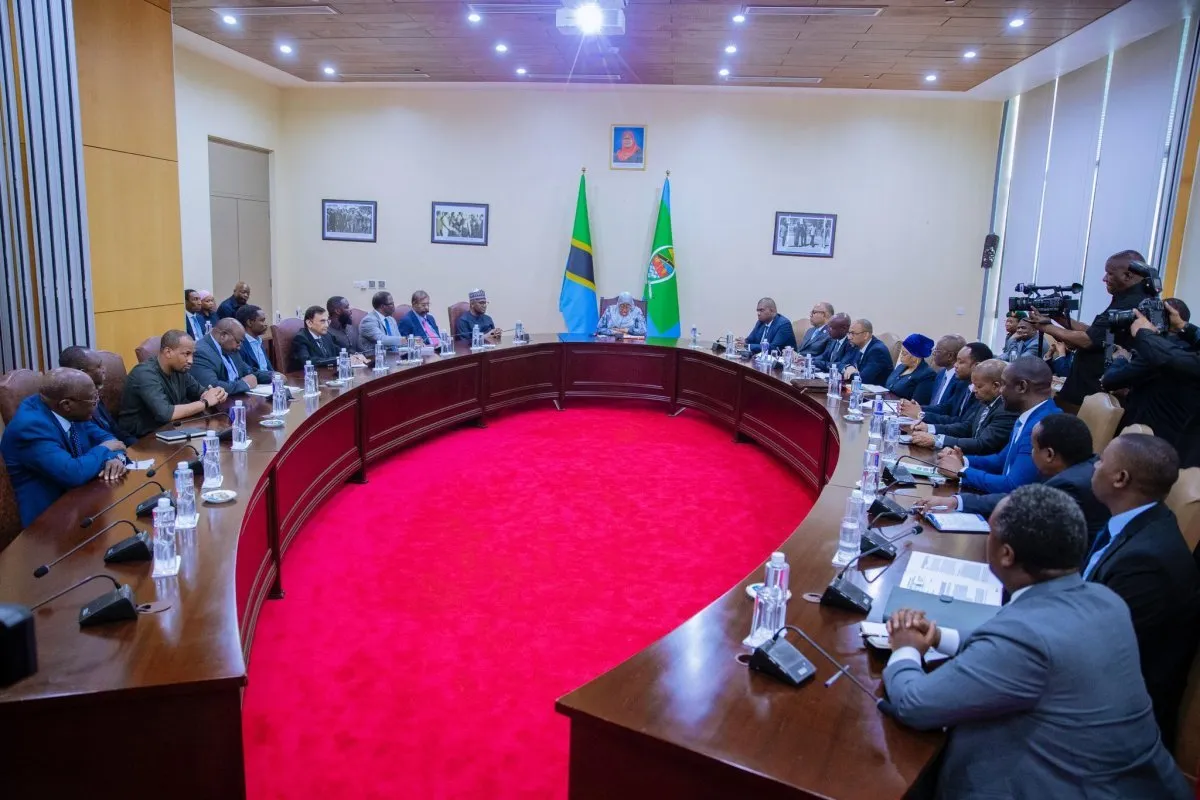 Aliko Dangote and his delegation meeting with Tanzania President Samia Suluhu Hassan and her investment officials
The project's stated objectives are reducing East Africa's dependence on petroleum product imports and shielding the region from global price volatility and supply disruptions, both of which have become more acute following the instability in the Middle East that has disrupted regional fuel supply chains and elevated landed fuel costs across the East African corridor.
The refinery's scale, at approximately USD 17 billion, is comparable to the Dangote Refinery in Nigeria whose construction cost reached USD 20 billion and whose commissioning transformed Nigeria's petroleum product economics. The Nigerian facility now operates at 650,000 barrels per day, has eliminated Nigeria's dependence on imported refined petroleum products for a significant share of domestic consumption, and has begun exporting petroleum products to Tanzania and other African markets. Dangote has described the planned East African facility as a refinery similar to the one in Nigeria.
The Mtwara Cement Plant and what it reveals about the relationship
Dangote's commendation of President Samia for personally resolving challenges at the Mtwara Cement Plant is the commercial foundation on which the refinery discussion sits, and its significance extends beyond courtesy. The Dangote Cement Factory in Mtwara is an existing Dangote Group industrial operation in Tanzania whose operational challenges the State House statement confirms were escalated to presidential level and resolved. Dangote's statement that every challenge has now been addressed satisfactorily, and that the government's interventions increased investor confidence and operational efficiency, is a public endorsement of Tanzania's investment environment from the industrialist whose assessment of African investment destinations carries more practical weight than most formal investor surveys.
"We are doing very well. We must thank Her Excellency the President for your leadership, because without your leadership, the market environment and investment conditions would not have allowed us to undertake a major business operation like this," Dangote said according to the official statement.
The factory expects to produce approximately 2.8 million tonnes in 2026 against a target of approximately 3.2 million tonnes. The production gap between actual and target output reflects the operational challenges whose resolution was the subject of the presidential-level intervention Dangote acknowledged, and whose full effect on production performance the remainder of 2026 will demonstrate.
The 400 natural gas trucks and what they signal
Dangote Group is preparing to introduce 400 trucks powered by natural gas for the transportation and distribution of cement across Tanzania, as part of a broader plan to convert 700 trucks to alternative energy use to improve operational efficiency and reduce transport costs, the State House statement confirms.
The announcement is commercially significant beyond its immediate operational implication. Converting 700 trucks from diesel to natural gas uses Tanzania's domestic gas supply as industrial input rather than export commodity, directly demonstrating the domestic gas utilisation logic that Uchumi360's energy series has identified as the most consequential policy decision Tanzania must make alongside the LNG export architecture. A logistics fleet of 700 natural gas-powered trucks is a domestic gas demand anchor whose scale, combined with the refinery's industrial gas requirements and the fertiliser production that President Samia invited Dangote to develop, begins to create the domestic industrial gas utilisation ecosystem that the LNG export project's domestic supply obligations must complement.
The transport cost reduction that natural gas trucking delivers relative to diesel improves the delivered price of Dangote cement across Tanzania's construction market, whose growth Uchumi360 documented at approximately 9% in 2023 according to National Bureau of Statistics data and whose infrastructure investment demand the government's TZS 56 trillion 2025/26 construction budget is sustaining.
President Samia's fertiliser invitation
President Samia invited Dangote Group to invest in fertiliser production in Tanzania, noting that domestic demand for fertiliser products remains significantly higher than the country's current production capacity, according to the State House statement.
The fertiliser invitation connects directly to Tanzania's natural gas position and to the broader backward integration logic that the Dangote model has demonstrated most consequentially in Nigeria. According to Tanzania Petroleum Development Corporation data, Tanzania holds approximately 57 trillion cubic feet of proven natural gas reserves whose domestic industrial applications include ammonia and urea production at costs substantially below the import price of the approximately USD 4 billion in nitrogen fertilisers that Africa imports annually according to African Fertilizer and Agribusiness Partnership data. A Dangote fertiliser plant in Tanzania using domestic natural gas feedstock would simultaneously reduce Tanzania's fertiliser import bill, improve agricultural input affordability for smallholder farmers whose productivity the fertiliser price constrains, and create the industrial chemical engineering capability whose adjacent applications extend to petrochemicals and pharmaceuticals.
The Dangote Group's fertiliser operation in Nigeria, whose output is currently oversold at USD 850 per tonne according to Dangote's publicly stated figures against a pre-Middle East crisis price of USD 400, demonstrates the commercial viability of the model whose replication in Tanzania the presidential invitation is seeking. Tanzania's combination of domestic gas feedstock, electricity generation surplus above 4,000 megawatts per Tanzania Electric Supply Company operational records, and the SGR logistics corridor whose USD 2.33 billion financing Standard Chartered arranged in April 2026 provides the industrial enabling conditions that a fertiliser plant requires for the agricultural market distribution that makes the investment commercially rational.
What the meeting means for East and Central Africa
The regional equity participation framework that Dangote described for the refinery project, creating opportunities for other East African countries to participate through equity ownership, is the most significant structural element of the announcement for the broader regional energy economics discussion. A USD 17 billion refinery owned through equity participation by Tanzania, Uganda, Kenya, Rwanda, Burundi, and potentially the DRC and Ethiopia would create the collective ownership model whose governance aligns the host country and the regional partners in the project's commercial success rather than positioning them as offtake customers in a transaction whose economics the developer controls.
Uganda's petroleum import bill, one of the most significant foreign exchange outflows in its fiscal position according to Uganda Bureau of Statistics economic data, would be directly addressed by equity participation in a regional refinery whose petroleum product output serves the Ugandan market at a cost structure whose domestic margin the equity ownership captures rather than transferring to an external producer. Rwanda's petroleum import costs, whose reduction improves Rwandan manufacturing competitiveness according to Rwanda Development Board economic data, would be similarly addressed. The DRC's eastern provinces, whose energy access constraints limit the mineral processing investment that the world's most significant cobalt and coltan deposits would otherwise attract according to Banque Centrale du Congo economic data, represent the downstream beneficiary market whose energy access improvement the regional refinery's distribution infrastructure would enable.
President Samia reaffirmed the government's commitment to cooperation and encouraged Dangote to continue exploring additional business and investment opportunities in Tanzania that would benefit investors, the government, and the nation, according to the State House statement.
What comes next
The official statement confirms the discussions and the broad parameters of the projects under consideration. It does not confirm a final investment decision, a financing structure, a site selection between Tanga and Mombasa, or a construction timeline. Those decisions require the technical development, regulatory framework design, and financing architecture that State House meetings initiate rather than conclude.
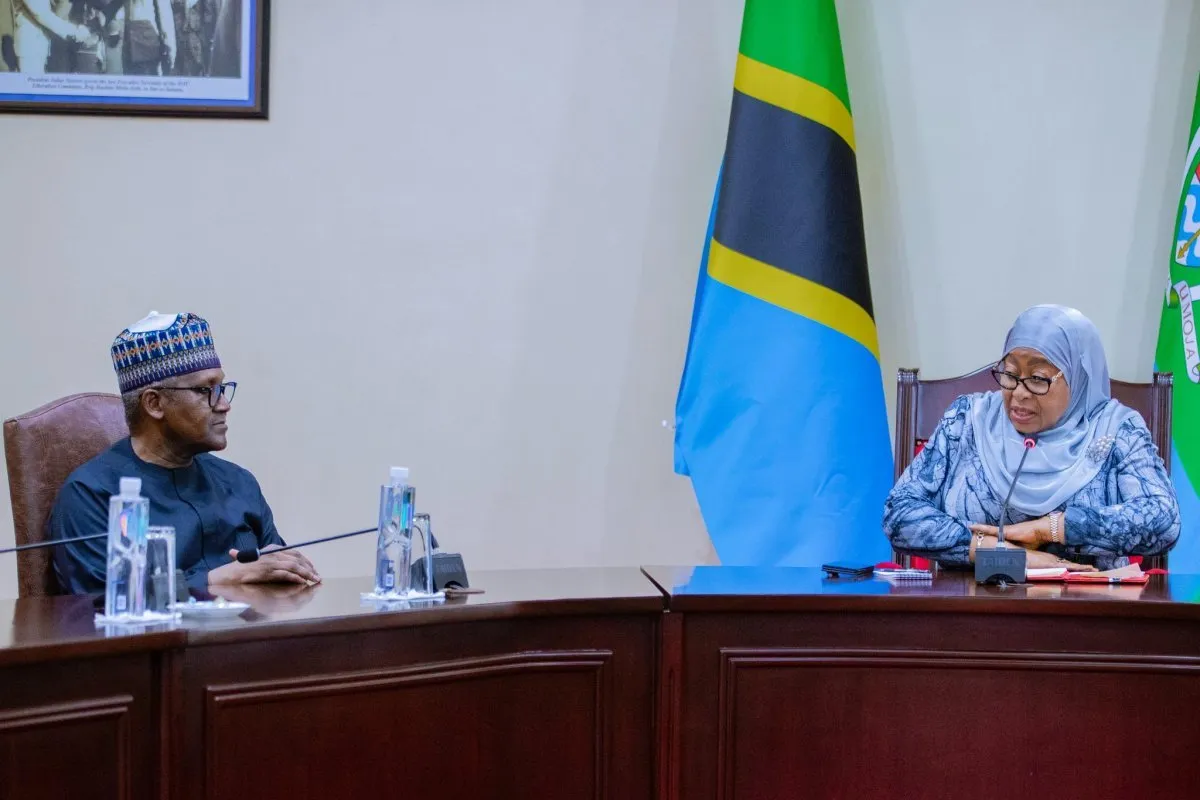 Aliko Dangote, Chairman of Dangote Group with Tanzania President Samia Suluhu Hassan at State House in Dar es Salaam, Tanzania
What the meeting has confirmed is that the world's most consequential African industrialist has an existing and productive commercial relationship with Tanzania through the Mtwara Cement Plant, has received presidential-level intervention to resolve operational challenges, is expanding that relationship through the 700-truck natural gas conversion programme, and is in active discussion about a USD 17 billion refinery and a fertiliser plant whose combined investment would represent the largest industrial capital deployment in Tanzania's modern economic history.
Uchumi360 will monitor developments as they are released by State House, the Dangote Group, and TISEZA. The meeting happened. The numbers are confirmed. Tanzania is making its case and Dangote is listening.
FAQ
What did the State House statement officially confirm about the refinery? The official statement confirmed that discussions covered the possibility of Dangote Group partnering with the government of Tanzania in implementing a crude oil refinery project estimated to cost approximately USD 17 billion that would serve East African countries and Ethiopia. Dangote stated the project could create opportunities for other East African countries to participate through equity ownership as part of building regional capacity in oil refining and petroleum product manufacturing.
What is the current status of Dangote's existing Tanzania operations? The Dangote Cement Factory in Mtwara is operational and expects to produce approximately 2.8 million tonnes in 2026 against a target of approximately 3.2 million tonnes according to the State House statement. Dangote commended President Samia for personally intervening to resolve challenges that had been affecting the plant, stating that every challenge has now been addressed satisfactorily. The group is also preparing to introduce 400 natural gas-powered trucks for cement distribution as part of a broader 700-truck alternative energy conversion programme.
Why did President Samia invite Dangote to invest in fertiliser? Because Tanzania's domestic demand for fertiliser remains significantly higher than current production capacity according to the State House statement, creating an import dependency whose resolution domestic natural gas feedstock production could address. Tanzania holds approximately 57 trillion cubic feet of proven natural gas reserves per TPDC data whose ammonia and urea production applications would reduce Tanzania's fertiliser import bill while improving agricultural input affordability. The Dangote Group's Nigerian fertiliser operation provides the operational template whose replication in Tanzania the presidential invitation is seeking.
What does the regional equity ownership model mean for East African countries? Dangote's proposal to create opportunities for East African countries to participate through equity ownership in the refinery would align the host country and regional partners in the project's commercial success rather than positioning them as external offtake customers. Uganda, Kenya, Rwanda, Burundi, Ethiopia, and potentially the DRC would each have financial interest in the refinery's petroleum product output, whose domestic pricing at production cost rather than import price would directly reduce their petroleum import bills and shield their economies from global price volatility.
What is the difference between the USD 17 billion figure and the 650,000 barrels per day capacity cited in earlier reports? The USD 17 billion figure is the cost estimate confirmed in the official State House statement for the Tanzania refinery project. The 650,000 barrels per day is the proposed capacity figure that has been cited in earlier reporting on the regional refinery discussions including President Ruto's April 2026 announcement. The Nigerian Dangote Refinery, which also operates at 650,000 barrels per day, cost approximately USD 20 billion to build. The USD 17 billion estimate for the Tanzania project requires verification against formal project feasibility documentation before publication.
 Uchumi360
Business Intelligence
Uchumi360
Business Intelligence
- State House United Republic of Tanzania, official photographs and statements confirming meeting between President Samia Suluhu Hassan and Aliko Dangote delegation, 16 May 2026
- Kenya State House, President Ruto announcement of East African joint refinery project at Tanga, April 2026
- Specific announcement documentation requires verification before publication
- EACOP official project updates, May 2026
- Chongoleani Marine Terminal exceeding 88% completion, first oil July to October 2026 target
- Available at eacop.com
- Tanzania Petroleum Development Corporation, natural gas reserve data
- Approximately 57 trillion cubic feet proven reserves
- Available at tpdc.go.tz
- Tanzania Electric Supply Company, operational records
- 4,000 MW capacity figure
- Verify against TANESCO most recent operational bulletin before publication
- Available at tanesco.co.tz
- Standard Chartered Bank, SGR financing announcement, 28 April 2026
- Available at sc.com
- Tanzania Investment and Special Economic Zones Authority, investment framework documentation
- Available at tiseza.go.tz
- Kenya Ports Authority, Mombasa port capacity and throughput data
- Available at kpa.co.ke
- Kenya Pipeline Company, petroleum product distribution network documentation
- Available at kpc.co.ke
- Uganda Bureau of Statistics, petroleum import bill data
- Available at ubos.org
- Rwanda Development Board, petroleum import cost and economic data
- Available at rdb.rw
- Banque Centrale du Congo, energy deficit and economic data
- Available at bcc.cd
- Dangote Industries, Nigerian refinery operational data
- 650,000 barrels per day capacity and East African export details cited from publicly available company records
Uchumi360 covers business, investment, and economic policy across East, Central, and Southern Africa.
For the serious reader
You read to the end. That places you in a small group.
Uchumi360 is built for readers who demand precision over speed, structure over sentiment, and analysis that holds uncomfortable conclusions rather than softening them. If this work sharpens how you think about Africa's economy, help us keep building the infrastructure behind it.
Institutional Partners
Commission intelligence. Shape the conversation.
Uchumi360 works with development finance institutions, investment firms, sovereign bodies, and strategic organisations across the coverage region. Institutional partnership unlocks:
- Commissioned sector and country intelligence reports
- Branded research series under your institution's authority
- Exclusive data briefings for internal strategy teams
- Speaking and editorial presence at Uchumi360 events
- Co-published investment outlooks for your markets
Support Our Work
Independent analysis has a cost. Help us bear it.
Uchumi360 does not carry advertising. It does not take editorial direction from sponsors. Every article is produced without commercial compromise. Your contribution funds the reporting, research, and editorial infrastructure that keeps this analysis free from influence.
Secure checkout: One-time and monthly support are processed securely. Add payment credentials to enable checkout here.
Stay Connected
Keep up with every new insight.
Follow our latest analysis, policy coverage, and market intelligence as soon as it is published. If you need something specific, reach out directly and we will point you to the right research.
