
Tanzania, Uganda and Vitol Sign US$20 Billion Tanga Energy Hub Deal to Transform East Africa's Oil Industry
Ready
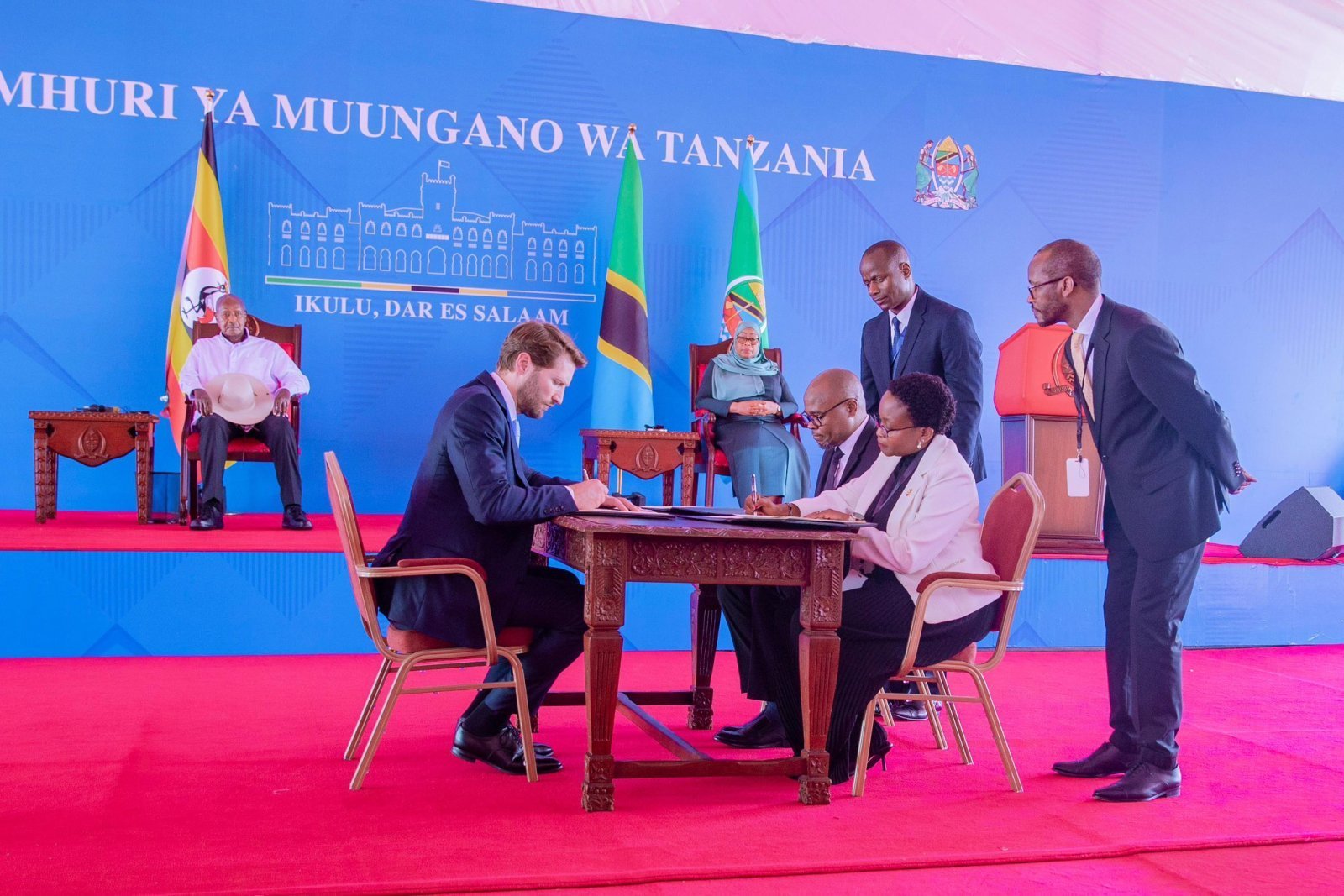
Tanzania and Uganda signed an MoU with Vitol Bahrain E.C. at State House in Dar es Salaam for the Tanga Regional Energy Hub, a $20 billion complex combining a crude refinery, a tank farm, a marine jetty and a products pipeline to Uganda. TPDC, UNOC and Vitol are the parties; Samia and Museveni witnessed the signing. It builds on EACOP, moving Uganda's crude from a straight export commodity into something Tanzania refines and distributes regionally before it leaves the coast.
Tanzania and Uganda have signed a memorandum of understanding with Vitol Bahrain E.C. to build the Tanga Regional Energy Hub, a $20 billion integrated refining and logistics complex on Tanzania's northern coast. Presidents Samia Suluhu Hassan and Yoweri Museveni witnessed the signing at State House in Dar es Salaam. The Tanzania Petroleum Development Corporation and Uganda National Oil Company sit opposite Vitol on the deal.
The timing matters. This MoU landed roughly three weeks after Aliko Dangote confirmed his 700,000 barrel-per-day, $15-17 billion regional refinery would be built in Kenya, not Tanzania, despite Tanga hosting the EACOP terminus. Read on its own, the Vitol deal is a straightforward infrastructure story. Read against the Dangote decision, it looks like Tanzania's answer to a question it just failed to win.
Round two: Tanzania didn't wait to lose again
This is where the story usually ends in most coverage: Kenya won, Tanzania learned something, moving on. It didn't end there. Three weeks after Dangote's decision, Tanzania, Uganda and Vitol Bahrain signed an MoU for the Tanga Regional Energy Hub, a $20 billion complex combining a crude refinery, a storage tank farm, a marine jetty and a products pipeline back to Uganda, signed at State House in Dar es Salaam before Presidents Samia Suluhu Hassan and Yoweri Museveni.
Vitol isn't a speculative name attached to an ambitious MoU. It's the world's largest independent oil trader, and it entered 2026 from a position of genuine strength: turnover rose 3.6% to $343 billion in 2025, oil refining capacity expanded to 1.2 million barrels a day, and LNG volumes grew 28% to 23 million metric tonnes, according to Reuters. The company said it entered 2026 "well-placed to deal with market volatility and dislocations," a reference to the disruption the US-Israeli war on Iran caused across energy markets that year. That matters for how this deal should be read: Vitol isn't chasing a foothold in East Africa from a weak position. It's expanding into refining capacity from a trading house that just posted its strongest turnover on record, which makes the Tanga commitment look more like Vitol allocating growth capital to a market it's betting on, not a speculative land-grab against Kenya's win.
Read against the Dangote outcome, the timing isn't incidental either. Tanzania just watched Kenya win a regional refinery contest on the strength of an integrated system Tanzania didn't have. The Vitol deal is Tanzania attempting to build that system on its own terms, with a partner that has the balance sheet to actually follow through, rather than wait for the next Dangote-scale decision to expose the same gap a second time.
That's a meaningfully different response than simply losing gracefully. Kenya proved its platform works by winning the bigger prize. Tanzania's answer isn't to argue the decision was wrong. It's to go build the thing Dangote said it was missing, backed by a trading house with the scale to actually finance it.
What's being built
The complex includes a crude oil refinery, a terminal tank farm for storing and loading refined products, a marine jetty for petroleum cargo, and a pipeline carrying refined products back to Uganda. That's the full downstream chain sited at one location: crude arrives via EACOP, gets refined at Tanga, and finished fuel moves both into the Tanzanian market and back up the pipeline to Uganda.
This is the same basic logic Dangote applied when weighing Tanga against Mombasa, refine close to where the crude lands rather than shipping it out and buying finished product back. The difference is scale. Dangote's Kenya refinery runs at 700,000 barrels a day. Nothing in the Tanga MoU specifies daily throughput for this facility, which on its own is a gap worth noting before treating the two projects as comparable in size.
Why this deal exists now
EACOP settled where Uganda's crude physically goes. It never settled who profits from turning that crude into something usable. For a while, the assumption in East Africa was that Dangote's decision would answer that question for the whole region, whoever hosted his refinery would capture most of the downstream margin, and everyone else would be a customer.
That assumption broke three weeks ago. Dangote's own explanation for choosing Kenya was blunt: Mombasa's deeper port, Kenya's larger fuel consumption, and a petroleum distribution network already reaching Uganda, Rwanda, South Sudan and eastern DRC that Tanga couldn't match on his timeline. Tanzania had the pipeline. Kenya had the system, and Dangote was buying a system, not proximity to crude.
The Vitol deal reads as Tanzania's response to that specific verdict. Rather than wait for another Dangote-scale opportunity to prove the same point again, Tanzania is building its own downstream platform with a different, smaller partner.
What Tanzania is actually solving for
The Dangote analysis of Tanzania's loss identified a specific gap: the country has genuine assets, more than 57 trillion cubic feet of proven gas reserves, EACOP's terminal, an expanding Dar es Salaam port, the SGR corridor, but hadn't assembled them into an integrated platform that lowers cost and uncertainty for investors making decades-long commitments. Assets sit on a map. Platforms function.
The Tanga hub is Tanzania's attempt to build exactly that kind of platform, refining, storage, marine logistics and distribution under one project rather than as separate, disconnected pieces of infrastructure. Whether it closes the gap Dangote's decision exposed depends on execution over years, not on the signing itself. A $20 billion MoU is a commitment on paper. Mombasa's advantage took decades of accumulated infrastructure to build, and Dangote said as much when explaining his choice.
Museveni's framing
Museveni tied the agreement directly to EACOP's momentum: "This partnership builds on the success of EACOP and will strengthen regional energy security, industrialisation and trade." He linked it to Uganda's own Hoima Refinery project, both aimed at keeping more value from Uganda's oil inside East Africa rather than exporting crude and buying back refined fuel at a markup. He called it a Pan-African approach, process resources at home instead of shipping them out raw.
That framing sits a little uneasily next to the Dangote outcome. Uganda backed Kenya's bid for the larger refinery too, since Kenya's distribution network already reaches Uganda more efficiently than Tanzania's does. Uganda's interest in the Tanga hub and its interest in Kenya's refinery aren't contradictory, Uganda benefits from cheaper refined fuel regardless of which coast it comes from, but it does mean Uganda isn't betting exclusively on Tanzania the way Museveni's language implies.
The comparison that actually matters
Dangote's Lagos refinery, 650,000 barrels a day, was built on a different logic entirely: domestic crude access and feedstock control inside Nigeria. The East Africa decision ran on regional distribution reach and consumption scale instead. Tanzania had the argument that would have worked for a Lagos-style project. It didn't have the argument that decided this one.
The Tanga hub with Vitol doesn't need to win on Dangote's terms to succeed. It's a different scale, a different partner, and it doesn't have to serve five countries to be viable, just Tanzania and Uganda's own consumption plus regional overflow. But it exists in the shadow of a decision that already told Tanzania what large-scale capital is actually optimising for, and it's fair to ask whether this deal was structured with that lesson in mind or signed regardless of it.
What East Africa gets either way
A refinery anywhere in the region, Kenya's or Tanzania's, reduces collective dependence on imported refined fuel and the foreign exchange drain that comes with it. The risk in having Kenya host the larger facility is straightforward: one country captures most of the refining margin on regional consumption while its neighbours remain customers. Tanzania building its own smaller platform at Tanga is one way to avoid becoming purely a consumer in that arrangement, even if it isn't competing at Dangote's scale.
The open question
Dangote's decision was one data point about what capital looks for in East Africa: a complete system, not the most impressive individual assets. The Tanga hub is Tanzania's first real test of whether it absorbed that lesson. The SGR, the port, the gas reserves and now this refinery and logistics complex are each significant pieces. Whether they get integrated into something investors read as a coherent platform, rather than a collection of separately impressive projects, is the question this MoU doesn't answer by itself. It only sets up the next few years to answer it.
FAQ
What does the Tanga Regional Energy Hub include? A crude refinery, a storage tank farm, a marine jetty, and a pipeline moving refined products from Tanga back to Uganda.
How does this relate to Dangote choosing Kenya? The Tanga hub was signed roughly weeks after Dangote confirmed his larger, 700,000 bpd regional refinery would go to Kenya instead of Tanzania. The Vitol deal looks like Tanzania building its own downstream platform after losing the bigger contest.
Is the Tanga hub the same size as Dangote's Kenya refinery? No. Dangote's Kenya project runs 700,000 barrels a day at $15-17 billion. The Tanga MoU doesn't specify daily throughput, and at $20 billion for a smaller-scope facility, it isn't a direct scale comparison.
Does Uganda's involvement in both projects create a conflict? Not directly. Uganda backed Kenya's bid for the larger refinery because Kenya's distribution network already serves it more efficiently, while also signing onto the Tanga hub. Uganda benefits from cheaper refined fuel regardless of source, but its interest isn't exclusive to Tanzania.
What does Tanzania need to do for this to actually close the gap Dangote's decision exposed? Integrate the refinery, storage, logistics and distribution pieces into a platform that functions the way Mombasa's does, not just complete construction. That's a multi-year execution question, not something the signing itself resolves.
 Uchumi360
Business Intelligence
Uchumi360
Business Intelligence
Uchumi360 covers business, investment, and economic policy across East, Central, and Southern Africa.
For the serious reader
You read to the end. That places you in a small group.
Uchumi360 is built for readers who demand precision over speed, structure over sentiment, and analysis that holds uncomfortable conclusions rather than softening them. If this work sharpens how you think about Africa's economy, help us keep building the infrastructure behind it.
Institutional Partners
Commission intelligence. Shape the conversation.
Uchumi360 works with development finance institutions, investment firms, sovereign bodies, and strategic organisations across the coverage region. Institutional partnership unlocks:
- Commissioned sector and country intelligence reports
- Branded research series under your institution's authority
- Exclusive data briefings for internal strategy teams
- Speaking and editorial presence at Uchumi360 events
- Co-published investment outlooks for your markets
Support Our Work
Independent analysis has a cost. Help us bear it.
Uchumi360 does not carry advertising. It does not take editorial direction from sponsors. Every article is produced without commercial compromise. Your contribution funds the reporting, research, and editorial infrastructure that keeps this analysis free from influence.
Secure checkout: One-time and monthly support are processed securely. Add payment credentials to enable checkout here.
Stay Connected
Keep up with every new insight.
Follow our latest analysis, policy coverage, and market intelligence as soon as it is published. If you need something specific, reach out directly and we will point you to the right research.
