
Kagame Tells 2,800 Business Leaders Africa Is Losing Its Most Valuable Assets Cheaply. The Continent Must Learn to Say No.
Ready
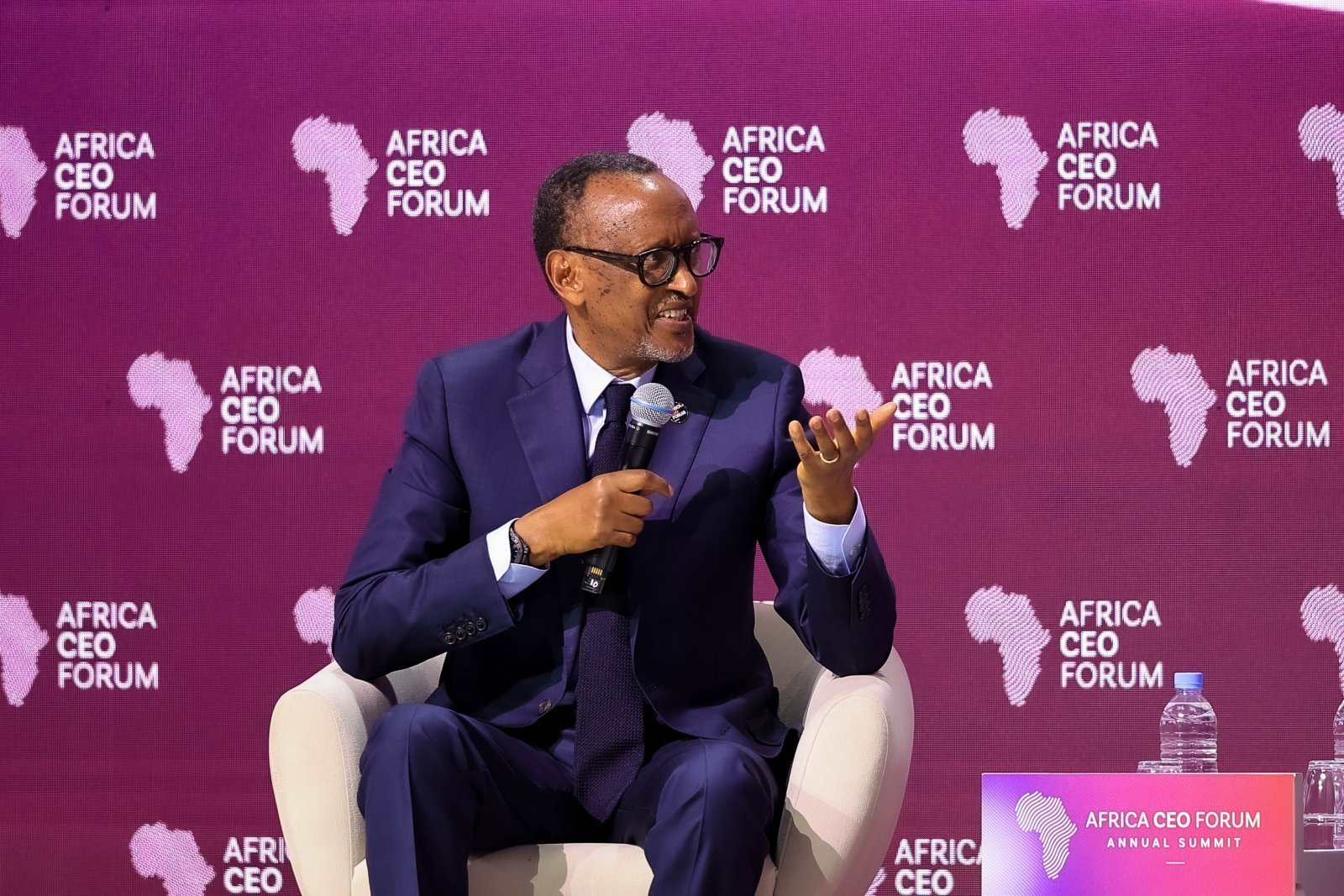
Speaking at the opening ceremony of the Africa CEO Forum 2026 in Kigali, President Paul Kagame delivered a fireside conversation moderated by CNN's Eleni Giokos that moved the forum's opening beyond economics and into power, arguing that Africa's structural disadvantage in the global economy is not a historical condition but an active and ongoing dynamic whose continuation depends on Africa's passivity rather than on any fixed feature of the global system. Africa holds approximately 60% of the world's solar potential and the bulk of critical minerals driving the global energy transition, yet continues to lose those assets cheaply to external powers who extract them while simultaneously lecturing the continent on democracy and human rights. On sanctions, Kagame was direct: they are meant to hurt, and Rwanda is hurt, but refusing the wrong things costs less in the long run than accepting them. Asked whether he would yield to external pressure, he said he had never capitulated in a war situation. His prescription was threefold: recognise the pattern, build collective leverage through shared ownership and scale, and develop the willingness to refuse deals that do not serve Africa's interests even at short-term cost. This article reports the session, situates Kagame's remarks within the forum's Scale or Fail theme, and identifies the specific arguments whose implications extend from Rwanda's immediate geopolitical situation to the broader question of how East, Central, and Southern African economies convert resource endowment into negotiating leverage. Africa already knows its problems and talks about them at length. What Kagame told 2,800 business leaders in Kigali is that knowledge without collective will and implementation is the continent's most expensive habit.
KIGALI — President Paul Kagame opened the 13th Africa CEO Forum on Wednesday with a fireside conversation that had no diplomatic softening in it.
Moderated by CNN anchor Eleni Giokos in front of 2,800 business leaders, investors, policymakers, and heads of state from more than 70 countries at the Kigali Convention Centre, the session covered geopolitics, sanctions, and Africa's persistent failure to convert its resources into leverage. The forum's theme this year is Scale or Fail: Why Africa Must Embrace Shared Ownership. Kagame gave it a harder edge than the title suggests.
He opened with a question whose answer the room already knew. "Why is Africa always at a disadvantage?" He traced the answer across centuries: the slave trade, colonialism, wars, pandemics, and the current scramble for minerals and strategic assets. His argument was that these are not sequential historical chapters but a single continuous dynamic. "We are in a different cycle now that is driven geopolitically," he said, "but you have had centuries of different things happening."
The resource argument
Africa's strategic position in the global economy is stronger than its negotiating outcomes suggest. Kagame made the gap between the two the centrepiece of his remarks.
The continent holds approximately 60% of the world's solar potential according to International Energy Agency data, and controls the majority of critical minerals whose demand is accelerating with the global energy transition: cobalt, graphite, lithium, manganese, platinum group metals, and rare earths whose processing and manufacturing applications feed the battery systems, electric vehicles, semiconductor manufacturing, and renewable energy infrastructure that the world's major industrial powers are competing to dominate. The Democratic Republic of Congo alone accounts for approximately 74% of global cobalt production according to USGS Mineral Commodity Summaries 2024. Tanzania holds globally significant graphite at Mahenge and Epanko, nickel at Kabanga, and helium in the Rukwa Basin. Zambia is central to global copper production. Mozambique's Rovuma Basin holds gas reserves whose scale makes it one of Africa's most significant emerging energy economies.
Yet the commercial terms on which those assets are being developed, the royalty structures, the processing requirements, the local content obligations, and the sovereign wealth arrangements, remain structured in ways that capture the extraction margin while the processing, manufacturing, and technology application value accumulates elsewhere. "Different powers are fighting over that," Kagame said, "but Africa that has a lot of that is silent or losing most of it cheaply."
On external pressure and the whip
The critique of external powers was the session's sharpest passage. Kagame described the current global environment as one in which the powers that be are holding a whip in their hands, using it to beat whoever they choose, openly, without concealment, while simultaneously presenting themselves as advocates of the values whose violation they are sanctioning others for.
"These powers you see that come here lecturing people democracy, human rights," he said, "and they are doing it in one arm and the other, they are just taking away everything that people own."
He drew a historical analogy that was direct in its implication. "In the old days, the kings and so on used to give their in-laws, their children, powers, say, go and control something somewhere. And this is happening today."
The remarks were widely read in the room as a reference to recent pressure from the United States administration, including sanctions linked to the eastern DRC situation, though Kagame named no government specifically. Rwanda has faced sustained international pressure over its reported involvement in the conflict in eastern DRC, whose mineral wealth, including coltan, gold, and cassiterite, sits at the intersection of the geopolitical resource competition Kagame was describing.
On sanctions and the calculation
When Giokos asked directly about sanctions, including those affecting Rwanda, Kagame engaged the question without deflection.
"Sanctions, first of all, are they justified? And it is not just in this case of Rwanda but in other cases." He acknowledged the cost without minimising it. "Sanctions are meant to hurt people, so in a way, we are hurt." But the calculation is clear. "I think we would be hurt more by not doing what we are doing, so it's always a calculation. It's not difficult to say no; in fact, it costs more to say yes to the wrong things."
Asked directly whether he would yield to external pressure, the answer was brief. "I never capitulated in a war situation."
The gap between knowledge and action
Throughout the conversation Kagame returned to a specific frustration whose target was not external powers but African leadership itself. "There is a lot we know and there is a lot we talk about. But we need to do a lot more."
The forum's 2,800 attendees, whose capital allocation decisions collectively determine which African industries get built and which remain aspirational, were the audience for its most pointed passage. "We can't just be people who are waiting to be ripped off, by somebody who is shrewd enough and has the power, we must be able to say, 'No'."
He framed the current geopolitical pressure not as a threat to be managed but as an opportunity to be seized. "My view is that these pressures that we get from the rest of the world, Africa, I think, is being reminded to wake up." The alternative he described in terms whose arithmetic is straightforward: "Either we keep paying the price, or we decide to build the scale we need to have leverage."
What the forum is being asked to deliver
The Scale or Fail theme frames the forum's 2026 agenda around shared ownership as the mechanism through which African economies build the scale that leverage requires. Kagame's opening gave that framing its geopolitical urgency. Shared ownership is not only a financing model or a governance structure. It is the condition under which African assets stop being extracted at terms set by those with more capital and more commercial sophistication than the sellers.
For East and Central Africa specifically, the argument has immediate operational relevance. Tanzania's USD 42 billion LNG project is being negotiated with Equinor, ExxonMobil, and Shell at a moment when the terms of that negotiation will determine whether Tanzania's gas reserves generate sovereign wealth and domestic industrial development or primarily export revenues whose fiscal contribution falls short of the asset's strategic value. The DRC's mineral wealth is being developed under commercial arrangements whose terms the eastern DRC conflict is simultaneously destabilising and making more urgent to resolve. Zambia's copper and emerging lithium sector, Mozambique's gas and graphite, Rwanda's own positioning as a financial and logistics hub whose institutional quality attracts investment that resource endowment alone does not, are all being shaped by the same structural question Kagame placed at the centre of Wednesday's opening session.
"I think we need to give ourselves value of some kind," he said. "The continent has a lot that is not being put to good use. And it is up to us."
The forum continues through Thursday with sessions on capital mobilisation, industrialisation, regional integration, energy, and the architecture of continental champions. The opening session established the terms on which those conversations will be evaluated. Not whether Africa can attract investment. Whether it can attract investment on terms it has chosen rather than terms it has accepted.
FAQ
What did Kagame say about Africa's resource position? Africa holds approximately 60% of the world's solar potential according to IEA data and the majority of critical minerals needed for battery production and the global energy transition. Kagame argued that different powers are fighting over those assets while Africa remains largely silent, losing most of them cheaply to those who know what they want to do with them. His framing was not historical grievance but present-tense diagnosis: the scramble for African resources is active and ongoing, and Africa's passivity in the face of it is a choice rather than an inevitability.
What did he say about sanctions? Kagame acknowledged directly that sanctions are designed to hurt and that Rwanda is hurt by them. His argument was that the calculation nonetheless favours refusal: it costs more in the long run to say yes to the wrong things than to absorb the short-term pain of saying no to them. Asked whether he would yield to external pressure, he said he had never capitulated in a war situation.
Who was he referring to when he talked about external powers? Kagame named no government specifically. His remarks about powers holding a whip and using it openly while lecturing on democracy and human rights were widely read in the room as a reference to recent pressure from the United States administration, including sanctions linked to Rwanda's reported involvement in the eastern DRC conflict whose mineral wealth sits at the centre of the geopolitical resource competition he was describing.
What is the forum's Scale or Fail theme and how did Kagame frame it? The Africa CEO Forum 2026 theme is Scale or Fail: Why Africa Must Embrace Shared Ownership, framed around the argument that African economies must build the continental scale through shared ownership structures that generates the leverage to negotiate on equal terms with external capital. Kagame's opening gave the theme its geopolitical dimension: shared ownership is not only a financing model but the condition under which African assets stop being extracted at terms set by others. Either Africa builds the scale it needs to have leverage, he said, or it keeps paying the price.
What was Kagame's core call to action? Three things: recognise the pattern of extraction and external pressure as an active dynamic rather than historical background, build collective leverage through shared ownership, scale, and continental unity, and develop the institutional and political willingness to refuse deals that do not serve Africa's interests even at short-term cost. His most direct formulation: Africa must be able to say no. His most pointed observation: Africa already knows its problems and talks about them extensively. What is missing is implementation and collective will.
 Uchumi360
Business Intelligence
Uchumi360
Business Intelligence
- Paul Kagame, fireside chat at the Africa CEO Forum 2026 Opening Ceremony, Kigali Convention Centre, 14 May 2026
- All direct quotations compiled from KT Press, The Africa Report, IGIHE reporting, and official video clips published by @UrugwiroVillage, the official X account of the Office of the President of Rwanda
- All quotes verified against multiple independent sources
- Rwanda Presidency, @UrugwiroVillage on X, 14 May 2026
- Video clip of Kagame speaking with caption: "We can't just be people who are waiting to be ripped off, by somebody who is shrewd enough and has the power, we must be able to say, 'No'
- President Kagame, Africa CEO Forum 2026."
- USGS, Mineral Commodity Summaries 2024
- DRC cobalt production share approximately 74% of global total
- Available at usgs.gov
- International Energy Agency, Africa Energy Outlook 2022
- Africa's approximately 60% share of global solar potential
- Available at iea.org
- Benchmark Mineral Intelligence, Tanzania graphite supply chain data
- Mahenge and Epanko deposit significance
- Tanzania Petroleum Development Corporation, natural gas reserve data
- Available at tpdc.go.tz
- Zambia Statistics Agency, copper production and mining sector data
- Available at zamstats.gov.zm
- Instituto Nacional de Estatística de Moçambique, Rovuma Basin gas development data
- Available at ine.gov.mz
- Africa CEO Forum, Scale or Fail: Why Africa Must Embrace Shared Ownership, 13th edition theme documentation, Kigali, 14 to 15 May 2026
- Available at theafricaceoforum.com
- Rwanda Development Board, Rwanda investment and institutional quality data
- Available at rdb.rw
- DRC Institut National de la Statistique, eastern DRC mineral production data
- Available at ins-rdc.org
- Specific data edition requires identification before publication
- AfCFTA Secretariat, shared ownership and continental integration framework
- Available at au-afcfta.org
Uchumi360 covers business, investment, and economic policy across East, Central, and Southern Africa.
For the serious reader
You read to the end. That places you in a small group.
Uchumi360 is built for readers who demand precision over speed, structure over sentiment, and analysis that holds uncomfortable conclusions rather than softening them. If this work sharpens how you think about Africa's economy, help us keep building the infrastructure behind it.
Institutional Partners
Commission intelligence. Shape the conversation.
Uchumi360 works with development finance institutions, investment firms, sovereign bodies, and strategic organisations across the coverage region. Institutional partnership unlocks:
- Commissioned sector and country intelligence reports
- Branded research series under your institution's authority
- Exclusive data briefings for internal strategy teams
- Speaking and editorial presence at Uchumi360 events
- Co-published investment outlooks for your markets
Support Our Work
Independent analysis has a cost. Help us bear it.
Uchumi360 does not carry advertising. It does not take editorial direction from sponsors. Every article is produced without commercial compromise. Your contribution funds the reporting, research, and editorial infrastructure that keeps this analysis free from influence.
Secure checkout: One-time and monthly support are processed securely. Add payment credentials to enable checkout here.
Stay Connected
Keep up with every new insight.
Follow our latest analysis, policy coverage, and market intelligence as soon as it is published. If you need something specific, reach out directly and we will point you to the right research.
