

Fiscal Discipline vs. Development Ambition: Can Tanzania Finance Its Transformation Sustainably?
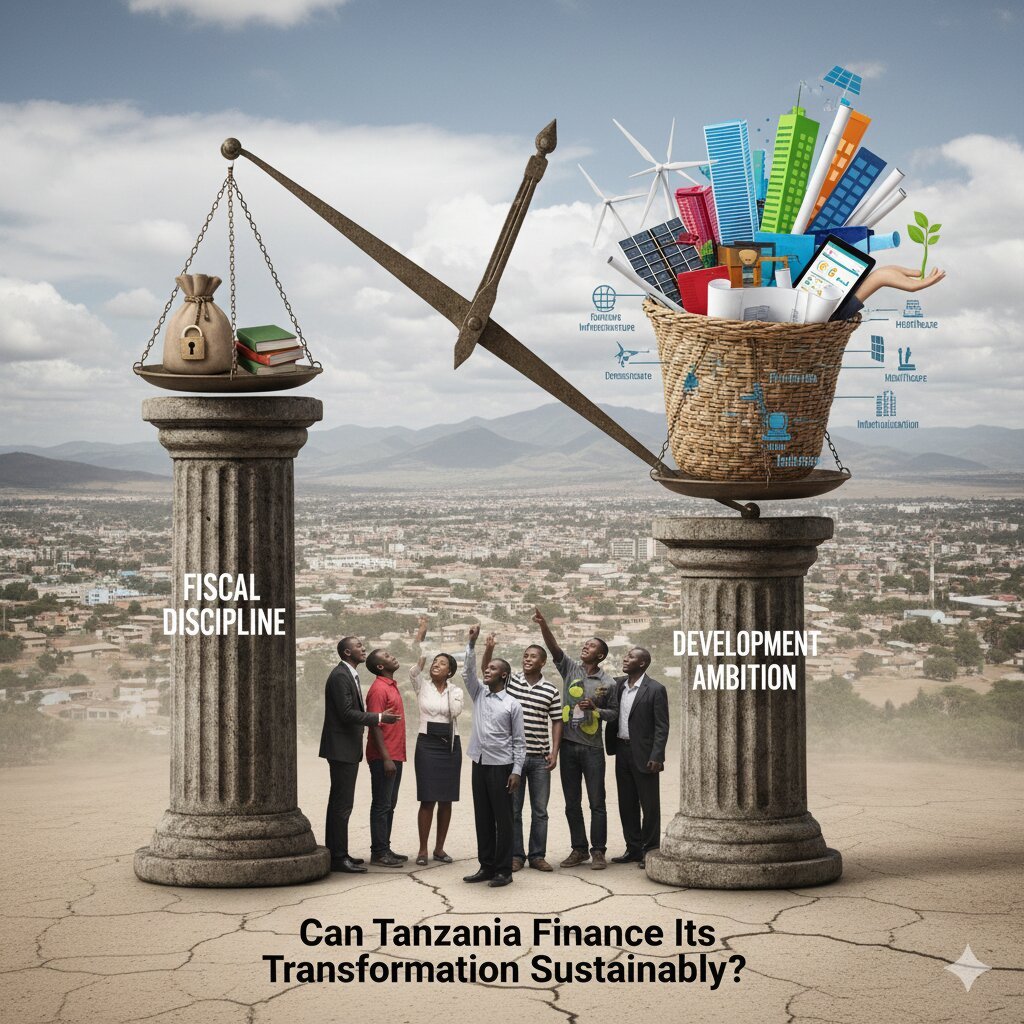
Tanzania’s transformation agenda demands massive capital investment, but sustainable growth depends on fiscal discipline. This analysis examines the tension between development ambition and debt sustainability, highlighting domestic resource mobilisation, capital markets, PPPs and expenditure efficiency as critical to long-term stability.
Tanzania’s development ambitions are large. The real constraint is financing discipline.
Ambition without financing realism leads to debt stress. Discipline without investment leads to stagnation. The balance between fiscal sustainability and transformation spending will determine whether Tanzania’s long-term growth agenda succeeds.
The next phase of economic strategy requires massive capital deployment into infrastructure, industrialisation, energy, logistics, social services and digital systems. The question is not whether investment is needed. It is how it will be financed without destabilising macroeconomic foundations.
The Scale of the Financing Challenge
Structural transformation at national scale requires:
- Industrial parks and manufacturing zones
- Energy generation and transmission expansion
- Logistics corridors and port upgrades
- Urban infrastructure and housing
- Skills development and health systems
- Digital governance and data infrastructure
These are capital-intensive undertakings. Public budgets alone cannot sustain them indefinitely.
Historically, infrastructure-led growth models rely on sovereign borrowing. But global interest rates have risen, currency volatility has increased, and debt sustainability thresholds are tighter than they were a decade ago.
The era of cheap external debt has narrowed.
The Core Fiscal Tension
There are two competing pressures:
- Accelerate development spending to support growth and employment.
- Preserve macroeconomic stability, debt sustainability and investor confidence.
If borrowing rises too quickly, debt servicing crowds out social and productive expenditure. If investment slows too much, growth decelerates and revenue mobilisation weakens.
The equilibrium requires disciplined sequencing and diversified financing sources.
Domestic Resource Mobilisation as the Anchor
Sustainable transformation requires stronger domestic revenue capacity.
This includes:
- Broadening the tax base
- Improving tax compliance
- Formalising informal economic activity
- Strengthening customs administration
- Digitising revenue systems
Domestic resource mobilisation reduces reliance on volatile external capital. It also strengthens fiscal sovereignty.
However, raising revenues must be calibrated carefully. Excessive tax burdens on productive sectors can discourage private investment. The objective is efficiency, not extraction.
Capital Markets and Institutional Funds
One underutilised lever in many developing economies is domestic institutional capital.
Pension funds, insurance companies and long-term savings pools can finance infrastructure and industrial projects if properly structured. Deepening capital markets can:
- Provide long-term local currency financing
- Reduce exchange rate risk exposure
- Support corporate bond issuance
- Enable project finance vehicles
For transformation to be sustainable, Tanzania must progressively shift from sovereign debt dependence toward market-based domestic financing.
Public-Private Partnerships and Risk Sharing
Public-private partnerships are not a financing shortcut. They are a risk-sharing mechanism.
Well-structured PPPs can:
- Transfer construction and operational risk
- Mobilise private capital
- Improve efficiency and cost control
- Accelerate project execution
Poorly structured PPPs, however, create hidden liabilities that eventually return to the public balance sheet.
The sustainability of development financing depends not only on the volume of capital raised, but on the allocation of risk.
Expenditure Rationalisation
Fiscal discipline is not only about raising revenue. It is about spending quality.
Key questions include:
- Are public investments generating measurable productivity gains?
- Is capital expenditure crowding in or crowding out private investment?
- Are subsidies and transfers targeted effectively?
- Is recurrent spending growing faster than productive investment?
Efficient public expenditure increases the growth multiplier of every shilling spent.
Inefficient spending increases debt without raising long-term output.
Growth as a Fiscal Strategy
Paradoxically, sustainable debt dynamics depend on growth itself.
If GDP expands faster than debt accumulation, the debt-to-GDP ratio stabilises or declines. If growth slows, even moderate borrowing becomes unsustainable.
This means fiscal discipline cannot come at the expense of growth-enhancing investments.
The goal is productive borrowing, not borrowing avoidance.
The External Sector Constraint
Foreign exchange stability is central to fiscal sustainability.
Large external borrowing creates currency risk. If the shilling depreciates significantly, debt servicing costs rise in local currency terms.
Export diversification and foreign exchange generation are therefore fiscal issues, not just trade issues.
An economy that exports at scale can borrow more safely than one dependent on volatile commodity revenues.
The Political Economy Dimension
Fiscal consolidation is politically difficult.
- Tax reforms can trigger resistance.
- Subsidy reductions can create social pressure.
- Spending rationalisation can affect entrenched interests.
Sustainable transformation requires political will to prioritise long-term stability over short-term populism.
Macroeconomic credibility is an asset. Once lost, it is expensive to rebuild.
The Path to Sustainable Financing
A disciplined transformation financing strategy should include:
- Gradual but firm expansion of the domestic tax base.
- Formalisation of informal economic activity through digital systems.
- Development of local currency capital markets.
- Strategic use of concessional and blended finance.
- Transparent debt management frameworks.
- Strict evaluation of project return on investment.
Financing ambition is not about maximising borrowing. It is about maximising productive impact per unit of capital.
Final Assessment
Tanzania’s development ambitions are large but not unrealistic.
The decisive variable is fiscal discipline.
If borrowing is strategic, projects are productive and revenue mobilisation strengthens steadily, transformation can be financed sustainably.
If spending outruns productivity gains and debt accumulates without export expansion, macro stability will erode.
Fiscal sustainability is not the enemy of development ambition.
It is the condition that makes ambition durable.