

Why Tanzania and Africa Must Choose Long-Term Economic Independence Over Strategic Dependence
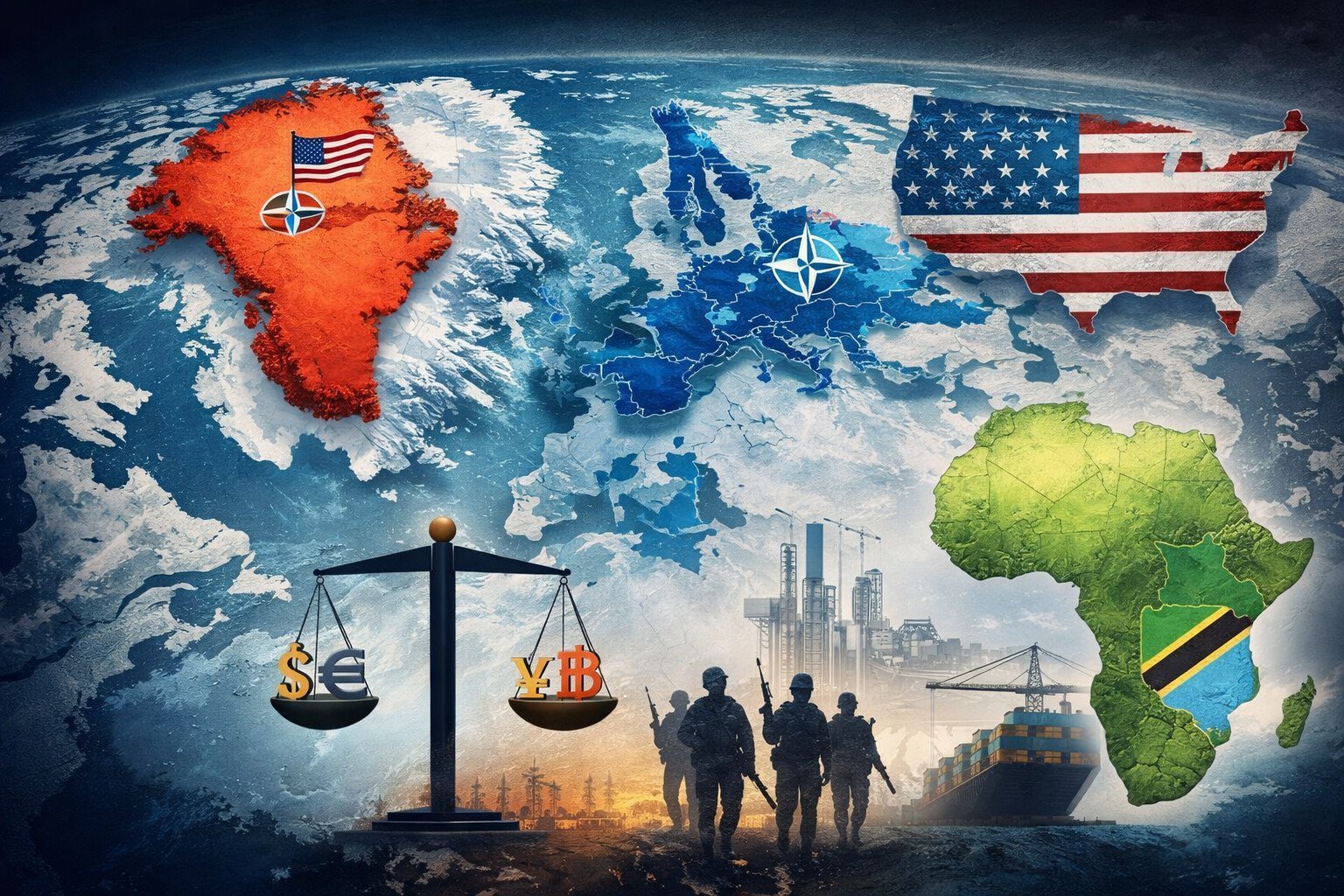
Europe’s confrontation with the United States over Greenland reveals an uncomfortable truth. Alignment does not mature into sovereignty. It matures into leverage. For Tanzania and Africa, the lesson is urgent. Development that depends on another power’s national security priorities will always be capped. Long-term economic independence is not ideological. It is defensive.
The most dangerous illusion in development policy is the belief that alignment with a great power eventually leads to autonomy. History shows the opposite. Alignment hardens into dependence, and dependence matures into leverage. When that leverage is activated, development goals are the first casualty.
Africa is now being encouraged, subtly and sometimes openly, to align its economic future with the national security priorities of the United States, Europe or other global powers. This is framed as partnership, stability, and shared values. In reality, it is an invitation to subordinate long-term development to external strategic needs.
Europe’s current predicament should serve as a warning.
For decades, Europe was held up as proof that deep alignment with the United States produces prosperity and security. Yet when strategic interests shifted, that partnership revealed its true structure. Europe outsourced its defense, tolerated energy dependence, integrated into dollar-centered financial systems, and accepted a subordinate technological position. These choices were rational in the short term. They were disastrous in the long term.
The Greenland episode makes this explicit. A territory legally tied to Denmark is treated as a negotiable strategic asset because it sits at the intersection of missile defense, Arctic access, and mineral supply chains. Tariffs are openly used as coercive tools to force political outcomes. Security guarantees are reframed as debts that must be repaid.
This is not how equals interact.
This is how dependency is enforced.
Europe is discovering a hard truth. Even advanced economies do not develop sovereignty by borrowing it. When security, energy, finance, and strategic technology are externally anchored, political independence becomes conditional. Legal ownership matters less than who controls the systems that keep society running.
Africa should be paying attention.
The United States National Security Strategy is not designed to produce African industrialization. It is designed to secure supply chains, contain rivals, protect the dollar system, and control strategic corridors. Africa appears in this framework as terrain, not as a future peer. Growth is acceptable. Transformation is not.
No country in history has developed by aligning its economic model to another power’s security doctrine. Not Japan. Not South Korea. Not China. All successful late developers practiced selective cooperation while fiercely protecting policy autonomy. They accepted friction. They absorbed short-term pain. They refused to freeze themselves into permanent roles.
For Tanzania, the implication is clear. Development cannot be outsourced. Security partnerships cannot substitute for industrial strategy. Aid cannot replace domestic capacity. Trade access cannot compensate for the absence of local value addition.
True independence is slow, uncomfortable, and politically expensive. It requires saying no to attractive deals that hollow out future options. It requires building regional markets before chasing global approval. It requires prioritizing food systems, energy control, logistics, skills, and manufacturing even when the returns are not immediate.
Europe’s experience shows that wealth does not immunize against dependency.
Africa’s position means the costs would be far higher.
The lesson is not anti-American, anti-European, or anti-global. It is pro-reality. Power does not reward loyalty. It rewards leverage. Countries without leverage are managed. Countries with leverage negotiate.
Africa must therefore choose long-term economic independence over short-term strategic comfort. Not because isolation is desirable, but because sovereignty without economic depth is a performance, not a condition.
Greenland is not Europe’s problem alone.
It is a case study in how dependence ends.
History does not repeat as tragedy or farce.
It repeats as policy for those who fail to learn.
