
Kenya Is Planning a Floating Power Barge at the Coast to Prevent Blackouts. Energy Experts Are Asking Why a Country Connected to Tanzania and Ethiopia Needs One.

Ready
Kenya Power Managing Director Joseph Siror confirmed plans to deploy a floating barge power plant at the Coast with 200 to 400 MW generation capacity, expected operational by December 2026, as a temporary measure against blackouts driven by fast-rising demand and delays in new plant commissioning. Kenya's current firm generation capacity stands at approximately 2,700 MW excluding imports plus approximately 600 MW from renewables including wind and solar, but renewable generation is not counted as firm capacity due to intermittency, meaning the effective dispatchable capacity is lower than the total installed figure. Kenya is interconnected with Tanzania, which has approximately 1,000 MW available for export, and with Ethiopia, whose hydropower surplus is sufficient to supply Kenya's entire electricity needs, making the floating barge solution a planning gap response rather than a structural necessity. Energy analysts are drawing direct comparisons to a 1997 episode during President Moi's time when a loan embargo prevented conventional financing and a 30 MW gas turbine barge moored at Kipevu under an arrangement with Westmont became Kenya's first Independent Power Producer, intended as a temporary measure that instead became the template for the IPP expansion whose legacy shapes Kenya's current power sector economics. A 200 to 400 MW gas turbine floating barge in 2026 will be significantly more expensive per unit than regional interconnection power purchase, and the planning question whose answer energy analysts are demanding is why the regional alternative is not being prioritised over the expensive temporary thermal solution. Kenya is planning an expensive short-term solution to a problem that two of its neighbours, both interconnected, could solve at lower cost. The planning failure that created the gap is the question that the barge announcement cannot answer but that Kenya's energy governance must.
NAIROBI — Kenya Power Managing Director Joseph Siror confirmed on 24 May 2026 that plans are at an advanced stage to deploy a floating barge power plant at the Coast with generation capacity of between 200 and 400 megawatts, expected to be operational by December 2026. The plant is described as a short-term measure to prevent rationing and blackouts amid fast-rising electricity demand and delays in onboarding new conventional power plants.
The announcement, reported by Kenya's media, has prompted immediate scrutiny from energy sector analysts whose questions go beyond the barge itself to the planning framework that produced the need for it.
What Kenya Power confirmed
Siror's statement confirms that Kenya is facing a generation adequacy problem whose near-term severity justifies the deployment of floating thermal generation rather than waiting for conventional power plant commissioning timelines. A floating barge power plant, typically a gas turbine or diesel generation facility mounted on a marine vessel and moored at a coastal location with grid connection, can be deployed significantly faster than land-based power plants whose site preparation, permitting, civil construction, and commissioning timelines typically run two to five years for utility-scale installations.
The 200 to 400 MW capacity range indicates a facility whose generation contribution is material rather than marginal for a grid whose firm dispatchable capacity Siror's announcement implicitly acknowledges is insufficient to meet current and projected near-term demand without the risk of blackouts or rationing. The December 2026 operational target, while described as an initial expectation rather than a confirmed commissioning date, indicates the urgency whose recognition the deployment decision reflects.
Kenya's current generation position and its structural problem
Kenya's electricity generation landscape contains a structural tension whose resolution the floating barge does not address but whose existence the barge announcement makes visible. Kenya's total installed capacity includes approximately 2,700 MW of firm generation excluding imports, plus approximately 600 MW from renewable sources including wind generation from Lake Turkana Wind Power at approximately 300 MW and Kipeto Wind at approximately 50 MW, plus approximately 300 MW of solar installations according to energy sector data from the Energy and Petroleum Regulatory Authority.
The structural problem is that renewable generation is not counted as firm dispatchable capacity because its output is intermittent and weather-dependent. Wind generation at Lake Turkana and Kipeto produces at full capacity when wind conditions allow and falls to near zero during calm periods. Solar generation produces only during daylight hours and at reduced output during cloud cover. The grid operator cannot schedule renewable generation with the reliability that firm demand management requires, meaning that the effective dispatchable capacity available to Kenya Power for reliable supply is the firm 2,700 MW figure rather than the combined 3,300 MW total installed capacity figure.
Energy analysts familiar with Kenya's power sector note that the investment emphasis on renewable generation, while environmentally beneficial and consistent with Kenya's climate commitments, has created a situation where total installed capacity appears adequate while firm dispatchable capacity is insufficient to meet demand peaks and provide the reserve margin that grid reliability requires. Thermal generation, whether gas turbine, diesel, or coal-fired, provides the dispatchable capacity whose availability regardless of weather conditions is the characteristic that the grid requires for reliable supply but that renewable investment cannot substitute for without the battery storage infrastructure whose cost at the scale Kenya's grid requires is currently prohibitive.
A 200 to 400 MW gas turbine floating barge, however, will generate expensive power. Gas turbine generation at floating barge scale, without the efficiency advantages of combined cycle operation and with the logistics costs of marine fuel supply, produces power at significantly higher cost per kilowatt-hour than Kenya's existing geothermal, hydro, and established thermal generation. The short-term necessity whose urgency justifies the deployment does not change the long-run economics whose expensiveness will be visible in Kenya Power's generation cost structure for the duration of the barge's operation.
The regional interconnection question that the barge announcement raises
The energy sector analysis that Kenya Power's announcement has provoked concentrates not on the barge's technical specifications but on the planning context within which it is being deployed, and specifically on why Kenya is pursuing an expensive temporary thermal solution when it is interconnected with two energy surplus economies whose power could supply the gap at lower cost than floating barge generation.
Tanzania's electricity generation capacity has exceeded 4,000 MW following the Julius Nyerere Hydropower Project commissioning according to Tanzania Electric Supply Company operational records, with installed capacity now moving ahead of immediate domestic demand. Tanzania has the available generation to supply approximately 1,000 MW to Kenya through the existing interconnection infrastructure, making it one of the most immediately accessible low-cost power supply alternatives to the floating barge solution whose deployment Kenya Power is advancing.
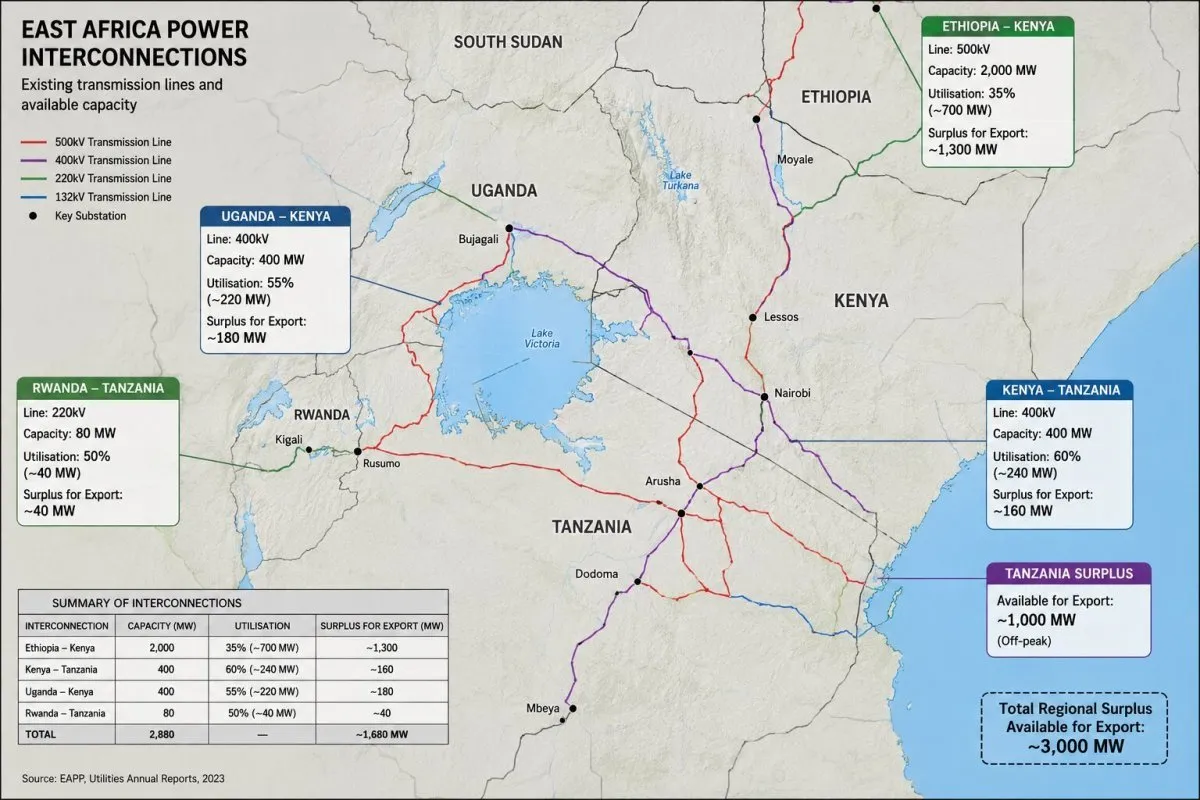 East Africa's power generation interconnections
Ethiopia's hydropower development, whose Grand Ethiopian Renaissance Dam and associated hydro cascade have created one of Africa's largest electricity generation systems, has produced a surplus whose scale is sufficient to supply Kenya's entire electricity needs through the Ethiopia-Kenya interconnection whose 2,000 MW capacity the East African Power Pool interconnection project developed. According to Ethiopian Electric Power data, Ethiopia has been exporting electricity to Kenya, Sudan, and Djibouti through the interconnection infrastructure whose utilisation rate reflects the commercial power purchase agreement terms that bilateral negotiations determine rather than any physical supply constraint.
Both Tanzania and Ethiopia are interconnected with Kenya through the transmission infrastructure whose construction the East African Power Pool and bilateral development financing supported precisely to enable the regional power trade whose lower-cost supply would reduce the need for the expensive temporary generation options that individual country supply gaps historically produced. The analyst commentary that Kenya Power's floating barge announcement has generated is asking directly why the regional interconnection infrastructure is not being utilised at the capacity whose availability would make the barge unnecessary or substantially smaller.
The 1997 precedent and what it reveals
The historical parallel that energy sector analysts are drawing to Kenya Power's floating barge announcement is precise enough to be instructive rather than merely rhetorical. In 1997, during President Moi's administration, a loan embargo prevented Kenya from financing conventional power generation investment. The response was the first Independent Power Producer arrangement in Kenya's electricity sector: a 30 MW gas turbine barge moored at Kipevu near Mombasa under an arrangement with Westmont, described at the time as a temporary measure whose removal would follow the resolution of the financing embargo that made conventional alternatives unavailable.
The Kipevu barge, thirty years later, is still physically present at its mooring, though not currently operational. The temporary measure whose necessity a specific financing constraint created became the template for the IPP expansion that followed as the loan embargo resolved but the IPP model whose commercial terms Independent Power Producers had established remained embedded in Kenya's power sector procurement framework. The IPPs were supposed to stop once loans ended. Instead they were enhanced, and the legacy of that enhancement is the expensive IPP generation cost structure that Kenya Power's customers continue paying for in their electricity tariffs.
The 2026 floating barge, at 200 to 400 MW, is ten to thirteen times larger than the 1997 Kipevu barge. The generation economics, at gas turbine efficiency levels without combined cycle heat recovery, will produce expensive power by any comparison with the regional interconnection alternatives available. If the 2026 barge follows the 1997 precedent and the temporary measure becomes embedded in Kenya's generation mix beyond the emergency period that justified its deployment, the cost consequence will be substantially larger than the 1997 episode produced.
What the announcement reveals about Kenya's energy planning
The floating barge announcement is a symptom of a planning gap whose existence the rapidly rising demand and delayed new plant commissioning that Siror identified as the context reveal. A grid operator planning adequately for demand growth commissions new generation in time to avoid the supply gap whose emergency response floating barge deployment represents. The gap between the demand growth trajectory and the generation commissioning pipeline that produced the need for an emergency barge in 2026 is the planning failure whose acknowledgement Kenya's energy governance framework owes its consumers alongside the barge deployment announcement.
The renewable investment emphasis that created the installed capacity appearance of adequacy while the firm dispatchable capacity remained insufficient is part of the planning story. Kenya's 600 MW of wind and solar represents real generation capacity whose contribution to supply during favourable conditions is valuable, but investment decisions that counted renewable nameplate capacity against peak demand without adequately weighting the firm capacity shortfall that intermittency creates produced the gap that the barge is now filling. The lesson that analysts are identifying is not that renewable investment was wrong but that it was not accompanied by the firm backup capacity investment whose adequacy the grid requires regardless of the renewable proportion.
The regional interconnection underutilisation whose persistence despite the availability of Tanzanian and Ethiopian surplus power is the second planning question whose answer Kenya's energy governance must provide. If the interconnection infrastructure exists, if the regional surplus exists, and if the regional power purchase agreements whose negotiation would activate that surplus can be concluded at costs lower than floating barge generation, then the planning question is why the regional alternative is not being prioritised and whether the commercial, regulatory, or institutional barriers whose removal would activate it are being addressed with the urgency that the barge deployment timeline indicates the situation demands.
Tanzania's energy surplus and its implication for the broader East African energy architecture is directly relevant to the Uchumi360 analysis of Tanzania's industrial positioning. An energy surplus whose export to Kenya through existing interconnection infrastructure would reduce Kenya's electricity costs while generating transmission revenue for Tanzania creates the mutual benefit whose realisation regional energy trade enables and whose absence in the face of a regional supply gap and an expensive temporary thermal solution represents the integration gap that the East Africa talks integration but its shelves tell a different story analysis applies to the electricity sector as directly as to the supermarket.
What comes next
Kenya Power has not confirmed a final commissioning date, a specific barge operator, or the commercial terms whose negotiation will determine the cost that Kenya's electricity consumers will absorb from the floating barge's operation. The December 2026 target whose achievement depends on procurement timelines, regulatory approvals, and grid connection works is the immediate operational milestone whose progress will determine whether the barge provides the blackout prevention that the deployment decision was designed to ensure.
The more consequential question for Kenya's medium-term energy economics is whether the barge deployment accelerates the regional interconnection utilisation and conventional generation commissioning whose combination would make the barge unnecessary before its economic life embeds it in the generation mix, or whether the 1997 precedent repeats and the temporary solution becomes permanent at a scale whose cost consequence Kenya Power's customers will pay for in electricity tariffs whose expensiveness compounds the manufacturing competitiveness and household affordability challenges that Uchumi360's analysis of Kenya's economic position has documented across its 2026 coverage.
FAQ
What did Kenya Power's Managing Director confirm about the floating barge? Joseph Siror confirmed on 24 May 2026 that plans are at an advanced stage to deploy a floating barge power plant at the Coast with generation capacity of 200 to 400 MW, initially expected operational by December 2026. The plant is described as a short-term measure to prevent rationing and blackouts amid fast-rising electricity demand and delays in onboarding new conventional power plants.
Why are energy analysts questioning the floating barge decision? Because Kenya is interconnected with Tanzania, which can supply approximately 1,000 MW, and with Ethiopia through a 2,000 MW interconnection whose capacity is sufficient to supply Kenya's entire electricity needs. Both countries have generation surpluses available for regional power trade. Energy analysts are asking why an expensive temporary thermal solution is being deployed when regional interconnection infrastructure exists and neighbouring energy surplus economies could supply the gap at lower cost than floating barge gas turbine generation.
What is Kenya's current generation capacity and why is it insufficient? Kenya has approximately 2,700 MW of firm dispatchable generation capacity excluding imports, plus approximately 600 MW of renewable capacity from wind and solar. However, renewable generation is not counted as firm capacity because its output is intermittent, meaning the effective reliable capacity is the 2,700 MW firm figure. The planning emphasis on renewable investment created total installed capacity that appears adequate while firm dispatchable capacity remained insufficient for demand peaks, producing the supply gap that the floating barge is designed to fill.
What is the historical precedent that analysts are referencing? In 1997, during President Moi's administration, a loan embargo prevented conventional power generation financing. The response was a 30 MW gas turbine barge moored at Kipevu near Mombasa under an arrangement with Westmont, described as a temporary measure. The barge remained at its mooring for decades. The temporary measure became the template for Kenya's IPP expansion, which was supposed to stop once financing returned but instead was enhanced. Analysts are warning that the 2026 floating barge, at 200 to 400 MW, risks repeating that pattern at a scale whose cost consequence would be substantially larger.
What does this mean for East Africa's regional energy integration? It illustrates the same integration gap that Uchumi360's analysis of EAC trade documented in the supermarket context. Kenya has the interconnection infrastructure to access Tanzanian and Ethiopian surplus power. Tanzania has the generation surplus. Ethiopia has the generation surplus. The regional energy trade whose activation would make the expensive temporary barge unnecessary is not happening at the pace the supply gap demands, and the institutional, commercial, and regulatory barriers whose removal would activate it are not being addressed with the urgency that the barge deployment timeline indicates the situation requires. East Africa's energy integration, like its trade integration, is politically advanced but commercially and operationally incomplete.
 Uchumi360
Business Intelligence
- Nation Media Group Business Daily, Kenya to get floating power plants to cater for blackouts and high demand, 24 May 2026
- Joseph Siror confirmed statements and Kenya Power Managing Director attribution
- Available at businessdailyafrica.com
- Kenya Power and Lighting Company, generation capacity data
- Available at kplc.co.ke
- Energy and Petroleum Regulatory Authority Kenya, installed generation capacity data including Lake Turkana Wind Power 300 MW, Kipeto Wind 50 MW, and solar 300 MW
- Available at epra.go.ke
- Tanzania Electric Supply Company, operational records
- 4,000 MW capacity following Julius Nyerere Hydropower Project commissioning
- Available at tanesco.co.tz
- Ethiopian Electric Power, interconnection and export capacity data
- Ethiopia-Kenya 2,000 MW interconnection capacity
- Available at eep.com.et
- East African Power Pool, interconnection infrastructure documentation
- Available at eappool.org
- Kenya Power and Lighting Company, Kipevu barge and historical IPP documentation
- Westmont arrangement 1997
- Available at kplc.co.ke
- Energy sector analyst commentary on floating barge deployment and regional interconnection alternatives
- Specific attribution requires identification before publication
- Uganda Electricity Transmission Company, East African interconnection data
- Available at uetcl.com
- Rwanda Energy Group, interconnection and import data
- Available at reg.rw
- DRC Société Nationale d'Electricité, regional power data
- Available at snel.cd
Uchumi360 covers business, investment, and economic policy across East, Central, and Southern Africa.
For the serious reader
You read to the end. That places you in a small group.
Uchumi360 is built for readers who demand precision over speed, structure over sentiment, and analysis that holds uncomfortable conclusions rather than softening them. If this work sharpens how you think about Africa's economy, help us keep building the infrastructure behind it.
Institutional Partners
Commission intelligence. Shape the conversation.
Uchumi360 works with development finance institutions, investment firms, sovereign bodies, and strategic organisations across the coverage region. Institutional partnership unlocks:
- Commissioned sector and country intelligence reports
- Branded research series under your institution's authority
- Exclusive data briefings for internal strategy teams
- Speaking and editorial presence at Uchumi360 events
- Co-published investment outlooks for your markets
Support Our Work
Independent analysis has a cost. Help us bear it.
Uchumi360 does not carry advertising. It does not take editorial direction from sponsors. Every article is produced without commercial compromise. Your contribution funds the reporting, research, and editorial infrastructure that keeps this analysis free from influence.
Secure checkout: One-time and monthly support are processed securely. Add payment credentials to enable checkout here.
Stay Connected
Keep up with every new insight.
Follow our latest analysis, policy coverage, and market intelligence as soon as it is published. If you need something specific, reach out directly and we will point you to the right research.
