

Essential Software Solutions Every Business in Tanzania Should Have in 2026
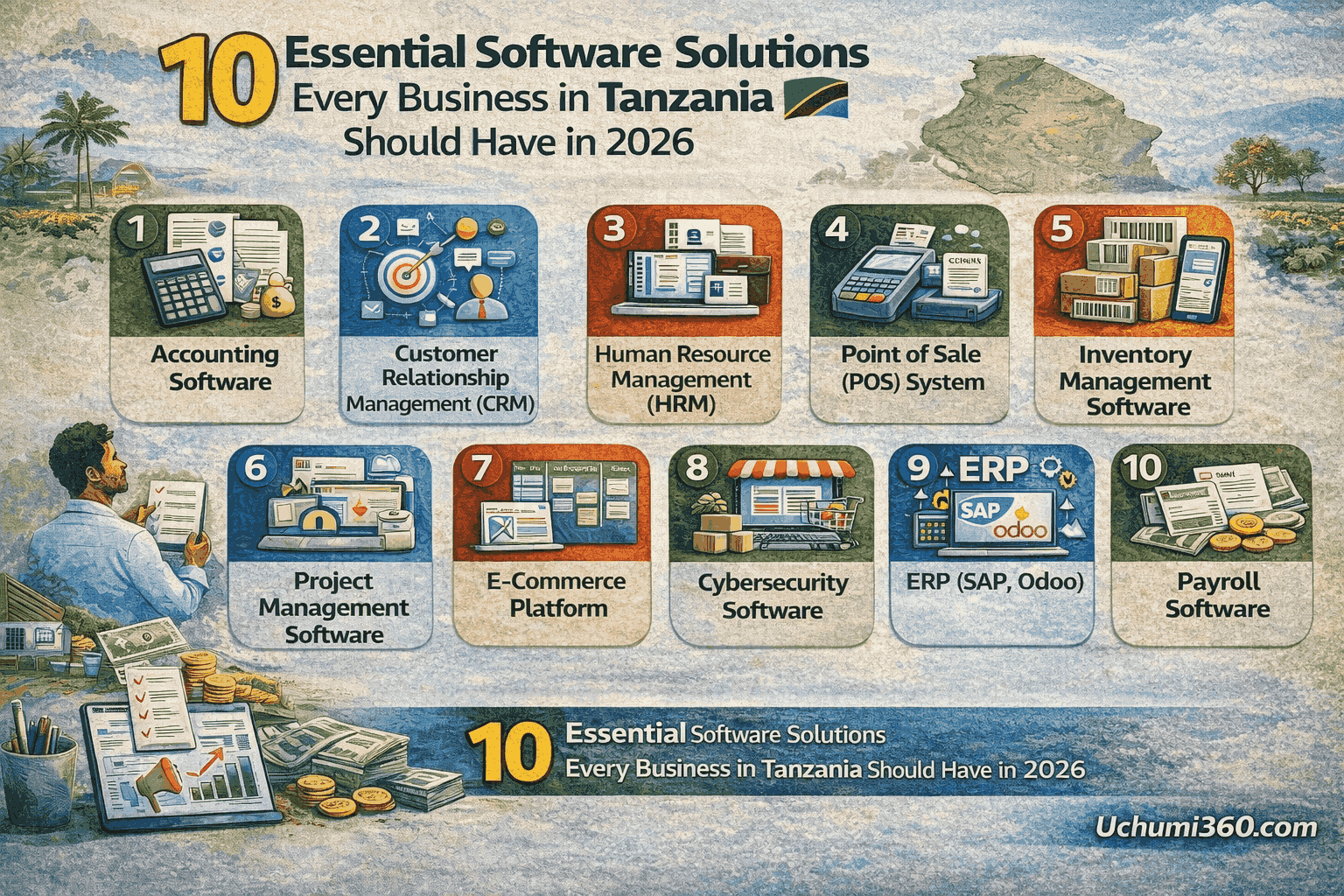
The future of Tanzanian business is digital. Companies that adopt the right software tools today will be better positioned to compete, attract investment, and expand regionally tomorrow.
As Tanzania’s economy becomes more competitive and digitally connected, businesses can no longer rely on manual systems, spreadsheets, or paper-based processes. Whether operating in agribusiness, manufacturing, retail, logistics, or professional services, digital tools are now fundamental to efficiency, compliance, and scalability.
From 2026 onward, businesses that fail to adopt the right software risk falling behind in productivity, financial control, customer engagement, and regulatory compliance.
Here are 10 essential software solutions every business in Tanzania should have to remain competitive and growth-ready.
1. Accounting and Bookkeeping Software
Financial discipline is the backbone of any sustainable business. Accounting software helps track income, expenses, VAT, PAYE, and generate financial reports required by the Tanzania Revenue Authority (TRA).
Why it matters:
- Ensures tax compliance
- Improves financial transparency
- Simplifies audits
- Enables better cash flow management
Popular options include QuickBooks, Xero, and Sage. For SMEs, cloud-based accounting solutions are cost-effective and scalable.
2. Enterprise Resource Planning (ERP) Systems
As businesses grow, managing finance, procurement, inventory, and HR separately becomes inefficient. ERP systems integrate all major functions into one platform.
Benefits:
- Real-time business visibility
- Reduced duplication and errors
- Improved operational efficiency
- Better decision-making through data
Solutions such as Odoo, SAP Business One, and Microsoft Dynamics 365 are increasingly used in Tanzania, especially in manufacturing and distribution.
3. Customer Relationship Management (CRM) Software
In a competitive market, managing customer relationships strategically is critical. CRM software tracks leads, sales pipelines, and customer interactions.
Why Tanzanian businesses need it:
- Improves customer retention
- Enhances sales tracking
- Enables targeted marketing campaigns
- Strengthens after-sales service
Tools such as Zoho CRM, HubSpot, and Salesforce are suitable for SMEs and growing enterprises.
4. Payroll and HR Management Systems
Managing employee records, payroll, leave, and statutory deductions manually increases compliance risk.
A dedicated HR and payroll system helps with:
- PAYE, NSSF, and WCF compliance
- Automated payslip generation
- Leave and performance tracking
- Workforce planning
This is particularly important as labor regulations and compliance oversight continue to strengthen.
5. Inventory Management Software
For retail, agribusiness, logistics, and manufacturing, inventory accuracy directly affects profitability.
Inventory software helps:
- Track stock levels in real time
- Prevent stockouts and overstocking
- Manage supplier relationships
- Improve warehouse efficiency
This is especially critical for businesses dealing with fast-moving goods or export products.
6. Point of Sale (POS) Systems
Retailers, restaurants, pharmacies, and hospitality businesses require modern POS systems.
Benefits include:
- Faster transactions
- Automated inventory updates
- Sales analytics
- Integration with accounting software
Digital POS systems also improve financial transparency and reduce revenue leakage.
7. E-Commerce and Website Platforms
Consumers and B2B buyers increasingly search and transact online. A professional website or e-commerce platform is no longer optional.
Advantages:
- Expands market reach beyond physical location
- Supports online payments
- Enhances brand credibility
- Enables export visibility
Platforms such as Shopify, WooCommerce, and locally integrated mobile-money systems help Tanzanian businesses tap into digital markets.
8. Project Management and Collaboration Tools
As teams grow and remote work increases, structured task management becomes essential.
Project management tools:
- Improve team coordination
- Track deadlines and milestones
- Increase accountability
- Enhance productivity
Platforms such as Asana, Trello, Microsoft Teams, and Notion are widely accessible and affordable.
9. Cybersecurity and Data Protection Software
With increased digitization comes increased cyber risk. Businesses handling financial transactions, customer data, or trade information must prioritize cybersecurity.
Essential protections include:
- Antivirus and endpoint protection
- Data encryption
- Secure backups
- Firewall systems
Data breaches can damage reputation and cause financial loss, making cybersecurity a strategic investment rather than a cost.
10. Cloud Storage and Backup Solutions
Business continuity depends on secure data access and storage. Cloud-based systems allow businesses to:
- Access files remotely
- Collaborate across locations
- Protect against data loss
- Scale storage as needed
Google Workspace, Microsoft 365, and similar platforms are widely used for document management and communication.
Bonus Needs (Depending on Industry)
- Accounting for Agriculture: Akorion, AgriWebb, Farm Focus (for agribusiness planning and cost tracking)
- Logistics and Fleet Management: Samsara, Routific, KeepTruckin (for transport operations)
- Digital Payment and POS: Pesapal, Mixx by Yas, M-Pesa, Selcom, hallopesa, Airtel money for Business (local mobile money integration)
- Data Analytics and BI Tools: Power BI, Tableau (for insights & reporting)
Why Software Adoption Is Critical for Tanzanian Businesses
From 2026 onward, Tanzania’s business environment will be shaped by:
- Increased tax compliance monitoring
- Growing regional trade under AfCFTA
- Expansion of digital payments
- Competitive pressure from regional firms
- Demand for operational transparency
Businesses that invest in digital systems will gain advantages in:
- Cost efficiency
- Data-driven decision-making
- Customer satisfaction
- Export readiness
- Investor confidence
Digital transformation is no longer limited to large corporations. SMEs, startups, and agribusiness enterprises must embrace software solutions to remain competitive and scalable.
Strategic Recommendation
Business owners should:
- Conduct a digital audit of current operations
- Prioritize accounting and payroll systems first
- Gradually integrate CRM, ERP, and inventory solutions
- Invest in staff training
- Adopt cloud-based platforms for flexibility
The future of Tanzanian business is digital. Companies that adopt the right software tools today will be better positioned to compete, attract investment, and expand regionally tomorrow.
