
Spiro's First Sustainability Report: What The Numbers Actually Say, And The Market It's Still Missing
Ready
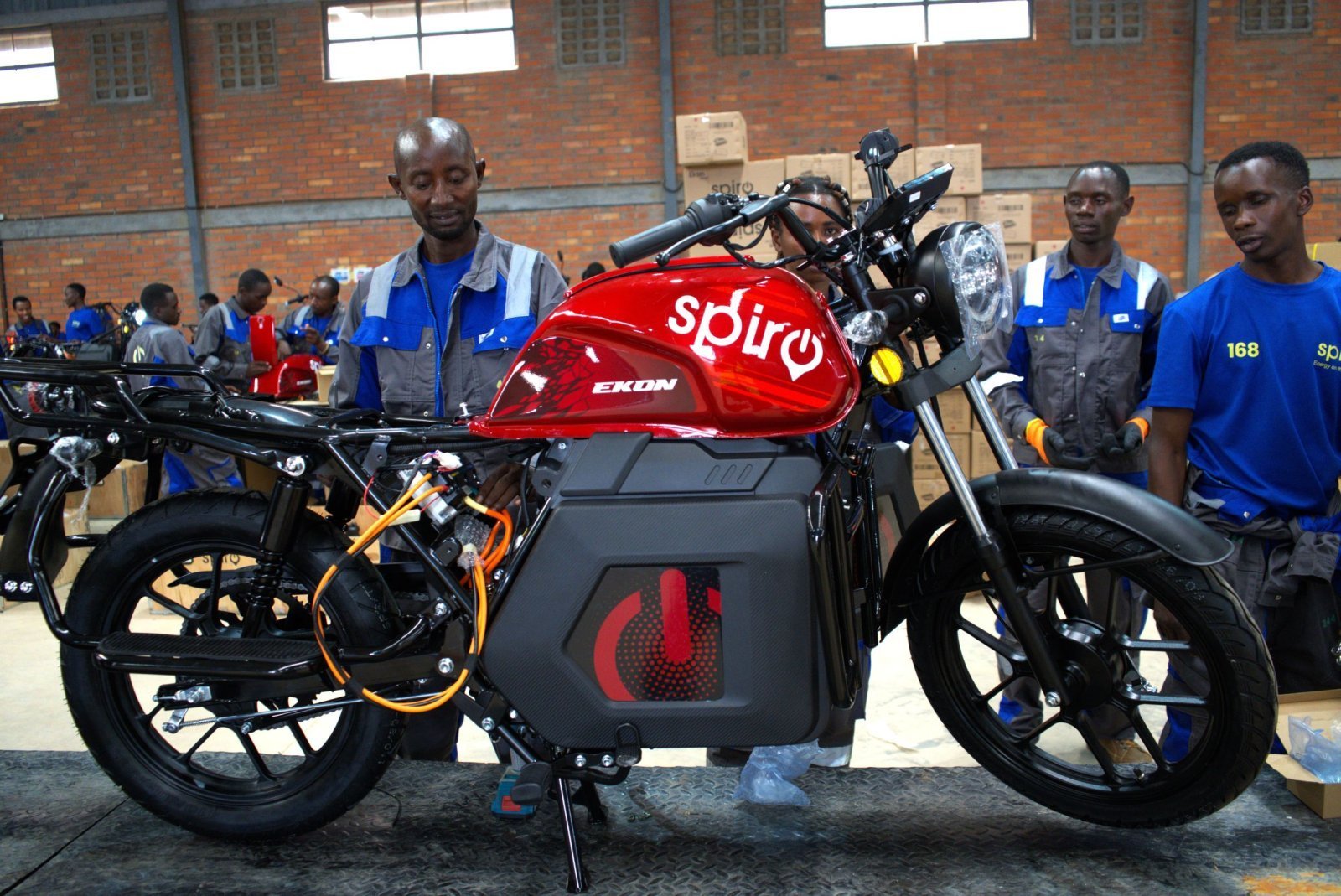
Spiro, the Dubai-headquartered electric mobility platform, published its first sustainability report for CY2025, covering operations across Kenya, Uganda, Rwanda, Nigeria, Benin and Togo: 75,000+ electric motorbikes, 1,500+ swap stations, 30 million battery swaps, roughly $150 million in secured asset financing. Its own disclosures show local procurement at 8.9% of $70.9 million total spend, CSR expenditure of $3,375 for the year, and Scope 3 emissions accounting for 67.6% of its carbon footprint, mostly imported goods and logistics. Notably absent from the six-country footprint is Tanzania, the city (Dar es Salaam) industry analysts use as the eastern anchor point of Africa's "boda belt," the motorcycle-taxi corridor Spiro's own business model is built to serve. Spiro has pilot activity underway in Tanzania and Cameroon, per external reporting, but neither appears among its operating markets in the report itself.
Spiro, the electric two-wheeler and battery-swapping platform now operating across six African countries, has published its inaugural sustainability report for calendar year 2025. It's an extensive document, GRI-aligned, referencing IFC Performance Standards, running through governance, climate, social and product sections in real detail. Underneath the ESG framing sit specific disclosed numbers that tell a narrower and more useful story than the report's own language does, and a geographic gap the report doesn't address at all.
The scale is real
Spiro has deployed more than 75,000 electric motorbikes and operates over 1,500 battery swap stations across Kenya, Uganda, Rwanda, Nigeria, Benin and Togo, completing more than 30 million battery swaps and over 1 billion electric kilometres since founding in 2022. External reporting from early 2026 puts the fleet even higher, over 80,000 motorcycles and 2,500+ swap stations, suggesting continued growth since the report's CY2025 cutoff. By its own account and by outside coverage, Spiro is Africa's largest battery-swapping and electric mobility platform. Country-level breakdowns in the report show Rwanda leading with 22,000 bikes and 600+ stations, followed by Uganda (16,000 bikes, 300+ stations) and Kenya (14,000 bikes, 300+ stations).
The company has secured approximately $150 million in asset financing cumulatively through partners including KCB, Centenary Bank, DFCU and Asaak, funded in part by a $100 million round in October 2025 led by FEDA, Afreximbank's investment arm, one of the largest single investments in African electric mobility to date. Total procurement spend for 2025 came to $70.9 million.
The gap: Tanzania isn't one of the six markets
Here's what the report doesn't mention, and what its own framing makes conspicuous by omission. The term "boda belt," coined by researcher Tom Courtright and now standard shorthand across e-mobility coverage of the continent, describes the stretch of countries where motorcycle taxis dominate urban transport, running from Dar es Salaam, Tanzania, westward to the outskirts of Dakar, Senegal. Tanzania isn't a peripheral market in that framing. It's the eastern anchor point, the city analysts use to define where the belt starts.
Spiro's six operating countries, as disclosed in its own sustainability report, are Kenya, Uganda, Rwanda, Nigeria, Benin and Togo. Tanzania isn't among them. External reporting from February and March 2026 confirms Spiro has pilot projects underway in Tanzania and Cameroon, but as of the company's own CY2025 disclosures, neither has graduated to a listed operating market with deployed fleet numbers, swap station counts, or workforce figures the way the six core countries have.
That's a genuine gap worth naming plainly. Tanzania has one of East Africa's largest boda boda populations, motorcycle taxis are a primary livelihood source and transport mode across Dar es Salaam and secondary cities, and the country sits geographically between Kenya, where Spiro claims roughly 60% of the e-motorcycle market, and the rest of the belt running west. A company that has raised $150 million-plus specifically to scale battery-swapping infrastructure across exactly this transport category, in exactly this region, has left its most obviously adjacent market as a pilot rather than a deployed operation, years into its expansion.
It's not clear from the public record why. Competing startups, including TankVolt, are reportedly already active or expanding into Tanzania, and Tanzania's own e-mobility policy environment appears less developed than Kenya's National E-Mobility Policy (2024) or Rwanda's tax-incentive framework, which may partly explain the sequencing. But for a company whose sustainability report leans heavily on "Pan-African" and "accelerating Africa's electric future" language, the absence of the boda belt's namesake city from its six listed markets is the kind of detail that undercuts the framing more than any single ESG metric does.
Where the localization claim doesn't quite match the numbers
Within the six markets it does operate, Spiro's report frames localization as central to its model: local assembly, domestic industrial capacity, reduced reliance on fossil-fuel imports. The disclosed local procurement figure is 8.9% of total spend, roughly $6.3 million of $70.9 million, concentrated in accessories and select mechanical components. The report describes this as active and improving, citing recently localized frame sub-assemblies, tire mounters and VIN punchers, but the current baseline is a company still substantially dependent on imported components for a platform pitched as reducing import dependence specifically.
This connects to the same value-addition logic running through East African industrial policy more broadly, Tanzania's own Vision 2050 among them, which treats local assembly and component sourcing as the mechanism that converts foreign investment into durable domestic industrial capacity rather than a pass-through of imported goods with local labour attached. An 8.9% local procurement share is the number regulators evaluating "local content" commitments in the EV space would reasonably want tracked over successive years, not cited once as a direction of travel.
CSR spend versus financing scale
The report's CSR Spend Summary for CY2025 lists total expenditure of $3,375: skill development ($2,210) and road safety and health initiatives ($1,165), alongside separately listed named programs (Gather & Grow, Rising Stars Africa) with their own line items. Set against $150 million in secured asset financing and $70.9 million in annual procurement spend, the CSR figure is negligible relative to the scale of everything else the report discloses, not a material social investment line as currently reported.
That's not automatically a criticism; a fast-scaling infrastructure platform reasonably prioritises capital toward deployment over philanthropy at this stage. But the "community development and impact" section carries equal structural billing with the financial and governance sections in the report's own table of contents, and readers weighing the report's ESG claims in aggregate should weight that section accordingly, against the actual dollar figure disclosed rather than the narrative built around it.
The emissions profile is upstream, not operational
Spiro's 2025 total Scope 1, 2 and 3 emissions came to 52,180 tCO₂e. Scope 1 (mobile combustion) was small: 243 tCO₂e. Scope 2 (purchased electricity) was 16,652 tCO₂e, about 32% of the total. Scope 3, calculated primarily using spend-based methodology, came to roughly 35,286 tCO₂e, 67.6% of the total footprint, driven mainly by purchased goods and services and upstream logistics.
That distribution links directly to the import dependency above: a company sourcing under 9% of its inputs locally will carry a heavier upstream freight and manufactured-goods emissions footprint than one with a more localized supply chain. The report's own 2026 climate action plan acknowledges this, stating it will place "greater emphasis on Scope 3 emissions, particularly logistics related impacts associated with raw material transportation." The company's net-zero target, Scope 1 and 2 by 2040, notably excludes Scope 3 from the binding commitment, leaving the largest share of its actual footprint outside the headline decarbonization pledge for now.
Governance note
The report states the roles of Board Chair and CEO were held by the same individual during the reporting period, with the company "progressing toward a separation of the Chair and CEO roles, aligned with internationally recognized governance best practices." That's not unusual at this stage of a company's life, but it's a governance gap the report identifies itself, relevant context for financiers or partners weighing the independence of board oversight as described elsewhere in the same section.
What's genuinely well-documented
Several sections hold up as substantive rather than promotional. The safety disclosures are specific: 195 total injuries recorded in 2025, LTIFR and TRIFR both at 29, tracked through a structured HIRA framework aligned with ISO 45001 principles. The battery circularity program includes a working second-life deployment in Nigeria sourcing batteries from Benin and Togo, concrete and geographically specific rather than aspirational. And the financing innovation, particularly the digital loan marketplace in Uganda using mobile money transaction data to build credit scores for riders without formal credit histories, is a genuinely distinctive mechanism for extending asset finance into an underserved borrower segment.
The Uchumi360 insight
Sustainability reports function as pitch documents as much as disclosure documents, and Spiro's inaugural report is no exception. Read past the framing, the disclosed numbers show a company with real operational scale and some well-built financing and safety systems, alongside a supply chain still substantially import-dependent, a CSR budget disproportionate to its financing scale, a decarbonization target that doesn't bind its largest emissions category, and a six-country footprint that skips the market literally named as the anchor of the industry it operates in. None of that undermines what Spiro has built across six years and six countries. It does mean Tanzania's boda boda economy, and the millions of riders and livelihoods running through it, remain a pilot-stage opportunity for the region's largest e-mobility platform, not a served market, and that gap is worth watching as closely as any KPI in the report itself.
FAQ
Which countries does Spiro currently operate in? Kenya, Uganda, Rwanda, Nigeria, Benin and Togo, per its 2025 sustainability report, with over 75,000 electric motorbikes deployed.
Is Spiro active in Tanzania? Only at a pilot stage, according to external reporting from early 2026. Tanzania is not among the six operating markets listed in Spiro's own sustainability disclosures, despite being the eastern anchor of the "boda belt" motorcycle-taxi corridor Spiro's model is built around.
What share of Spiro's procurement is local? 8.9% of total procurement spend ($70.9 million), roughly $6.3 million, concentrated in accessories and select mechanical components.
What is Spiro's emissions target? Net-zero Scope 1 and Scope 2 emissions by 2040. Scope 3 emissions, 67.6% of the 2025 total footprint, are not currently part of the binding 2040 target.
How much did Spiro spend on CSR in 2025? $3,375, covering skill development and road safety initiatives, against $150 million in secured asset financing.
Where is Spiro headquartered? Dubai, UAE, despite operations being entirely across African markets.
 Uchumi360
Business Intelligence
Uchumi360
Business Intelligence
- Sources: Spiro Sustainability Report 2025
- electrive.com
- motorcycles.news
- TC Insights (TechCabal)
Uchumi360 covers business, investment, and economic policy across East, Central, and Southern Africa.
For the serious reader
You read to the end. That places you in a small group.
Uchumi360 is built for readers who demand precision over speed, structure over sentiment, and analysis that holds uncomfortable conclusions rather than softening them. If this work sharpens how you think about Africa's economy, help us keep building the infrastructure behind it.
Institutional Partners
Commission intelligence. Shape the conversation.
Uchumi360 works with development finance institutions, investment firms, sovereign bodies, and strategic organisations across the coverage region. Institutional partnership unlocks:
- Commissioned sector and country intelligence reports
- Branded research series under your institution's authority
- Exclusive data briefings for internal strategy teams
- Speaking and editorial presence at Uchumi360 events
- Co-published investment outlooks for your markets
Support Our Work
Independent analysis has a cost. Help us bear it.
Uchumi360 does not carry advertising. It does not take editorial direction from sponsors. Every article is produced without commercial compromise. Your contribution funds the reporting, research, and editorial infrastructure that keeps this analysis free from influence.
Secure checkout: One-time and monthly support are processed securely. Add payment credentials to enable checkout here.
Stay Connected
Keep up with every new insight.
Follow our latest analysis, policy coverage, and market intelligence as soon as it is published. If you need something specific, reach out directly and we will point you to the right research.
