
Commercial Real Estate in Tanzania: Why Business Space Is Becoming the Next Urban Growth Play
Ready
Tanzania’s commercial real estate opportunity is being driven by urban growth, services-sector expansion, infrastructure investment and rising demand for formal business space.
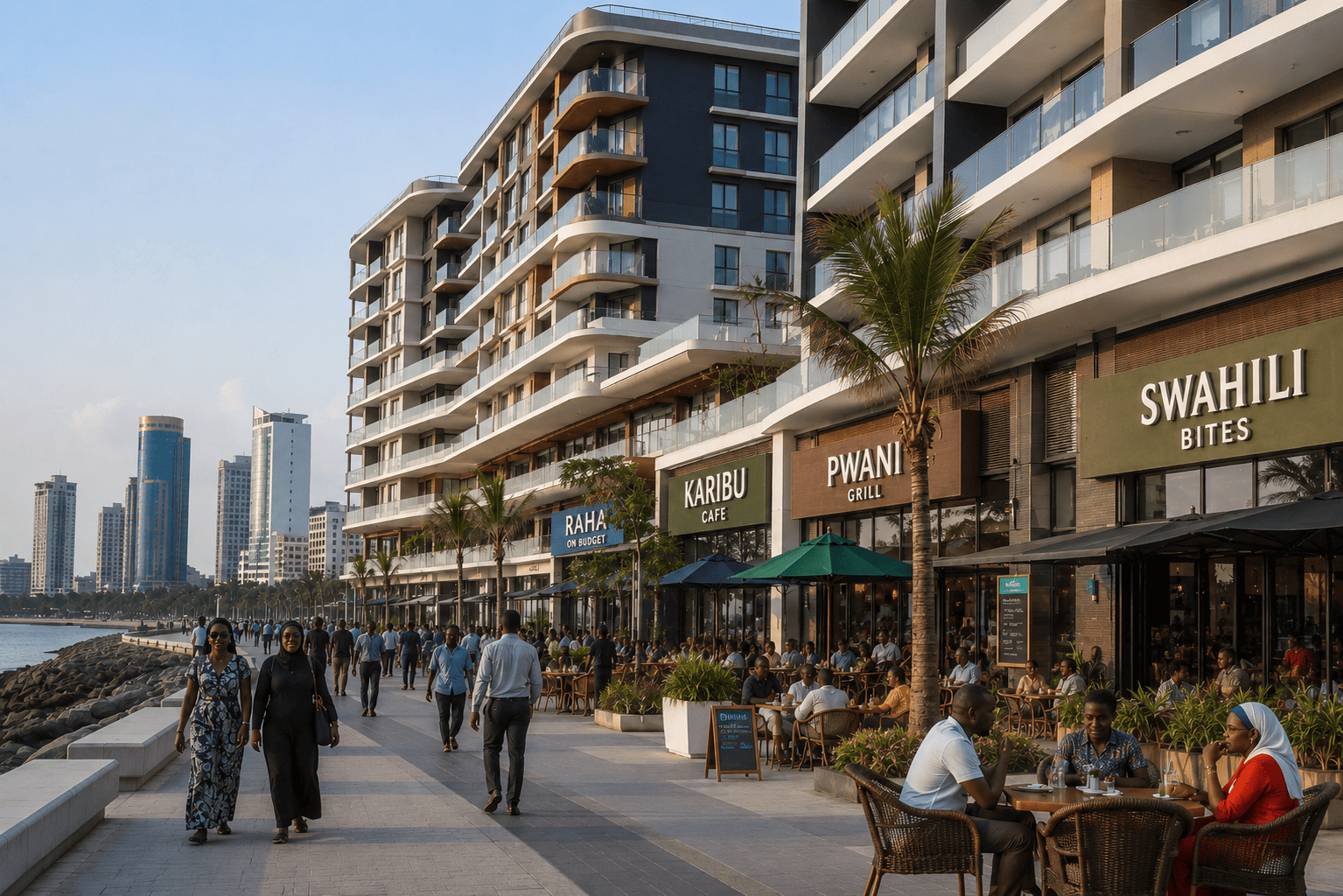
Commercial real estate development in Tanzania is becoming a stronger investment case because the country’s economy is urbanizing, expanding and formalizing at the same time. The opportunity is no longer limited to office towers in central Dar es Salaam or high-end retail in established neighbourhoods. It is now spreading across logistics parks, warehouses, mixed-use buildings, neighbourhood retail centres, hospitality-linked properties, medical buildings, education facilities, transport hubs and serviced commercial plots.
The central argument is straightforward: as Tanzania’s cities grow, businesses need better places to operate. Population growth creates residential demand, but it also creates commercial demand around that population. Every expanding urban area needs supermarkets, pharmacies, schools, clinics, restaurants, workshops, fuel stations, storage facilities, offices, markets, banks, hotels, transport yards and professional-service buildings. Commercial real estate is therefore not just a property story. It is a physical expression of how the economy organizes itself.
Dar es Salaam shows the scale of demand
Dar es Salaam is the strongest commercial real estate signal because it concentrates people, income, institutions, logistics and national economic activity.
Dar es Salaam remains the clearest signal. The city is estimated to have about six million inhabitants, representing around 40% of Tanzania’s urban population and about 17% of national GDP. It has been growing at about 5.6% annually and is projected to exceed 10 million people by 2030. That scale of urban expansion does not only require housing; it requires structured commercial space to serve households, firms, institutions and regional trade flows.
Formal planning has not kept pace with growth, and the World Bank has estimated that about 70% of development in the city is informal and not accompanied by service extensions. That is both a challenge and an investment signal. Where population growth is moving faster than planned infrastructure, demand emerges for organized retail centres, formal markets, small business premises, logistics nodes, mixed-use buildings and commercial facilities that bring services closer to where people live and work.
The economy is already supporting commercial property demand
Construction contributes 12.8% of GDP, while real estate contributes 2.7%, showing that property development is already part of Tanzania’s economic structure.
The economic data supports the case. Tanzania’s 2024 Economic Survey shows that construction contributed 12.8% of GDP in 2024, while real estate activities accounted for 2.7% of GDP. Real estate activities grew by 4.3% in 2024, driven by demand for residential, commercial and office buildings as population and economic activity expanded. Construction remains one of the largest channels through which investment moves into the physical economy, and commercial real estate sits directly inside that value chain.
Commercial demand is also being pulled by several sectors at once. Trade and repair activities grew by 4.8% in 2024 and contributed 8.6% of GDP, creating demand for retail premises, showrooms, workshops, storage facilities and distribution points. Accommodation and food services grew by 6.0%, supported by tourism, with inbound tourists rising from 1.81 million in 2023 to 2.14 million in 2024. Transport and storage activities grew by 4.2%, while information and communication grew by 14.3%. These sectors consume space in different ways, but they all need buildings, land, access, utilities and location discipline.
The strongest opportunity is demand-led development
The best commercial projects will start with tenant demand, customer movement and location logic, not land speculation.
The strongest commercial real estate opportunity in Tanzania is demand-led development rather than speculative construction. A good commercial project should begin with the tenant, customer flow and use case before the design is finalized. The question is not only whether a developer owns land, but whether that land sits in the path of economic movement.
A site near a port, highway, bus terminal, hospital, school, industrial zone, tourism corridor, government office or dense residential neighbourhood carries a different investment profile from a site that is merely available. Commercial real estate performs best when it follows real economic movement: people, goods, services, transport and institutions.
Retail is becoming a neighbourhood-level opportunity
Urban households are creating demand for practical retail: supermarkets, pharmacies, clinics, food outlets, salons, mobile-money agents and daily-service centres.
Retail is one of the clearest opportunities. Tanzania’s urban households are growing in number, and urban consumers need convenient access to everyday goods and services. This creates room for neighbourhood retail centres, roadside commercial strips, ground-floor mixed-use retail, supermarket-led centres, pharmacies, clinics, salons, mobile-money agents, restaurants, bakeries and hardware outlets.
The most successful retail projects are likely to be those that serve daily consumption rather than relying only on luxury shopping. Convenience, accessibility, parking, visibility and tenant mix matter more than architectural prestige. A retail centre that solves daily household needs in a fast-growing urban area may be more resilient than a high-end mall built ahead of purchasing power.
Logistics and warehousing are becoming institutional plays
Ports, roads, rail and regional trade corridors are creating demand for warehouses, truck yards, cold storage and distribution centres.
Logistics and warehousing may offer an even stronger long-term institutional opportunity. Tanzania is positioning itself as a regional trade gateway through ports, road corridors and railway infrastructure. As trade volumes grow, businesses need storage, cold chains, distribution centres, truck yards, bonded warehouses, inland logistics facilities and last-mile delivery points.
These assets are less visible than shopping malls, but they are often closer to the operating needs of a growing economy. A logistics facility near a strong corridor can serve importers, exporters, manufacturers, retailers, agriculture processors, e-commerce operators and regional traders. For investors seeking income-generating commercial assets, logistics-linked real estate may become one of the most important segments of the market.
Mixed-use development can reduce risk
Mixed-use projects spread income across retail, offices, housing, parking, hospitality and services, reducing dependence on one tenant category.
Mixed-use development is becoming more practical. A project that combines retail, office space, apartments, serviced rooms, parking, food outlets and professional services can spread risk across multiple income streams. In fast-growing urban corridors, single-use buildings can become vulnerable if one tenant category weakens.
Mixed-use projects are better positioned when they respond to how people actually live and work. Residents need services. Offices need food, banking and convenience retail. Shops need foot traffic. Hospitality needs surrounding activity. A well-planned mixed-use development can create an internal demand ecosystem rather than depending entirely on external traffic.
Office development still matters, but selectivity is key
The next office opportunity is not only towers; it is flexible, efficient, service-ready space for cost-sensitive formal businesses.
Office development remains relevant, but it needs more discipline than before. The strongest office demand is likely to come from flexible, efficient and well-managed buildings rather than large speculative towers. Banks, insurance firms, NGOs, professional services companies, technology firms, logistics operators, government contractors and growing SMEs need formal space, but many tenants are cost-sensitive.
Developers who build adaptable floor plates, reliable utilities, proper parking, lifts, security, backup power, internet readiness and professional management will have a stronger case than those who rely only on location or height. In a market where operating reliability matters, building management can be as important as design.
Tourism is widening the commercial real estate map
Rising tourism is supporting demand for hotels, serviced apartments, restaurants, recreation facilities and airport-linked commercial property.
Hospitality-linked commercial real estate is another growth lane. Tanzania’s tourism numbers are rising, and the accommodation and food services sector is benefiting from that recovery. Commercial opportunities around tourism include boutique hotels, serviced apartments, food courts, restaurants, recreation facilities, conference-linked properties, airport-area hotels, beach-town commercial spaces and mixed-use hospitality developments.
Zanzibar, Arusha, Dar es Salaam, Moshi, Bagamoyo and selected coastal and safari gateway areas all have different versions of this opportunity. The investment case is strongest where tourism traffic, business travel, local spending and accessibility meet.
Healthcare and education real estate are underappreciated
Clinics, diagnostic centres, pharmacies, schools, training centres and student accommodation can produce stable commercial demand because they serve essential needs.
Healthcare and education-linked real estate should also be taken seriously. As cities expand, demand rises for private clinics, diagnostic centres, pharmacies, schools, colleges, training centres and student accommodation. These assets are not always treated as mainstream commercial real estate, but they can produce stable demand because they are tied to essential services.
A well-located medical or education building can also anchor surrounding retail and transport activity. Once a clinic, school or training centre draws regular users, nearby demand grows for food outlets, pharmacies, stationery shops, mobile-money agents, transport services and convenience retail.
PPPs are opening new routes into strategic land
Public-private partnerships can unlock underutilized government land for commercial buildings, logistics hubs, hotels and mixed-use urban regeneration.
Government policy is beginning to create additional development channels. In July 2026, the Tanzania Buildings Agency invited local and international investors to submit expressions of interest for 38 government-owned sites under Public-Private Partnership arrangements. The opportunities cover 20 regions and include residential, commercial, mixed-use, logistics and transport facilities, as well as hospitality and tourism developments.
This matters because public land is often well-positioned but underutilized. PPP structures can allow private investors to develop commercial assets without carrying the full burden of private land acquisition, provided the projects are transparent, bankable and properly governed. For commercial real estate investors, public land partnerships may become an important route into large sites, transport-linked hubs, mixed-use developments, logistics centres, hotels and urban regeneration projects.
Real estate is becoming part of Tanzania’s investment infrastructure
Commercial property should be viewed as enabling infrastructure for trade, services, tourism, logistics and urban employment.
Tanzania’s investment promotion framework recognizes real estate demand. Investment promotion materials have pointed to shortages of accommodation and commercial space in Dar es Salaam and other cosmopolitan areas because economic projects are attracting local and international populations that need places to live, work and transact.
This policy framing shows that real estate is not being treated as an isolated private-sector activity. It is part of the infrastructure required by economic expansion. Commercial buildings are where businesses formalize, banks serve customers, traders store goods, clinics treat patients, schools educate children, hotels host travellers and logistics firms move products.
Where the strongest investment opportunities sit
The strongest commercial real estate segments are logistics, neighbourhood retail, mixed-use, hospitality-linked property, institutional real estate and PPP-led redevelopment.
For investors, the strongest opportunities are likely to sit in six segments. The first is logistics and warehousing near ports, highways, industrial zones, airports and rail-linked corridors. The second is neighbourhood retail in fast-growing urban and peri-urban areas where population growth is ahead of formal retail supply.
The third is mixed-use development that combines commercial, residential and service functions. The fourth is hospitality-linked property in tourism and business-travel corridors. The fifth is institutional real estate for healthcare, education, training and professional services. The sixth is PPP-led redevelopment of underutilized public land in strategic urban locations.
These opportunities differ in risk and capital intensity, but they share one common principle: they must be located where actual demand exists.
Risks investors must manage
The main risks are poor location, weak tenant demand, high construction costs, financing pressure, infrastructure gaps and weak property management.
The risk is that many investors still approach commercial real estate as a land-first business. They buy or hold land, then look for a project to place on it. A better approach is market-first. Developers should begin by identifying the tenant base, customer movement, rent ceiling, access points, competing supply, infrastructure condition, parking requirements, utility needs and long-term use pattern.
Financing also requires discipline. Commercial real estate can generate stronger yields than residential property, but it carries higher vacancy, tenant and management risk. A developer must model construction costs, debt costs, rent assumptions, service charges, maintenance, taxes, insurance, fit-out costs, leasing time and tenant turnover. A project that appears attractive at full occupancy can become weak if tenants take longer to sign, rents fall below projections, or service costs are underestimated.
The quality of management will increasingly separate successful assets from average buildings. Tenants want predictable service, security, cleanliness, parking control, working lifts, reliable power, internet readiness, waste management and clear service-charge systems. In a market where many properties are informally managed, professional property management can become a competitive advantage.
Infrastructure and climate resilience matter
Commercial buildings depend on roads, drainage, water, power and waste systems; weak infrastructure can damage even a well-designed project.
There is also a planning and infrastructure risk. Commercial buildings depend heavily on roads, drainage, water, power and waste systems. If a development sits in an area with poor access or recurrent flooding, tenant demand may weaken even if the building itself is strong.
In Dar es Salaam especially, climate resilience and drainage should be part of the investment model, not an afterthought. A commercial property that cannot function during heavy rains or traffic disruption will lose value in practice, even if it looks good on paper.
Bottom line
Commercial real estate in Tanzania is a long-term urban growth play, not just a building-ownership opportunity.
The investment case remains strong because Tanzania is still underbuilt in formal commercial space relative to the direction of its economy. The country is urbanizing, trade is expanding, tourism is recovering, transport corridors are being upgraded, public land is being opened for PPP development, and services are deepening. These trends create long-term demand for structured business space.
Commercial real estate development in Tanzania should therefore be viewed as a long-term urban growth play. The opportunity is not simply to own buildings. It is to build the physical platforms that businesses need to trade, store, serve, employ, distribute, host and scale.
The strongest investors will be those who follow economic movement rather than speculation. Where people live, retail follows. Where infrastructure improves, logistics follows. Where tourism grows, hospitality follows. Where institutions expand, offices and service buildings follow. Where government unlocks land, PPP capital can follow.
Tanzania’s commercial real estate story is still developing, but the direction is clear. The next wave of opportunity will belong to projects that are well-located, demand-led, professionally managed and connected to the real needs of a growing urban economy.
 Uchumi360
Business Intelligence
Uchumi360
Business Intelligence
Uchumi360 covers business, investment, and economic policy across East, Central, and Southern Africa.
For the serious reader
You read to the end. That places you in a small group.
Uchumi360 is built for readers who demand precision over speed, structure over sentiment, and analysis that holds uncomfortable conclusions rather than softening them. If this work sharpens how you think about Africa's economy, help us keep building the infrastructure behind it.
Institutional Partners
Commission intelligence. Shape the conversation.
Uchumi360 works with development finance institutions, investment firms, sovereign bodies, and strategic organisations across the coverage region. Institutional partnership unlocks:
- Commissioned sector and country intelligence reports
- Branded research series under your institution's authority
- Exclusive data briefings for internal strategy teams
- Speaking and editorial presence at Uchumi360 events
- Co-published investment outlooks for your markets
Support Our Work
Independent analysis has a cost. Help us bear it.
Uchumi360 does not carry advertising. It does not take editorial direction from sponsors. Every article is produced without commercial compromise. Your contribution funds the reporting, research, and editorial infrastructure that keeps this analysis free from influence.
Secure checkout: One-time and monthly support are processed securely. Add payment credentials to enable checkout here.
Stay Connected
Keep up with every new insight.
Follow our latest analysis, policy coverage, and market intelligence as soon as it is published. If you need something specific, reach out directly and we will point you to the right research.
