
Dar es Salaam's Apartment Boom Is Ending. The Signs Are Already In The Data.
Ready
The Evergrande saga I wrote about earlier is not a Chinese anomaly. It is a particularly loud thunderclap in a global storm. When a developer with liabilities twenty times the size of Tanzania’s national budget collapses under the weight of its own leverage, it reminds every market that real estate prices are not suspended by prayer. They rest on credit, income, and confidence. All three are now under pressure worldwide, and East Africa is not shielded.
In 2022, on LinkedIn, I drew parallels between the collapse of Evergrande, a property giant whose liabilities once dwarfed entire national budgets, and the quiet risks accumulating in markets like ours, where opacity and leverage can grow unchecked until they don’t. I’m returning to this conversation because the ground beneath urban real estate in Tanzania is shifting. Quietly, but unmistakably, the signs point toward a fall in apartment prices across our major cities. Not necessarily a dramatic crash overnight, but a correction that will expose the weak foundations our valuation and investment practices have built. This isn’t a prediction born from alarmism. It’s a reading of the same global and local forces I’ve been tracking: the mispricing of assets, the evaporation of cheap foreign capital, the oversupply of mid‑ and high‑end units chasing a thin buyer pool, and the growing realization that what we call value may not hold up when income realities and credit costs bite.
In this essay, I want to walk through why apartment prices in urban Tanzania are likely heading downward, who stands to lose, and perhaps who might gain, and, most importantly, what the link is between a massive Chinese developer’s fall from grace and the home a middle‑class family in Mbezi Beach is struggling to sell. The warning shots have been fired. The question now is whether we choose to read them.
The world is already exhaling
Before we look at Dar es Salaam, it’s worth glancing at what is happening around the world. A recent Yahoo Finance report examined twenty countries where housing prices have either declined or flattened over the past years. The list is not a collection of fragile states; it includes advanced and emerging economies alike, all caught in the same undertow: central bank rate hikes, stretched affordability, and a post‑pandemic hangover that has taken the fever out of residential markets. Meanwhile, Insider Monkey identified a smaller cluster of countries where the cooling is most pronounced, noting that the era of cheap money that fueled a global property boom is firmly over.
Data from the Bank for International Settlements (BIS) confirms the breadth of the slowdown. Its long residential property price series, covering over 60 countries, shows that real house prices in many advanced and emerging economies have been flat or declining since 2022, with the steepest drops concentrated in markets that had previously seen the most rapid pandemic‑era run‑ups. When even well‑documented, highly liquid markets are losing steam, the idea that Dar es Salaam can continue its ascent on the back of opaque, manually‑valued stock becomes harder to sustain.
The Evergrande saga I wrote about earlier is not a Chinese anomaly. It is a particularly loud thunderclap in a global storm. When a developer with liabilities twenty times the size of Tanzania’s national budget collapses under the weight of its own leverage, it reminds every market that real estate prices are not suspended by prayer. They rest on credit, income, and confidence. All three are now under pressure worldwide, and East Africa is not shielded.
A look at Nairobi gives us a preview
If you want to know what Dar es Salaam will look like in six to twelve months, glance at Nairobi. The Kenya Real Estate Index, compiled quarterly by the Kenya Bankers Association, has been painting a sobering picture. Asking prices for apartments in Nairobi and its satellite towns have largely stagnated, and in several segments, sellers are quietly accepting discounts. More tellingly, rental yields are compressing. Landlords who once hiked rents annually are now holding steady, or offering a month free, just to keep buildings occupied.
Why does this matter for Dar? Because the two cities share the same investor DNA. Diaspora capital, institutional funds, and regional high‑net‑worth buyers cross the border as easily as a morning flight. When Kenya’s market sneezes, the risk appetite for “the next big thing” in Tanzania doesn’t stay healthy for long. The oversupply of modern apartments in Westlands, Gigiri, Karen, and Kitisuru today is an advance screening of what Masaki, Mbezi Beach, Mikocheni, and Mbweni may host tomorrow.
Crucially, affordability metrics underscore the vulnerability. The Centre for Affordable Housing Finance in Africa (CAHF) has compared housing affordability across the continent using Purchasing Power Parity dollars, revealing that even in Nairobi, often seen as a more mature market, a standard 40m² apartment can require over 10 times the median annual household income. In Dar es Salaam, where incomes are lower but construction costs and developer return expectations remain elevated, the multiple is likely even steeper. When the price‑to‑income gap widens to such extremes, either prices must eventually bend toward incomes, or the pool of eligible buyers shrinks to an unsustainable sliver. That sliver is exactly what we see today.
Dar es Salaam’s three‑speed market is becoming one
Dar es Salaam’s apartment market has always had tiers. At the top, luxury units aimed at expatriates and wealthy Tanzanians. In the middle, aspirational two‑ and three‑bedroom apartments for the salaried class. At the bottom, the informal, lower‑cost rooms that house the majority. For years, the upper and middle tiers inflated rapidly, propelled by a construction boom, diaspora inflows, and a widespread belief that “ardhi ni urithi.”
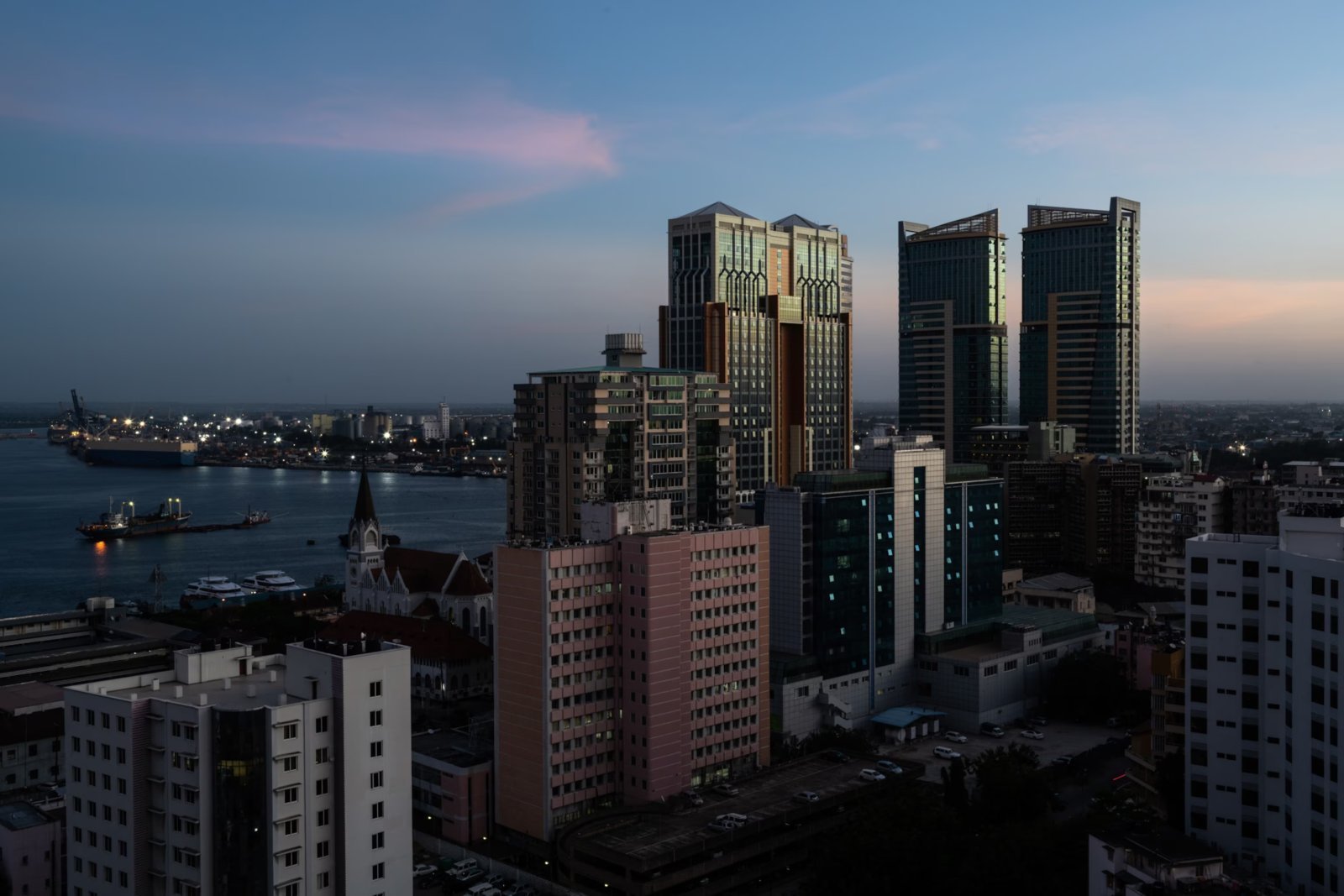
Now let’s apply a litmus test on housing supply. Walk through Masaki, Sinza, Mikocheni, Kawe, or the fringes of the central business district, and you’ll count cranes like they are streetlights. Thousands of apartment units have been completed or are nearing completion. Many were designed for a buyer or tenant whose income is in dollars, a legacy of late‑2010s consumption characteristics and the emergence of Airbnb‑driven yields. That dollar‑earning pool is shrinking as the shilling adjusts under current Bank of Tanzania measures and as expatriate packages become leaner. Absorption is visibly slowing. Developers who once sold off‑plan within weeks now hold completed units for months, quietly slashing prices or offering flexible payment plans that didn’t exist two years ago.
On the demand side, the picture is just as tight. Mortgage credit remains expensive and scarce; the banking sector, already cautious after a spate of non‑performing loans, is not rushing to finance speculative apartment purchases. The diaspora, long the reliable buyer of last resort, is feeling the squeeze from inflation in host countries and is becoming more selective. And the local middle class, whose salaries have not kept pace with the doubling of asking prices since 2018, is priced out, waiting on the sidelines or retreating into cheaper rental stock.
Recent rankings reinforce this demand‑side distress. Business Insider Africa’s 2025 list of the top eight African countries with the least affordable housing places several East African neighbors in the spotlight. While the precise rankings shift depending on the metric, the common thread is that urban shelter costs have decoupled from local incomes. In Tanzania, where the minimum wage and mid‑level professional salaries remain modest by regional standards, the cost‑of‑living data collated by MOHAC Africa paints a similar picture: housing and utilities absorb a disproportionate share of household expenditure, leaving little room to absorb further price hikes. When the median urban household is already stretched to its limit, the price at which a new apartment can sell or rent becomes anchored to an affordability ceiling, not to developer cost‑plus models.
The valuation gap I documented in my earlier Uchumi360 article makes this worse. Because our professionals still lean on outdated methods that ignore climate risk, energy costs, and real market liquidity, many apartments are sitting on bank balance sheets at values that no longer reflect what a willing buyer will pay. This mispricing has not only inflated collateral but also masked the gradual softening of the market. When the correction becomes visible, it may appear sudden only because we refused to measure it gradually.
Rents are not a safe harbor
If you think rental income will shield landlords while sale prices wobble, the data from Nairobi, and the economics of Dar es Salaam, suggest otherwise.
New supply enters the rental market at the same time it enters the sales market. When an investor cannot sell a unit, they rent it. This pushes more stock onto the rental side, competing with existing landlords for the same tenants. We are already seeing anecdotal signs: “To Let” signs lingering longer in Masaki and Victoria lane, landlords offering to cover service charges, and a growing number of furnished units listed for months. As more apartments come online through 2026, this renter’s market will only deepen.
The affordability ceiling matters here too. The median urban household simply cannot afford the rent that would justify the construction cost of a modern apartment. That forces landlords to choose between a prolonged vacancy and a lower rent that undermines the investment case. Over time, the “valuation” of the property based on its income stream, if anyone were to run a proper income‑capitalization model, would decline. Slowly but surely, rents will either stay flat in nominal terms, which in an inflationary environment means they are falling in real terms, or they will drift downward explicitly. The global evidence from the BIS dataset supports this pattern: in cooling markets, real rental growth turns negative well before nominal rents drop, as inflation outpaces stagnant asking prices.
Who loses, and who might quietly gain
A price correction hurts most those who bought recently, near the peak, using high leverage. If your deposit was small and your mortgage large, a 10–15% decline in value wipes out equity fast. Banks, too, will feel the tremor as collateral values soften. The systemic risk I flagged in my Evergrande analysis, where leverage meets opacity, is not a billion‑mile‑away story. It sits in the loan books of our own financial institutions.
But not everyone loses. A correction is also an overdue re‑pricing of urban shelter. For the growing number of young professionals who have been locked out of homeownership, flat or falling prices are a bridge back to possibility. If the decline is orderly, and if we finally invest in the data, valuation, and transparency infrastructure I have been calling for, Tanzania could emerge with a housing market that is more affordable, less speculative, and more attractive to genuine long‑term investors. The alternative, denial, followed by a disorderly fall, is the one we should fear.
A prediction, not a prophecy
I am not forecasting a crash of 30% in twelve months. That would require a financial panic, and Tanzania’s market, for all its opacity, is not as deeply securitized as the markets that collapsed in 2008. What I am forecasting is a prolonged period of flat or gently declining nominal prices in the mid‑ and high‑end segments, perhaps 5–15% over two to three years, with larger real declines when inflation is considered. Rents will follow a similar trajectory: stagnant in shilling terms, falling in purchasing‑power terms, and increasingly negotiable.
Some neighborhoods with genuine scarcity and solid infrastructure will hold better than others. But the broad direction of travel is no longer up. The global winds, the regional evidence from Kenya, the affordability data stretching from CAHF to MOHAC Africa, and the local arithmetic of supply, income, and credit all point the same way. The only question left is whether our institutions will read the map in time, or keep navigating by a compass we already know is broken.
The warning shots have been fired across the world, from Evergrande’s boardrooms to Nairobi’s quarterly index. In Dar es Salaam, the cranes are still swinging, but the ground beneath them is cooling. We can either prepare for the landing, or pretend the laws of economic gravity do not apply to us. I know which bet the data would make.
 Uchumi360
Business Intelligence
Uchumi360
Business Intelligence
- Yahoo Finance (2023)
- 20 Countries Where Housing Prices Are Declining or Flat
- Available at: https://finance.yahoo.com/news/20-countries-where-housing-prices-183715980.html
- Insider Monkey (2023)
- 5 Countries Where Housing Prices Are Declining or Flat
- Available at: https://www.insidermonkey.com/blog/5-countries-where-housing-prices-are-declining-or-flat-1187864/
- Bank for International Settlements (BIS) (2026)
- Residential Property Price Statistics
- Available at: https://www.bis.org/statistics/pp_residential_2605.pdf
- Kenya Bankers Association (2026)
- Kenya Real Estate Index
- Kenyan Wall Street
- Available at: https://kenyanwallstreet.com/kenya-real-estate-index
- Table.Media (2026)
- East Africa: How Tanzania Is Competing with Kenya
- Available at: https://table.media/en/africa/feature/east-africa-how-tanzania-is-competing-with-kenya
- Centre for Affordable Housing Finance in Africa (CAHF) (2022)
- Comparing Housing Affordability in Different African Countries Using Purchasing Power Parity Dollars
- Available at: https://housingfinanceafrica.org/discussion/comparing-housing-affordability-in-different-african-countries-using-purchasing-power-parity-dollars/
- Business Insider Africa (2025)
- Top 8 African Countries with the Least Affordable Housing in 2025
- Available at: https://africa.businessinsider.com/local/lifestyle/top-8-african-countries-with-the-least-affordable-housing-in-2025/gpbkmdy
- MOHAC Africa (2026)
- Cost of Living in Africa
- Available at: https://mohacafrica.org/cost-of-living-in-africa/
- Yusuph I
- (2026)
- Tanzania's Property Valuations Are Stuck In The Past
- Here Is The Cost
- Uchumi360
- Available at: https://uchumi360.com/inf/real-estate-market/tanzania-property-valuations-stuck
Uchumi360 covers business, investment, and economic policy across East, Central, and Southern Africa.
For the serious reader
You read to the end. That places you in a small group.
Uchumi360 is built for readers who demand precision over speed, structure over sentiment, and analysis that holds uncomfortable conclusions rather than softening them. If this work sharpens how you think about Africa's economy, help us keep building the infrastructure behind it.
Institutional Partners
Commission intelligence. Shape the conversation.
Uchumi360 works with development finance institutions, investment firms, sovereign bodies, and strategic organisations across the coverage region. Institutional partnership unlocks:
- Commissioned sector and country intelligence reports
- Branded research series under your institution's authority
- Exclusive data briefings for internal strategy teams
- Speaking and editorial presence at Uchumi360 events
- Co-published investment outlooks for your markets
Support Our Work
Independent analysis has a cost. Help us bear it.
Uchumi360 does not carry advertising. It does not take editorial direction from sponsors. Every article is produced without commercial compromise. Your contribution funds the reporting, research, and editorial infrastructure that keeps this analysis free from influence.
Secure checkout: One-time and monthly support are processed securely. Add payment credentials to enable checkout here.
Stay Connected
Keep up with every new insight.
Follow our latest analysis, policy coverage, and market intelligence as soon as it is published. If you need something specific, reach out directly and we will point you to the right research.
