
Kenya vs Tanzania: The Railway Race to Move East Africa’s Trade
Ready
Kenya has a stronger, established SGR freight business. Tanzania is expanding an electric railway and rebuilding its connection to Zambia. The competition will influence regional trade, the location of industry and the returns on billions of dollars of infrastructure investment.
East Africa’s railway competition is entering a more demanding phase. Kenya is trying to extend an established freight business further into the region. Tanzania is developing an electric standard gauge railway while pursuing connections towards the Great Lakes and revitalising the separate Tanzania–Zambia Railway, known as TAZARA. Both are seeking a larger role in moving the region’s goods, but their networks offer different strengths and face different unfinished tasks.
For manufacturers, farmers and traders, the competition could determine which port offers the most dependable route to inland markets. It could also influence where businesses build warehouses, process agricultural produce and establish factories. For governments, it poses a harder financial question: whether railway traffic and the economic activity around stations and terminals can justify the cost of construction, maintenance and borrowing.
The prize extends beyond railway income. A reliable connection to the coast can reduce the amount of stock a business must hold against delivery delays, improve access to imported machinery and make inland production more competitive. Those benefits depend on the performance of an entire transport chain, including ports, railways, customs and the roads connecting terminals to customers.
Kenya’s operating SGR runs from Mombasa through Nairobi to Naivasha. Kenya Railways’ strategic plan records 472 kilometres between Mombasa and Nairobi and another 120 kilometres to Naivasha, approximately 592 kilometres combined. Passenger services began in 2017, followed by SGR freight operations in 2018. The same plan identifies a separate metre gauge network of about 2,046 kilometres, although that inventory includes sections with different operating conditions.
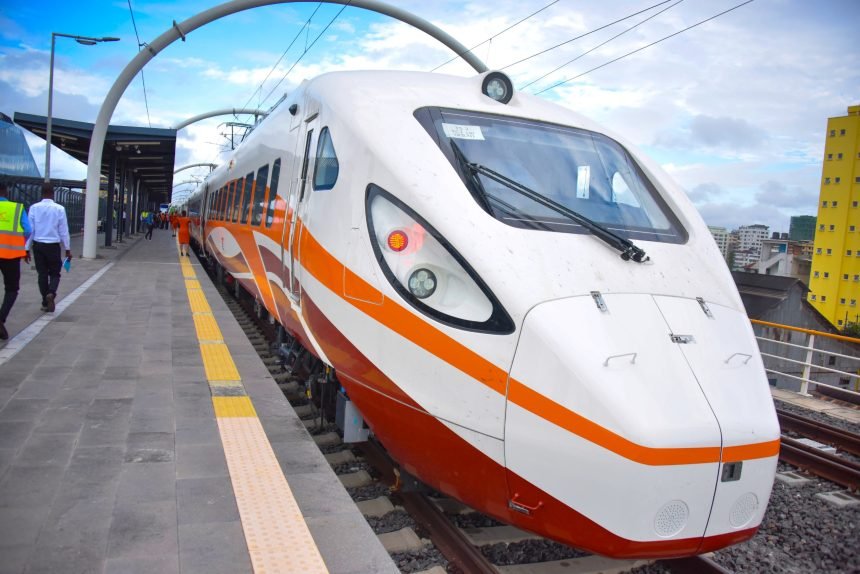
Tanzania combines an approximately 2,707-kilometre metre gauge network with its newer SGR, whose passenger services began in June 2024 and serve the Dar es Salaam–Morogoro–Dodoma corridor. Its railway geography also includes TAZARA, a jointly owned Tanzania–Zambia system extending 1,860 kilometres between Dar es Salaam and New Kapiri Mposhi. That entire cross-border distance should not be counted as railway located inside Tanzania.
These networks are difficult to compare through a single kilometre total. An existing branch line, an operating intercity railway and a construction contract represent different transport capabilities. Project announcements can also include sidings and station tracks, while other figures describe only the main line. The economically useful comparison is how much freight and passenger traffic each connected system can carry reliably.
Their geography also creates different commercial possibilities. Kenya’s current SGR centres on the Mombasa–Nairobi–Naivasha axis, with the next extension directed towards Kisumu and Uganda. Tanzania is pursuing connections towards both Lake Victoria and Lake Tanganyika, alongside the existing southern route through TAZARA. This gives Tanzania several directions in which to seek traffic, while increasing the number of railway, terminal and connecting-service investments that must work together.
On established SGR freight activity, Kenya has a clear lead. The Kenya National Bureau of Statistics reports that its SGR carried 7.332 million tonnes in 2025, up 12.3% from 2024. Freight revenue reached KSh16.638 billion. Passenger journeys rose 11.6% to 2.731 million, generating KSh4.794 billion. Together, those revenue streams show an operating business with substantial demand, although revenue alone cannot establish profitability or the ability to repay construction debt.
Kenya’s older railway remains commercially relevant. It carried 1.083 million tonnes of freight in 2025, an increase of 5.2%, according to KNBS. Its continued use demonstrates why modernisation cannot be assessed solely through the SGR: older routes can connect customers and destinations beyond the reach of the new line.
Tanzania’s newer SGR has developed a substantial passenger business while freight remains at an earlier stage. The transport ministry recorded 2,515,203 passenger journeys and 102,452 tonnes of SGR freight between July 2025 and March 2026. Passenger numbers increased 22.4% from the corresponding nine months a year earlier. Those figures cover nine months, whereas Kenya’s figures cover calendar 2025; they cannot support a direct annual market-share comparison.
The distinction matters commercially. Passenger demand can establish a railway as an essential public service and support activity around stations. Freight growth requires additional arrangements with ports, cargo owners, warehouses and inland terminals. A railway can therefore attract busy passenger trains before developing the regular cargo flows needed to use its freight infrastructure effectively.
The potential cargo pool is substantial. Kenya Ports Authority reported that Mombasa handled more than 45 million tonnes in 2025. But total port throughput is broader than the market available to rail: it includes different cargo categories, local destinations and maritime transshipment. Rail operators must identify the particular consignments, routes and customers they can serve competitively, rather than assume every tonne passing through a port can move inland by train.
The countries made different initial technology choices. Kenya introduced its SGR with diesel traction, while Tanzania built electric operation into its new railway. TRC describes a system designed for passenger trains travelling at 160 kilometres an hour. The term standard gauge identifies the distance between the rails, 1,435 millimetres; it does not, by itself, identify a railway’s power source, operating speed or quality of service.
For Tanzania, electric rail makes coordination with the electricity system central to railway performance. Power must reach traction substations dependably, while the operator needs electrical maintenance skills, spare parts and suitable trains. Its financial advantage will depend on electricity tariffs, traffic volumes and maintenance costs. Passenger journey times will still reflect stopping patterns and station access, while freight customers will judge the time between releasing a container at the port and receiving it inland.
Urban rail presents another important dimension. At a June 2026 market engagement forum, Kenya Railways presented plans under the Kenya Urban Mobility Improvement Project for Nairobi Central Station, commuter-network electrification, modern trainsets and maintenance workshops. These proposals concern metropolitan transport and should be assessed separately from the western SGR extension.
Dar es Salaam also has an urban railway role beyond its intercity SGR. TRC lists commuter services towards Pugu and Ubungo, while TAZARA’s January 2025 infrastructure inspection included its commuter route towards Mwakanga. For these services, the relevant tests are affordable fares, useful departure times, station access and dependable connections to other public transport.
The economic logic differs from long-distance freight. A commuter railway can widen the area from which employers recruit workers and make jobs accessible to households without cars. Intercity services can support business travel and tourism. Passenger numbers therefore need to be interpreted alongside affordability and access: growth concentrated in premium services would have different social effects from growth in everyday commuter travel.
Kenya’s Naivasha inland container depot connects to the older railway through a 23.7-kilometre metre gauge link to Longonot. Cargo transfers between systems for onward movement towards western Kenya and regional markets, making the terminal a critical part of the transport chain.
Tanzania is pursuing a comparable approach while its new railway advances inland. In a May 2026 update, TRC described the planned freight chain from Dar es Salaam port by SGR to Bahi, where cargo would transfer to the metre gauge network. This gives the older railway an immediate role in extending the reach of the newer investment. It also makes the speed and cost of transferring containers between gauges commercially significant.
A September update illustrates how Tanzania is developing that inland business. TRC outlined plans to increase trains and wagons serving Isaka dry port, identifying traders from Rwanda, Burundi, the Democratic Republic of Congo and Uganda as intended beneficiaries. Its strategy explicitly involves both standard and metre gauge railways. Isaka’s role should consequently be understood as part of an interconnected freight system, rather than evidence that the electric SGR has already been completed to the town.
For both countries, these transfer points can extend a railway’s reach before the whole modern network is complete. They also introduce handling charges and waiting time. The commercial opportunity is to offer customers coordinated bookings, clear responsibility for the cargo and a dependable schedule across the different stages. Savings on the main railway journey can be lost if containers wait too long for unloading, clearance or onward transport.
Kenya’s next major expansion is intended to reduce its dependence on the Naivasha transfer point. President William Ruto launched the Naivasha section of the Naivasha–Kisumu–Malaba SGR extension on 19 March 2026. The transport ministry describes a 264-kilometre main line to Kisumu, an additional 8.69-kilometre branch to a proposed new Kisumu port, and a further 107 kilometres from Kisumu to Malaba. These are extension projects, with the regional benefits dependent on completion and connections beyond Kenya’s border.
Kenya Railways subsequently reported in July that physical construction had commenced on the Naivasha–Kisumu section. That is a further implementation milestone, although the commercial test comes when the infrastructure, stations, signalling and rolling stock can support regular services.
The direction is economically significant. A continuous SGR towards Malaba would bring Kenya’s modern railway closer to Uganda’s market, while a Kisumu port connection would support rail-and-lake transport. The eventual gain will depend on the performance of the entire corridor: railway operations, border procedures, connecting services and the cost of getting goods from the destination terminal to customers.
Uganda’s progress is consequently part of Kenya’s investment case. In April 2026, Uganda appointed Citibank to mobilise financing for its planned 272-kilometre Malaba–Kampala railway, contracted to Yapi Merkezi. Reuters reported then that preparatory work had begun, while full construction awaited financing. The two countries therefore need compatible infrastructure and coordinated delivery schedules: completing one side of the border does not automatically produce a continuous SGR service from Mombasa to Kampala.
The extension also introduces a financing shift. Reuters reported at the March launch that Kenya intended to use revenue securitisation backed by railway development levy receipts, with China Road and Bridge Corporation remaining the contractor. At that point, the government and Kenya Railways had not disclosed the full financing structure. The commercial question is how future public revenues will be committed and how construction and traffic risks will be allocated.
Tanzania’s expansion is spreading across several construction sections. Standard Chartered’s April 2026 financing announcement covers work towards Isaka and Mwanza, involving Turkey’s Yapi Merkezi and China Civil Engineering Construction Corporation. The geography would connect the central railway more closely with western and north-western Tanzania, expanding the potential catchment of Dar es Salaam’s port.
The bank described financing exceeding US$2.33 billion across SGR Lots 3, 4 and 5, combining export credit support, commercial banks and development finance institutions. Its breakdown included facilities signed or drawn before 2026, so the headline amount represents a financing programme assembled over time. It should not be interpreted as an entirely new cash injection made available on the announcement date.
The different financing approaches expose a shared challenge. Long-lived infrastructure must be paid for while traffic is still developing. Foreign-currency borrowing can create pressure when repayment obligations and local-currency revenues move differently. Committing future levy receipts can provide construction funding, but those receipts then become less available for other purposes. In either model, the important questions concern repayment schedules, public guarantees, construction delays and who bears the cost if traffic disappoints.
The western branch has also advanced through a recent political milestone. On 21 July 2026, President Samia Suluhu Hassan laid the foundation stone for the Tabora–Kigoma SGR project. TRC describes the contract as covering 506 kilometres and costing US$2.74 billion. Reaching Kigoma would strengthen the railway’s relationship with Lake Tanganyika and the markets beyond it. Those gains remain prospective while construction proceeds.
Tanzania’s regional ambitions also include the Uvinza–Musongati railway towards Burundi, whose groundbreaking took place on 16 August 2025. The Central Corridor agency identifies it as Burundi’s first railway project and part of a wider programme of regional connections. Its eventual commercial contribution will depend on completing both the cross-border line and the connecting Tanzanian infrastructure.
Lake connections add another layer to the comparison. Railway access to Kisumu, Mwanza or Kigoma can support onward movement by water, provided vessels, terminal equipment and schedules are available. This can expand the catchment of a railway beyond its final station. It also means that investment decisions must consider the capacity of the connecting lake service, rather than treating arrival at a lakeside rail terminal as the completion of the customer’s journey.
TAZARA gives Tanzania another strategic direction. Its existing route to Zambia creates a separate opportunity to develop freight business linked to southern Africa. Under the concession signed in September 2025, CCECC is to rehabilitate and modernise the railway and operate its freight component, with planned investment exceeding US$1.4 billion. In July 2026, TAZARA announced the start of construction of a new training centre and operations control centre in Dar es Salaam as visible implementation milestones.
That rehabilitation should be assessed separately from Tanzania’s SGR construction. TAZARA uses 1,067-millimetre gauge, while TRC’s older railway uses 1,000-millimetre gauge; TAZARA identifies Kidatu as a transfer point between them. The different systems can broaden Tanzania’s commercial reach, but moving cargo efficiently between them requires functioning terminals and coordinated operations.
The rehabilitation need is substantial. In January 2025, TAZARA reported concerns over worn infrastructure, bridges, tunnels and ageing rolling stock. Kenya has also experienced the commercial consequences of infrastructure damage: KNBS linked weaker metre gauge passenger revenue in 2025 to disruption of the Nairobi–Kisumu service following damage at Kijabe.
These experiences make maintenance a central investment issue. A railway’s usefulness depends on drainage, bridge condition, track inspections, spare locomotives and the speed of repairs as much as on its original design. Businesses may tolerate a longer scheduled journey if delivery is predictable. Repeated disruption can instead force customers to maintain alternative transport arrangements, weakening the value of the railway even when its advertised tariff is attractive.
Both countries place railways within wider national development plans. Kenya Railways’ 2023–2027 strategy aligns its programme with Vision 2030 and the Fourth Medium Term Plan. Tanzania’s 2026/27 transport budget places its priorities within Development Vision 2050 and the Fourth Five Year Development Plan for 2026/27–2030/31. The policy ambition is to connect transport investment with production, trade and industrial development.
Naivasha offers a concrete example of how Kenya intends to join those activities. The Special Economic Zones Authority describes a 1,000-acre zone along the SGR, combining industrial parks, logistics facilities and railway marshalling space. Its targeted activities include agro-processing, textiles, leather and construction materials. The commercial proposition is to bring production closer to transport infrastructure.
Tanzania’s programme of inland terminals, including Kwala and Isaka, creates a comparable opportunity to organise warehousing and distribution around rail access. Whether that leads to a wider industrial base will depend on serviced land, reliable utilities, skilled workers and businesses with viable markets. Railway access can improve an industrial location, but factories still need competitive production costs and customers for what they make.
Agriculture illustrates the conditions required. A producer rarely has enough goods at one location to fill a train. Aggregators, cooperatives, storage operators and processors can assemble larger consignments, while feeder roads connect collection centres to railway terminals. Grain and other storable products have different transport requirements from perishable produce. The latter needs suitable handling, temperature control and dependable departures before a railway connection can become a useful route to market.
Mining and heavy industry raise another commercial question: what will actually be shipped, in what form and at what volume? Ore, processed minerals, machinery and industrial inputs place different demands on wagons and terminals. A railway forecast built around a proposed mine or factory needs to be linked to that project’s financing and production timetable. Otherwise, the transport infrastructure can be ready before the customer generates the expected cargo.
Return traffic matters as well. Railways that carry imported goods inland need opportunities to move exports back towards the coast. More balanced flows can improve the use of locomotives, wagons and containers. Export-oriented agriculture and manufacturing could therefore strengthen railway economics, while dependable transport could help those businesses reach markets. Creating that relationship requires commercial coordination between operators and producers.
Delivering that ambition requires investment around the tracks. Kenya’s transport ministry announced on 7 September 2026 the launch of an access-road upgrade for the proposed Ongata Rongai SGR station, including drainage, pedestrian facilities and crossings. Such projects receive less attention than long-distance extensions, yet they influence whether surrounding communities and businesses can use railway services conveniently.
The domestic business opportunity also extends beyond construction contracts. Railways require continuing supplies of components, workshop services, track maintenance, electrical expertise and cargo-handling equipment. Procurement and training can help local firms participate in that expenditure over the life of the assets. The maintenance workshops included in Kenya’s urban rail plans and the training facilities in TAZARA’s rehabilitation programme show where that longer-term capability can be developed.
Road transport will remain part of the business model. Trucks can connect farms, factories and shops to railway terminals and handle consignments for which rail is unsuitable. The practical objective is an efficient division of work, with rail carrying suitable volumes over longer distances and road transport providing flexible collection and delivery. The outcome should be judged by the customer’s total cost and service quality.
Public reporting will be essential to judging progress. Passenger journeys, freight tonnes, average distances travelled, train reliability, revenue, operating costs and debt service answer different questions. A railway may cover day-to-day operations while still needing public support for major renewals or construction debt. Governments and operators would make the investment case easier to assess by publishing these measures consistently, alongside the obligations attached to loans, concessions and other financing arrangements.
The evidence points to different strengths at this stage. Kenya has an established SGR freight operation, an expanding urban rail agenda and a western extension intended to deepen its regional reach. Tanzania combines electric SGR development with several prospective Great Lakes connections and the rehabilitation of an existing route to Zambia. Kenya’s challenge is to extend its operating advantage while maintaining the network it already uses. Tanzania’s is to turn a broad construction programme into dependable services and sustained freight volumes.
For East Africa’s inland economies, stronger performance by both systems would provide more transport choices and greater resilience when one route is disrupted. Competition could encourage better service, while cross-border cooperation remains necessary to make either network work. The decisive measure will be the complete journey: the price paid, the time taken and the confidence that goods will arrive when promised. That is where railway investment becomes a competitive advantage for the wider economy.
 Uchumi360
Business Intelligence
Uchumi360
Business Intelligence
Uchumi360 covers business, investment, and economic policy across East, Central, and Southern Africa.
For the serious reader
You read to the end. That places you in a small group.
Uchumi360 is built for readers who demand precision over speed, structure over sentiment, and analysis that holds uncomfortable conclusions rather than softening them. If this work sharpens how you think about Africa's economy, help us keep building the infrastructure behind it.
Institutional Partners
Commission intelligence. Shape the conversation.
Uchumi360 works with development finance institutions, investment firms, sovereign bodies, and strategic organisations across the coverage region. Institutional partnership unlocks:
- Commissioned sector and country intelligence reports
- Branded research series under your institution's authority
- Exclusive data briefings for internal strategy teams
- Speaking and editorial presence at Uchumi360 events
- Co-published investment outlooks for your markets
Support Our Work
Independent analysis has a cost. Help us bear it.
Uchumi360 does not carry advertising. It does not take editorial direction from sponsors. Every article is produced without commercial compromise. Your contribution funds the reporting, research, and editorial infrastructure that keeps this analysis free from influence.
Secure checkout: One-time and monthly support are processed securely. Add payment credentials to enable checkout here.
Stay Connected
Keep up with every new insight.
Follow our latest analysis, policy coverage, and market intelligence as soon as it is published. If you need something specific, reach out directly and we will point you to the right research.
