
Tanzania, Zambia, and China Sign $1.4 Billion Deal to Rehabilitate TAZARA Railway, Unlocking Regional Trade Potential
Ready
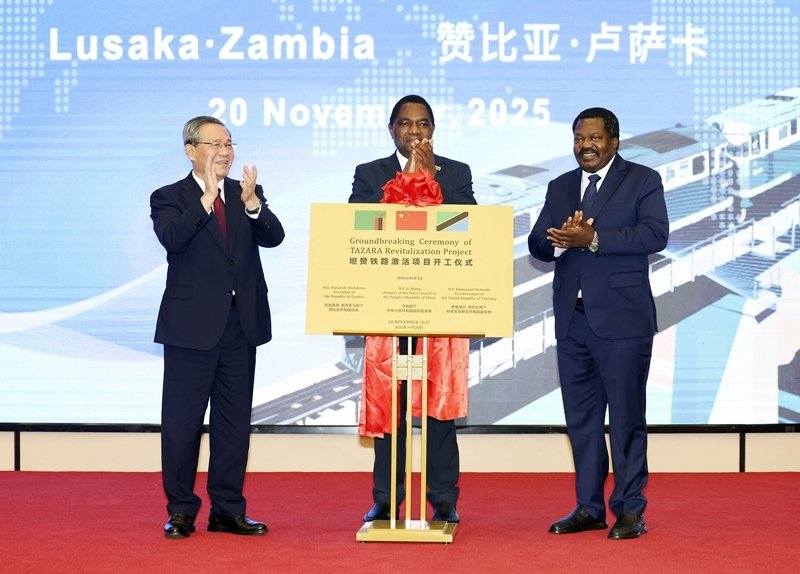
Tanzania and Zambia, with China, have signed a $1.4B deal to rehabilitate the TAZARA Railway. The project aims to lower transport costs, boost trade, and unlock industrial growth along the corridor, transforming a historic railway into a regional economic engine.
Tanzania and Zambia, in partnership with China, have formalized a $1.4 billion agreement to rehabilitate the Tanzania–Zambia Railway Authority (TAZARA), a strategic corridor that links Zambia’s Copperbelt to the port of Dar es Salaam. The project, which revives a Cold War-era railway, represents a significant opportunity for both countries to enhance trade efficiency, industrial development, and regional economic integration, while positioning Dar es Salaam as a major logistics hub in Southern Africa. Led by the China Civil Engineering Construction Corporation (CCECC), which originally constructed TAZARA in the 1970s, the agreement grants the company a 30-year concession to operate the line, combining technical expertise, financing, and operational management.
The investment, totaling $1.4 billion, will be allocated across two main areas: $1 billion for track reconstruction, signaling upgrades, and infrastructure modernization, and $400 million for rolling stock, including 34 new locomotives and 762 freight and passenger wagons. The rehabilitation phase is expected to last three years, after which CCECC will manage operations under the long-term concession. Analysts note that the modernization of TAZARA is likely to increase freight capacity dramatically, with current volumes of roughly 400,000 metric tons per year projected to rise to 1.2 million tons in the first year and potentially 2.4 million tons within four years, dramatically lowering logistics costs for exporters and enhancing the competitiveness of Zambian copper and Tanzanian industrial goods.
For Tanzania, the TAZARA railway rehabilitation is poised to generate multiple economic benefits. By increasing freight throughput and improving reliability, the Dar es Salaam port is likely to capture higher revenue from handling fees, customs charges, and ancillary services, solidifying its position as a regional logistics hub. The corridor also opens opportunities for industrial growth along the rail line, particularly in agro-processing, manufacturing, and mineral value-addition industries, where reduced transport costs directly improve competitiveness. Additionally, improved rail connectivity can enhance cross-border trade under the African Continental Free Trade Area (AfCFTA), enabling Tanzania to leverage its geographic advantage and strengthen trade linkages with Southern and Central African markets.
For Zambia, the economic implications are equally significant. The Copperbelt region, which supplies a substantial portion of Zambia’s export revenue, relies heavily on efficient transport infrastructure to maintain global competitiveness. By lowering freight costs and improving the reliability of the export corridor to Dar es Salaam, Zambia can increase its mineral export volumes while fostering the development of downstream processing industries, retaining more value domestically. The revitalized TAZARA line also diversifies Zambia’s trade routes, reducing dependency on southern corridors such as the Lobito line in Angola, and enhancing resilience against logistical disruptions. Analysts project that sustained investment and industrial uptake along the corridor could stimulate broader economic activity, including manufacturing, logistics services, and employment creation in construction and rail operations.
 Despite its promise, the TAZARA project is not without economic and operational risks. The long-term financial success of the rehabilitation depends on consistent freight volumes, and underutilization could undermine projected returns. A 30-year operational concession to CCECC requires careful regulatory oversight to ensure fair tariff structures and protection of national interests, while maintenance and operational efficiency must remain a priority to prevent erosion of the railway’s economic benefits. Competition from alternative regional transport corridors could also impact the railway’s market share, necessitating strategic marketing and infrastructure integration to maximize corridor utilization.
From a broader perspective, China’s involvement in the TAZARA rehabilitation underscores its ongoing role in financing and managing major infrastructure projects across Africa. By combining technical expertise with long-term operational control, China is strengthening its influence in regional logistics corridors, while Tanzania and Zambia have the opportunity to leverage this partnership to accelerate industrialization, expand trade, and increase regional competitiveness. Economists highlight that if managed effectively, the TAZARA rehabilitation could function as a transformative economic artery, driving trade, industrial growth, and job creation along the corridor, while reinforcing Dar es Salaam’s strategic importance as a regional logistics gateway.
 Uchumi360
Business Intelligence
Uchumi360
Business Intelligence
Uchumi360 covers business, investment, and economic policy across East, Central, and Southern Africa.
For the serious reader
You read to the end. That places you in a small group.
Uchumi360 is built for readers who demand precision over speed, structure over sentiment, and analysis that holds uncomfortable conclusions rather than softening them. If this work sharpens how you think about Africa's economy, help us keep building the infrastructure behind it.
Institutional Partners
Commission intelligence. Shape the conversation.
Uchumi360 works with development finance institutions, investment firms, sovereign bodies, and strategic organisations across the coverage region. Institutional partnership unlocks:
- Commissioned sector and country intelligence reports
- Branded research series under your institution's authority
- Exclusive data briefings for internal strategy teams
- Speaking and editorial presence at Uchumi360 events
- Co-published investment outlooks for your markets
Support Our Work
Independent analysis has a cost. Help us bear it.
Uchumi360 does not carry advertising. It does not take editorial direction from sponsors. Every article is produced without commercial compromise. Your contribution funds the reporting, research, and editorial infrastructure that keeps this analysis free from influence.
Secure checkout: One-time and monthly support are processed securely.
Stay Connected
Keep up with every new insight.
Follow our latest analysis, policy coverage, and market intelligence as soon as it is published. If you need something specific, reach out directly and we will point you to the right research.
