
In Tanzania, a Tarmaced Road Is Not Infrastructure. It Is a Luxury Good. That Is the Country's Most Expensive Urban Planning Failure.
Ready
Ask anyone searching for a house in Dar es Salaam what the first question is. It is not how many bedrooms. It is not the rent. It is "barabara imefika?" Has the road arrived? Lami imefika? Has the tarmac arrived? In a city of six million people, in the second-largest economy in East Africa, in a country that has spent billions on a standard gauge railway and a 2,115 megawatt hydropower dam, whether a neighbourhood has a paved road remains a meaningful question. That is not a failure of ambition. It is a failure of priority. Tanzania has treated tarmac as a reward for development rather than a condition of it, and the cost of that inversion is paid every day by every person whose school, clinic, business, and home sits on a dirt road that turns to mud in March and dust in August.
Tanzania has less than 40 percent of its roads paved nationally. In Dar es Salaam, unpaved neighbourhood streets are the norm rather than the exception outside the coastal corridor. The phrase "barabara imefika?" has become shorthand for whether an area is considered developed, with tarmac access directly inflating property values in ways that expose the road's function not as infrastructure but as a premium amenity. The government's investment pattern is incremental and project-driven rather than systematic: trunk roads and showcase corridors get paved while neighbourhood streets remain dirt. NHC and Watumishi Housing Company deliver well-built residential estates in Dodoma, Arusha, and Dar es Salaam whose residents step outside the gate onto unpaved roads that break cars, flood in the rains, and generate dust all year. Kigali treats road connectivity as a prerequisite for any residential development approval. Addis Ababa has implemented systematic neighbourhood road programmes whose ambition, while imperfect in execution, reflects a government that has decided paved streets are an obligation rather than a reward. Tanzania has not made that decision. This piece argues it must.
The question that should not exist
When someone is looking for a house in Dar es Salaam, the conversation follows a predictable sequence. Location. Rent. Rooms. And then, almost always, the question that carries more weight than any of the others.
Barabara imefika?
Has the road arrived? Is it tarmac? Lami imefika? Can you get there in the rainy season without destroying your suspension? Kuna barabara? Is there even a road?
This question should not exist. Not in 2026. Not in a city of six million people. Not in a country that is constructing nearly 3000 kilometres of standard gauge railway, commissioned a 2,115 megawatt hydropower dam, expanded its airports, and announced ambitions to reach a USD 1 trillion economy by 2050. The question "does your neighbourhood have a paved road" belongs to an earlier decade, a smaller budget, and a lower level of national ambition.
It persists because Tanzania has made a choice, not always consciously, not always deliberately, but consistently across budget cycles and development plans, to treat tarmac as a reward for development rather than a condition of it. Trunk roads get paved. Showcase corridors get paved. Roads connecting ministerial buildings and SGR stations get paved. The neighbourhood streets where the majority of Tanzanians actually live, walk to school, carry goods to market, and receive ambulances in emergencies, remain unpaved at a rate that should embarrass a country at Tanzania's stage of growth.
What unpaved roads actually cost
The conversation about Tanzania's road infrastructure usually focuses on kilometres, budgets, and project completions. It rarely focuses on what the absence of tarmac costs the people who live on dirt roads every day.
Tanzania has less than 40 percent of its roads paved nationally, according to TICGL research. In Dar es Salaam, the formal road network of paved streets concentrates along the coastal corridor, the Bagamoyo Road artery, the Kilwa Road corridor improved by BRT investment, and the trunk roads connecting the city centre to major districts. Away from those corridors, neighbourhood streets in Kinondoni, Temeke, Kigamboni, Mbagala, Mbezi, and the vast settlements that house the majority of the city's residents are largely unpaved.
Ambassador John Ulanga made the economic case precisely at the Mwananchi Thought Leadership Forum in June 2025: transportation accounts for between 30 and 50 percent of the final cost of goods in Tanzania. That figure is not driven by long-distance freight alone. It is driven by the last kilometre, the neighbourhood street that a delivery truck cannot navigate in the rainy season, the market trader who spends two hours reaching a main road that is twenty minutes away by distance, the small business whose supplier adds a premium for the road condition their vehicle will face.
An unpaved road is not just an inconvenience. It is a tax. It is charged to every household on that road every day, invisibly, in the form of higher transport costs, vehicle repair bills, lost time, missed appointments, and the economic decisions that rational people make to avoid the friction.
Barabara imefika as a real estate pricing mechanism
The phrase "barabara imefika" is not conversational shorthand. It is a real estate pricing variable.
In Dar es Salaam's property market, proximity to a tarmaced road inflates values in ways the Masaki Paradox's price-per-square-metre data only partially captures. A plot in Mbagala on an unpaved street and a plot in Mbagala fifty metres from tarmac are not the same investment. The tarmac-adjacent plot commands a premium whose size reflects not the road itself but everything the road signals: drainage, accessibility in all seasons, likelihood of utility connection, probability of neighbourhood commercial development, and proximity to the formal economy's supply chains.
In normal urban economics, a paved road is background infrastructure. Nobody in Singapore or Kigali pays a premium for a paved street because every street is paved and the premium has long since been absorbed into the baseline. In Dar es Salaam, tarmac functions as a premium amenity because its absence is the norm. The premium is real and measurable. It reveals not how valuable tarmac is but how expensive its absence is for the majority of residents who live without it.
The NHC paradox: beautiful buildings, broken roads
Tanzania's road investment is not absent. It is real, growing, and in some dimensions impressive. The trunk road network has expanded significantly. The Kigongo-Busisi Bridge, the BRT corridors, the SGR approach roads, the regional connections between major cities are genuine investments whose economic value is substantial.
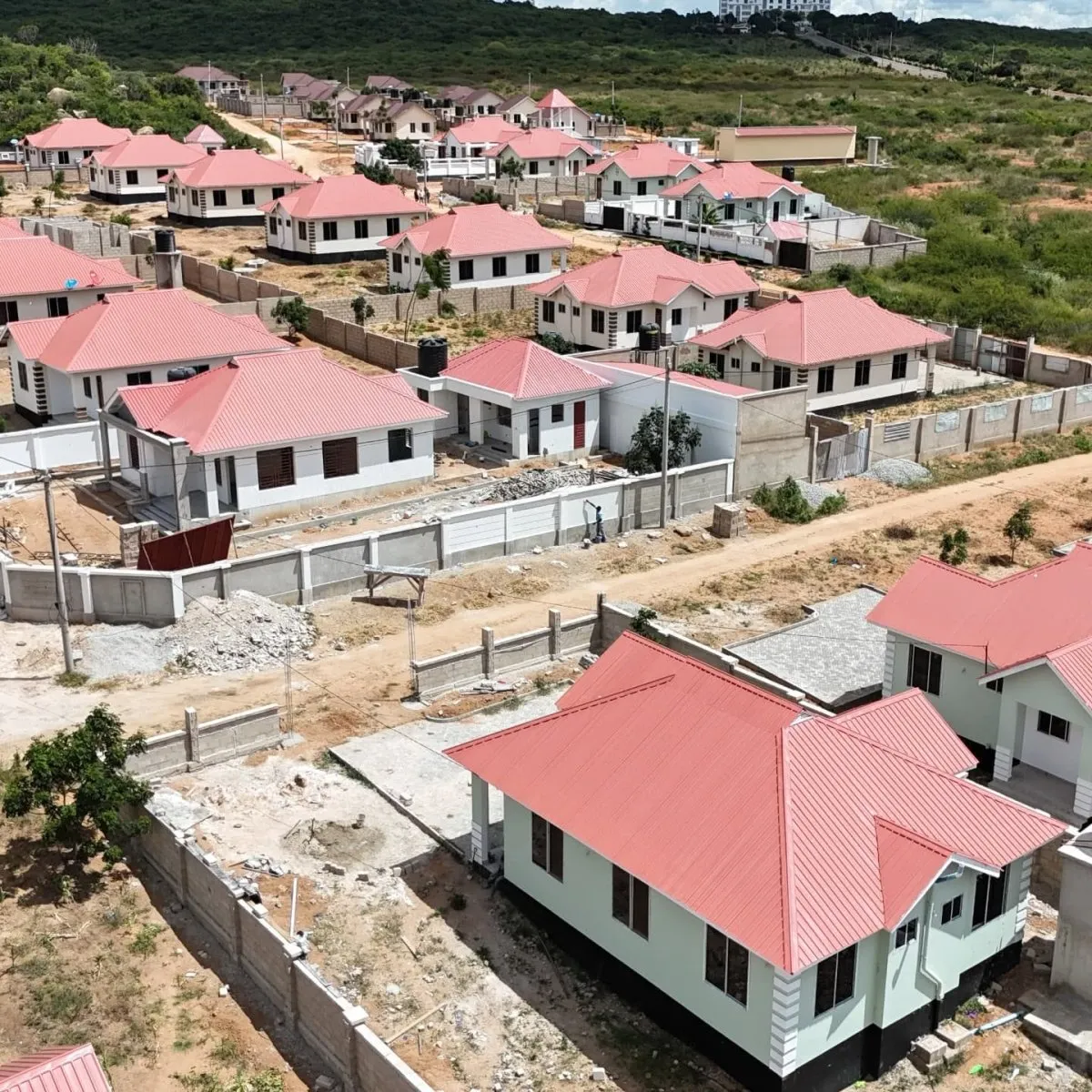 NHC Housing project with dirt roads
But nowhere is the failure of Tanzania's urban planning model more visible, or more absurd, than in the gap between what the country builds and what it builds around it.
Consider what happens when the National Housing Corporation develops a residential estate in Dodoma or Arusha. The project is genuinely impressive. Multi-storey apartment blocks. Tiled floors. Painted facades. Security perimeters. Functional plumbing and electrical installations. NHC's housing estates represent real construction quality at a scale that most private developers in Tanzania cannot match.
Then you step outside the gate.
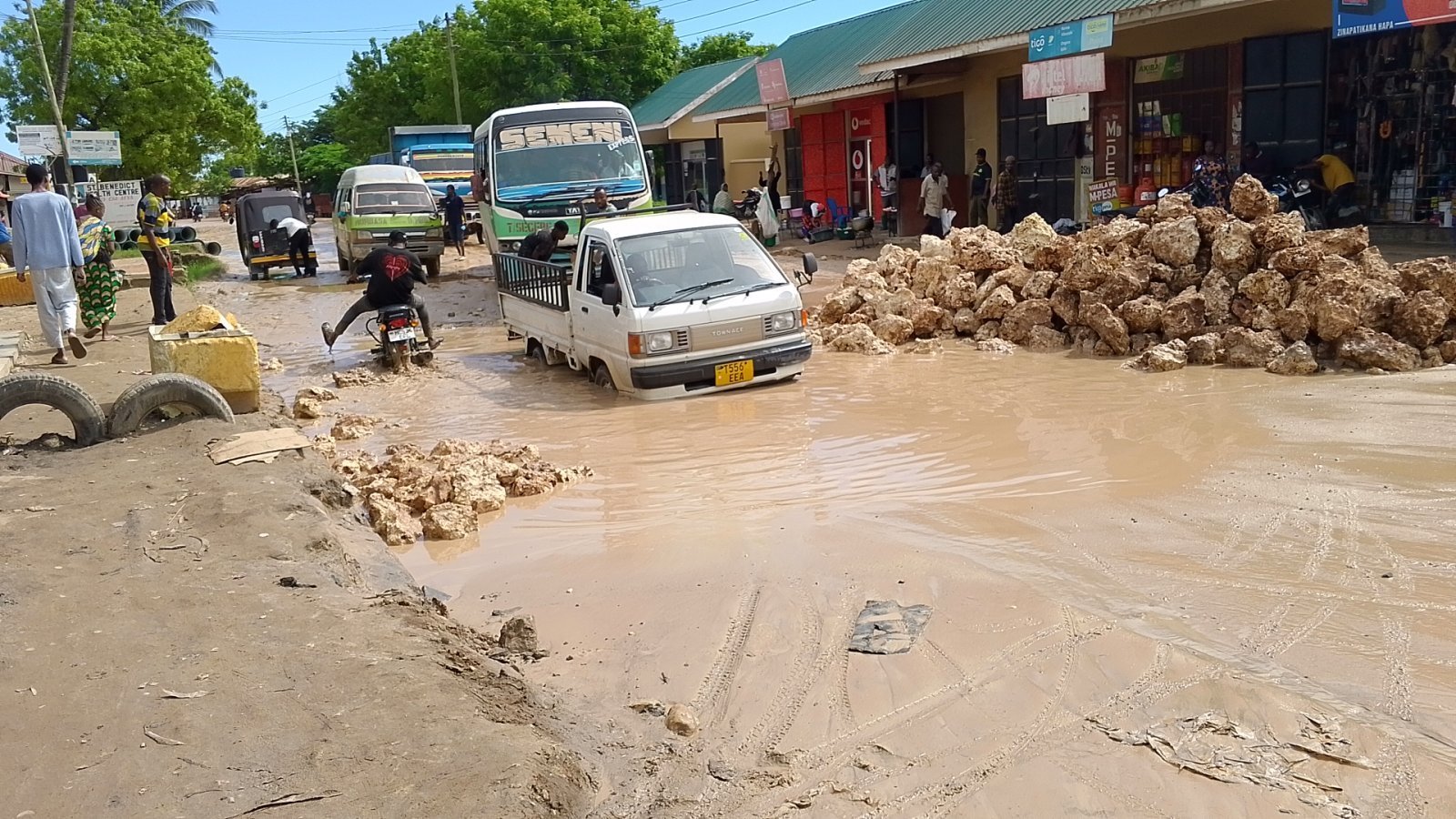
The road connecting the estate to the nearest tarmacked road is unpaved. In the dry season it is dust, coating every surface, entering every window, damaging air filters and lungs simultaneously. In the wet season it is mud, whose depth after heavy rain can strand a saloon car, make the estate temporarily unreachable by emergency vehicles, and render the school run a daily calculation between attendance and vehicle damage. The road that carries children to school, that suppliers use to deliver food and water, that residents use to reach hospitals and workplaces, is a dirt track whose condition makes a mockery of the investment sitting behind it.
This is not a hypothetical. It is the lived experience of residents in NHC and Watumishi Housing Company estates across Tanzania's secondary cities and in the peri-urban corridors of Dar es Salaam itself. A civil servant who has qualified for subsidised housing and moved into a purpose-built apartment spends the first rainy season learning that the quality of the unit means nothing when the road to it is impassable.
The failure is not in the building. The failure is in the planning. Tanzania's urban development model treats the building and its surrounding road infrastructure as separate projects, separately funded, separately planned, separately timed, and more often than not separately forgotten. The NHC estate gets built because it has a dedicated developer, a dedicated budget, and a dedicated ministerial mandate. The road outside it gets built when, if ever, the roads authority's budget cycle aligns with the neighbourhood's position in a priority list that is long, underfunded, and politically managed.
That alignment rarely happens. The result is a recurring and deeply revealing pattern: Tanzania builds beautiful things surrounded by infrastructure that prevents those beautiful things from functioning properly.
Tarmac is not part of urban design at the highest level
This is the core institutional failure, and it deserves to be stated plainly.
In Tanzania, paved roads are not a standard component of urban development planning. They are a separate sector, separately administered, separately funded, with a separate chain of accountability that does not consistently connect to the decisions made about what gets built and where.
When NHC designs a housing estate, the design process encompasses unit specifications, common area planning, utility connections, and security arrangements. It does not encompass the road from the estate gate to the nearest tarmac, because that road is TANROADS' responsibility, or the local authority's responsibility, or the district council's responsibility, depending on the classification of the road in question. NHC builds what NHC is mandated to build. The road is someone else's mandate.
That division of mandate is the institutional expression of the deeper failure: Tanzania does not plan urban development as a system. It plans its components separately and hopes the connections materialise. Sometimes they do. More often they do not, for years, during which residents pay the price of the gap between the building they were promised and the neighbourhood they actually received.
The car that breaks and the life that changes
The economic language of transport costs and logistics friction distances the conversation from what unpaved roads actually mean at the level of individual lives.
The car that breaks. Not once, but repeatedly, on the same road, because the potholes reform faster than the repair budget allows. Shock absorbers replaced every rainy season. The tyre that blows on a hidden rock. The alignment that goes out on a corrugated dirt surface. In Tanzania, a vehicle on an unpaved road is not just a vehicle. It is a liability that the road destroys at a pace that renders car ownership financially ruinous for people whose incomes cannot absorb the maintenance cost the infrastructure imposes.
The school run that becomes a negotiation. Parents in neighbourhoods with unpaved access roads make daily calculations that parents on tarmac do not make. Can I get the child there and back if it rains this afternoon? Is the road passable with yesterday's rain still sitting in the low section? Is it worth the school bus being unable to complete its route? These are not the calculations of bad parents. They are the calculations of rational people managing the costs imposed on them by an infrastructure failure that is not their fault.
The ambulance that arrives late. Road quality is a medical variable in Tanzania in ways that health planners rarely articulate explicitly. An ambulance that would take eight minutes to reach a patient on a paved road takes twenty-five minutes on an unpaved one, not because the driver is slower but because the vehicle is physically incapable of travelling at ambulance speed on a corrugated dirt surface. The difference between eight minutes and twenty-five minutes is the difference between outcomes in cardiac events, obstetric emergencies, and trauma cases. This is not a metaphor. It is a clinical reality in Tanzania's unconnected urban neighbourhoods.
The business that never opened. The entrepreneur who calculated that the lower rent in an unpaved neighbourhood was insufficient compensation for the supplier access, customer reluctance, and vehicle costs that an unpaved road imposes, and chose to pay higher rent on tarmac instead. That decision, made thousands of times across Tanzania's cities, is the aggregate of the commercial drag that unpaved roads impose on urban economic activity.
What Kigali decided and what happened next
Kigali does not have the "barabara imefika?" conversation in the same way. That is not an accident of geography or income. It is the result of a decision Rwanda's government made explicitly and has sustained consistently.
Rwanda's master planning framework treats road connectivity as a prerequisite for residential development approval rather than a subsequent addition. Before a housing project breaks ground in a new Kigali neighbourhood, the road network serving that neighbourhood is either already paved or is under active construction with a confirmed timeline and a confirmed budget. Building and road infrastructure are planned as one project with one timeline and one accountability chain. The Rwanda Housing Authority does not deliver an apartment block and then hope the road follows.
The specific institutional mechanism is straightforward. Kigali City Council's development permit process requires confirmed road infrastructure as a condition of approval, not a commitment for future delivery. A developer who wants to build in Gasabo or Kicukiro must demonstrate either that paved road access exists or that a signed road construction contract with a completion date is in place. If neither condition is met, the permit is not issued.
The result, built over roughly fifteen years of consistent application, is a city where the question is not whether the road is paved but which route to take. Kigali is not a wealthy city by global standards. Rwanda's GDP per capita remains below Tanzania's on several metrics. The difference in neighbourhood road quality between Kigali and Dar es Salaam is not a function of resource availability. It is a function of what each government has decided is a non-negotiable condition for urban development.
Rwanda also applies a systematic ward-level paving programme that does not depend on individual project funding. Each Kigali sector has a road improvement plan whose implementation is tracked quarterly and published in the Rwanda Development Board's performance reporting. The accountability is public. The timelines are enforced. When a section is not completed on schedule, the explanation is required and the revised timeline is published.
Tanzania has no equivalent requirement, no equivalent permit condition, and no equivalent public accountability mechanism for neighbourhood road delivery.
What Addis Ababa built and the lesson it carries
Addis Ababa is the comparison that matters most for Tanzania, because Ethiopia's challenges are more directly comparable to Tanzania's than Rwanda's are. Ethiopia is a large, fast-urbanising, lower-middle-income economy whose capital has grown at a pace whose pressure on infrastructure is closer to Dar es Salaam's experience than Kigali's more managed scale.
In the mid-2000s, Addis Ababa had a neighbourhood road problem comparable to Dar es Salaam's today. Large sections of the city were connected by unpaved tracks. Flooding during the rainy season cut off significant residential areas. The question of whether a neighbourhood was accessible was a meaningful one for property buyers and business investors alike.
Ethiopia's government made a decision in the early 2010s that Tanzania has not yet made: it treated systematic urban road paving as a national programme rather than a project. The Addis Ababa Roads Authority, established as a dedicated city-level institution with a multi-year budget and a systematic coverage mandate, undertook a neighbourhood-by-neighbourhood paving programme whose ambition was explicit: no permanently inhabited residential area in Addis Ababa should be more than 500 metres from a paved road.
The programme was imperfect. Implementation was uneven across woredas. Some timelines slipped. The quality of paving in lower-priority areas was sometimes below standard. But the institutional decision, that systematic neighbourhood connectivity was a government obligation rather than a development aspiration, changed the trajectory. By the late 2010s, paved road coverage in Addis Ababa's residential areas had improved materially from its early-2000s baseline. Property markets in previously unconnected areas responded. Business investment followed paving. The property price premium for tarmac adjacency, which had been as pronounced in Addis as it is in Dar es Salaam today, began to compress as paved roads became less scarce.
Addis Ababa also integrated road connectivity into its large-scale housing programme in ways Tanzania has not. The Integrated Housing Development Programme, which delivered hundreds of thousands of condominium units across the city from 2004 onward, built road access as a simultaneous rather than subsequent component. The condominium blocks that line Addis Ababa's inner and middle rings were delivered with paved roads, not promises. Residents moved into buildings that were connected to the city's network from the first day of occupancy.
Tanzania's NHC and Watumishi estates were delivered without that guarantee. The institutional difference is not architectural. It is a question of whether the government that designs the housing also controls the road budget, or whether the road is left to a separate ministry, a separate budget cycle, and a separate set of priorities that may or may not align with the housing programme's timeline.
The government's incremental approach and why it fails
Tanzania's road investment pattern at the neighbourhood level is a few metres here and a few kilometres there. A ward councillor secures funding for the street adjacent to the ward office. A road improvement is announced ahead of an election. A drainage project covers one block and stops at the boundary of the project scope.
This approach has two structural failures that compound each other.
The first is that incremental paving creates disconnected sections of tarmac that do not produce the full network effect a paved road delivers. A street that is paved for 200 metres and then becomes dirt provides 200 metres of infrastructure whose value is substantially lower than 200 metres within a fully paved network, because the bottleneck relocates to the unpaved section rather than disappearing. The car that navigates 200 metres of tarmac and then faces 800 metres of mud has received a partial solution whose practical value approaches zero in the rainy season.
The second is that incremental paving prioritises visible, attributable improvements over systematic coverage. A councillor who paves a 200-metre section adjacent to a school gets credit for the school's road improvement. A government that commits to a programmatic, decade-long street-by-street paving programme for an entire ward gets no visible milestone to announce until the programme is complete. The political economy of infrastructure investment rewards visible projects and punishes invisible programmes, which is why Tanzania has impressive trunk roads and unpaved neighbourhood streets simultaneously.
What a different approach looks like
The argument here is not that Tanzania lacks resources for road investment. Tanzania's FY2026/27 budget allocates substantial resources to road construction and rehabilitation. The argument is that the investment pattern needs to change in two specific ways.
The first is systematisation. Every ward in Dar es Salaam should have a published paving plan with a completion timeline, a budget allocation, and a monitoring framework. Not a project. A programme. The difference is that a project ends when the money runs out. A programme continues until the objective is achieved, with each year's budget building on the previous year's coverage rather than starting fresh on a new location.
The second is planning integration. No residential development of more than fifty units, whether by NHC, Watumishi, or any private developer, should receive planning approval unless either confirmed paved road access exists or a signed road construction contract with a completion date is in place before groundbreaking. Tanzania's planning authority has the mandate to require this. Kigali proved it works. Addis Ababa proved that a large, fast-urbanising city can make systematic progress on neighbourhood connectivity when the institutional decision to do so is made at the right level.
A housing ministry that builds 1,000 units on an unpaved road has not delivered housing. It has delivered a building. The distinction matters. And Tanzania has been delivering buildings while calling them housing for long enough that the residents who live in them deserve a more honest accounting of what they were promised and what they actually received.
The Vision 2050 contradiction
Tanzania's Vision 2050 targets a USD 1 trillion economy and a city of ten million people in Dar es Salaam by the early 2030s. A megacity whose neighbourhood streets are predominantly unpaved is not a functioning city. It is a population concentration whose productive potential is systematically constrained by the friction costs that unpaved roads impose on every economic transaction, every commute, every supply chain, and every investment decision made within its boundaries.
The SGR reduces transport costs between cities. The port expansion reduces import costs at the national level. The Julius Nyerere Hydropower Project reduces electricity costs for industry. These are macro-level interventions whose productivity returns are real and measurable. But the citizen who benefits from cheaper electricity in her home still spends ninety minutes travelling twenty kilometres to work because the neighbourhood road is unpaved. The macro investments do not compensate for the micro failure. They compound it.
Tanzania does not need to wait until it is wealthy to pave its streets. It needs to pave its streets to become wealthy. Kigali understood this. Addis Ababa understood this imperfectly but substantially. Tanzania has not yet decided that it understands it at all.
The sequence matters. And the current sequence is backwards.
The beautiful NHC apartment in Dodoma, the well-designed Watumishi estate in Arusha, the Vision 2050 economy growing at 6 percent annually: none of it changes the fact that a prospective tenant's first question is still whether the road is tarmac. Until that question disappears because the answer is always yes, Tanzania is building on a foundation that its own residents do not trust, because experience has taught them that the building and the infrastructure around it are two entirely different problems, solved by two entirely different budgets, on two entirely different timescales.
Tarmac is not a luxury. It is the floor. Tanzania has not yet decided to treat it as such. And every rainy season it does not, the cost of that decision is paid, invisibly, by the millions of people whose cars break, whose children miss school, whose ambulances arrive late, and whose businesses never open, on the roads that development forgot.
FAQ
What does "barabara imefika?" mean and why does it matter? Literally "has the road arrived?" or "has the tarmac arrived?", it is the most consequential question in Tanzanian urban real estate. Whether a neighbourhood has a paved road determines property values, rental premiums, business viability, school accessibility, flood risk, and health outcomes simultaneously. It functions as a shorthand for the full bundle of urban development that tarmac historically predicts, making it a pricing mechanism as much as a practical inquiry.
How does Kigali handle road infrastructure relative to new housing development? Kigali City Council requires confirmed paved road access as a condition of residential development approval. Developers must demonstrate either that paved access exists or that a signed road construction contract with a confirmed completion date is in place before a permit is issued. The Rwanda Housing Authority integrates road delivery into the same project timeline and accountability chain as building delivery. This institutional requirement, consistently applied over fifteen years, is the primary reason the "barabara imefika?" question carries less weight in Kigali than in Dar es Salaam.
What did Addis Ababa do differently? Ethiopia established the Addis Ababa Roads Authority as a dedicated city-level institution with a multi-year systematic neighbourhood paving mandate, targeting that no permanently inhabited residential area should be more than 500 metres from a paved road. The Integrated Housing Development Programme, which delivered hundreds of thousands of condominium units from 2004 onward, built road access simultaneously rather than subsequently. Implementation was imperfect, but the institutional decision that systematic neighbourhood connectivity was a government obligation rather than an aspiration changed the trajectory materially over fifteen years.
What is wrong with Tanzania's current road investment approach at the neighbourhood level? Two structural failures. First, incremental paving creates disconnected sections of tarmac that do not produce full network effects, because the bottleneck relocates to the unpaved section rather than disappearing. Second, project-driven investment rewards visible attributable improvements over systematic coverage, producing impressive trunk roads and unpaved neighbourhood streets simultaneously because the political economy of infrastructure investment rewards ribbon-cutting over programmatic completion.
What would a different approach require institutionally? Two changes. A systematic ward-level paving programme with published timelines, annual budget allocations building on previous coverage, and public monitoring rather than episodic project funding. And a planning requirement that no residential development above a defined unit threshold receives approval without confirmed paved road access as a condition, not a subsequent commitment. Both changes are within existing institutional authority. Neither requires new legislation. Both require the political decision that neighbourhood road connectivity is a non-negotiable obligation rather than a desirable outcome.
*The views expressed in this article are those of the author and do not represent the editorial position of Uchumi360.
 Uchumi360
Business Intelligence
Uchumi360
Business Intelligence
Uchumi360 covers business, investment, and economic policy across East, Central, and Southern Africa.
For the serious reader
You read to the end. That places you in a small group.
Uchumi360 is built for readers who demand precision over speed, structure over sentiment, and analysis that holds uncomfortable conclusions rather than softening them. If this work sharpens how you think about Africa's economy, help us keep building the infrastructure behind it.
Institutional Partners
Commission intelligence. Shape the conversation.
Uchumi360 works with development finance institutions, investment firms, sovereign bodies, and strategic organisations across the coverage region. Institutional partnership unlocks:
- Commissioned sector and country intelligence reports
- Branded research series under your institution's authority
- Exclusive data briefings for internal strategy teams
- Speaking and editorial presence at Uchumi360 events
- Co-published investment outlooks for your markets
Support Our Work
Independent analysis has a cost. Help us bear it.
Uchumi360 does not carry advertising. It does not take editorial direction from sponsors. Every article is produced without commercial compromise. Your contribution funds the reporting, research, and editorial infrastructure that keeps this analysis free from influence.
Secure checkout: One-time and monthly support are processed securely. Add payment credentials to enable checkout here.
Stay Connected
Keep up with every new insight.
Follow our latest analysis, policy coverage, and market intelligence as soon as it is published. If you need something specific, reach out directly and we will point you to the right research.
