
What Is the Economic Implication of an Increase in Foreign Currency Exchange Shops in Tanzania?
Ready
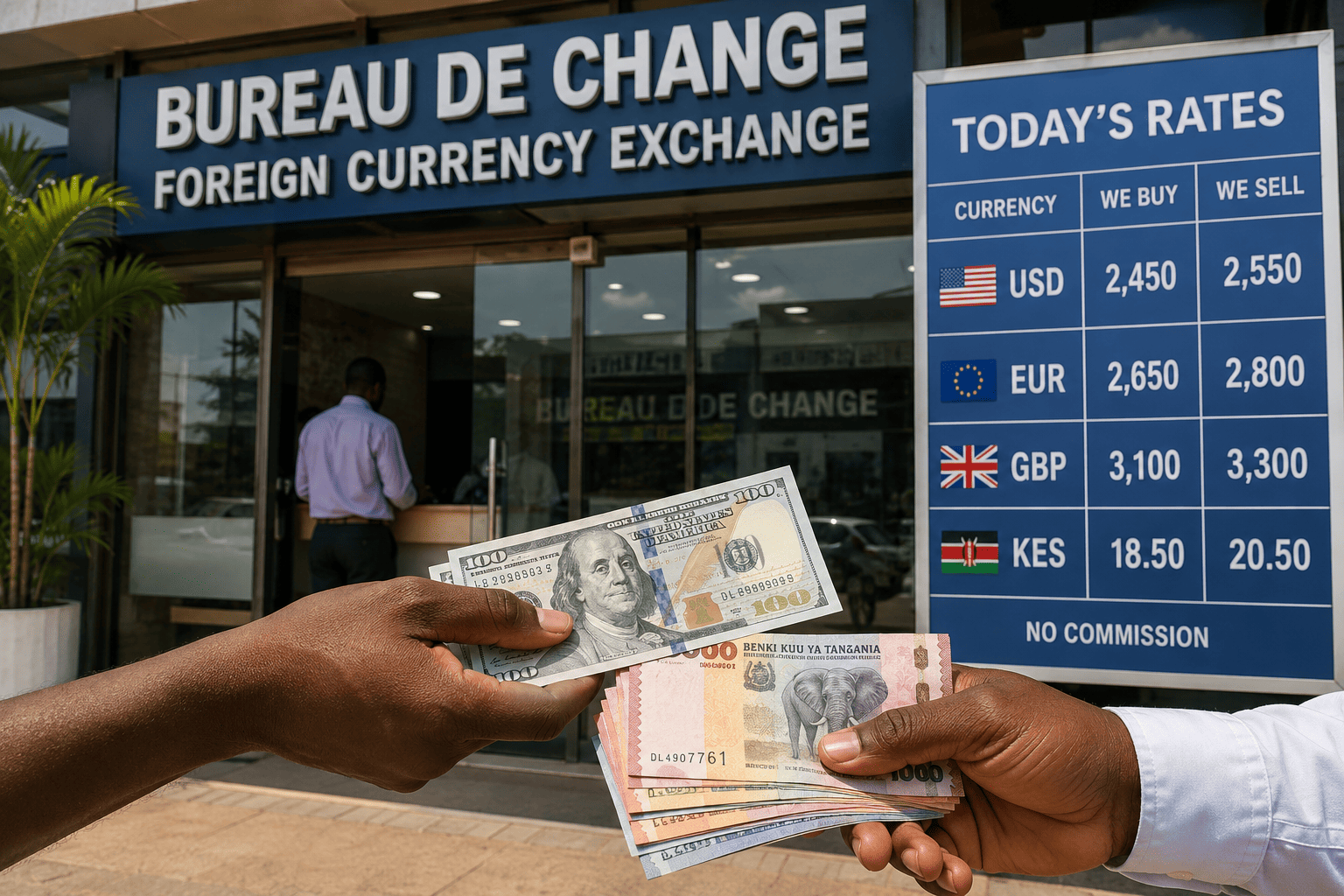
The economic implication is not just more shops on the street. It is a more formal retail foreign exchange infrastructure. If implemented well, the expansion can improve liquidity, support tourism, reduce informal trading, strengthen data collection and reinforce confidence in regulated financial services. If implemented poorly, it could widen compliance risk. The policy test will be whether the 202 licensed bureaux de change become channels of transparency, not just channels of currency exchange.
Tanzania’s decision to expand the licensing space for bureaux de change is more than a retail financial-services story. It is part of a wider attempt to formalize the foreign exchange market, improve access to foreign currency services, strengthen regulatory visibility, support tourism and reduce the space in which informal currency trading can grow.
The recent information shared from TBC Online, based on Governor Emmanuel Tutuba’s interview, puts the issue into clear policy context. According to the report, the Bank of Tanzania has issued 202 licences for foreign currency exchange shops and divided the sector into three operating categories: Class A, Class B and Class C. Class A requires capital of TZS 1 billion for foreign investors and TZS 500 million for Tanzanians. Class B requires TZS 200 million and operates as a single branchless shop, while Class C is reserved for bureaux de change located in tourist hotels.
That structure reflects the 2023 Foreign Exchange (Bureau de Change) Regulations, which replaced the 2019 framework and introduced a more flexible licensing system. The regulations allow Class A bureaux de change to operate with branches, require Class B operators to work within a smaller local structure, and create a hotel-based Class C licence for tourist-facing foreign exchange services. This is not deregulation in the loose sense. It is controlled liberalization: more players are allowed into the market, but within capital, ownership, reporting, anti-money-laundering and operational requirements.
The first economic implication is improved access to foreign exchange services. In a country where tourism, trade, cross-border movement, remittances and small import activity are significant, the availability of licensed exchange points matters. More bureaux de change can reduce the friction faced by tourists, traders, hotels, transport operators, small businesses and citizens who need legitimate currency exchange outside the banking hall. If well distributed geographically, the expansion can also move forex services closer to airports, hotels, border towns, urban commercial centres and tourist destinations.
The second implication is market formalization. When licensed outlets increase, more transactions can move from informal dealers into supervised channels. This gives the central bank better visibility over cash-based foreign exchange activity, including transaction volumes, customer behaviour, currency demand patterns and regional liquidity pressure. The 2023 regulations require applicants to show proof of source of funds, capital declarations, credit reference reports, governance structures and fit-and-proper information for shareholders, directors and senior officers. They also require bureaux de change to maintain data systems, submit financial statements and comply with anti-money-laundering and counter-terrorism financing rules. That turns foreign exchange retailing into a more reportable, auditable and supervised activity.
The third implication is price discovery. A wider licensed market can improve competition between exchange shops, which may narrow spreads between buying and selling rates where operators are adequately capitalized and transparent. This matters for consumers because exchange-rate costs are often hidden in wide margins. The regulations require bureaux de change to display buying and selling rates, charges and licences in a conspicuous place. If enforced properly, this improves transparency and makes it easier for customers to compare rates across providers.
The fourth implication is support for tourism. Tanzania’s tourism economy depends heavily on international visitors, and tourists often need convenient currency exchange when paying for local expenses, tips, transport, experiences and small purchases. The creation of Class C bureaux de change in hotels is economically significant because it places regulated forex services directly inside the hospitality chain. This can improve visitor convenience while keeping hotel-based exchange transactions inside the formal system. For destinations such as Zanzibar, Arusha, Moshi, Dar es Salaam, Serengeti gateways and Mafia Island, the ability to exchange currency safely and visibly is part of the visitor experience.
The fifth implication is stronger alignment with Tanzania’s shilling-use policy. In 2025, Tanzania introduced regulations requiring domestic prices for goods and services to be quoted in Tanzanian shillings and requiring local transactions to be conducted in Tanzanian shillings, with limited exceptions such as embassies, international organizations, foreign-currency loans from banks and duty-free shops. This means the expansion of bureaux de change should not be read as a return to dollarization. It serves the opposite function: foreigners and residents can exchange currency through licensed outlets, then use Tanzanian shillings for domestic transactions. In that sense, more licensed bureaux de change can support de-dollarization by making conversion into shillings easier.
The sixth implication is foreign exchange liquidity management. Tanzania has faced periods of foreign exchange pressure, like many import-dependent emerging economies. In such an environment, the central bank has an interest in drawing more foreign currency flows into formal channels. IMF reporting in 2025 noted that greater exchange rate flexibility and foreign exchange market reforms had helped bring foreign exchange flows back into the formal market, increase liquidity and reduce the parallel-market premium. More licensed bureaux de change can support this direction if they operate within the official reporting system and source currency lawfully.
The seventh implication is financial-sector deepening. Class A and Class B bureaux de change are allowed to engage in spot foreign exchange transactions and, under the regulations, may also carry out certain approved agency activities involving banks, financial institutions, insurance companies, mobile money operators or other financial services. This creates a pathway for bureaux de change to become more than exchange counters. In the right model, they can become retail financial access points, especially in areas where banks are less physically present but tourism, trade or cross-border cash movement exists.
The eighth implication is investment and employment. A sector with 202 licensed operators represents capital formation, rental demand, technology investment, compliance services, employment, security services, accounting, audit, cash handling, insurance and local commercial activity. The capital thresholds are not minor: Class A operators require TZS 1 billion for foreign majority ownership or TZS 500 million for local majority ownership, while Class B requires TZS 200 million. This means the sector is being positioned as a serious regulated business rather than a low-barrier informal cash trade.
The ninth implication is better data for monetary and external-sector policy. Foreign exchange pressures are easier to manage when the central bank can see where demand is coming from, which currencies are moving, where cash shortages appear, how exchange outlets behave and whether informal premiums are emerging. Bureaux de change are small compared with banks, but collectively they can provide important signals from the retail market. In a country with tourism inflows, import demand, cross-border trade and mobile citizens, these retail-level signals matter.
The risk is that more shops do not automatically mean a healthier market. If supervision is weak, a larger bureau de change network can also create vulnerabilities. These include money laundering, unreported transactions, hoarding, illegal sourcing of currency, false reporting, speculative behaviour, wide spreads, customer abuse and leakage into informal markets. That is why the 2023 regulations matter: the economic benefit depends on compliance, not merely licensing.
There is also a competition risk. If too many shops are licensed in the same locations, margins may narrow beyond sustainable levels and weaker operators may be tempted into non-compliant behaviour. Conversely, if licences are concentrated only in high-value urban or tourist areas, the access benefits may be limited. The real economic value will depend on how the 202 licences are distributed across regions, tourism zones, border areas, airports, hotels and commercial districts.
The shilling policy also creates an adjustment issue for businesses. Since domestic transactions must be priced and paid in Tanzanian shillings, businesses that previously quoted in dollars must adjust contracts, accounting systems, invoices and pricing behaviour. More bureaux de change can make this transition easier, but they do not remove the need for businesses to comply with shilling-based pricing and payment rules.
The broader economic reading is therefore balanced. An increase in foreign currency exchange shops can improve access, transparency, formalization and tourism convenience. It can help move retail forex transactions into regulated channels and support better monetary-policy visibility. It can deepen the financial-services ecosystem and reduce the role of informal dealers. But those gains depend on strong supervision, disciplined reporting, rate transparency, lawful sourcing of currency and alignment with Tanzania’s wider policy of strengthening the use of the shilling in domestic transactions.
The most important point is that Tanzania is not simply allowing more foreign exchange shops because demand exists. It is trying to organize that demand. A growing economy, a larger tourism sector, expanding cross-border trade and stronger formal financial supervision all require a forex market that is more accessible but also more visible to regulators.
The economic implication is not just more shops on the street. It is a more formal retail foreign exchange infrastructure. If implemented well, the expansion can improve liquidity, support tourism, reduce informal trading, strengthen data collection and reinforce confidence in regulated financial services. If implemented poorly, it could widen compliance risk. The policy test will be whether the 202 licensed bureaux de change become channels of transparency, not just channels of currency exchange.
 Uchumi360
Business Intelligence
Uchumi360
Business Intelligence
Uchumi360 covers business, investment, and economic policy across East, Central, and Southern Africa.
For the serious reader
You read to the end. That places you in a small group.
Uchumi360 is built for readers who demand precision over speed, structure over sentiment, and analysis that holds uncomfortable conclusions rather than softening them. If this work sharpens how you think about Africa's economy, help us keep building the infrastructure behind it.
Institutional Partners
Commission intelligence. Shape the conversation.
Uchumi360 works with development finance institutions, investment firms, sovereign bodies, and strategic organisations across the coverage region. Institutional partnership unlocks:
- Commissioned sector and country intelligence reports
- Branded research series under your institution's authority
- Exclusive data briefings for internal strategy teams
- Speaking and editorial presence at Uchumi360 events
- Co-published investment outlooks for your markets
Support Our Work
Independent analysis has a cost. Help us bear it.
Uchumi360 does not carry advertising. It does not take editorial direction from sponsors. Every article is produced without commercial compromise. Your contribution funds the reporting, research, and editorial infrastructure that keeps this analysis free from influence.
Secure checkout: One-time and monthly support are processed securely. Add payment credentials to enable checkout here.
Stay Connected
Keep up with every new insight.
Follow our latest analysis, policy coverage, and market intelligence as soon as it is published. If you need something specific, reach out directly and we will point you to the right research.
