
Standard Chartered Completes Uganda Retail Exit, Customers and Accounts Move to Absa
Ready
The transfer gives Absa a larger retail and wealth-management franchise while Standard Chartered concentrates on corporate and investment banking. Customers are moving to Absa’s systems from November 16, but the value of the transaction has not been disclosed.
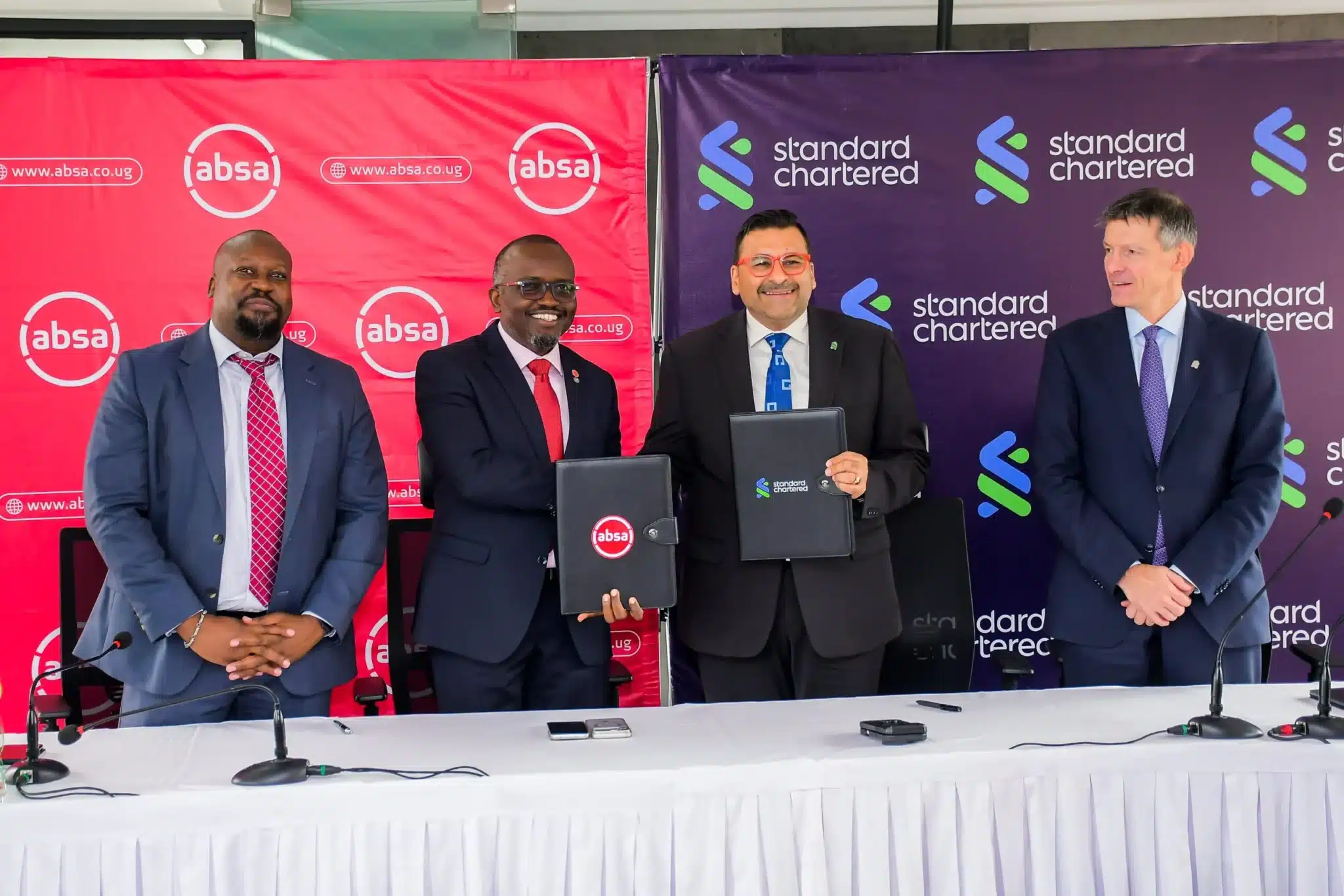
Standard Chartered has completed the transfer of its wealth and retail banking business in Uganda to Absa Bank Uganda, marking one of the country’s most consequential recent changes in banking ownership and customer relationships.
Standard Chartered’s Ugandan website confirmed that its wealth and retail business had transitioned to Absa, directing customers seeking information about personal accounts, cards, loans, mortgages and investments to the acquiring bank. Standard Chartered will remain in Uganda through its corporate and investment banking franchise.
The transfer follows regulatory approval by the Bank of Uganda and a migration exercise conducted between November 13 and 15. Customers are expected to begin accessing the transferred accounts and services through Absa’s banking channels from November 16.
The banks have not publicly disclosed the transaction’s financial value, the volume of deposits transferred or the number of customers covered. The development should therefore be understood as a confirmed transfer of a business portfolio, employees and customer relationships, not a full acquisition of Standard Chartered Bank Uganda.
Absa announced the agreement to acquire Standard Chartered Uganda’s wealth and retail business on October 24, 2025. The agreement provided for the transfer of the affected customers and employees, subject to regulatory approval and other conditions.
What has transferred and what remains
The transaction covers Standard Chartered Uganda’s consumer-facing wealth and retail activities. These include personal deposit accounts, payment cards, mortgages, personal loans, investment products and other individual banking services attached to the transferred portfolio.
Standard Chartered has retained its corporate and investment banking operations. It will continue serving large companies, financial institutions, public-sector entities, development organisations and clients requiring cross-border banking, capital-markets, trade-finance and structured-finance services.
This distinction matters because Standard Chartered is not leaving Uganda entirely. Instead, it is narrowing its business to the segment in which its international network may provide the strongest competitive advantage.
The strategy is consistent with the group’s decision to concentrate resources on corporate, institutional, affluent and cross-border clients in selected markets. For Uganda, the immediate result is a more specialised Standard Chartered operation and a larger retail and wealth franchise for Absa.
Absa said the acquisition had received Bank of Uganda approval and would strengthen its retail and wealth-management capabilities through its existing digital platforms, infrastructure and workforce. It also said customers would be informed of operational changes and that continuity would remain a priority during the transition.
What the transfer means for customers
For former Standard Chartered retail customers, the most immediate test is whether account balances, standing orders, cards, loan repayments, mobile and internet banking access, investment instructions and salary payments continue without material disruption.
The migration is not simply a change of branding. It involves moving customer data and product relationships between banking systems while maintaining transaction histories, contractual obligations, security controls and regulatory records.
Customers should verify that their balances, loan terms, scheduled payments, beneficiaries and personal information have migrated accurately. They should also rely only on official communication from the two banks, given the increased risk of criminals using a large banking transition to send fraudulent account-update links or request passwords and one-time passcodes.
Standard Chartered had already begun discontinuing selected retail services in phases from October 31 in preparation for the November 13–15 migration. The bank’s website now states that the retail transition has been completed.
Existing contractual obligations do not automatically disappear because the banking portfolio has changed ownership. Borrowers remain responsible for outstanding loans and mortgages, while the acquiring bank assumes responsibility for the transferred customer relationships under the approved transaction structure.
Any eventual changes to fees, interest rates, branch access, cards or product terms should be communicated in accordance with Ugandan banking and consumer-protection requirements. Customers should not assume that every Standard Chartered product feature will remain unchanged indefinitely, even if the initial migration preserves continuity.
Absa gains scale in retail and wealth banking
For Absa, the transaction offers a faster route to increasing deposits, lending relationships, wealth-management customers and fee-generating activity than building the same portfolio entirely through organic growth.
A larger customer base can improve the economics of investments in digital banking, cybersecurity, analytics, payment infrastructure and product development. It may also allow Absa to distribute insurance, investments, cards and credit products across a wider market.
The acquisition could strengthen Absa’s position in higher-income personal banking and wealth management, areas where Standard Chartered had built a recognised franchise. Former Standard Chartered employees transferring with the business may help preserve specialist expertise and customer relationships.
Scale alone will not guarantee value. Absa must retain the transferred customers, maintain service quality and prevent migration problems from weakening trust. The bank will also need to integrate different product structures and customer-service expectations without allowing operating costs to absorb the expected benefits.
The acquisition was approved without conditions by the COMESA's Competition and Consumer Commission, indicating that the regional competition authority did not identify concerns requiring formal remedies.
A significant change in Uganda’s banking structure
The transfer illustrates the strategic divide emerging in African banking. Some international banks are concentrating on multinational companies, institutional clients and cross-border transactions, while African banking groups are expanding in domestic retail, digital financial services and wealth management.
That creates opportunities for regional banks to acquire established customers, employees and product portfolios from global institutions that are narrowing their geographic or business focus.
For Uganda, the transaction could intensify competition among banks seeking deposits, salaried customers, mortgage borrowers and affluent clients. Competitors may respond with improved digital services, higher deposit returns, lower transaction fees or more aggressive customer-acquisition campaigns.
However, concentration must still be monitored. Larger banks can invest more heavily in technology and risk management, but reduced competition can weaken customer choice if market consolidation continues without strong regulatory oversight.
The transfer also underlines the importance of operational resilience. Banking migrations can disrupt payments, salary access and business cash flow if systems fail or customer records are not transferred correctly. The Bank of Uganda’s role will therefore extend beyond approving the transaction to supervising the stability and customer-treatment aspects of the integration.
What to watch next
The immediate indicator will be the performance of Absa’s systems as transferred customers begin using accounts, cards and digital channels. Complaints about unavailable balances, delayed transactions, failed standing orders or card problems would indicate that the operational transition requires further attention.
The market should also watch for Absa’s eventual disclosure of the acquired portfolio’s contribution to deposits, loans, revenue and operating expenses. Those figures will help establish whether the acquisition materially changes its position in Uganda’s banking market.
Other issues include customer retention, any revision of product pricing, the treatment of Standard Chartered-branded cards and documents, branch-network changes and the pace at which the transferred business is fully integrated.
For Standard Chartered, the question is whether a narrower corporate and investment banking model can produce stronger returns while continuing to support Uganda’s trade, infrastructure and cross-border investment requirements.
The transaction is now more than an announced plan. The retail portfolio has transferred and customers are moving onto Absa’s systems. Its economic success will be measured by service continuity, customer retention and whether the enlarged bank translates its new scale into more competitive financial services.
 Uchumi360
Business Intelligence
Uchumi360 covers business, investment, and economic policy across East, Central, and Southern Africa.
For the serious reader
You read to the end. That places you in a small group.
Uchumi360 is built for readers who demand precision over speed, structure over sentiment, and analysis that holds uncomfortable conclusions rather than softening them. If this work sharpens how you think about Africa's economy, help us keep building the infrastructure behind it.
Institutional Partners
Commission intelligence. Shape the conversation.
Uchumi360 works with development finance institutions, investment firms, sovereign bodies, and strategic organisations across the coverage region. Institutional partnership unlocks:
- Commissioned sector and country intelligence reports
- Branded research series under your institution's authority
- Exclusive data briefings for internal strategy teams
- Speaking and editorial presence at Uchumi360 events
- Co-published investment outlooks for your markets
Support Our Work
Independent analysis has a cost. Help us bear it.
Uchumi360 does not carry advertising. It does not take editorial direction from sponsors. Every article is produced without commercial compromise. Your contribution funds the reporting, research, and editorial infrastructure that keeps this analysis free from influence.
Secure checkout: One-time and monthly support are processed securely. Add payment credentials to enable checkout here.
Stay Connected
Keep up with every new insight.
Follow our latest analysis, policy coverage, and market intelligence as soon as it is published. If you need something specific, reach out directly and we will point you to the right research.
