

Why Manufacturing Still Defines Development And Why Tanzania Cannot Skip It
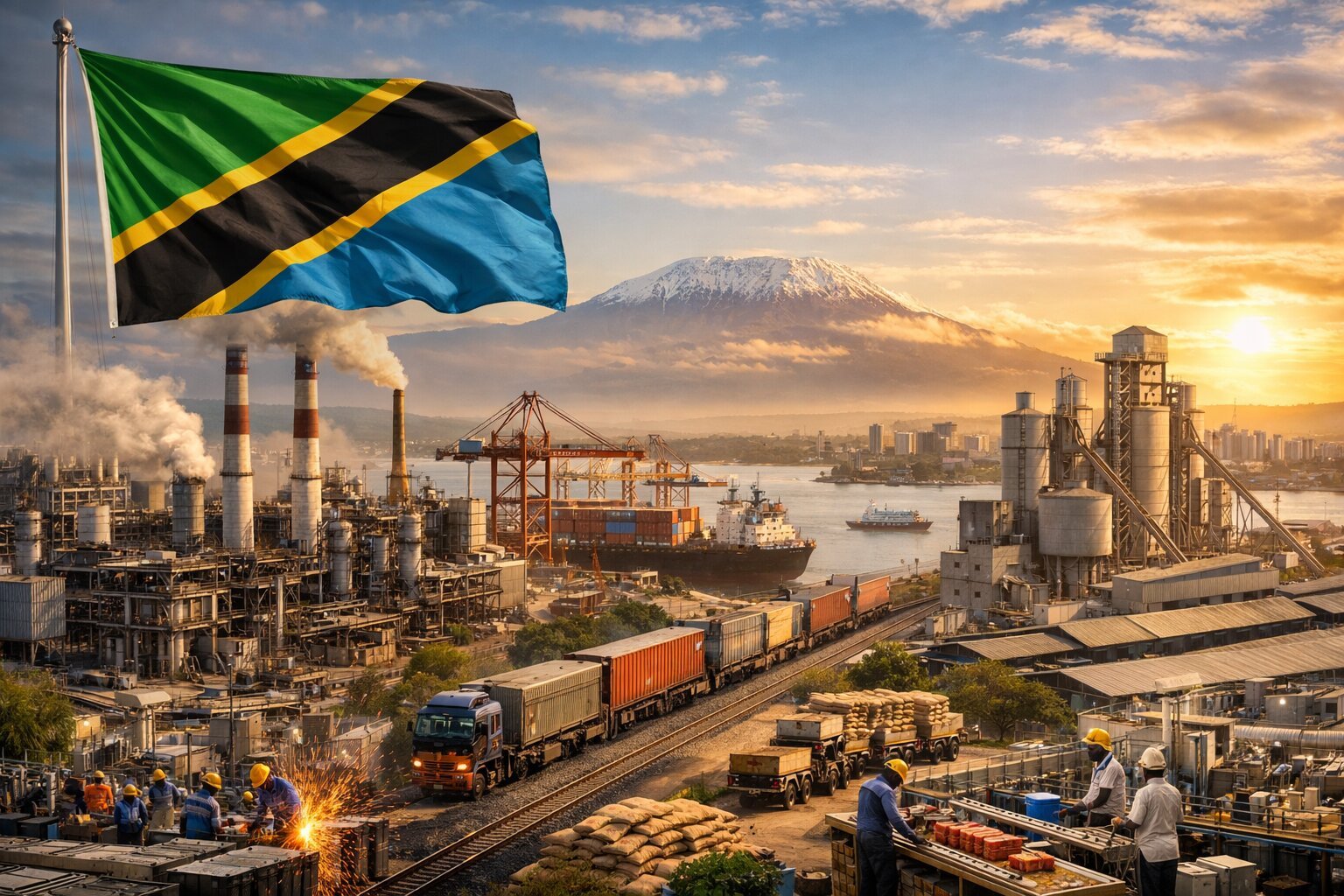
Manufacturing remains the proven engine of long-term economic transformation, and Tanzania cannot rely on services alone to achieve sustained productivity growth, export competitiveness, and large-scale job creation. Industrial capacity, supported by infrastructure and strategic policy, is central to the country’s path to middle-income resilience.
The idea that developing countries can leap from agriculture straight into a services-driven economy is increasingly popular. Digital platforms, fintech, outsourcing, and tourism appear to offer faster and cleaner growth than factory-based production.
But history and economics point in a different direction. No country has achieved broad-based prosperity without building a competitive manufacturing base. Services can accelerate growth. They cannot anchor structural transformation.
For Tanzania, this is not a theoretical debate. It is a strategic development choice.
Across history, sustained high-growth economies industrialized first. From Britain to South Korea to China and Vietnam, rapid development was built on manufacturing expansion. Countries that skipped or prematurely abandoned industrialization experienced slower productivity growth and persistent trade deficits.
Manufacturing drives sustained productivity in ways services struggle to replicate. Industrial production benefits from economies of scale, mechanization, and cumulative learning. Factories cluster, supply chains deepen, and technological capability compounds over time. These dynamics create structural transformation rather than incremental expansion.
Manufacturing also drives innovation. Globally, more than half of research and development expenditure originates in manufacturing sectors. Industrial firms invest in process engineering, materials science, and applied technology. This builds technological depth across the economy. Services can innovate, but they rarely generate the same scale of productive spillovers.
Trade reinforces this advantage. Roughly 80 percent of global exports consist of goods, largely manufactured products. Goods are scalable, storable, and globally tradable. Most services remain geographically constrained. For developing economies, export-led manufacturing remains the most proven path to rapid income growth.
For Tanzania, the implications are direct.
The country’s economic structure remains heavily dependent on primary commodities, agriculture, tourism, and extractives. Gold, agricultural produce, and raw materials dominate exports. While these sectors generate foreign exchange, they do not generate the same productivity multipliers as industrial production.
Tanzania’s long-term development plans, including industrialization strategies and special economic zones, recognize this reality. Investments in the Standard Gauge Railway, port expansion in Dar es Salaam, and energy projects such as the Julius Nyerere Hydropower Plant are not isolated infrastructure projects. They are foundational inputs for industrial growth.
Lower logistics costs, reliable power supply, and transport connectivity are prerequisites for competitive manufacturing. Without them, local firms cannot integrate into regional or global value chains.
Automation is often presented as a threat to industrialization in late-developing countries. The argument suggests that robots eliminate labor-intensive manufacturing opportunities. The evidence does not support this conclusion.
China expanded its industrial robot stock dramatically over the past decade while maintaining one of the largest manufacturing workforces in the world. Automation transformed production processes but did not eliminate labor absorption. Productivity gains expanded output.
For Tanzania, where wage levels remain relatively low compared to advanced economies, automation adoption will likely be gradual. Labor-intensive manufacturing in textiles, agro-processing, leather, food processing, and light assembly remains viable. What matters is not avoiding automation but upgrading alongside it.
Another concern is China’s dominance in global manufacturing, which now accounts for roughly one-third of global output. Some argue that this leaves little room for others.
But evidence suggests integration, not isolation, is the path forward. Vietnam industrialized rapidly while deeply integrated into Chinese supply chains. Proximity to strong manufacturing ecosystems can accelerate capability-building when supported by deliberate policy.
Tanzania is already embedded in regional markets through the East African Community and SADC. Its strategic location, with access to the Indian Ocean and growing rail connectivity to landlocked neighbors, positions it as a potential regional production and logistics hub. The opportunity lies in moving beyond raw material exports toward value-added processing and light manufacturing.
Services remain important. Financial services, digital platforms, logistics, and tourism generate employment and investment opportunities. Dar es Salaam’s financial ecosystem is expanding. Tech entrepreneurship is growing. But without a strong industrial base, services operate on a narrow productive foundation.
Sustained middle-income transformation requires deep productive capacity. Manufacturing creates backward and forward linkages across agriculture, transport, energy, and services. It absorbs labor at scale. It drives export competitiveness. It builds technological capability.
For Tanzania, the strategic path is clear. Industrial policy must focus on competitive sectors where the country holds or can build advantage, such as agro-processing, textiles, construction materials, fertilizers, pharmaceuticals, and light consumer goods. Infrastructure investments must translate into productive output. Industrial parks must host real production, not speculative land holding.
The factory of the future will be digitalized, energy-efficient, and globally connected. But the core principle remains unchanged.
Sustainable prosperity still runs through making things.
For Tanzania, industrialization is not optional. It is foundational to long-term economic resilience, export diversification, and employment generation in a rapidly growing population.
