
Dar es Salaam’s BRT Expansion Is Not About Traffic. It Is an Attempt to Reduce the Economic Cost of Movement Across Tanzania’s Core Urban Engine.

Ready
Dar es Salaam is scaling one of Africa's most ambitious urban transport systems, with six BRT phases planned to cover over 150 kilometres of dedicated lanes and serve the majority of the city's population. The expansion of Nelson Mandela Road into an eight-lane artery and the addition of dedicated corridors across the metropolitan area signal something larger than congestion relief. But this must be understood for what it actually is: not an urban transport project, but a macroeconomic intervention. A city that anchors Tanzania's national economy and serves as the primary trade gateway for Rwanda, Burundi, eastern DRC, and parts of Zambia cannot afford to treat the cost of movement within its boundaries as a municipal inconvenience. That cost is embedded in every supply chain that passes through the port, in every labour market outcome for the city's growing workforce, and in every investment location decision made by companies assessing Tanzania against its regional competitors. The BRT expansion does not solve all of these problems. It is the most significant attempt underway to structurally reduce the friction that Dar es Salaam's scale has embedded into Tanzania's economic operating costs.
The City That Tanzania's Economy Runs Through
Dar es Salaam's population stands at approximately 7 million in 2026, according to Tanzania's National Bureau of Statistics, and World Bank population growth projections place it on a trajectory to exceed 10 million by 2030, crossing the megacity threshold that only a handful of African cities have reached. That addition of approximately 3 million people in four years, roughly 750,000 additional residents annually, is not a demographic abstraction. It is 750,000 additional daily commuters requiring movement between residence and employment, 750,000 additional consumers requiring goods movement through the city's logistics network, and 750,000 additional pressure points on a road and transit infrastructure that is already operating beyond its design capacity.
The BRT expansion across six phases covering over 150 kilometres of dedicated lanes is not being built for the city that exists today. It is being built for the city that will exist in 2030, and the pace of construction relative to the pace of population growth determines whether Dar es Salaam arrives at megacity status with a functional urban mobility system or with a congestion crisis that has compounded for four additional years beyond what current conditions already impose.
The Port of Dar es Salaam handles the import and export cargo of Tanzania and serves as the primary ocean access point for Rwanda, Burundi, eastern DRC, and Zambia through the Central Corridor. Tanzania's financial sector, its professional services, its manufacturing base, and its government administrative functions are all concentrated in and around the city to a degree that makes its operational efficiency directly equivalent to national economic efficiency.
This concentration creates a specific and quantifiable vulnerability. When Dar es Salaam functions inefficiently, the cost does not stay within the city boundaries. It transmits outward through the supply chains, the logistics networks, the labour markets, and the trade corridors that connect Tanzania to its regional hinterland and to global markets. A three-hour commute for a port worker in Temeke is not just a personal inconvenience. It is a reduction in the effective labour hours available to Tanzania's most important trade infrastructure. A congested Nelson Mandela Road that delays container truck movements from the port to inland dry ports is not just a traffic management failure. It is a direct cost to the importers in Rwanda and Burundi whose supply chains depend on reliable Dar es Salaam transit times.
The city's population has grown at a pace that its infrastructure was not designed to accommodate. Dar es Salaam is among the fastest-growing cities in Africa by absolute population addition, with projections suggesting continued rapid growth over the coming decade as rural-urban migration and demographic growth combine to add millions of residents to a metropolitan area whose road network, public transport system, and urban services infrastructure were built for a city a fraction of its current size. The transport system that resulted from this growth is dominated by daladala minibuses, privately operated informal vehicles that are responsive to demand but structurally inefficient at the scale of a multi-million-person metropolitan economy. Fragmented routes, unpredictable journey times, congestion at interchange nodes, and the absence of the scheduling and capacity management that large urban transport systems require have created a city where the cost of movement has become embedded in the daily operating budget of every business, every worker, and every household.
What Congestion Actually Costs: The Economic Arithmetic
The economic cost of urban congestion in a city of Dar es Salaam's scale and strategic importance is measurable, and measuring it precisely changes the political economy of transport investment from a municipal budget question to a national economic priority.
Time lost in transit translates directly into labour output lost. A worker who spends three hours commuting rather than one spends two additional hours outside productive employment per day. Across a workforce of several million in Dar es Salaam's metropolitan economy, the aggregate labour hours lost to transport inefficiency annually represent a productivity cost that is substantial relative to the investment required to reduce it. The World Bank's urban transport research consistently finds that cities with high congestion costs grow more slowly than comparable cities with efficient transport, because the friction in labour market matching, the reduced effective size of the catchment area from which employers can recruit, and the increased operational uncertainty that unpredictable travel times impose on business planning collectively dampen the productivity gains that urban concentration should generate.

For informal traders, who constitute a large proportion of Dar es Salaam's commercial economy and whose livelihoods depend on physical mobility, the cost of congestion is even more direct. A trader who cannot reach her market reliably, whose goods cannot be restocked on a predictable schedule, and whose customers face access barriers that reduce foot traffic, earns less from the same physical infrastructure and the same working hours than she would in a city where movement is efficient. The informal economy that dominates Dar es Salaam's commercial fabric, and that Uchumi360's analysis of Tanzania's housing and economic structure identified as the dominant mode of economic activity for the majority of urban Tanzanians, is disproportionately exposed to the costs of transport inefficiency because it lacks the capital buffers and operational flexibility that formal businesses use to absorb those costs.
For the port economy specifically, the interaction between urban congestion and trade efficiency is direct and consequential. Dar es Salaam Port handles cargo volumes that are growing as Tanzania's investment surge generates increased import demand for capital goods and industrial inputs, and as the Central Corridor's role as the primary export route for regional mineral production continues to expand. Container dwell times at the port, the period between a container's discharge from a vessel and its collection by an importer's truck, are affected by the efficiency of truck movement between the port and its hinterland destinations. A port surrounded by a city where Nelson Mandela Road and other arterial routes are chronically congested faces higher effective dwell times than a port with clear arterial access, and higher dwell times increase costs for importers, reduce vessel turnaround efficiency, and make Dar es Salaam less competitive as a trade gateway relative to alternatives including Mombasa and Beira.
The DART System: What Has Been Built and What Remains
The Dar es Salaam Rapid Transit system, managed by the DART Agency, represents Tanzania's most ambitious urban transport infrastructure investment and the primary mechanism through which the city's transport dysfunction is being addressed structurally rather than incrementally.
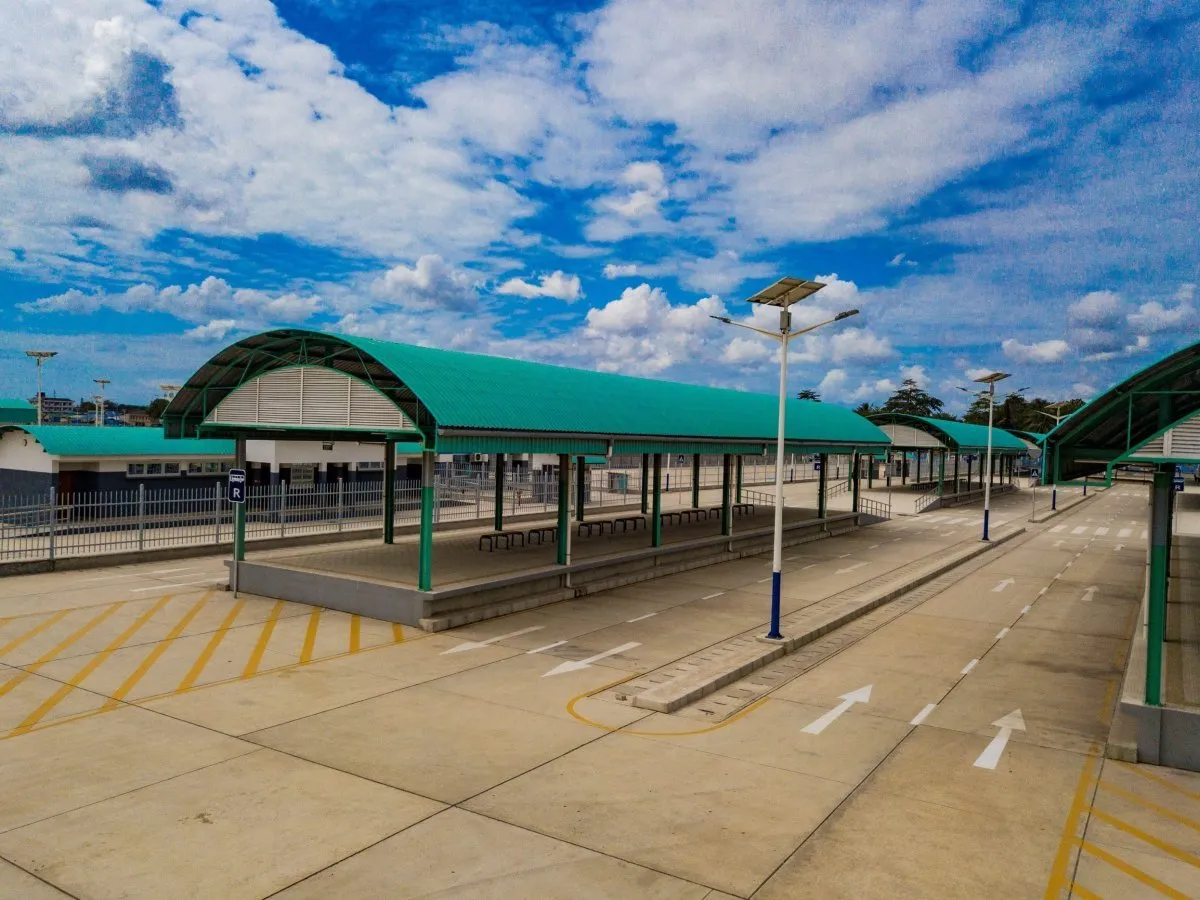
Phase 1, the trunk corridor along Morogoro Road connecting the city centre to Kimara, was the first operational BRT route in East Africa when it launched and has demonstrated the fundamental proposition that dedicated bus lanes can move substantially more passengers per hour than the mixed traffic they replace. The Morogoro Road corridor carries thousands of passengers daily, with journey times significantly more predictable than the daladala alternative on the same route during peak hours.
The expansion to six phases, covering additional corridors including Kilwa Road to the south, Bagamoyo Road to the north, and the Gerezani hub connections, is designed to extend the network effect that a single corridor cannot achieve. The economic value of BRT is not linear with corridor length. It is network-dependent: each additional corridor increases the number of origin-destination pairs that the system can serve efficiently, expanding the effective catchment area for employers and workers simultaneously. A six-phase system that covers the major arterials of Dar es Salaam creates a fundamentally different urban labour market geography from a single corridor, because it allows workers from across the metropolitan area to access employment concentrations along multiple corridors rather than only along Morogoro Road.
The financing structure of the BRT expansion involves the World Bank, the African Development Bank, the European Investment Bank, and bilateral donors, reflecting the scale of investment that urban transport infrastructure at this level requires and the development finance community's recognition of urban mobility as a productive infrastructure investment rather than a social expenditure. This multi-financier structure is also a governance signal: the conditionalities and reporting requirements attached to multilateral transport financing create accountability mechanisms for project delivery quality that purely domestically financed infrastructure does not carry.
The Daladala Question: Integration, Not Replacement
Any serious analysis of Dar es Salaam's transport evolution must engage with the daladala system honestly rather than simply treating it as the problem that BRT is solving. The daladala network is the primary transport system for the majority of Dar es Salaam's residents, serving routes, times of day, and origin-destination combinations that the BRT network does not and cannot cover at the density and flexibility that informal minibus operations provide. Eliminating or marginalising the daladala system would not improve urban transport. It would leave the majority of the city's residents without their primary mobility option while the BRT network reaches its intended coverage.
The more productive framing, and the one that Dar es Salaam's transport planners are working toward, is integration: a transport system in which BRT provides the high-capacity, high-frequency trunk service on the major corridors, while restructured daladala and other informal services provide the feeder connectivity from residential areas to BRT stations and the last-mile coverage in areas the trunk network does not reach. This integration model requires the daladala industry to restructure its route network, its fare collection systems, and its operational practices in ways that complement rather than compete with the BRT. It also requires physical infrastructure, feeder bus stops, interchange facilities, and integrated ticketing systems, that allows passengers to move between modes efficiently.

The economic implications of successful integration are significant. A transport system where BRT handles the high-volume trunk corridors efficiently and daladala provides flexible feeder coverage creates a more productive urban mobility outcome than either system could achieve alone. It preserves the employment and economic function of the daladala industry, which employs tens of thousands of drivers, touts, mechanics, and support workers across the metropolitan area, while channelling its activity toward the parts of the mobility system where its flexibility and low capital cost are advantages rather than inefficiencies.
The Regional Trade Dimension: Where Dar es Salaam Competes Against Mombasa
Uchumi360's analysis of the LAPSSET corridor competition documented the strategic contest between Tanzania's Central Corridor and Kenya's Northern Corridor for the transit trade of Rwanda, Burundi, Uganda, and eastern DRC. That competition is played out in port efficiency, corridor infrastructure quality, customs processing speed, and logistics cost at every point in the supply chain from ocean vessel to inland destination. Urban transport efficiency in Dar es Salaam is one of the factors in that competition, and it is one that Tanzania has historically conceded to Mombasa unnecessarily.
The distance from Dar es Salaam Port to the Zambian border via the Central Corridor road and rail network is shorter than the equivalent distance from Mombasa through the Northern Corridor for traffic destined for Zambia, eastern DRC, and Rwanda via the southern route. Tanzania's geographic advantage in this competition is real. But geographic advantage only translates into commercial advantage when the total supply chain cost and reliability from ocean vessel to inland destination is competitive, and the internal transport efficiency of the gateway city is a component of that total cost.
A Dar es Salaam where container trucks can move reliably from port to inland dry port along Nelson Mandela Road and the connecting arterials, where port workers can reach their shifts without the three-hour commutes that current congestion imposes, and where logistics companies can plan departure times with the confidence that arterial routes will be passable at commercially viable speeds, is a Dar es Salaam that is more competitive against Mombasa than the current congestion-impaired version. The BRT expansion contributes to this competitiveness by separating passenger and freight movement on the city's major arterials, reducing the competition between commuter buses and container trucks for road space during peak hours.
This is the point where urban transport policy and trade corridor strategy intersect, and it is the intersection that Tanzania's transport planning framework needs to hold simultaneously rather than treating urban mobility and trade logistics as separate domains managed by separate agencies with separate mandates.
The Land Use Question: Infrastructure Without Planning Is Incomplete
The economic returns from BRT investment are not determined solely by the quality of the infrastructure itself. They are significantly shaped by the land use patterns that develop around BRT corridors, and by the urban planning framework that either channels or dissipates the commercial and residential development that transport investment attracts.
The international evidence on BRT and urban development is consistent: dedicated transport corridors generate commercial densification along their routes as businesses locate to capture the foot traffic and accessibility that high-frequency transit creates. Property values increase near BRT stations. Retail and office development clusters around interchange nodes. Residential density rises along corridors as workers seek to reduce commuting time by living near transit access points.
These land use changes are economically valuable because they increase the productive density of urban land, generate property tax revenue for the city, and create the commercial concentration that makes urban economies more efficient. But they only materialise reliably when the urban planning framework anticipates and manages them, zoning land for appropriate development intensities near transit corridors, providing the utility infrastructure that densification requires, and ensuring that the communities already living in corridor zones are integrated into the development opportunity rather than displaced by it.
Dar es Salaam's urban planning framework, like its transport system, is under stress from the pace and scale of the city's growth. The coordination between DART's corridor expansion programme and the city's land use planning authorities determines whether BRT investment generates the full range of urban productivity benefits that its scale justifies, or whether physical transport infrastructure improvement is partially offset by land use patterns that fail to capture the agglomeration economies that the investment creates.
What This Means for Tanzania's Economic Trajectory
Uchumi360's analysis of Tanzania's sovereign credit rating identified urban infrastructure efficiency as one of the structural features that rating agencies assess in determining how productively Tanzania converts investment into economic output. The rating agencies do not specifically assess BRT phase completion status. They assess the aggregate productivity of Tanzania's economic infrastructure, and urban transport efficiency in the city that anchors the national economy is a component of that aggregate.
The connection to Tanzania's housing analysis is similarly direct. The 90 percent self-built informal housing that dominates Dar es Salaam's urban fabric is partly a consequence of land markets that are shaped by transport accessibility. Affordable land in Dar es Salaam is concentrated in areas with poor transport connectivity, because proximity to employment concentrations commands a price premium that low-income households cannot meet. BRT corridors that extend reliable, affordable transit access to peri-urban areas expand the geographic range within which households can find affordable land while maintaining reasonable commuting times. This does not solve the housing affordability problem, but it changes the land market dynamics that contribute to it.
The connection to Tanzania's investment surge is the most direct. The USD 10.95 billion in approved investment capital that Tanzania registered in 2025 will generate increased economic activity across the metropolitan area, in manufacturing zones, in logistics infrastructure, in commercial services, and in the construction activity that the investment itself requires. All of this activity requires workers who can move reliably between residence and workplace, goods that can move reliably between production facilities and distribution points, and a business environment where operational uncertainty from transport disruption is manageable rather than chronic.
A Dar es Salaam with six operational BRT corridors is a materially more productive economic environment for this investment than a Dar es Salaam with one. The investment in urban mobility is not separate from the investment in manufacturing zones, energy infrastructure, and port capacity that Tanzania's development agenda is pursuing. It is the connective tissue that determines whether all of those investments generate their intended returns.
The Risk of Infrastructure Without Systems
The analytical caveat that applies to every major infrastructure investment in Tanzania's current pipeline applies with particular force to urban transport, where the physical infrastructure is only one component of a system whose performance depends equally on institutional capacity, regulatory quality, and operational management.
A BRT system whose buses run late because maintenance protocols are inadequate, whose fare collection revenue is insufficient to cover operating costs because fares are set below cost-recovery levels, whose stations are inaccessible to disabled passengers, and whose route network does not connect to feeder services generates less economic value than its capital cost justifies. The international record of BRT systems includes both successes, Bogotá's TransMilenio being the most cited, and failures where capital investment in infrastructure was not matched by operational investment in the systems that make infrastructure productive.
Tanzania's institutional track record on major infrastructure projects, as Uchumi360's mega projects analysis documented, is improving but not yet consistently at the standard that the ambition of the current investment pipeline requires. The DART Agency's capacity to manage a six-corridor BRT network operationally, the city's capacity to coordinate land use planning around BRT corridors, and the national government's capacity to integrate urban transport policy with trade corridor strategy are the institutional dimensions of this infrastructure investment whose quality will determine whether Dar es Salaam's mobility improves at the scale the investment justifies.
The Bottom Line
Dar es Salaam's BRT expansion is one of the most economically significant infrastructure investments currently underway in Tanzania, not because of its scale in isolation, but because of what it is connected to. A city that functions as the entry point for USD 10.95 billion in annual investment approvals, as the gateway for the trade of four landlocked countries, as the labour market for Tanzania's largest concentration of formal and informal economic activity, and as the anchor of the country's financial and professional services economy cannot sustain its economic ambitions if movement within it remains as expensive, unpredictable, and inefficient as current conditions impose.

The BRT corridors are not a solution to all of Dar es Salaam's urban challenges. They are a structural intervention in the most binding operational constraint on the city's economic performance. If the infrastructure is built on schedule, integrated with land use planning, connected to feeder transport networks, and operated at the service quality that makes it genuinely competitive with the daladala alternative, it will generate economic returns that compound across every sector of the economy that runs through this city.
If it is built without the institutional coordination, the operational investment, and the land use integration that productive urban transport requires, it will add physical infrastructure to a system that remains functionally fragmented, and the congestion cost that is currently embedded in Tanzania's economic operating costs will persist under a more expensive infrastructure canopy.
The difference between those two outcomes is not in the engineering. It is in the institutional quality, the coordination capacity, and the political will to build systems rather than simply structures. That is the same challenge Tanzania faces across every dimension of its current development agenda. Dar es Salaam's BRT expansion is where that challenge is most visible, most measurable, and most directly connected to the economic performance of the country as a whole.
_______________________________________________________________________________________
Sources: Dar Rapid Transit Agency Project Documentation 2024 to 2026. World Bank Dar es Salaam Urban Transport Improvement Project Reports. European Investment Bank BRT Financing Framework 2025. Tanzania National Roads Agency Corridor Upgrade Plans 2025. Tanzania Ports Authority Trade and Logistics Reports 2024. African Development Bank Urban Mobility and Transport Reports 2024. World Bank Urban Transport and Congestion Cost Research. Tanzania National Bureau of Statistics Dar es Salaam Population and Economic Data.
_______________________________________________________________________________________
Uchumi360 covers business, investment, and economic policy across East, Central, and Southern Africa.
 Uchumi360
Business Intelligence
Uchumi360
Business Intelligence
Uchumi360 covers business, investment, and economic policy across East, Central, and Southern Africa.
For the serious reader
You read to the end. That places you in a small group.
Uchumi360 is built for readers who demand precision over speed, structure over sentiment, and analysis that holds uncomfortable conclusions rather than softening them. If this work sharpens how you think about Africa's economy, help us keep building the infrastructure behind it.
Institutional Partners
Commission intelligence. Shape the conversation.
Uchumi360 works with development finance institutions, investment firms, sovereign bodies, and strategic organisations across the coverage region. Institutional partnership unlocks:
- Commissioned sector and country intelligence reports
- Branded research series under your institution's authority
- Exclusive data briefings for internal strategy teams
- Speaking and editorial presence at Uchumi360 events
- Co-published investment outlooks for your markets
Support Our Work
Independent analysis has a cost. Help us bear it.
Uchumi360 does not carry advertising. It does not take editorial direction from sponsors. Every article is produced without commercial compromise. Your contribution funds the reporting, research, and editorial infrastructure that keeps this analysis free from influence.
Secure checkout: One-time and monthly support are processed securely. Add payment credentials to enable checkout here.
Stay Connected
Keep up with every new insight.
Follow our latest analysis, policy coverage, and market intelligence as soon as it is published. If you need something specific, reach out directly and we will point you to the right research.
