
Lobito or TAZARA? The Founding Motives Tell Us Why Africa Must Read This Moment Carefully
Ready
The better African strategy is therefore not Lobito or TAZARA. It is Lobito and TAZARA, but on African terms. Every corridor agreement should be judged against five questions. Does it reduce logistics costs for African producers? Does it support processing and value addition before export? Does it create African-owned service companies along the route? Does it improve bargaining power for landlocked countries? Does it leave behind skills, infrastructure, tax revenue and industrial capacity in the local economy?
The debate between the Lobito Corridor and the Tanzania-Zambia Railway Authority should not begin with today’s financiers. It should begin with the original reason each railway was built. Without that foundation, the comparison becomes too shallow: Atlantic Ocean versus Indian Ocean, Western capital versus Chinese capital, Angola versus Tanzania, Lobito versus Dar es Salaam.
The TAZARA's foundation.
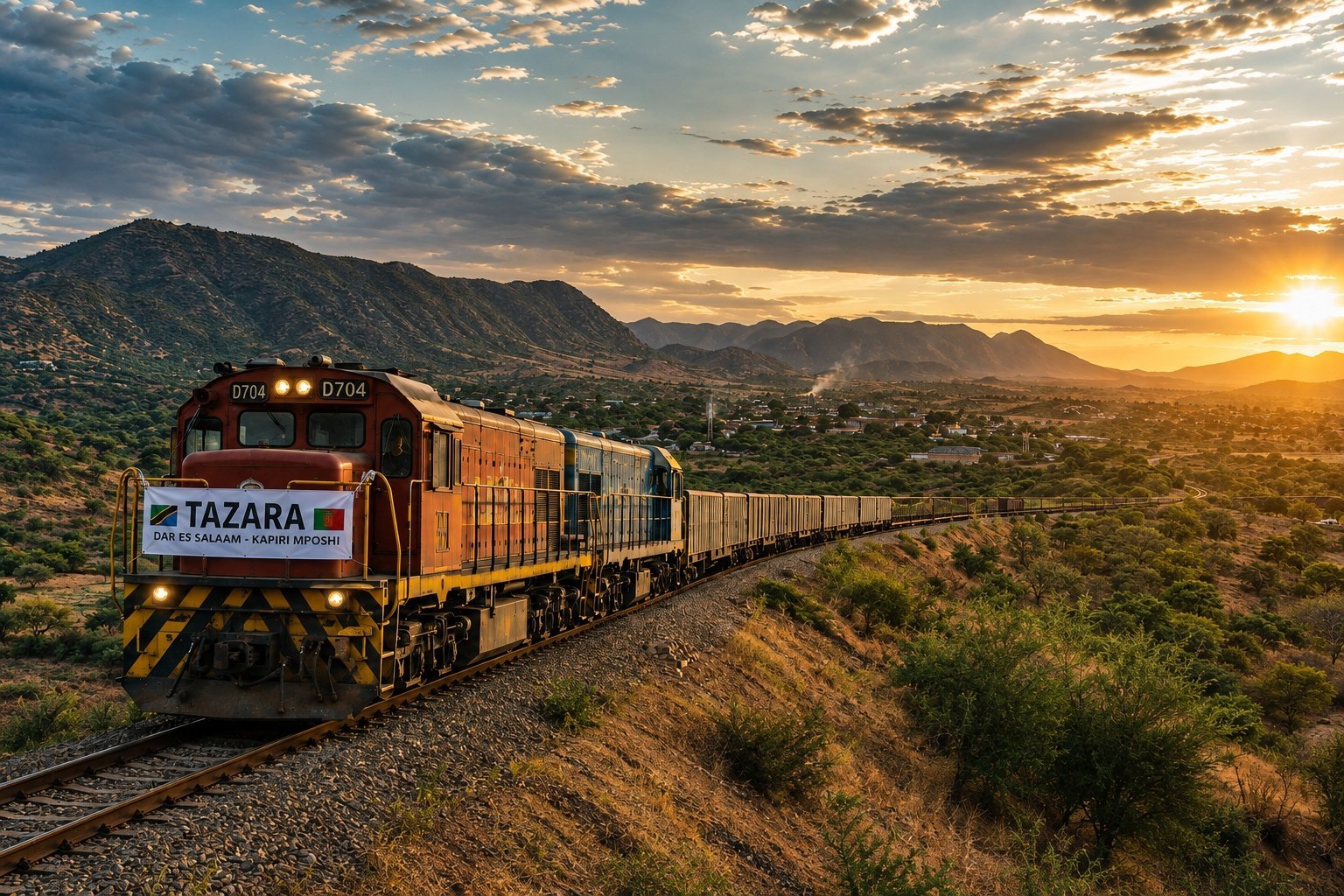
The Tanzania-Zambia Railway Authority, widely known as TAZARA, was born from the politics of sovereignty. The Benguela Railway, which forms the historical backbone of the Lobito route, was born from the economics of extraction. Today, both are being revived because copper, cobalt and other critical minerals have made African corridors strategic again. The question is whether Africa can use this renewed interest to create inland value, or whether it will simply rebuild faster routes for minerals to leave the continent.
TAZARA’s original motive was direct and political. Zambia was landlocked, newly independent, and dependent on routes through Southern Rhodesia and South Africa to reach the sea. That dependence became dangerous because Zambia supported liberation movements while white-minority regimes controlled its southern access routes. Chinese diplomatic history says Tanzania and Zambia needed the railway to develop their economies, support liberation struggles and reduce dependence on sea routes controlled by South Africa and Southern Rhodesia.
That is why TAZARA was not merely a transport project. It was an act of strategic refusal. Tanzania and Zambia first sought help from Western powers and the Soviet Union, but the project did not receive the support they needed. Julius Nyerere raised the railway request during his first visit to China in 1965, and Kenneth Kaunda later pursued the same issue with Chinese leaders. In 1967, China, Tanzania and Zambia signed the construction agreement.
The financing structure gave the railway its political meaning. China provided an interest-free loan of 988 million renminbi yuan, shipped about one million tons of equipment and materials, and dispatched tens of thousands of workers and technicians. The line was completed and handed over in July 1976.
This is why Nyerere’s interpretation still matters. He contrasted TAZARA with older foreign-built railways in Africa, saying that many had been built to plunder African wealth, while China’s support for TAZARA was aimed at helping Tanzania and Zambia develop their national economies. Kaunda’s framing was equally direct: in a difficult moment, China had acted as a friend.
So when TAZARA is revived today, Tanzania and Zambia are not only reviving steel, sleepers and rolling stock. They are reviving a historical asset that was originally built to defeat transport dependency. TAZARA was a railway of sovereignty before it was a railway of cargo.
Lobito has a different foundation.
The Lobito route is built around the Benguela Railway. Its historical purpose was to connect the mineral-rich interior of Central Africa to Angola’s Atlantic coast. By 1931, the Benguela Railway had established Lobito as Central Africa’s Atlantic outlet: the first copper shipment from Katanga reached the Port of Lobito on 10 June 1931, confirming the corridor’s original role as a westward mineral-export route.
That fact matters because it reveals the railway’s economic DNA. Lobito was not founded as a liberation-era sovereignty project. It was built into the colonial mineral economy. Its original function was to move value from the interior to the ocean.
This distinction does not mean Lobito is bad and TAZARA is good. It means their founding motives were different. TAZARA began as an anti-dependence railway. Lobito began as a mineral evacuation railway. Today, those histories are converging because the same minerals that shaped colonial logistics have become central to the global energy transition.
The new Lobito language is modern and strategic. At the Lobito Corridor Trans-Africa Summit in Benguela, Angola, President Félix Tshisekedi of the Democratic Republic of the Congo described the corridor as more than a transport axis. He presented it as an opportunity for regional integration, economic transformation and improved living conditions. He also linked it directly to copper and cobalt, arguing that the corridor could reduce logistics costs and raise export revenues for the Democratic Republic of the Congo and Zambia.
That is the correct African reading of Lobito. If it is only a faster railway for exporting minerals, it modernises the old extraction model. If it lowers logistics costs while supporting processing, industrial clusters, local procurement, training and African-owned services, then it becomes a development corridor.
President Hakainde Hichilema of Zambia made an even more important point. He did not frame Lobito and TAZARA as enemies. At the Lobito summit, he spoke of linking Angola through the Democratic Republic of the Congo and Zambia, then connecting that line to TAZARA and Tanzania. His view points to a two-ocean strategy: Zambia should not be trapped into choosing one corridor when it can use both.
That is probably the most logical position for Zambia. Lobito gives the Copperbelt an Atlantic option. TAZARA gives it an Indian Ocean option. The more routes Zambia has, the more bargaining power it gains over logistics costs, port dependence, political exposure and shipping direction.
Tanzania’s position at the same summit also supports this wider reading. Vice President Philip Mpango presented Lobito as part of a broader African connectivity strategy, while reminding the summit that Tanzania already links landlocked countries to the Indian Ocean through TAZARA and the Tanzania-Zambia Mafuta Pipeline, known as TAZAMA. He also described TAZARA as an interstate railway link connecting Tanzania to Southern African Development Community member states including Zambia, Zimbabwe and South Africa.
This is the point Tanzania should not lose. TAZARA is not only Zambia’s route to Dar es Salaam. It is Tanzania’s inland economic spine into Southern Africa. If revived properly, it can support the Port of Dar es Salaam, Mbeya, Iringa, logistics parks, agro-processing, dry ports, industrial zones, rolling-stock maintenance, warehousing, mining services and cross-border trade.
The current funding motives show why both corridors have returned to the centre of geopolitical attention.
The Lobito Corridor is being advanced through Western-backed financing and strategic coordination. The Africa Finance Corporation acted as co-financial adviser for the Lobito Atlantic Railway Project, with financing involving the United States International Development Finance Corporation and the Development Bank of Southern Africa. The financing package is expected to increase Lobito’s transport capacity ten-fold to about 4.6 million metric tonnes per year and reduce the cost of transporting critical minerals by about 30%.
The European Union, through its Global Gateway strategy, frames the Lobito Corridor as a route connecting the southern Democratic Republic of the Congo, northwestern Zambia and Angola to global markets through the Port of Lobito. Its project framing includes not only rail infrastructure, but also transit and trade facilitation, renewable energy, climate adaptation, technical and vocational education and training, jobs, agriculture and critical raw-material value chains.
That language is important. It shows that Lobito is not only being sold as a railway. It is being sold as a strategic supply-chain corridor for critical raw materials, trade and industrial development. But the risk remains: if most of the value still leaves Africa as raw or minimally processed minerals, then the corridor will be efficient without being transformative.
TAZARA’s revival is moving through a different political and financing channel. In September 2024, during the Forum on China-Africa Cooperation in Beijing, China, Tanzania and Zambia signed a Memorandum of Understanding for the concession of TAZARA. TAZARA said it was negotiating with China Civil Engineering Construction Corporation, one of China’s leading state-owned overseas engineering contractors and the original builder of the railway. Under the plan, the concession could run for up to 30 years, with annual tonnage expected to rise from about 500,000 metric tons to approximately 2 million metric tons.
Reuters later reported the broader comparison more sharply: Lobito could cost up to US$6 billion by completion around 2030, while the Chinese-backed TAZARA upgrade was expected to cost around US$1.4 billion and lift annual capacity to about 2.4 million tons. Reuters framed both projects as examples of how global powers are seeking to source and control minerals needed for industrial economies and the energy transition.
What is the African interest?
Lobito and TAZARA are no longer just railways. They are bargaining instruments in a world where critical minerals, ports, railways, energy systems and industrial policy have merged into one strategic map.
Analysts support this wider interpretation. Chatham House has described the Lobito Corridor as a focal point in the race for critical minerals, while arguing that digital infrastructure, data governance and traceability will be important if the corridor is to become an integrated mineral-supply ecosystem rather than just a physical transport route.
The Atlantic Council makes a related point from the United States-Africa policy angle. It argues that the United States should not focus only on raw material access, but should also support processing infrastructure, transparent governance frameworks and equitable partnerships that deliver mutual prosperity.
That is exactly where the African interest lies. Railways alone will not change the structure of trade. What matters is what happens before the minerals reach the train and after the train begins moving. Are copper and cobalt processed closer to the source? Are battery precursor industries developed near the corridor? Are African firms entering logistics, warehousing, maintenance, insurance, security, engineering, food supply, housing, data systems and finance? Are corridor towns becoming industrial locations or just places where wagons pass?
My personal reading is that Lobito currently looks stronger as a financing and implementation story. It has Western development finance, European and American diplomatic backing, private concession logic and a clear geopolitical purpose. It speaks the language of critical minerals, supply-chain security and the energy transition.
TAZARA, however, remains stronger as a historical and sovereignty story. It carries the memory of African liberation, non-alignment, Chinese solidarity and Indian Ocean access. It speaks the language of strategic independence and regional linkage. That history is not sentimental; it is useful. A railway that was born to defeat dependency should not be revived in a way that creates a new dependency.
The mistake would be to treat TAZARA only as an old railway that needs repair. The better view is to treat it as a corridor around which Tanzania can build a new inland logistics economy. Dar es Salaam should not simply wait for minerals to arrive at the port. Tanzania should use TAZARA to build logistics towns, industrial services, agro-processing zones, fuel supply systems, rail-linked warehouses, cross-border trade platforms and manufacturing support around the corridor.
The same warning applies to Lobito. The old Benguela logic was extraction to the Atlantic. The new Lobito language speaks of transformation, value chains and regional integration. The test is whether those words become industrial facts. Angola, the Democratic Republic of the Congo and Zambia must ensure the corridor does not only serve foreign mining houses, traders, lenders and manufacturers. It must also serve African producers, workers, suppliers, municipalities and industrial policy.
The better African strategy is therefore not Lobito or TAZARA. It is Lobito and TAZARA, but on African terms.
Every corridor agreement should be judged against five questions. Does it reduce logistics costs for African producers? Does it support processing and value addition before export? Does it create African-owned service companies along the route? Does it improve bargaining power for landlocked countries? Does it leave behind skills, infrastructure, tax revenue and industrial capacity in the local economy?
If the answer is no, Africa will have upgraded the railway while leaving the economic model unchanged.
The foundational motive matters because it tells us what each railway was originally designed to do. TAZARA was designed to give Zambia and Tanzania strategic freedom. Lobito was designed to move Central African minerals to the Atlantic. Today, both are being reintroduced under the language of development, energy transition, regional integration and supply-chain resilience.
Africa should welcome the competition, but not romanticise it. Western-backed does not automatically mean developmental. Chinese-backed does not automatically mean sovereign. Lobito can help Africa, but it can also modernise extraction. TAZARA can help Tanzania and Zambia, but it can also become a nostalgic revival if it does not anchor new value creation.
The final question is not which ocean wins. The final question is whether Africa uses two-ocean competition to create inland value before minerals reach either coast.
That is the better way to read Lobito and TAZARA. The railways are not only routes to the sea. They are tests of whether Africa has learned to negotiate from the value of what lies inland.
 Uchumi360
Business Intelligence
Uchumi360
Business Intelligence
Uchumi360 covers business, investment, and economic policy across East, Central, and Southern Africa.
For the serious reader
You read to the end. That places you in a small group.
Uchumi360 is built for readers who demand precision over speed, structure over sentiment, and analysis that holds uncomfortable conclusions rather than softening them. If this work sharpens how you think about Africa's economy, help us keep building the infrastructure behind it.
Institutional Partners
Commission intelligence. Shape the conversation.
Uchumi360 works with development finance institutions, investment firms, sovereign bodies, and strategic organisations across the coverage region. Institutional partnership unlocks:
- Commissioned sector and country intelligence reports
- Branded research series under your institution's authority
- Exclusive data briefings for internal strategy teams
- Speaking and editorial presence at Uchumi360 events
- Co-published investment outlooks for your markets
Support Our Work
Independent analysis has a cost. Help us bear it.
Uchumi360 does not carry advertising. It does not take editorial direction from sponsors. Every article is produced without commercial compromise. Your contribution funds the reporting, research, and editorial infrastructure that keeps this analysis free from influence.
Secure checkout: One-time and monthly support are processed securely. Add payment credentials to enable checkout here.
Stay Connected
Keep up with every new insight.
Follow our latest analysis, policy coverage, and market intelligence as soon as it is published. If you need something specific, reach out directly and we will point you to the right research.
