
How PPPs Can Help Close Dar es Salaam’s 167-Million-Litre Daily Water Gap
Ready
Ruvu Chini could add treatment capacity, Rufiji could diversify supply, and leak repairs could recover water the utility already treats. The economic test is how much dependable, affordable water reaches customers for every shilling spent.
Dar es Salaam and parts of the Coast Region are short of about 167 million litres of water a day, according to the Dar es Salaam Water Supply and Sanitation Authority (DAWASA). At a Public-Private Partnership Centre forum on 24 November, the utility put daily supply at 553 million litres against estimated demand of 720 million. It outlined two proposals for private participation: a TSh4.6 trillion scheme to bring water from the Rufiji basin and a US$111.5 million rehabilitation and expansion of the Ruvu Chini treatment plant. The briefing did not announce a selected investor or a financing agreement for either project.
The two investments address different weaknesses. Ruvu Chini would get more out of an existing plant. Rufiji would give Dar es Salaam a major new source and reduce its dependence on the Ruvu. Neither, on its own, can guarantee what matters to a household buying tanker water or a food processor losing a production shift: safe water arriving when it is needed. Tanzania should design its public-private partnerships (PPPs) around that service, with separate contracts where the risks and results can be measured separately.
Recover water DAWASA already treats
The Energy and Water Utilities Regulatory Authority (EWURA) reported that DAWASA’s non-revenue water rose from 39.6 per cent in 2023/24 to 53.5 per cent in 2024/25. Separately, the Ministry of Water’s Water Sector Status Report 2025put the average across urban water systems, including national projects, at 33.2 per cent as of December 2025.
Non-revenue water is not all leakage. It includes water lost through bursts and leaks, water consumed but not properly recorded because of faulty meters or unauthorised connections, and authorised use that is not billed. Fixing a leak can free up water for another customer; correcting an inaccurate meter can help the utility bill for water it already delivers. DAWASA needs both gains, but it should measure them separately.
That is where the proposed Kibaha and Bagamoyo pilots can earn their place. Divide the network into zones with metered inlets, establish how much water each receives and loses, and pay contractors for sustained, independently verified reductions in physical losses. Adjust the baseline for changes in pressure and supply hours so that a contractor cannot earn a bonus by delivering less water. Meter replacement, billing corrections and collections should have their own targets.
The scale is worth testing. If 553 million litres a day were entering the network, a five-percentage-point reduction in physical losses at unchanged input would make about 28 million litres a day available for service. That is an illustration, not an estimate of recoverable leakage or a forecast for the two pilots. DAWASA needs measurements by zone before it can compare the cost of saving a cubic metre with the cost of producing and delivering a new one.
Secure raw water before buying treatment capacity
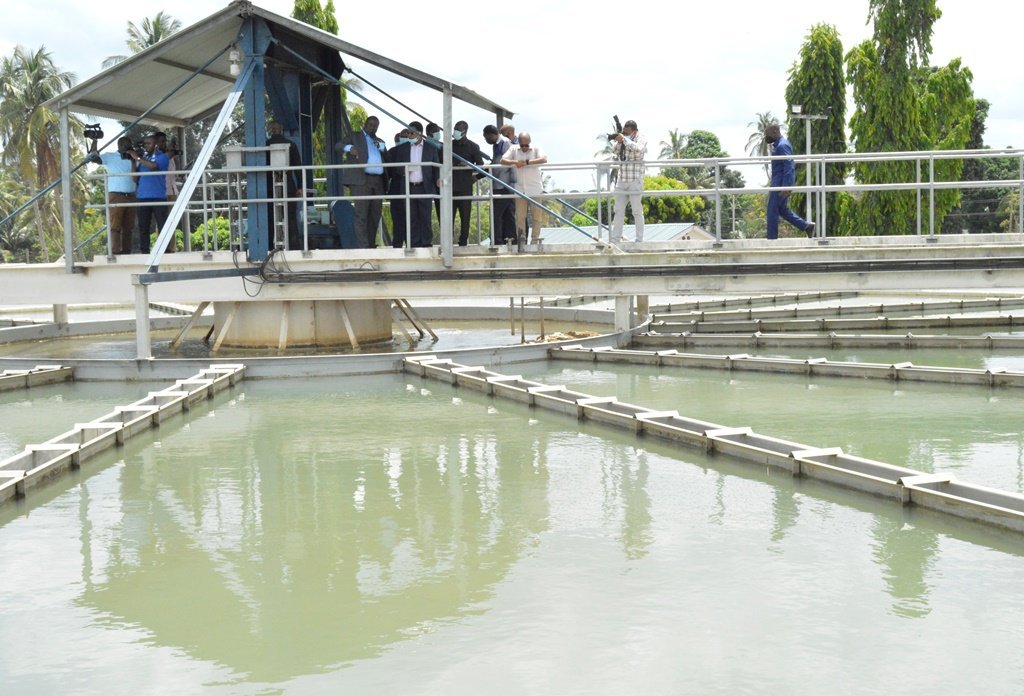
DAWASA’s Ruvu Chini proposal would raise daily output from 270 million to 360 million litres. The extra 90 million litres is equivalent to about 54 per cent of the reported shortfall, before distribution losses and assuming the plant can sustain that output. The proposal envisages a private partner financing the upgrade and selling treated water in bulk to DAWASA, which would distribute it.
A bigger plant cannot treat water the river does not supply. The Ministry of Water has previously attributed shortages in Dar es Salaam and the Coast Region to falling flows on the Ruvu. The separate Kidunda dam is intended to store water for release during dry periods. In October, DAWASA reported that construction was 65 per cent complete and targeted completion in June 2027. Its planned 190 billion litres is a storage volume, not new daily output. The investment case for Ruvu Chini should therefore rest on how much raw water is reliably available in a dry year, not what the plant could produce in favourable conditions.
A Ruvu Chini contract should also account for the cost of keeping the existing plant running during construction. The operator should show how it will maintain service while replacing equipment, then meet measurable standards for water quality, equipment uptime and energy use. DAWASA’s separate proposal for solar at treatment plants and pumping stations should be judged on how much it cuts electricity costs and whether the power system keeps pumps running when needed, including after dark.
Settle Rufiji’s first-phase scope before committing to buy water
The TSh4.6 trillion Rufiji proposal would draw from the Julius Nyerere Hydropower Project reservoir. The 24 November presentation, reported by The Citizen, put the first stage at 750 million litres a day through two pipeline corridors and the completed scheme at 1.5 billion litres a day. DAWASA’s own 17 November update described a four-phase project with 375 million litres a day in the first phase. The public accounts do not explain whether those figures refer to different construction packages or to a change in scope.
The difference affects the size of the initial investment, the timing of pipes and pumping stations, and the volume DAWASA might have to agree to buy. At the forum, the utility projected demand of 1.3 billion litres a day across its service area by 2050. That helps explain the scale of Rufiji, but it does not justify paying for the full volume before the network and demand are ready.
Before tendering, DAWASA should publish how much water each phase can reliably deliver in a dry year, where the water will enter the network and which districts it will serve. Tanzania’s water resources law requires water-use permits to account for environmental flows. The operating plan should also show how withdrawals would be coordinated with hydropower and other water users. Protecting the catchment from pollution and erosion belongs in that plan: the quality of raw water affects treatment costs as well as water safety.
Build the route to the customer alongside the plant
DAWASA’s November notice on repairs to the 72-inch main at Mpiji showed what can go wrong after treatment. The work disrupted service in areas from Bagamoyo to Ilala served by Ruvu Chini. Additional output will not fix that vulnerability if it must travel through the same bottleneck. Alternative routes, service reservoirs, pressure management and street-level mains should be planned against the plant’s commissioning date, with a named party accountable for each link.
Rwanda offers a warning about getting that sequence wrong. Its 40-million-litre-a-day Kanzenze bulk-water PPP began operating in 2021. Rwanda’s Auditor General found that the public utility received only 46 per cent of the water planned for Bugesera in the year to June 2022, citing unfinished downstream infrastructure and developments. The utility incurred about US$4.45 million in fixed costs for water not supplied between January 2021 and October 2022. Tanzania can reduce that risk by tying increases in contracted volumes to evidence that pipelines, storage and customer connections are ready.
Last-mile contracts can reward connections that actually work, rather than kilometres of pipe laid. EWURA recorded 19 hours of daily service for DAWASA in 2024/25; a system-wide measure cannot tell a household when its tap will run. A new connection should count once it delivers safe water at an agreed pressure and for specified hours. For households that cannot afford an upfront connection fee, targeted subsidies or instalment plans could turn a pipe in the street into usable service.
Tanzania’s National Water Policy also identifies reuse of treated wastewater as a potential source. A separate contract could supply an industrial park with reclaimed water for suitable non-drinking uses, provided there is a reliable source of effluent, enforceable quality standards and a buyer willing to pay. DAWASA has raised desalination as a longer-term option. Its value as a drought backup should be weighed against electricity costs and the cost of managing the concentrated brine left by treatment.
Make the bulk price affordable before agreeing to buy
Private financing changes who pays upfront, not who ultimately pays. EWURA’s 2024/25 profile lists about TSh159 billion in total income for DAWASA against TSh187 billion in operation and maintenance expenses. Those historical figures are not a measure of current cash flow, but they show why lenders and government should test whether the utility can afford a long-term bulk-water bill while maintaining its network.
A workable contract could combine a limited payment for capacity that meets agreed availability and quality standards with a charge per cubic metre of compliant water delivered. The private operator should bear the risks it can control, including construction costs, equipment performance and treatment quality. Any minimum purchase guarantee should be capped and sized to what DAWASA can distribute and afford. If payments are linked to foreign currency, the cost of a weaker shilling should be tested against local-currency financing and hedging options. Tanzania’s PPP law requires feasibility studies to compare the full public costs with and without a partnership. The question is whether the risks passed to the operator justify the cost of private finance.
The bulk price is not the price at the household meter. EWURA’s tariff rules require consideration of basic water affordability and the sustainability of the service. If a viable bid would make basic service unaffordable, an explicit, budgeted contribution to connections or shared infrastructure is more transparent than a blanket guarantee or an unfunded promise to keep bills unchanged. The household comparison should include what people already pay for backup water. And Tanzania need not use private finance for every link: publicly funded mains or competitively procured maintenance may cost less where long-term financing adds little.
What Tanzania should do first
DAWASA can establish where its water goes and launch the loss-reduction pilots while preparing Ruvu Chini and settling Rufiji’s scope. It should coordinate the Ruvu Chini upgrade with Kidunda’s commissioning and fund the network improvements that will carry the extra water. For Rufiji, the milestones are a reconciled phase plan, a timetable for downstream works and disclosure of the proposed bulk price, payment obligations and guarantees before the state makes binding commitments.
The public scorecard should show litres produced and delivered, physical losses and unbilled consumption, water quality, hours of service by zone, functioning new connections and the cost of providing that service. The PPP that does the most for Dar es Salaam may not be the one that raises the most capital. It will be the one that gives households and businesses the most reliable water for what they and the state can afford to pay.
 Uchumi360
Business Intelligence
Uchumi360 covers business, investment, and economic policy across East, Central, and Southern Africa.
For the serious reader
You read to the end. That places you in a small group.
Uchumi360 is built for readers who demand precision over speed, structure over sentiment, and analysis that holds uncomfortable conclusions rather than softening them. If this work sharpens how you think about Africa's economy, help us keep building the infrastructure behind it.
Institutional Partners
Commission intelligence. Shape the conversation.
Uchumi360 works with development finance institutions, investment firms, sovereign bodies, and strategic organisations across the coverage region. Institutional partnership unlocks:
- Commissioned sector and country intelligence reports
- Branded research series under your institution's authority
- Exclusive data briefings for internal strategy teams
- Speaking and editorial presence at Uchumi360 events
- Co-published investment outlooks for your markets
Support Our Work
Independent analysis has a cost. Help us bear it.
Uchumi360 does not carry advertising. It does not take editorial direction from sponsors. Every article is produced without commercial compromise. Your contribution funds the reporting, research, and editorial infrastructure that keeps this analysis free from influence.
Secure checkout: One-time and monthly support are processed securely. Add payment credentials to enable checkout here.
Stay Connected
Keep up with every new insight.
Follow our latest analysis, policy coverage, and market intelligence as soon as it is published. If you need something specific, reach out directly and we will point you to the right research.
