
Opinion: Tanzania's Foreign Exchange Problem Is Really a Production Problem

Ready
Tanzania's foreign exchange challenge is ultimately a production challenge. As Dira 2050 enters its first five-year implementation period to 2030, the country must decide whether it will keep importing products it has the capacity to produce, or use its energy, minerals, agriculture, infrastructure and regional market access to build an economy that earns and retains far more foreign exchange.
Tanzania should stop asking how to protect its foreign exchange reserves and start asking a harder question: why does an economy with Tanzania's land, minerals, energy, agricultural potential, coastline, population and regional market access still require so much foreign exchange to satisfy domestic demand?
That question should sit at the centre of Tanzania's economic conversation as the country begins implementing Dira 2050. It is especially urgent now that the first five-year implementation period, FYDP IV, covering 2026/27 to 2030/31, has begun. The Government describes this period as the first major implementation phase of Dira 2050, themed around economic transformation for inclusive growth and employment creation.
I deliberately frame the discussion around 2030 because this first five-year period will tell us whether Dira 2050 has become an operating economic strategy or remains primarily a long-term national aspiration. Tanzania does not have a separate national Vision 2030 replacing Dira 2050; the relevant 2030 milestone is FYDP IV itself, running from 2026/27 to 2030/31 as the first implementation vehicle for the 2050 vision.
My argument is straightforward: if Tanzania wants to enter 2030 with a stronger economy, a more resilient shilling and deeper foreign exchange reserves, the country must build an economy that produces more of what it currently imports and exports much more of what it currently produces in low-value forms. This is, at bottom, a production question.
The Foreign Exchange Numbers Should Change How We Think About Tanzania's Economy
The Bank of Tanzania's recent economic data presents an economy that is growing and increasingly integrated into regional and global markets, while simultaneously carrying a structural demand for foreign exchange that deserves far more attention from policymakers than it currently receives.
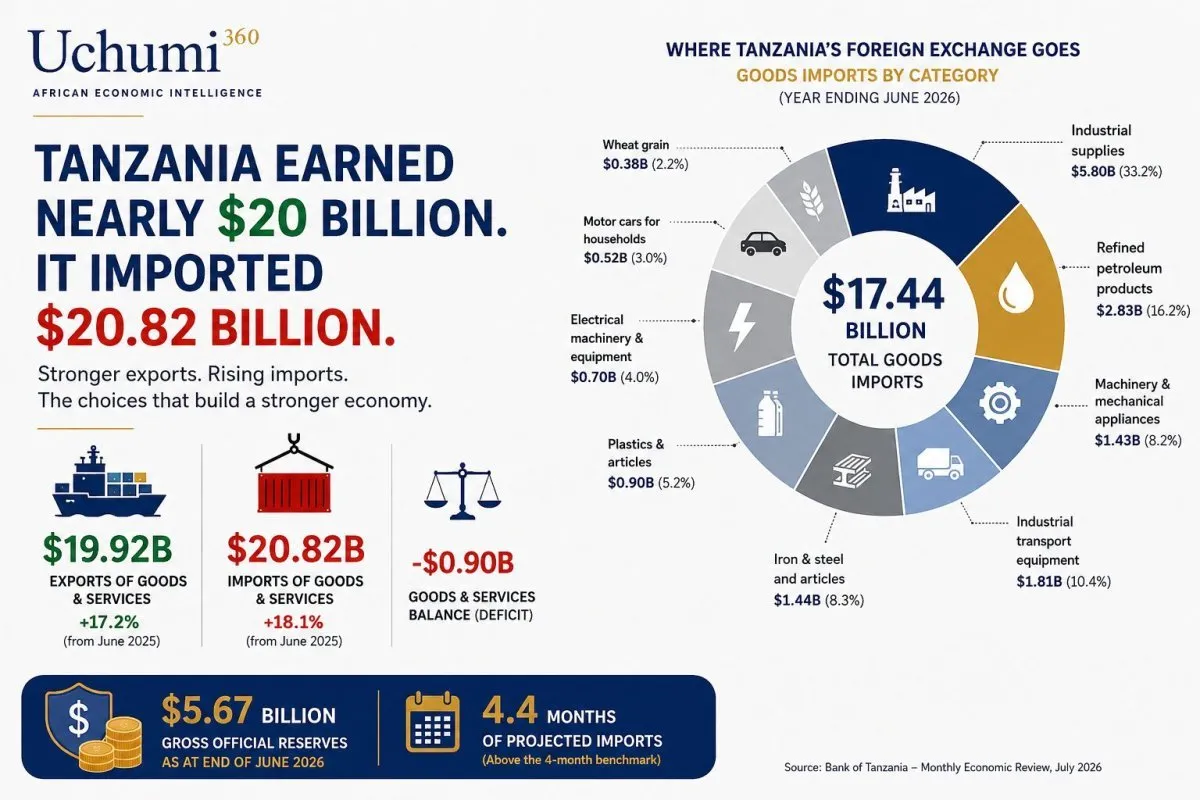
In the year ending June 2026, Tanzania's imports of goods and services reached about US$20.82 billion, compared with US$17.63 billion a year earlier. Goods imports alone reached roughly US$17.44 billion. Exports of goods and services were also strong, reaching about US$19.92 billion. The country therefore carried a substantial external financing requirement even while its export performance was improving, not a sign of failure, but a sign of an economy whose two sides, what it sells and what it buys, are both growing fast and roughly in step.
 The reserve position remains adequate by Tanzania's own policy standard. The Bank of Tanzania requires official reserves equivalent to at least four months of imports, with reserves also serving as a buffer for external debt obligations, foreign exchange market intervention and external shocks. That distinction matters: Tanzania is not facing a simple story of depleted reserves and economic collapse. The more serious issue sits underneath the headline numbers. When imports keep growing alongside economic activity, the country has to continuously generate enough foreign exchange, through exports, tourism, investment income, remittances and capital inflows, to keep financing that demand.
The strategic question is therefore much larger than reserve management. What kind of Tanzanian economy will generate the foreign exchange required to sustain a US$1 trillion economy by 2050? The Planning Commission has already framed Tanzania's long-term ambition in exactly those terms, describing the country as having begun its journey toward a US$1 trillion economy by 2050, with the first implementation phase now underway. That ambition demands a different way of thinking about imports altogether.
We Should Stop Treating Every Import as a Problem
There is a dangerous temptation in discussions about foreign exchange to treat imports as inherently undesirable. That would be economically illiterate. A country that wants to industrialise will import machinery. A country building railways will import equipment. A country expanding electricity generation will import turbines, transformers and specialised technology. A country modernising agriculture will import machinery, irrigation equipment and technologies it has not yet developed domestically. Those imports strengthen the economy rather than weaken it.
The real problem appears when a country repeatedly imports products it already has the resources, market and technical capacity to produce competitively at home. That distinction should become central to Tanzania's economic policy.
I would divide Tanzania's import bill into three broad categories. The first consists of goods and services Tanzania will keep importing because domestic production would be economically inefficient or technically unrealistic. The second consists of productive inputs and capital equipment that should be imported precisely because they expand future domestic productive capacity. The third consists of goods and services Tanzania has a realistic opportunity to produce domestically, either for its own market or for the wider African market.
That third category should become the centre of industrial policy. This is where the conversation gets interesting, because Tanzania already has a large domestic market, significant natural resources, expanding electricity supply, access to the Indian Ocean and direct access to several landlocked economies. The open question is whether those advantages are actually being converted into production.
Tanzania Should Know Exactly What Its Foreign Exchange Is Buying
I would like to see the Government establish a national foreign exchange import map that goes far deeper than the conventional classification of imports into consumer goods, intermediate goods and capital goods. Every major import category should be examined against four questions: How much does Tanzania spend importing it? How much of it can Tanzania produce competitively? What prevents domestic production from reaching scale? And how much foreign exchange could eventually be saved or earned by producing it locally? Asking those four questions consistently would immediately produce a much more intelligent industrial policy.
Take steel. Tanzania spent roughly US$1.44 billion importing iron, steel and related products in the year ending June 2026. Plastics and related products accounted for approximately US$899 million. Fertilisers were around US$413 million. Wheat imports were about US$380 million. These are substantial, recurring markets, and in several cases, inputs into industries Tanzania wants to expand. The answer is not to suddenly ban these imports. The answer is to ask why Tanzanian industry cannot capture a larger share of these markets.
A country that spends hundreds of millions of dollars importing a product year after year has effectively created a market for someone. The only real question is whether that market gets served by factories in Dar es Salaam, Tanga, Morogoro, Dodoma, Mwanza and other Tanzanian industrial centres, or whether Tanzania keeps sending the money abroad.
Steel Should Become One of Tanzania's Great Industrial Projects
I would put steel near the top of the national industrialisation agenda. The opportunity extends well beyond producing steel bars for construction; Tanzania should be thinking about the entire chain, from iron ore and scrap collection through steel production, sheets, pipes, structural steel, machinery components and fabricated industrial products.
This matters because steel sits underneath almost every physical development project Tanzania is pursuing. Railways consume steel. Ports consume steel. Energy infrastructure consumes steel. Mining consumes steel. Construction consumes steel. Agriculture consumes steel through machinery and equipment. A domestic steel industry therefore has the potential to reduce several layers of import dependence simultaneously.
The same principle applies to plastics, packaging, chemicals, construction materials, electrical equipment and agricultural inputs. These industries can become the connective tissue between Tanzania's raw materials and the products consumed by households, companies and governments. Dira 2050 itself identifies manufacturing as a cornerstone of Tanzania's economic diversification, stating that manufacturing has the potential to increase local value addition, reduce imports and improve export performance, while positioning Tanzania as a globally competitive manufacturing hub. The policy question is therefore no longer whether Tanzania should industrialise. It is whether we are industrialising around the products that matter most to our foreign exchange position.
Energy Could Become Tanzania's Greatest Foreign Exchange Policy
There is another number that deserves far more attention: Tanzania imported approximately US$2.83 billion in petroleum products in the year ending June 2026, roughly 16% of total goods imports. This is where energy policy and foreign exchange policy become inseparable.
Tanzania is now investing heavily in electricity generation. The Julius Nyerere Hydropower Project has fundamentally changed the scale of the country's electricity ambitions, and the country is simultaneously developing gas, renewable energy and transmission infrastructure. The economic return on that investment will ultimately depend on what the electricity actually enables the country to produce. If electricity simply lets households consume more imported products, the foreign exchange impact will be limited. If it lets factories operate more efficiently, mines process more minerals locally, farms irrigate more land, cold chains expand, transport systems electrify where viable and manufacturers replace imported products, the economic impact becomes much larger.
This is why I believe Tanzania should start measuring electricity in economic terms that go beyond megawatts. How many factories were made possible by additional generation? How much agricultural output became commercially viable because of reliable electricity? How much imported fuel was displaced? How many dollars of additional exports were generated? Electricity becomes economically powerful precisely when it changes what the country is capable of producing.
Agriculture Should Be Treated as an Industrial Sector
The same argument applies to agriculture. Tanzania has the land, climate and labour force to become one of Africa's major food production centres, yet agricultural production also creates demand for imported fertiliser, machinery, chemicals, packaging and processing equipment. The answer is to build agricultural production around domestic industrial capacity: fertiliser production connected to domestic natural resources and energy, agricultural machinery developed around local demand and regional export markets, food processing that links farmers with factories, locally produced packaging, expanded cold storage, industrial-scale irrigation, and a serious animal feed manufacturing industry.
The objective is a chain in which agriculture generates foreign exchange while requiring progressively less foreign exchange to produce each unit of output. Dira 2050 identifies agriculture as one of Tanzania's major potential sectors and envisages the country becoming a leading regional food hub through higher productivity, value addition, technology, infrastructure and stronger links with manufacturing and trade. That is precisely the direction Tanzania should take.
The Biggest Opportunity May Be Services
There is a second side to the foreign exchange equation that receives far less attention: Tanzania does not have to manufacture everything it consumes in order to improve its external position. It can also sell more services to the rest of the world.
Tourism already demonstrates this. Tanzania has built one of its strongest foreign exchange-generating industries around visitors who purchase accommodation, transport, food, entertainment and park access without Tanzania having to export a single physical container. The next step is to expand that concept. Tanzania can export financial services, insurance, professional consulting, engineering, software, education, healthcare, logistics and creative services. It can build business process operations serving companies across Africa.
This matters because the global economy increasingly lets countries earn foreign exchange without shipping physical products across oceans. A Tanzanian software company selling to Rwanda earns foreign exchange. A Tanzanian engineering firm designing a project in Zambia earns foreign exchange. A Tanzanian university educating students from neighbouring countries earns foreign exchange. A Tanzanian fintech company serving East African customers earns foreign exchange. Tanzania's future foreign exchange position will depend on both physical production and the ability of Tanzanian firms to sell knowledge and services beyond the domestic market.
The Real Prize Is the Regional Market
This is where I think Tanzania needs to think much bigger. Import substitution confined to the Tanzanian market can easily become expensive protectionism. Tanzania should instead build industries that use Tanzania as their initial market and East and Central Africa as their eventual one.
The geography is unusually favourable. Tanzania has the Port of Dar es Salaam, the Central Corridor, and access to Uganda, Rwanda, Burundi, Zambia, Malawi and the Democratic Republic of Congo, alongside a large domestic population and one of Africa's fastest-growing consumer markets. That combination makes a regional manufacturing platform genuinely possible. A steel factory in Tanzania does not need to sell only to Tanzanians. A fertiliser producer can serve Zambia, Malawi, Rwanda, Burundi and the DRC. A food processing company can sell across East Africa. A packaging manufacturer can serve regional exporters. A pharmaceutical company can build scale through regional markets. That is how Tanzania solves the scale problem that has undermined many African industrial projects.
We should stop asking whether Tanzania has enough consumers to justify industrialisation, and start asking whether Tanzania can become the factory serving the consumers of the region.
I Would Introduce a Foreign Exchange Return Test for Major Investments
There is one policy instrument I would like to see introduced under the first five-year implementation phase of Dira 2050: every major project receiving substantial public incentives should be assessed through what I would call a Foreign Exchange Return Test. The test would examine how much foreign exchange the project is expected to save, how much it is expected to generate through exports, how much domestic value it will create, how much of its inputs can eventually be sourced locally, and how much foreign exchange will leave the country through imported inputs, external debt service and profit repatriation.
This would meaningfully change the quality of industrial policy. A factory importing US$100 million of inputs while generating US$500 million of exports is fundamentally different from a business importing US$100 million of finished products for domestic consumption, yet both transactions appear identically as imports in the balance of payments. Their economic consequences are not remotely the same, which is exactly why Tanzania needs a more sophisticated understanding of foreign exchange than the headline figures currently provide.
Government Procurement Should Become Part of the Industrial Strategy
The same thinking should apply to public procurement. Government is one of the largest buyers in the economy, and if ministries, public institutions and local authorities collectively purchase products Tanzanian companies could produce competitively, the Government is effectively deciding, whether it intends to or not, where domestic economic capacity will develop.
Local procurement should therefore become a deliberate instrument for industrial development, provided quality and price remain competitive. If Tanzania is constructing schools, hospitals, railways, roads, water systems and energy infrastructure, the question should always include the domestic industrial opportunity: can the steel be produced here, the furniture, the cables, the pipes, the uniforms, the food supplies, the engineering services, the software? The answer will sometimes be no. But the question should be asked consistently, every time, not occasionally.
The First Five Years of Dira 2050 Should Have Measurable Foreign Exchange Targets
This is where 2030 becomes so important. The Government has already established FYDP IV as the first five-year implementation instrument for Dira 2050, covering 2026/27 to 2030/31, alongside monitoring mechanisms including the National Framework for Monitoring and Evaluation of Development Programmes and Projects and the E-Delivery digital system.
I would use those systems to introduce a national foreign exchange production dashboard. By 2030, Tanzania should know how much of its major import bill has been replaced by domestic production, how much foreign exchange has been saved through domestic manufacturing, how much new foreign exchange has been generated through manufactured exports, the domestic value added in major export sectors, the foreign exchange cost of imported energy, and which imported services could competitively be supplied by Tanzanian firms. Most importantly, every major industrial programme should carry a measurable contribution to the country's external position. That would give Dira 2050 a much sharper economic test than it currently has.
Tanzania Should Enter 2030 With a Different Economic Structure
The objective should not be to make Tanzania an economy that imports very little. That would be unrealistic and counterproductive. The objective should be an economy in which imports increasingly represent machinery, technology, specialised inputs and productive capital that expand future output, a very different economy from one that repeatedly imports finished products it could have produced locally.
That distinction will only grow more important as Tanzania moves toward a US$1 trillion economy, which will require a much larger volume of imports than Tanzania has today, since a larger economy consumes more technology, machinery, energy and industrial inputs. The real question is whether the economy will simultaneously generate enough foreign exchange through exports and services to finance those imports comfortably. That is why the true challenge is productivity: Tanzania must produce more per hectare, more per worker, more per unit of electricity, more per unit of capital, and more value from every tonne of mineral, agricultural product and natural resource that leaves the country. The country must move from exporting resources toward exporting increasingly sophisticated products and services.
The long-term planning documents already point in this direction. Dira 2050 prioritises economic diversification, manufacturing, agriculture, tourism, technology, human capital and private sector development, and its long-term perspective plan explicitly identifies export diversification and reduced import dependence as part of the strategy for macroeconomic stability. The framework exists. The question now is execution.
My Proposition for Tanzania
If I were designing Tanzania's economic strategy for the next five years, I would put one principle above almost everything else: every major investment should make Tanzania better at earning, saving or retaining foreign exchange.
That does not mean closing the economy. It means opening the economy from a position of greater productive strength. It means using Tanzania's energy to power factories, its agricultural land to feed regional markets, its minerals to build domestic processing industries, its ports to move Tanzanian manufactured goods into Africa, its universities to produce skills that can be sold internationally, its digital infrastructure to export services, its public procurement to create industrial scale, and its foreign investment to bring in technology, capital, markets and productive capacity.
Most importantly, it means changing the national understanding of foreign exchange itself. Reserves are not simply money sitting at the Bank of Tanzania. They are the accumulated result of everything the economy produces for the outside world and everything it buys from it: every tourist who arrives, every mineral shipment that leaves, every service sold abroad, every barrel of petroleum purchased, every machine imported, every dollar that enters or leaves the country. The reserve position is, in that sense, a mirror of the productive structure of the economy.
If Tanzania wants stronger reserves, it must build a stronger production system. If it wants a stronger shilling, it must build stronger sources of foreign exchange. If it wants to reach a US$1 trillion economy, it must create industries capable of generating value at that scale. And if Dira 2050 is serious about building a Tanzania that is prosperous, competitive and increasingly self-reliant, the first five years ending in 2030 should be judged by one thing above all: whether the country has begun to produce its way out of foreign exchange dependence.
A country does not become economically independent by holding more dollars. It becomes economically independent by becoming indispensable to the people who have them.
FAQ
What is Tanzania's main foreign exchange challenge? Tanzania's central challenge is structural. The country has a large and growing import bill that must be financed through exports, tourism, services, investment and other foreign exchange inflows. The long-term solution is to increase domestic production, diversify exports and expand foreign exchange earning services.
Is Tanzania facing a foreign exchange reserve crisis? Tanzania's reserves remain above the national minimum benchmark. The Bank of Tanzania manages reserves to provide import cover, meet external obligations, support exchange rate policy and cushion the economy against external shocks. The policy challenge is maintaining and strengthening this position as imports and economic activity expand.
What imports should Tanzania target through domestic production? Priority areas include steel and metal products, plastics, fertiliser, food processing, agricultural inputs, construction materials, selected machinery and other products where Tanzania has sufficient resources, market demand and potential production capacity.
Should Tanzania ban imports to protect foreign exchange? Broad import restrictions would risk raising domestic prices and weakening industrial competitiveness. A better approach is to distinguish productive imports that expand future capacity from recurring imports that can realistically be replaced by competitive domestic production.
How does Dira 2050 address import dependence? Dira 2050 places manufacturing, agriculture, tourism, technology and economic diversification at the centre of Tanzania's long-term transformation. Its long-term planning framework explicitly links export diversification and reduced import dependence with macroeconomic stability.
What is the significance of 2030? The period 2026/27 to 2030/31 is Tanzania's first five-year implementation phase under Dira 2050 through FYDP IV. It should therefore be treated as the first major test of whether the country's long-term economic vision is producing measurable structural change.
What should Tanzania measure by 2030? Tanzania should measure domestic replacement of major imports, foreign exchange saved through local production, manufactured exports, domestic value addition, service exports, petroleum import dependence and the foreign exchange contribution of major public and private investments.
What is the central argument of this opinion piece? Tanzania's foreign exchange position will ultimately be determined by the productive structure of the economy. The country can strengthen its reserves over the long term by producing more competitive goods and services, reducing avoidable import dependence and expanding its ability to sell higher-value products to regional and global markets.
 Uchumi360
Business Intelligence
Uchumi360
Business Intelligence
Uchumi360 covers business, investment, and economic policy across East, Central, and Southern Africa.
For the serious reader
You read to the end. That places you in a small group.
Uchumi360 is built for readers who demand precision over speed, structure over sentiment, and analysis that holds uncomfortable conclusions rather than softening them. If this work sharpens how you think about Africa's economy, help us keep building the infrastructure behind it.
Institutional Partners
Commission intelligence. Shape the conversation.
Uchumi360 works with development finance institutions, investment firms, sovereign bodies, and strategic organisations across the coverage region. Institutional partnership unlocks:
- Commissioned sector and country intelligence reports
- Branded research series under your institution's authority
- Exclusive data briefings for internal strategy teams
- Speaking and editorial presence at Uchumi360 events
- Co-published investment outlooks for your markets
Support Our Work
Independent analysis has a cost. Help us bear it.
Uchumi360 does not carry advertising. It does not take editorial direction from sponsors. Every article is produced without commercial compromise. Your contribution funds the reporting, research, and editorial infrastructure that keeps this analysis free from influence.
Secure checkout: One-time and monthly support are processed securely. Add payment credentials to enable checkout here.
Stay Connected
Keep up with every new insight.
Follow our latest analysis, policy coverage, and market intelligence as soon as it is published. If you need something specific, reach out directly and we will point you to the right research.
