
President Samia to Local Leaders: Tighten Your Belts, the Treasury Isn't Bottomless
Ready
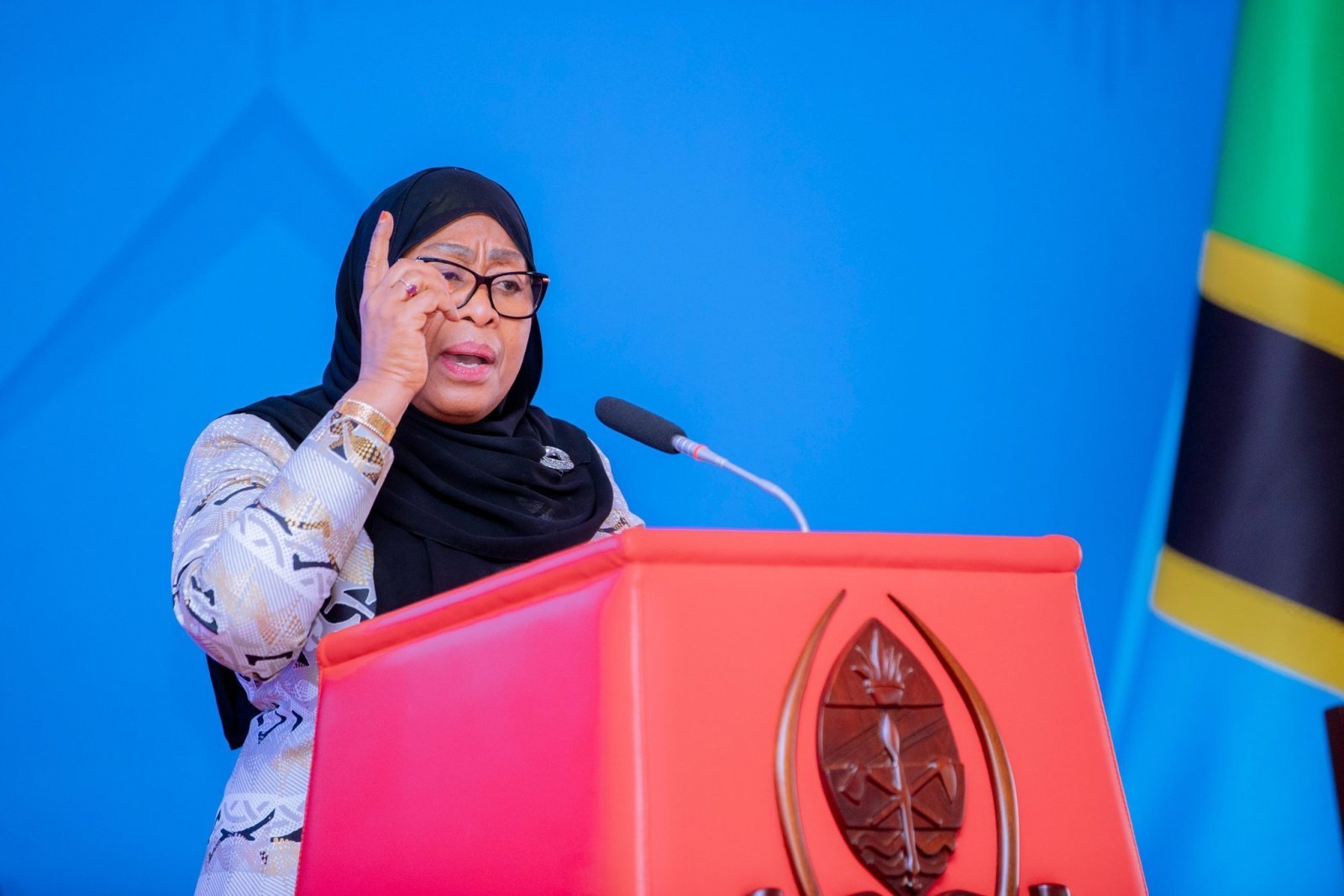
President Samia Suluhu Hassan told Tanzania's newly sworn-in regional leaders on 2 September that local authorities cannot expect every request to be funded by the central Treasury, and that revenue collection, spending discipline and protecting health and education above lower-priority expenditure now have to take precedence over simply asking for more. Her message landed the same week IMF Managing Director Kristalina Georgieva warned that continued disruption of the Strait of Hormuz is pushing global borrowing costs higher for advanced, emerging and low-income economies alike, a claim now illustrated in the starkest way possible: Saudi Arabia, sitting on some of the world's largest oil reserves and a debt-to-GDP ratio of just 33.9%, is in the market for an $8 billion loan of its own. Tanzania doesn't control global interest rates or Gulf shipping lanes. Neither, it turns out, does Riyadh's war bill. Both arrive in national budgets anyway.
ZANZIBAR — President Samia Suluhu Hassan gave one of the clearest public descriptions yet of the fiscal pressure facing Tanzania on 2 September 2026, telling newly sworn-in regional leaders at Ikulu Ndogo in Tunguu, Zanzibar, that the money available from the central government cannot satisfy every demand, and that the response has to be sharper prioritisation rather than repeated requests for more.
Speaking at the swearing-in of new Regional Commissioners and the Regional Administrative Secretary for Pwani, President Samia was direct: "Every leader responsible for an area should strive to ensure things move forward in that area; not everything should come from the government Treasury." She tied the instruction to implementation of the CCM 2025 Election Manifesto and Tanzania's Vision 2050, telling councils to strengthen their own-source revenue collection and use part of it to finance development directly rather than relying so heavily on Treasury transfers.
A Government Comparing Itself to a Household
President Samia reportedly compared the position of government institutions to that of an ordinary household: a person doesn't necessarily receive everything they want, they receive what they receive, and organise their spending around that income. The same principle, she said, has to apply to regions and districts. What comes from the Treasury is what gets delivered, but once it arrives, it has to go toward the activities that were actually planned for it.
That is a notably direct way to describe fiscal scarcity. Governments rarely announce budget constraints by simply saying they cannot afford everything; they usually let the constraint show up indirectly, through delayed projects, arrears, supplementary budgets or revised implementation schedules. Telling local officials plainly that the answer isn't to keep asking for more money, but to make harder choices about what gets funded, is a different register entirely.
Health and Education, Then Everything Else
Healthcare was the clearest example President Samia gave. She acknowledged that some health funds have not been sufficiently disbursed, and that facility performance is deteriorating as a result, saying she would raise the matter with the Ministry of Finance to determine how funding could be released and sustained. But she drew a firm line around which sectors get protected first: health and education, she said, have no real alternative. A farmer who doesn't receive a subsidy can still adjust, buying fewer inputs or scaling back production to match available resources. A child who doesn't get educated, or a patient who doesn't get treated, has no comparable fallback.
That distinction effectively creates a spending hierarchy. When resources are plentiful, governments can fund many priorities at once. When resources tighten, the operative question shifts from what should government do to what must government protect first, and Tanzania's own numbers show where that protection is actually landing: the health sector budget grew from TZS 1.8 trillion in 2024/25 to TZS 3.1 trillion in 2026/27, alongside the continued rollout of universal health insurance and, according to figures President Samia cited separately at an African Union health summit in Accra in July, an increase in health facilities nationally from roughly 10,000 to 13,700 by March 2026.
Contractors, TARURA and Who Owns the Problem
President Samia also raised unpaid obligations to contractors working under TARURA, the Tanzania Rural and Urban Roads Agency, instructing officials to manage those commitments directly rather than treating every financial gap as automatically the central government's responsibility. Her message to local leaders was blunt: not every shortfall is simply "the central government hasn't brought the money." Officials, she said, need to plan properly and identify where spending can be compressed without abandoning the country's underlying development priorities, describing it as an ordinary belt-tightening exercise rather than a crisis response.
That instruction matters beyond administrative tidiness. If Treasury transfers cannot satisfy every demand, local authorities have to make their own decisions about sequencing and priority within the resources they actually receive, and unresolved contractor arrears carry consequences that spread well past the government's own balance sheet: contractors face cash flow strain, construction slows, suppliers get paid late, banks face stressed borrowers, and projects that were already underway simply take longer and often cost more by the time they're finished.
Why a G20 Meeting in North Carolina Matters to Tanzania
The same week President Samia addressed Tanzania's regional leaders, IMF Managing Director Kristalina Georgieva was in Asheville, North Carolina, delivering a warning with direct relevance to exactly the kind of fiscal squeeze Tanzania is describing. Speaking to Reuters on the sidelines of a G20 finance ministers' and central bank governors' meeting, Georgieva said rising bond yields in advanced economies, driven by higher overall debt levels, persistent inflation linked to the still-closed Strait of Hormuz, and competition for capital from AI-related debt issuance, are threatening to undo progress developing and low-income countries have made in managing their own debt. "This is not just a low-income developing countries problem," she said.
The scale of the backdrop is genuinely large. Global public debt now sits at almost 100% of GDP worldwide, per the IMF's own conclusion statement from the meeting, exceeding its post-World War II peak and still climbing. The Strait of Hormuz has remained largely closed since a crisis beginning in late February 2026, and the IMF has separately downgraded its 2026 Middle East growth forecast to just 0.7%, a cut of 1.2 percentage points since April. The pressure on developing-economy debt isn't theoretical either: the IMF announced a staff-level agreement with Senegal at the same G20 session for a $2.2 billion three-year loan package, conditional on Senegal pursuing debt treatment under the G20's Common Framework, a live example of the exact dynamic Georgieva was describing playing out on the African continent in real time.
Even Saudi Arabia Is Borrowing
The clearest evidence that Georgieva's warning is genuinely universal arrived within days of it, and it came from the last place fiscal stress is normally expected to show up. Saudi Arabia's National Debt Management Center has opened early talks with international banks for a five-year syndicated loan of at least $6 to $8 billion, structured so the facility can grow larger if needed, according to Bloomberg reporting. State oil giant Aramco is holding parallel discussions with banks for its own financing. Neither deal is confirmed, and both remain at an early stage.
The kingdom is not in fiscal distress by any conventional measure. Saudi government debt stood at approximately SAR 1.685 trillion in the second quarter of 2026, equivalent to just 33.9% of GDP, a ratio the IMF itself has described as moderate by international standards, and the Fund has separately noted that Saudi Arabia entered the war with Iran carrying low debt, ample reserves and substantial financial buffers. What's changed is the cost of covering a widening deficit: Riyadh posted a second-quarter 2026 deficit of roughly $9.1 billion, an improvement on the first quarter's $33.5 billion shortfall as oil revenue rose 22% year-on-year, but the first-half deficit of about $42.6 billion is already close to the government's full-year forecast of $44 billion, all of it financed through borrowing rather than drawing down reserves.
The $8 billion loan under discussion sits inside a roughly $58 billion full-year 2026 borrowing programme that Riyadh had already approved in January, months before the war began, and it represents only 10 to 14% of that annual target. Saudi Arabia has been an unusually active borrower all year regardless: roughly $6 billion raised through domestic and international bonds, another $4 billion raised by Aramco, and $7 billion raised by the kingdom's sovereign wealth fund in May, one of its first public-market transactions since the conflict started. Late in 2025, the National Debt Management Center had already arranged a $13 billion, seven-year syndicated loan for power, water and public-utility projects, a sign Riyadh was leaning on non-market financing sources even before the current pressure began.
None of this means Saudi Arabia is in trouble. It means a government with oil wealth, low debt and deep reserves is nonetheless actively diversifying how it borrows because a regional conflict has made its usual financing options more expensive to rely on exclusively. If that pressure reaches Riyadh, a government facing none of Tanzania's structural constraints, it is a considerably harder case to argue that Tanzania's own tightening is a local policy failure rather than a symptom of the same global conditions Georgieva described in Asheville.
The Arithmetic Doesn't Arrive All at Once
That pressure rarely shows up as one dramatic event. It accumulates. A government collects a limited pool of revenue against salaries, debt service, contractor payments, hospitals, schools, roads and the development projects already underway, before any external shock even enters the picture. Add higher fuel costs, pricier imports or more expensive financing on top of that, and the arithmetic gets harder without a single new decision being made.
President Samia's comparison to household finances captures that dynamic more precisely than it might first appear. Households cannot spend indefinitely beyond their income without cutting consumption, drawing down savings, or borrowing. Governments have more financing tools, borrowing, taxation, asset sales, spending cuts, project deferrals, but none of those tools create unlimited fiscal space either, and Tanzania is being asked to operate as though that ceiling is now real rather than theoretical.
What Counts as Development Spending Now
Tanzania's underlying development ambitions haven't changed: the country is still investing in railways, ports, energy, roads, water, education, health and industrial infrastructure, much of it economically justified because it expands future productive capacity and, eventually, government revenue. The harder problem is that today's development spending has to coexist with obligations created by yesterday's spending decisions, which is precisely why unresolved TARURA arrears matter beyond one agency's books: a government can announce a road project and award a contract, but the financial obligation doesn't disappear because the project remains popular, and delayed payment doesn't just strain the contractor, it moves financial stress through banks, suppliers and workers connected to that contract.
Debt sustainability, as the IMF's own framework makes clear, isn't determined by debt levels alone. It depends on the relationship between borrowing costs, economic growth, government revenue and the primary fiscal balance together. A fast-growing economy carries debt more comfortably than a slow-growing one facing the same borrowing costs, and a government with strong revenue collection has more room to service debt than one with a narrow tax base, which is exactly why President Samia's push for stronger own-source revenue collection at the local level connects directly to Tanzania's broader debt position, not just to individual district budgets.
The Regional Test Is Shifting
Tanzania isn't alone in facing this pressure, and neither, evidently, is Saudi Arabia. The IMF's warning applies across developing economies broadly, and East Africa is particularly exposed because the region is simultaneously investing heavily in infrastructure while carrying substantial development financing needs. Kenya, Uganda, Tanzania, Rwanda and their neighbours are all trying to expand infrastructure and productive capacity while managing debt and external shocks at the same time, which means the regional competition is no longer simply about which country announces the biggest infrastructure programme. It's increasingly about which country can finance and complete that programme without letting debt servicing and recurrent expenditure crowd out the productive investment the programme was meant to deliver.
Tanzania has real advantages heading into that test: a relatively large domestic market, significant natural resources, a strategic Indian Ocean coastline, expanding infrastructure, and an economy capable of generating substantial domestic revenue. None of that eliminates fiscal constraints. It raises the stakes on getting the quality of fiscal decisions right, since the same advantages that make Tanzania's growth story credible also mean the cost of misallocating scarce resources is larger, not smaller.
President Samia's remarks in Zanzibar should be read as a signal that Tanzania is entering a period where government cannot simply answer every demand with an additional allocation. Some projects will move faster, some slower. Some expenditure gets protected, some gets cut. Some contractors wait longer than they'd like. That is a harder governing posture than the alternative, but it is the posture the same global debt pressures the IMF flagged in Asheville, and that even Saudi Arabia is now navigating, are pushing nearly every economy toward, whether their leaders say so as directly as Tanzania's president did this week or not.
FAQ
What did President Samia actually say to Tanzania's local leaders? Speaking at a swearing-in ceremony for new Regional Commissioners and Pwani's Regional Administrative Secretary on 2 September 2026 in Zanzibar, she said local authorities must strengthen their own revenue collection, cut unnecessary spending, and stop assuming every budget shortfall is the central government's responsibility, stating that "not everything should come from the government Treasury."
Which sectors did she say should be protected first? Health and education, which she described as priorities with no real alternative, contrasted with lower-priority expenditure such as agricultural subsidies, where affected parties may have some ability to adjust their own activities.
What did the IMF warn about the same week? IMF Managing Director Kristalina Georgieva, speaking at a G20 finance ministers' meeting in Asheville, North Carolina, warned that continued disruption of the Strait of Hormuz, combined with global public debt approaching 100% of GDP, is pushing bond yields and borrowing costs higher for advanced, emerging and developing economies alike.
Why is Saudi Arabia seeking an $8 billion loan relevant to Tanzania? It's the clearest available evidence that the fiscal pressure the IMF described isn't limited to low-income countries. Saudi Arabia has low debt (33.9% of GDP) and substantial reserves, yet is still diversifying its borrowing because the same regional conflict driving up costs for Tanzania is also straining its own budget, through military spending, disrupted supply chains and a widened deficit.
Is Saudi Arabia in financial trouble? No. The IMF has described the kingdom's debt level as moderate by international standards and noted it entered the conflict with low debt and ample financial buffers. The $8 billion loan under discussion represents only 10 to 14% of Saudi Arabia's already-approved $58 billion annual borrowing programme for 2026, and reflects a strategy of diversifying funding sources rather than an emergency.
How is Tanzania connected to a shipping crisis in the Middle East? Indirectly but concretely: disruption to the Strait of Hormuz has contributed to global inflation and higher borrowing costs, which raise the price Tanzania pays to import fuel and goods and to finance its own debt and development projects, even though Tanzania has no direct role in the underlying crisis.
Is Tanzania's health budget actually growing despite these warnings about fiscal tightening? Yes. Tanzania's health sector budget rose from TZS 1.8 trillion in 2024/25 to TZS 3.1 trillion in 2026/27, alongside the continued rollout of universal health insurance, consistent with President Samia's stated priority of protecting health and education spending even while asking other areas of government to cut back.
 Uchumi360
Business Intelligence
Uchumi360
Business Intelligence
Uchumi360 covers business, investment, and economic policy across East, Central, and Southern Africa.
For the serious reader
You read to the end. That places you in a small group.
Uchumi360 is built for readers who demand precision over speed, structure over sentiment, and analysis that holds uncomfortable conclusions rather than softening them. If this work sharpens how you think about Africa's economy, help us keep building the infrastructure behind it.
Institutional Partners
Commission intelligence. Shape the conversation.
Uchumi360 works with development finance institutions, investment firms, sovereign bodies, and strategic organisations across the coverage region. Institutional partnership unlocks:
- Commissioned sector and country intelligence reports
- Branded research series under your institution's authority
- Exclusive data briefings for internal strategy teams
- Speaking and editorial presence at Uchumi360 events
- Co-published investment outlooks for your markets
Support Our Work
Independent analysis has a cost. Help us bear it.
Uchumi360 does not carry advertising. It does not take editorial direction from sponsors. Every article is produced without commercial compromise. Your contribution funds the reporting, research, and editorial infrastructure that keeps this analysis free from influence.
Secure checkout: One-time and monthly support are processed securely. Add payment credentials to enable checkout here.
Stay Connected
Keep up with every new insight.
Follow our latest analysis, policy coverage, and market intelligence as soon as it is published. If you need something specific, reach out directly and we will point you to the right research.
