
Dar es Salaam’s Snatching Problem Is Becoming an Economic Risk
Ready
Police data do not show a city overwhelmed by violent crime. But rising anxiety over phone and bag theft exposes gaps in reporting, investigation and urban surveillance. Kigali offers useful lessons, if Tanzania adapts them carefully.
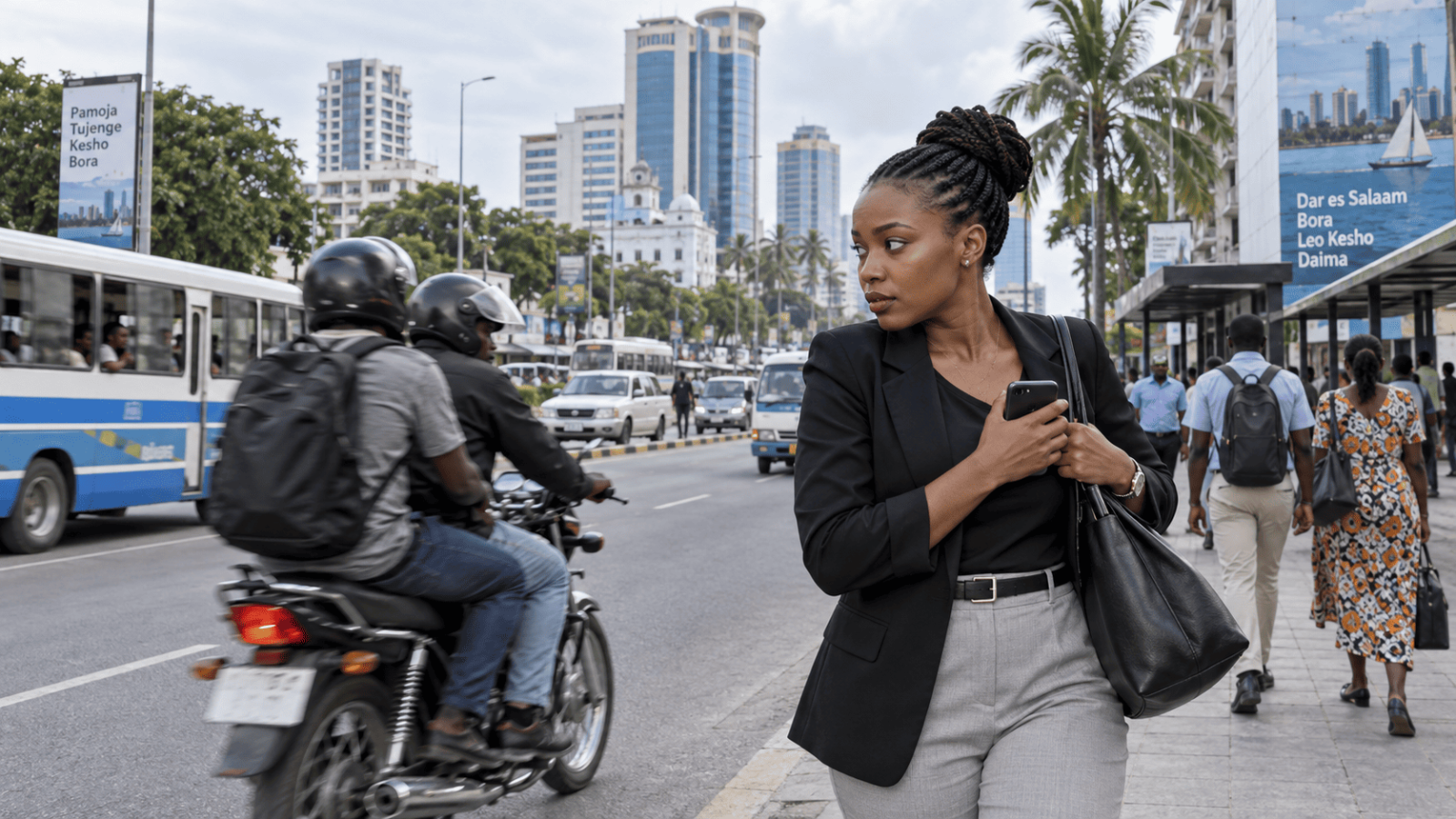
A mobile phone rings beside a road in Dar es Salaam. Its owner does not answer immediately. First comes a look over the shoulder, then a step away from the traffic and a tighter grip on the device.
Across Tanzania’s commercial capital, such small adjustments are becoming routine. Women move handbags away from the roadside. Professionals disguise laptop bags. Motorists close their windows when motorcycles approach in slow traffic. Some residents pay for taxis over distances they would previously have walked.
The anxiety is driven by reports of criminals using motorcycles and other fast-moving vehicles to snatch phones, handbags, laptops and jewellery before escaping through congestion or narrow neighbourhood roads.
Dar es Salaam is not a city defined by crime. It remains one of East Africa’s most vibrant commercial centres: socially active, broadly welcoming and essential to Tanzania’s trade, investment and tourism ambitions. Millions of journeys take place safely across the city every day.
But protecting that reputation requires more than insisting that the city is safe. It requires responding decisively when residents begin changing how they move, communicate and work because they fear losing ordinary possessions in public.
The emerging problem is not only theft. It is the possibility that fear is imposing an informal tax on urban life.
What Tanzania’s police data show
The latest Crime and Traffic Incidents Statistics Report, published by the National Bureau of Statistics using Tanzania Police Force records, offers a more nuanced picture than public anxiety alone.
Tanzania recorded 595,549 criminal offences in 2025, down 3.2% from 615,051 in 2024. Major criminal offences declined by 8.4%, while minor offences fell by 2.7%.
Serious property crimes also declined. Armed robbery fell to 288 cases from 410, robbery with violence dropped to 604 from 1,027, and breaking and burglary declined to 8,053 from 10,749.
Those reductions are material. They suggest that Tanzania did not experience a generalised crime surge in 2025 and that policing, prevention and community cooperation may be producing results in important categories.
The picture is less reassuring in some narrower areas. Theft within the report’s major-property category increased 21.9% to 456 cases, while motorcycle theft edged up to 3,872. The report does not specify how many thefts involved phones, bags or laptops, or how frequently motorcycles were used as getaway vehicles.
Classification creates another difficulty. Tanzania Police Force treats “stealing from a person” as a minor offence, while armed robbery and robbery with violence are major offences. A phone grabbed without significant force may therefore enter a different statistical category from a handbag snatching in which the victim is dragged or injured.
The published data are extensive, but they do not isolate the crime residents increasingly describe: a person on a motorcycle approaching at speed, grabbing a portable item and disappearing before the victim can identify the rider or registration plate.
Dar es Salaam carries Tanzania’s heaviest recorded urban-crime burden
Dar es Salaam recorded 143,611 major and minor criminal offences in 2025, according to police data. That was equivalent to 2,445 offences per 100,000 residents, the highest population-adjusted rate among Tanzania Mainland regions.
Kilimanjaro followed at 1,404 offences per 100,000 people, Mwanza at 1,211, Mara at 1,019 and Pwani at 1,014.
Dar es Salaam also recorded about 10,258 offences per 100 square kilometres, reflecting the concentration of people, commerce and reported crime within a relatively small geographical area. The official report partly attributes such concentrations to population density and economic activity.
These figures do not mean that an ordinary resident has a one-in-41 chance of being attacked. The total covers many types of crime, and one person or institution may be associated with several recorded offences. Regions with more police stations, commercial activity and accessible reporting systems may also record more cases.
Still, the figures establish that Dar es Salaam carries Tanzania’s largest recorded urban-crime load.
Within the city, Kinondoni registered 1,688 major property offences in 2025, the highest of any police region nationally. Ilala recorded 870, an 11% increase from 2024, while Temeke recorded 613.
The three police regions also recorded a combined 67,369 minor property offences: 30,980 in Kinondoni, 19,177 in Ilala and 17,212 in Temeke. This broader category is likely to include many incidents of stealing from people, although the public tables do not separate phone snatching from pickpocketing, shop theft or other property offences.
That is the central data problem. Dar es Salaam has crime statistics, but not enough publicly accessible street-crime intelligence.
Why a stolen phone is an economic event
A smartphone is no longer merely a telephone. It can contain bank accounts, mobile-money applications, passwords, business records, client contacts, identification documents and years of private communication.
For a small trader, the phone may be a payment terminal, customer database and marketing platform. For a gig worker, it is the instrument through which work is assigned. For a professional, a stolen laptop can disrupt contracts, expose confidential information and suspend productivity.
Victims face costs extending beyond the replacement value:
- Money may be stolen through mobile banking or mobile-money accounts.
- Business records and customer contacts can be lost.
- Personal information can be exposed.
- SIM cards, bank cards and identity documents must be replaced.
- Working hours are lost while accounts are secured.
- Injuries may result when victims are pushed or dragged.
- Fear changes future movement and spending decisions.
At city level, these individual losses accumulate. Residents spend more on private transport. Pedestrian activity falls after dark. Roadside businesses lose customers. Employers absorb downtime. Visitors carry away negative impressions.
Crime becomes an economic risk before it reaches the level of a citywide emergency.
Motorcycles are not the problem
Dar es Salaam’s motorcycle economy remains essential. Bodaboda riders provide employment, reduce travel time and serve neighbourhoods inadequately covered by formal public transport.
Most riders are legitimate workers. Collective suspicion would be unfair and economically counterproductive.
The security vulnerability comes from the characteristics that make motorcycles useful: speed, manoeuvrability and access to narrow roads. Offenders can approach a pedestrian, take an exposed item and escape through traffic within seconds. Helmets conceal faces, while folded, obscured or altered plates undermine identification.
The policy objective should therefore be to eliminate anonymity, not to criminalise motorcycles.
The police response is stronger than it appears, but less visible than it should be
Tanzania Police Force regularly conducts operations against robbery groups, motorcycle-theft syndicates and suspected dealers in stolen property. Arrests and recoveries demonstrate that the Force possesses investigative and intelligence capabilities.
The national decline in armed robbery, violent robbery and breaking also deserves acknowledgment. It would be inaccurate to claim that police are doing nothing. The public-confidence problem begins after an ordinary theft report is filed.
A victim may provide the location, time, suspect description and phone’s International Mobile Equipment Identity (IMEI). If there is no readable registration plate, usable camera footage, or immediate witness, the investigation becomes difficult.
What follows is often unclear to the complainant. Victims may not know whether an investigator was assigned, nearby footage was requested, the IMEI was circulated, the incident was connected to similar cases or recovered devices were checked against reported identifiers.
This does not prove that no investigation occurred. It shows that investigation outcomes are not communicated consistently.
The national report details offences received but does not provide a complete public breakdown of street-theft cases investigated, cleared, prosecuted or concluded with property recovery. It also does not provide average investigation times.
That opacity creates a damaging cycle. People who believe reporting will achieve nothing stop reporting. Underreporting weakens official statistics. Weak statistics prevent police from seeing hotspots and repeat methods. Criminal groups then benefit from the resulting information gap.
Kigali offers a useful but not necessarily perfect comparison
Comparing Dar es Salaam with Kigali comes with caution. Dar es Salaam is much larger, more populous, more commercially complex and more geographically dispersed. Its congestion and informal settlements create policing challenges that Kigali does not face at the same scale.
Kigali is also not free from crime. The UK Foreign, Commonwealth and Development Office describes Rwanda’s crime level as relatively low but acknowledges burglary, theft, bag-snatching and mugging in Kigali. Canada similarly warns of pickpocketing, bag-snatching and theft in crowded areas, hotel rooms and vehicles.
The difference is not the absence of theft. It is the visibility and integration of the response.
Rwanda’s commercial motorcycle operators generally work within licensed cooperatives and more structured identification systems. Police have arrested riders and impounded motorcycles over concealed or “stealth” number plates, treating deliberate avoidance of identification as a security concern rather than a minor traffic defect.
Kigali also combines cameras, vehicle records, traffic enforcement, local patrols and community-policing structures. Rwanda National Police credits neighbourhood night patrols known as Irondo, Community Policing Committees, youth volunteers and district security personnel with helping prevent theft.
That does not automatically make every policy transferable. Rwanda’s surveillance system raises legitimate questions about privacy, personal freedom and government access to citizen data. Dar es Salaam should adopt traceability and coordination without creating unlimited surveillance.
RIB gives victims a clearer investigative route
Another structural difference is the Rwanda Investigation Bureau (RIB), which is separate from the Rwanda National Police.
RIB receives complaints, conducts criminal investigations, gathers evidence and prepares files for prosecutors. Its public services include online case reporting, a dedicated telephone-theft complaint form, lost-and-theft certification and the toll-free investigative number 166.
A dedicated phone-theft process does not guarantee recovery. It does, however, standardise how critical details, including IMEI numbers, telephone information and the circumstances of theft, enter the investigative system.
RIB also publicises investigations that connect apparently separate offences. After receiving complaints about technology-assisted theft of vehicle components, phones, supermarkets and fuel stations, it reported arresting a six-person group with specialised mechanical knowledge. Investigators treated the incidents as connected organised activity rather than unrelated complaints.
In a separate fraud case, suspects were tracked and arrested individually in Kigali after investigators followed communication and payment trails. RIB has also demonstrated cooperation with telecom operators and regulators: information supplied by MTN Rwanda assisted an investigation that uncovered SIM-box operations in Kigali and Rusizi.
The street-theft lesson is straightforward. Ten phones stolen along the same corridor at similar times may not represent ten unrelated crimes. They may point to one group, one motorcycle, one receiver or one electronics shop.
Rwanda measures the justice chain more visibly
Rwanda’s strongest efficiency figures relate to the wider prosecution system rather than RIB alone. During the 2023/24 judicial year, the National Public Prosecution Authority received 90,493 case files and processed 90,079, about 99.5%. Theft and voluntary assault were reported as the country’s most prevalent offences, together accounting for 57% of recorded criminal cases.
Rwanda also reported a prosecution conviction rate of about 93%. Authorities attributed the performance to electronic indictment, technology-assisted case management and training for investigators and prosecutors. That figure applies to cases reaching prosecution and judgment; it does not mean 93% of all crimes committed in Rwanda resulted in convictions.
The distinction matters. Rwanda’s relative strength lies partly in measuring each stage: complaints, investigations, files transferred to prosecutors and court outcomes.
Tanzania publishes substantial offence data but less information on clearance rates, investigation time, property recovery and prosecution outcomes. As a result, the public can see the size of the recorded problem more clearly than it can see the performance of the response.
International advisories reinforce Dar es Salaam’s street-theft concern
Foreign travel advisories are not substitutes for Tanzania Police Force statistics. They are designed for travellers and can apply conservative risk standards. Their value lies in identifying recurring methods not isolated in the domestic data.
Australia’s Smartraveller advisory says armed robbery, petty theft and threats of violence occur particularly in Dar es Salaam. It cites regular incidents along Toure Drive and the Msasani Peninsula, including bag-snatching from moving vehicles, and warns that victims may be seriously injured when resisting.
The US Department of State says pickpockets and bag snatchers target people in tourist areas and notes limits in the capacity of local authorities to prevent and investigate some crimes. International security reporting similarly describes much urban street crime as opportunistic and directed at people carrying visible bags and valuables.
These assessments do not establish that Dar es Salaam is broadly unsafe. They corroborate a specific risk that official domestic tables do not yet isolate.
Dar needs an investigation system, not a crackdown
The city’s response should begin with better classification. Police reports should record whether an item was taken from a pedestrian, passenger or motorist; whether force was used; whether a motorcycle was involved; whether the plate was visible; and whether the victim was injured.
Dar es Salaam should then strengthen transparency in its reporting route for stolen phones and portable electronics. Each complaint should capture the IMEI or serial number and generate a reference that victims can follow through SMS or an online portal.
Reports from Kinondoni, Ilala and Temeke should feed into a single analytical system capable of identifying repeated locations, descriptions, motorcycles and receivers.
Motorcycles with concealed, folded or altered plates should be removed from operation until the owner and rider are verified. Commercial motorcycles should be digitally linked to their registered owners, current riders, licences, insurance and associations.
CCTV investment should start with confirmed crime corridors, bus stops, junctions and escape routes. The priority is not the number of cameras but whether they provide readable night images, retain footage securely and allow investigators to retrieve evidence quickly.
The second-hand electronics market also needs attention. Dealers should record the verified identity of sellers and the serial or IMEI numbers of devices they purchase. Technicians and shops repeatedly handling stolen property should face licence suspension and prosecution.
Finally, the Police Force should publish Dar es Salaam property crime data regularly, capturing complaints, arrests, cases cleared, files submitted for prosecution and property recovered. No personal victim information would be necessary.
Protect Dar es Salaam by making crime less anonymous
Dar es Salaam does not need to become Kigali. It needs to learn from Kigali’s strongest features: identifiable commercial motorcycles, multiple reporting channels, connected investigations, cooperation with telecommunications companies and public measurement of case progress.
The city’s reputation is not protected by describing every security concern as an exaggeration. Nor is it protected by sensationalising street theft until Dar es Salaam appears hostile to residents and visitors.
A fair reading of the evidence is more useful. Tanzania’s serious recorded property crimes declined in 2025. Dar es Salaam remains economically active and generally navigable. Police continue to arrest suspects and recover stolen property. At the same time, the city carries the country’s highest recorded crime rate, tens of thousands of minor property offences and a poorly measured snatching problem that is changing public behaviour.
That is not a reason for panic. It is a reason for precision. Dar es Salaam needs better data, faster reporting, readable vehicle identification, connected investigations, regulated resale markets and visible feedback to victims.
A modern commercial capital should allow residents to answer a phone, carry a laptop or walk to a bus stop without constantly looking over their shoulders.
The solution is not fear-driven policing. It is intelligent policing and a city-security system that makes offenders easier to trace, investigations easier to measure, and public confidence easier to defend.
 Uchumi360
Business Intelligence
Uchumi360
Business Intelligence
Uchumi360 covers business, investment, and economic policy across East, Central, and Southern Africa.
For the serious reader
You read to the end. That places you in a small group.
Uchumi360 is built for readers who demand precision over speed, structure over sentiment, and analysis that holds uncomfortable conclusions rather than softening them. If this work sharpens how you think about Africa's economy, help us keep building the infrastructure behind it.
Institutional Partners
Commission intelligence. Shape the conversation.
Uchumi360 works with development finance institutions, investment firms, sovereign bodies, and strategic organisations across the coverage region. Institutional partnership unlocks:
- Commissioned sector and country intelligence reports
- Branded research series under your institution's authority
- Exclusive data briefings for internal strategy teams
- Speaking and editorial presence at Uchumi360 events
- Co-published investment outlooks for your markets
Support Our Work
Independent analysis has a cost. Help us bear it.
Uchumi360 does not carry advertising. It does not take editorial direction from sponsors. Every article is produced without commercial compromise. Your contribution funds the reporting, research, and editorial infrastructure that keeps this analysis free from influence.
Secure checkout: One-time and monthly support are processed securely. Add payment credentials to enable checkout here.
Stay Connected
Keep up with every new insight.
Follow our latest analysis, policy coverage, and market intelligence as soon as it is published. If you need something specific, reach out directly and we will point you to the right research.
