
America Warns Africa About China While Its Billionaires Fly to Beijing. Africa Should Study That Contradiction, Not the Rhetoric.
Ready
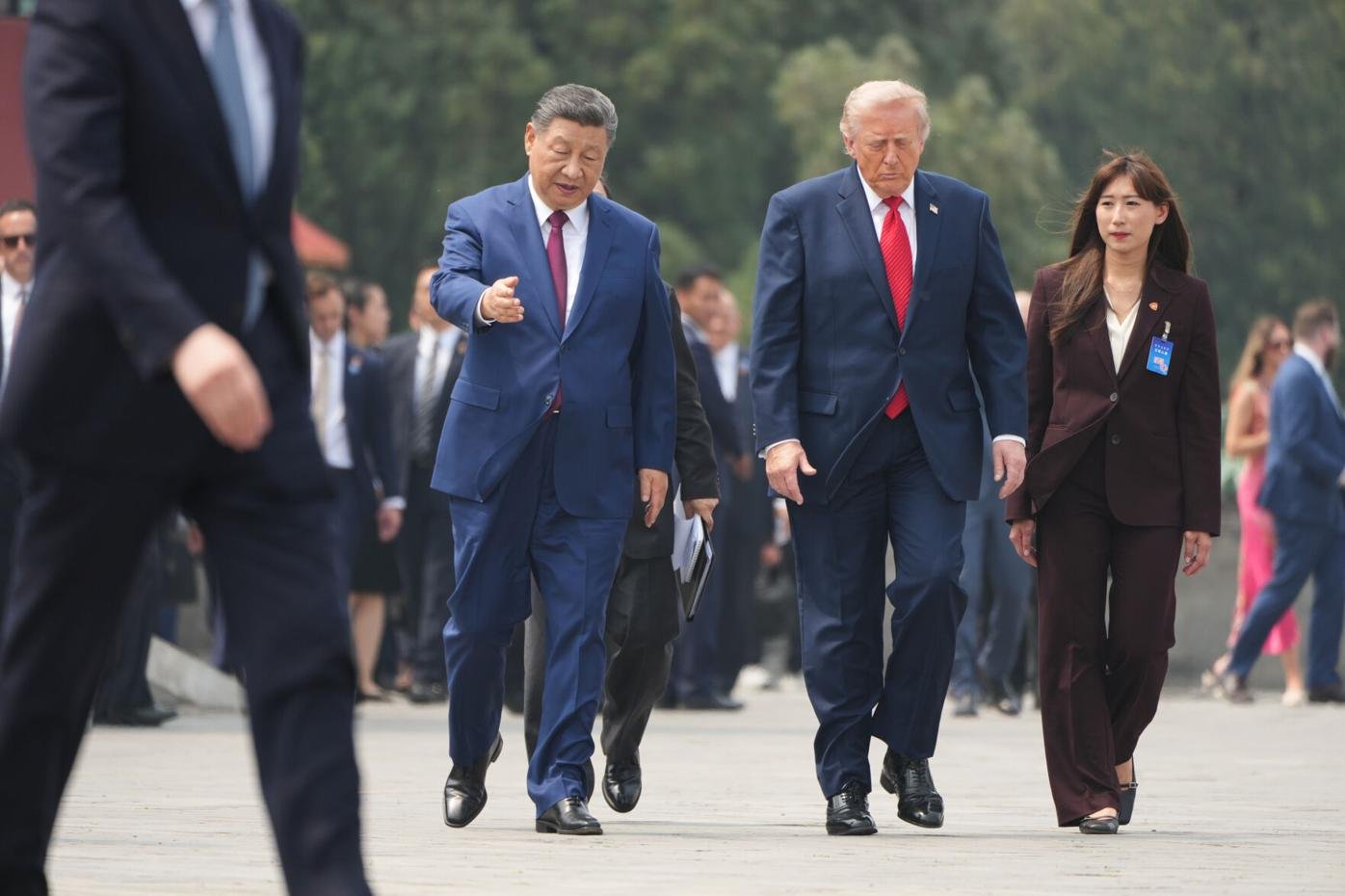
On 13 May 2026, Donald Trump arrived in Beijing for a state visit accompanied by more than a dozen of America's most powerful corporate leaders including Elon Musk, Jensen Huang, Tim Cook, Larry Fink, and David Solomon, introducing them to Chinese leadership as representatives who all respect and value China, while the Observatory of Economic Complexity data published the day before the delegation landed shows that in 2024 the United States bought USD 453 billion worth of goods from China, with machinery and electrical machines alone accounting for USD 212 billion. Musk is in Beijing seeking USD 2.9 billion worth of Chinese solar panel manufacturing equipment and Tesla Full Self-Driving regulatory clearance in a market where the Shanghai Gigafactory is Tesla's largest global export hub. Huang joined Air Force One at the Alaska stopover after Trump personally called him, seeking to unlock stalled H200 chip sales in a Chinese AI market estimated at USD 50 billion annually. Cook is negotiating tariff relief for the approximately 80% of US-sold iPhones manufactured in China. Boeing's CEO expects aircraft orders worth hundreds of aircraft to be announced. Africa is simultaneously being warned about Chinese debt traps and strategic dependence by the government whose CEOs are flying to Beijing on Air Force One. The article argues that Africa should extract the industrial lesson from that contradiction rather than the alignment lesson, because China did not become economically unavoidable through ideology but through four decades of building productive systems the world cannot replace, and that instruction is more consequential for Africa's development trajectory than any position on which side to choose in a competition between powers that are themselves deeply economically integrated.The most important question Africa should ask about the Trump delegation in Beijing is not which side the continent should support. It is why the world's most powerful economy cannot afford to stay away from China, because the answer to that question is an industrial instruction manual rather than a geopolitical alignment guide.
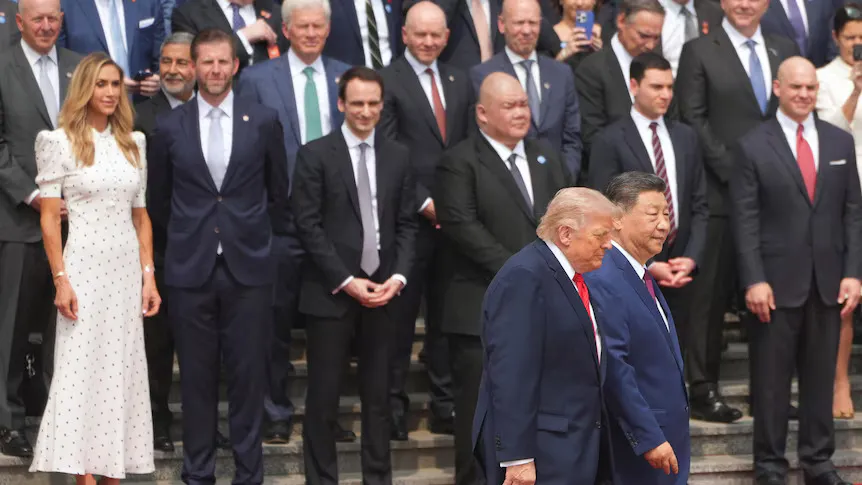
African political discourse often treats China as though it is an ideological trap that serious economies should fear approaching too closely, and that treatment sits in uncomfortable contrast with what the world's most powerful American corporations are simultaneously doing. On 13 May 2026, United States President Donald Trump landed at Beijing Capital Airport for a state visit, introducing to China's Vice President Han Zheng more than a dozen of America's most consequential corporate leaders as, in Trump's own characterisation reported by China's Xinhua news agency, distinguished representatives of the American business community who all respect and value China. The delegation included Elon Musk of Tesla and SpaceX, Jensen Huang of Nvidia, Tim Cook of Apple, Larry Fink of BlackRock, David Solomon of Goldman Sachs, Jane Fraser of Citi, Stephen Schwarzman of Blackstone, Kelly Ortberg of Boeing, and executives from Meta, Visa, Qualcomm, Micron, GE Aerospace, Cargill, Mastercard, Coherent, and Illumina, according to reporting by the BBC, Al Jazeera, and ABC News. These are not obscure commercial actors hedging political risk at the margins of a diplomatic visit. They are the chief executives of the companies that define American technological, financial, and industrial power. Jensen Huang of Nvidia joined Air Force One at an Alaska stopover after Trump personally called him, according to BBC reporting, to support America and the administration's goals in a country whose AI market Huang has estimated at USD 50 billion annually and where Nvidia previously controlled approximately 95% of the advanced chip market before export restrictions were imposed. Tim Cook of Apple is managing the trade economics of the approximately 80% of iPhones sold in the United States that are manufactured in China, according to Reuters figures cited by Al Jazeera. Elon Musk is seeking USD 2.9 billion worth of Chinese solar panel manufacturing equipment and regulatory clearance to expand Tesla's Full Self-Driving system in a country where the Shanghai Gigafactory is Tesla's largest global export hub and reported sales of 292,876 vehicles in the first four months of 2026 alone. Capital behaves differently from ideology, and capital rarely lies about where productive value exists.
The USD 453 billion that makes the contradiction impossible to dismiss
The Observatory of Economic Complexity data published on 12 May 2026, the day before Trump's delegation landed in Beijing, provides the single most precise quantification of the contradiction between American political rhetoric about China and American commercial reality with China. In 2024, the United States bought USD 453 billion worth of goods from China, with machinery and electrical machines accounting for USD 212 billion of that total, bedding, furniture, toys, and games at USD 57.9 billion, textiles at USD 31.9 billion, metals at USD 28.1 billion, plastics and rubbers at USD 24.3 billion, chemical products at USD 22.8 billion, cars, parts, and transport at USD 19.9 billion, instruments at USD 13.9 billion, and footwear and headwear at USD 13.7 billion. The political system simultaneously labels China a strategic rival and sources USD 212 billion of machinery from it annually. The country whose government warns Africa about Chinese debt traps and strategic dependence bought USD 453 billion of Chinese goods in a single year whose trade relationship is too commercially consequential to exit regardless of the political environment whose signals the same government is sending.
That figure is not incidental context for the Trump-Xi summit. It is the economic reality that the summit is designed to manage. According to independent China strategist Andrew Leung, quoted by Al Jazeera, the presence of top US CEOs in Beijing signals what Trump needs to take home: market access and investment commitments he can present to his political base with midterm elections approaching and his popularity under pressure. In return, according to the same analysis, China is pressing for tariff relaxation, lifting of sanctions on Chinese entities, greater access to advanced semiconductors, and the opening of markets for Chinese investment in the United States. Both sides are negotiating because both sides need what the other's productive systems provide, which is precisely the outcome that results when one economy builds industrial capacity at a scale that makes it commercially unavoidable to even the most ideologically motivated competitor. The tariff war that saw levies exceeding 100% on both sides, according to Al Jazeera and BBC reporting, has been partially suspended through a truce agreed in South Korea in October 2025, and the Beijing summit is designed to extend that truce, because the USD 453 billion trade relationship whose disruption the tariffs threaten is too commercially consequential for either side to sustain full decoupling regardless of the strategic competition framework both governments are simultaneously articulating.
What China built to make itself indispensable to its rivals
China did not become the economy that even its most powerful competitor cannot stay away from through political rhetoric, diplomatic positioning, or ideological appeal. It became indispensable because Beijing spent four decades building productive capacity at a scale the modern world had never previously seen, constructing factories, ports, highways, industrial zones, rail systems, manufacturing ecosystems, export infrastructure, technical workforces, and supply chain integration capable of producing enormous volumes of industrial output competitively across every category that the USD 453 billion American import bill documents. According to National Bureau of Statistics of China industrial output data, China produces more steel than the rest of the world combined, dominates solar panel manufacturing whose economics Musk's USD 2.9 billion equipment procurement in Beijing reflects, controls battery processing supply chains, leads in industrial machinery exports, and has built shipbuilding capacity making it the dominant commercial vessel producer globally. According to IEA Critical Minerals Market Review 2023 data, China refines approximately 80% of global graphite, 60% of lithium, and dominant shares of rare earth elements and cobalt, not because China holds the largest raw reserves in every category but because it built the processing infrastructure, industrial chemical engineering capability, and manufacturing ecosystems that converted raw material access into supply chain control.
The rare earth dimension of the Trump-Xi summit is itself confirmation of how completely China's industrial positioning has converted geological endowment into geopolitical leverage. According to Al Jazeera reporting on the summit agenda, China controls the majority of global mining and processing of critical rare earth metals whose restriction Beijing has deployed as a trade war instrument, with export restrictions on seven of twelve specific rare earth categories imposed in April 2025 and a planned second tranche of five more paused as part of the October 2025 truce whose extension the Beijing summit is designed to negotiate. The United States cannot resolve this vulnerability through political rhetoric. It is attempting to resolve it through the USD 52 billion CHIPS Act semiconductor manufacturing investment and through the rare earth processing and battery manufacturing incentives of the Inflation Reduction Act, whose combined scale reflects the cost of recreating in America the industrial processing capability that China built over forty years through a different policy approach. The political system is catching up to the economic reality that corporate behaviour has been reflecting all along: industrial capacity is the foundation of commercial power, and no amount of geopolitical positioning substitutes for its development.
Why Africa's geopolitical conversation is extracting the wrong lesson
Africa often misunderstands the relationship between political alignment and economic power in ways that direct the continent's geopolitical energy toward the least consequential dimension of the global competition it is being asked to participate in. African countries are repeatedly pressured to choose sides inside the US-China strategic competition, with Western governments framing the alignment question as a choice between democratic values and authoritarian influence, and Chinese engagement framing it as a choice between win-win cooperation and Western conditionality. Both framings treat the alignment question as the primary variable whose answer determines Africa's development trajectory, which is analytically incorrect in the way that matters most for the continent's long-run economic positioning.
The Trump-Xi summit of May 2026 provides the most current and most specific available evidence that the alignment question is not the primary variable. The world's largest democracy is in Beijing with its most powerful technology, finance, and industrial CEOs seeking market access, manufacturing permissions, chip sales clearances, and aircraft orders from the country its political leadership simultaneously frames as a strategic rival. According to BBC reporting, Xi told the delegation that American companies will have broader prospects in China, and Trump told Xi he would make his very first request the opening of China to American firms so that these brilliant people can work their magic. The bilateral relationship is being managed through commercial negotiation rather than through ideological positioning, because the productive systems China built make commercial negotiation the only rational framework for managing a USD 453 billion annual trade relationship whose disruption imposes costs on both sides that the political competition framework cannot absorb without economic damage whose scale both governments understand.
Africa should extract the industrial lesson from that pattern rather than the alignment lesson, because the industrial lesson is the one whose application to Africa's own development trajectory would change the continent's negotiating position in ways that alignment choices cannot. According to Harvard Growth Lab Economic Complexity Index research, the countries that have most successfully improved their positions in the global income hierarchy are the ones that increased their productive complexity, building manufacturing capability, supply chain depth, and technical workforce development that made them commercially consequential regardless of the geopolitical alignment framework in which that commercial consequence was evaluated. China's global influence is a function of its productive power rather than its political system, and the instruction for Africa is that productive power is what the continent must build rather than the political positioning that productive power would eventually make more consequential.
What Africa supplies and what it fails to capture
Africa currently exports many of the minerals feeding the industries China now dominates, supplying critical inputs into the global industrial economy while processing, manufacturing, and value addition accumulate in the jurisdictions whose industrial investment converted raw material access into supply chain control. The rare earth restriction that China deployed as a trade war instrument against the United States, documented in Al Jazeera's summit reporting, originates in processing capacity that China built from African and other raw material inputs rather than from Chinese geological endowment alone. According to USGS Mineral Commodity Summaries 2024, the Democratic Republic of Congo accounts for approximately 74% of global cobalt production. Tanzania holds graphite at Mahenge and Epanko whose battery anode material significance Benchmark Mineral Intelligence documents as globally consequential, nickel at Kabanga increasingly viewed as one of the world's most strategically important undeveloped nickel resources, and helium in the Rukwa Basin essential for the semiconductor manufacturing that Huang's Nvidia chip sales negotiation in Beijing reflects. Zambia produces copper. Zimbabwe holds lithium reserves. Southern Africa supplies platinum group metals whose applications span the full technology economy.
The continent supplies critical inputs and captures the extraction margin while the processing, manufacturing, refining, and value addition whose combined economic return substantially exceeds the extraction margin accumulates elsewhere. China recognised earlier than most countries that controlling raw materials alone was insufficient for the supply chain leverage that industrial power generates. The real power existed in controlling processing capacity, industrial manufacturing, logistics systems, and supply chain integration around those materials, and Beijing built the refining capacity, battery production systems, chemical processing infrastructure, and manufacturing ecosystems that converted African raw material access into Chinese supply chain control. The rare earth export restriction that is on the Trump-Xi negotiating table in Beijing is not simply a trade war instrument. It is the most recent demonstration that industrial processing capacity converts geological endowment into geopolitical leverage, and that the conversion requires the industrial investment that Africa has historically deferred while China made it.
What Tanzania's trajectory represents within this framework
Tanzania's current economic direction deserves regional attention precisely because it represents an attempt to strengthen productive capability rather than merely consumption capacity, and the distinction between those two development orientations is the distinction between the approach that made China globally indispensable and the approach that kept Africa globally peripheral despite its resource endowment. According to Standard Chartered Bank's official announcement of 28 April 2026, the USD 2.33 billion SGR financing for Lots 3, 4, and 5 is restructuring Central Corridor logistics economics in ways that reduce the transport cost component of manufacturing and processing investment for corridor-adjacent facilities. According to Tanzania Electric Supply Company operational records, installed electricity generation capacity has crossed approximately 4,000 megawatts, creating the energy foundation whose industrial investment significance Uchumi360 documented in its May 2026 energy analysis. Tanzania's critical minerals pipeline across graphite, nickel, helium, and rare earths, combined with natural gas reserves whose domestic industrial applications in fertiliser production and industrial energy supply create productive rather than simply extractive economic activity, collectively describe a country whose infrastructure investment programme is attempting to build the physical enabling conditions for the processing and manufacturing investment that converts resource endowment into supply chain position.
The Trump-Xi summit's rare earth agenda is directly relevant to Tanzania's mineral strategy because it demonstrates in real time the leverage that processing capacity generates for the economy that holds it. China's ability to restrict rare earth exports as a trade war instrument against the United States depends not on the geological endowment whose distribution gives African countries dominant positions in several critical categories but on the processing infrastructure whose construction China prioritised and Africa has not. Tanzania's graphite, nickel, and helium assets create the geological positioning from which processing leverage could be built if the licensing frameworks, processing requirements, and industrial financing instruments are designed to embed processing investment in the commercial architecture of each mineral development before extraction architecture is established. The licensing decisions being made now will determine whether Tanzania holds a seat at the table whose terms the Trump-Xi summit is illustrating or remains at the extraction layer whose position the summit's rare earth negotiation is designed to manage rather than to transfer.
The industrial instruction that Africa must extract from the Beijing delegation
The Trump delegation in Beijing on 13 May 2026 is Africa's most current and most precisely documented confirmation of the article's central argument: America warns Africa about China while its own capital rushes there, and the reason its capital rushes there is industrial rather than ideological. Musk needs Chinese solar panel manufacturing equipment whose scale and cost competitiveness Chinese industrial investment over four decades has made impossible to source elsewhere on equivalent terms. Huang needs access to a Chinese AI market whose development Chinese manufacturing and technology investment created. Cook needs the Chinese manufacturing ecosystem whose iPhone production capacity Apple cannot quickly replicate elsewhere despite significant investment in diversification toward India and other locations. Ortberg needs aircraft orders from a market whose commercial aviation demand Chinese economic development generated. The delegation is in Beijing not because its members are ideologically sympathetic to China but because Chinese industrial capacity is commercially indispensable to American business in ways that the USD 453 billion annual trade figure documents with a precision that no political rhetoric can obscure.
Africa's development conversation needs to make the same transition from emotional to industrial that China's development strategy made before Beijing's commercial relevance became as consequential as its economic indispensability. The continent cannot debate global systems emotionally while others dominate them economically and expect the debate to change the economic outcome. What changes economic outcomes is productive investment, industrial policy, patient capital, and the manufacturing capability that makes a country commercially consequential regardless of which power holds diplomatic primacy in any given decade. The world does not respect countries because they pick sides loudly at summits and alignment forums. It respects countries because they build systems others cannot ignore, and the most vivid available demonstration of that principle is the spectacle of America's most powerful technology and industrial CEOs walking behind their president on a red carpet in Beijing because China built exactly those systems across four decades of productive seriousness that Africa's development discourse has not yet matched with equivalent industrial commitment. The instruction is available in the contradiction. The question is whether Africa extracts the industrial lesson or continues treating the geopolitical one as the primary variable.
FAQ
Who accompanied Trump to Beijing in May 2026 and why does it matter for Africa? According to BBC, Al Jazeera, and ABC News reporting, more than a dozen of America's most powerful corporate leaders accompanied Trump including Elon Musk of Tesla and SpaceX, Jensen Huang of Nvidia, Tim Cook of Apple, Larry Fink of BlackRock, David Solomon of Goldman Sachs, Jane Fraser of Citi, Stephen Schwarzman of Blackstone, Kelly Ortberg of Boeing, and executives from Meta, Visa, Qualcomm, Micron, GE Aerospace, Cargill, Mastercard, Coherent, and Illumina. It matters for Africa because these are the chief executives of the companies whose government simultaneously warns Africa about Chinese debt traps and strategic dependence, demonstrating through their presence in Beijing that Chinese industrial capacity is commercially indispensable to American business in ways that the political rhetoric does not change.
What does the USD 453 billion figure reveal about the US-China relationship? According to Observatory of Economic Complexity data published 12 May 2026, the United States bought USD 453 billion worth of goods from China in 2024, with machinery and electrical machines alone accounting for USD 212 billion. This figure documents the commercial reality that the Trump delegation's presence in Beijing reflects: the political competition framework and the trade relationship coexist because Chinese industrial capacity built over four decades is too commercially indispensable to exit regardless of the strategic competition framework both governments articulate. America cannot simply walk away from USD 453 billion in annual imports, and the CEO delegation in Beijing is the commercial expression of that constraint.
What specific deals were individual CEOs seeking in Beijing? According to Al Jazeera and BBC reporting: Musk was seeking USD 2.9 billion worth of Chinese solar panel manufacturing equipment and Tesla Full Self-Driving regulatory clearance in China, where the Shanghai Gigafactory reported 292,876 vehicle sales in the first four months of 2026. Huang was seeking to unlock stalled H200 chip sales in a Chinese AI market estimated at USD 50 billion annually where Nvidia previously held approximately 95% market share. Cook was managing tariff relief for iPhones approximately 80% of which are manufactured in China. Boeing's CEO expected aircraft orders including potentially 500 Boeing 737 Max jets. Each motivation reflects the commercial indispensability of Chinese industrial and consumer market access rather than ideological affinity.
What is the industrial lesson Africa should extract from this? That China did not become economically unavoidable through political positioning but through four decades of building productive systems the world cannot replace, and that the instruction for Africa is to build the manufacturing capability, processing infrastructure, and industrial depth that makes it commercially consequential rather than to choose the diplomatic positioning that makes it geopolitically affiliated. According to Harvard Growth Lab ECI research, the countries that have most improved their global economic positions increased their productive complexity rather than their geopolitical alignment. China's commercial indispensability reflects productive power, and the instruction for Africa is to build that power.
How does the Trump-Xi summit's rare earth agenda relate to Tanzania's mineral strategy? China's ability to restrict rare earth exports as a trade war instrument against the United States, documented in the summit's negotiating agenda by Al Jazeera and BBC reporting, depends on processing capacity rather than geological endowment. Africa holds many of the raw minerals in the same supply chains, but China's processing infrastructure converted that raw material into geopolitical leverage. Tanzania's graphite, nickel, and helium assets create the geological positioning from which processing leverage could be built if licensing frameworks embed processing requirements before extraction architecture is established. The rare earth negotiation in Beijing is a real-time demonstration of the difference between holding minerals and controlling the industrial processing that converts them into supply chain power.
 Uchumi360
Business Intelligence
Uchumi360
Business Intelligence
- Xinhua News Agency, Trump introduction of US business delegation to China's Vice President Han Zheng, 13 May 2026
- Quoted characterisation of delegates as those who all respect and value China cited from Xinhua via Al Jazeera reporting
- Al Jazeera, "Who are the US CEOs in China with Trump, and what's in it for them?", 14 May 2026
- Delegation composition, individual CEO motivations, Musk's USD 2.9 billion solar equipment procurement, Tesla Shanghai Gigafactory sales data, Apple iPhone manufacturing in China, Boeing aircraft order discussions, Andrew Leung analysis, and China rare earth restriction details cited from this source
- BBC, "Elon Musk and Jensen Huang among CEOs joining Trump on China trip", 14 May 2026
- Full delegation list, Huang's Air Force One addition, Trump personal call to Huang, Nvidia H200 chip sales and Chinese AI market value, tariff war history, and China rare earth export restriction details cited from this source
- ABC News, "Who is in President Trump's entourage of billionaires and executives in Beijing?", 14 May 2026
- Delegation composition, summit agenda, Xi statement on American companies having broader prospects in China, Trump Truth Social quote, and US-China Constructive Strategic Stability announcement cited from this source
- Observatory of Economic Complexity, US imports from China by category, 12 May 2026
- USD 453 billion total, USD 212 billion machinery and electrical machines, USD 57.9 billion bedding and furniture, USD 31.9 billion textiles, USD 28.1 billion metals, and other category figures cited from OEC data as published by AJLabs
- National Bureau of Statistics of China, industrial output data
- Steel production dominance, solar manufacturing, battery processing, industrial machinery, and shipbuilding figures
- Available at stats.gov.cn
- IEA, Critical Minerals Market Review 2023
- China processing market share for graphite, lithium, cobalt, and rare earths
- Available at iea.org
- USGS, Mineral Commodity Summaries 2024
- DRC cobalt production share and African mineral positions
- Available at usgs.gov
- Harvard Growth Lab, Economic Complexity Index
- Productive complexity and economic positioning research
- Available at growthlab.hks.harvard.edu
- Benchmark Mineral Intelligence, Tanzania graphite and nickel supply chain data
- Specific report requires identification before publication
- Tanzania Petroleum Development Corporation, natural gas reserve data
- Available at tpdc.go.tz
- Tanzania Electric Supply Company, operational records
- 4,000 MW capacity figure
- Available at tanesco.co.tz
- Standard Chartered Bank, SGR financing announcement, 28 April 2026
- Available at sc.com
- US Department of Commerce, CHIPS Act implementation documentation
- USD 52 billion semiconductor investment figure
- Available at commerce.gov
Uchumi360 covers business, investment, and economic policy across East, Central, and Southern Africa.
For the serious reader
You read to the end. That places you in a small group.
Uchumi360 is built for readers who demand precision over speed, structure over sentiment, and analysis that holds uncomfortable conclusions rather than softening them. If this work sharpens how you think about Africa's economy, help us keep building the infrastructure behind it.
Institutional Partners
Commission intelligence. Shape the conversation.
Uchumi360 works with development finance institutions, investment firms, sovereign bodies, and strategic organisations across the coverage region. Institutional partnership unlocks:
- Commissioned sector and country intelligence reports
- Branded research series under your institution's authority
- Exclusive data briefings for internal strategy teams
- Speaking and editorial presence at Uchumi360 events
- Co-published investment outlooks for your markets
Support Our Work
Independent analysis has a cost. Help us bear it.
Uchumi360 does not carry advertising. It does not take editorial direction from sponsors. Every article is produced without commercial compromise. Your contribution funds the reporting, research, and editorial infrastructure that keeps this analysis free from influence.
Secure checkout: One-time and monthly support are processed securely. Add payment credentials to enable checkout here.
Stay Connected
Keep up with every new insight.
Follow our latest analysis, policy coverage, and market intelligence as soon as it is published. If you need something specific, reach out directly and we will point you to the right research.
