
Kenya Is Spending USD 37 Billion and Half of It Goes to Debt. Tanzania Has the Region's Second Largest Budget at USD 24.3 Billion and Almost Nobody Is Talking About It. Here Is What Six East African Budgets Actually Tell You.
Ready
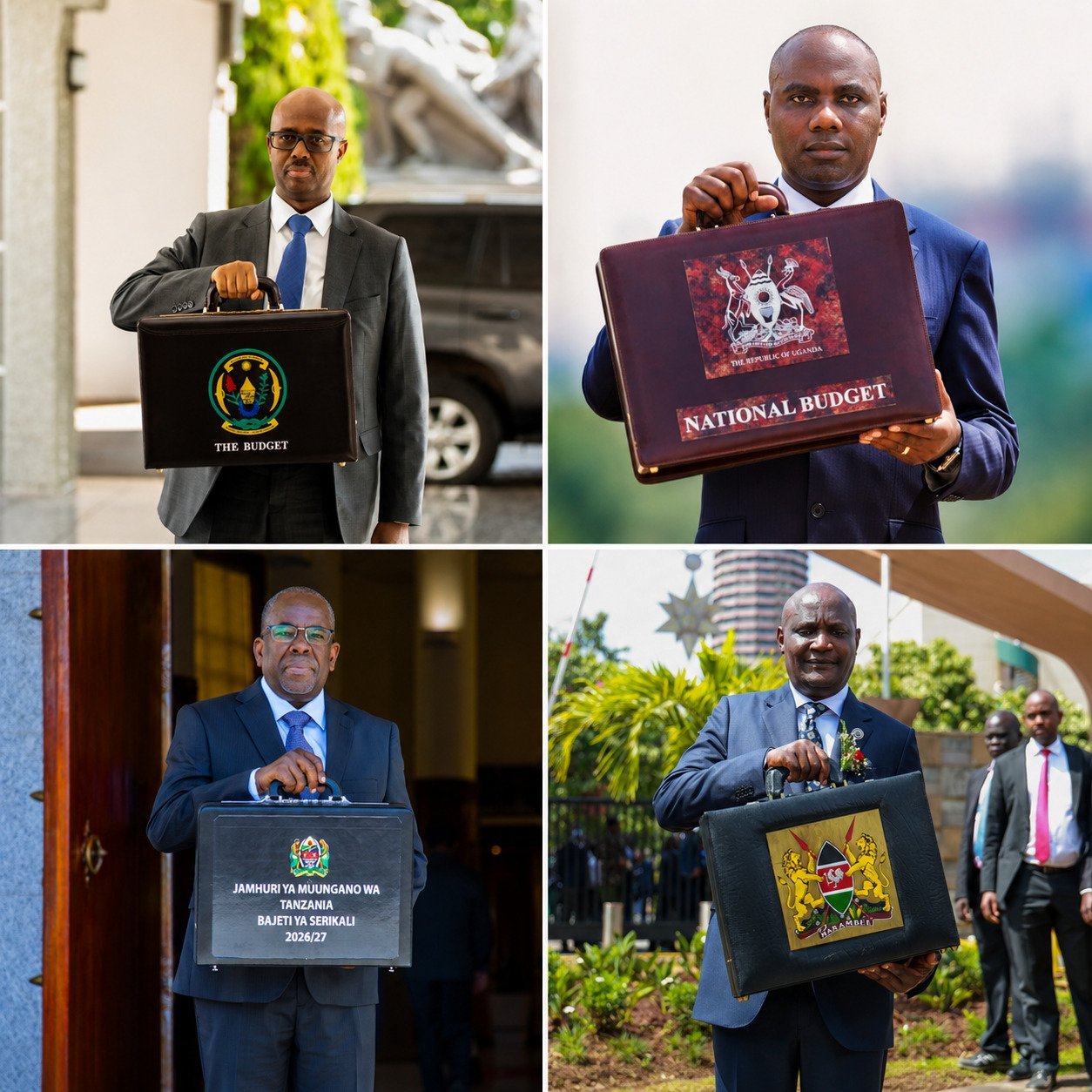
East Africa FY2026/27 confirmed budgets: Kenya USD 37 billion with KSh 2.31 trillion going to debt service before development begins, Tanzania USD 24.3 billion as the region's second largest budget deployed from a position of fiscal health with debt-to-GDP at approximately 40 percent, Uganda USD 22.4 billion stretching a smaller GDP across EACOP, the Kampala-Jinja Expressway, and industrial investment, Ethiopia USD 14.8 billion rebuilding post-conflict while executing transformative energy and digital economy programmes, Rwanda USD 5.3 billion generating 8.9 percent GDP growth through institutional discipline, Burundi USD 2.3 billion structurally constrained for a country of 13 million people. Tanzania's second place position in the regional budget ranking is the most underreported fiscal story in East Africa. The Tanzania-Uganda comparison is the most analytically interesting: Tanzania is USD 1.9 billion ahead of Uganda from a debt position approximately 30 percentage points cleaner. The Rwanda story is the most instructive: the smallest major budget producing the highest growth rate. The Kenya story is the most cautionary: the largest budget increasingly functioning as a debt management instrument. The Burundi story is the most urgent: USD 2.3 billion is structurally insufficient and the gap with Rwanda is widening with every budget cycle. East Africa is not one fiscal story. It is six. And the differences between them tell you more about where the region is going than any single GDP growth rate.
NAIROBI / DAR ES SALAAM — Six East African governments have confirmed their national budgets for FY2026/27, and the aggregate picture they produce is one of the most instructive available views of where the region's fiscal priorities, debt trajectories, and development ambitions actually stand beneath the headline growth rates that dominate the international conversation about East Africa.
Kenya at USD 37 billion. Tanzania at USD 24.3 billion. Uganda at USD 22.4 billion. Ethiopia at USD 14.8 billion. Rwanda at USD 5.3 billion. Burundi at USD 2.3 billion. Six numbers that do not speak for themselves until you ask what each country is spending the money on, where it is coming from, and what the spending is expected to produce.
The answers to those three questions produce a regional fiscal picture whose contrasts are sharper, and whose implications for investors, development partners, and policymakers are more specific, than the headline budget sizes suggest. And the first thing the confirmed numbers reveal is a fact the regional economic narrative has not yet caught up with: Tanzania has the second largest budget in East Africa, and almost nobody is talking about it.
Tanzania: the region's second largest budget that the narrative has missed
Tanzania's FY2026/27 budget of TZS 62.3 trillion, equivalent to USD 24.3 billion at current exchange rates, places it firmly in second position in the East African regional ranking, ahead of Uganda by USD 1.9 billion and behind only Kenya. This is not a marginal difference. It is a structural positioning that the dominant East African economic narrative, which still defaults to Kenya and Rwanda as the primary reference points for regional investment and policy commentary, has systematically underreported.
The budget's size is one part of the story. The fiscal context in which it is deployed is the more important part. Tanzania's debt-to-GDP ratio sits at approximately 40 percent, the lowest among the major East African economies. Inflation at 3.6 percent is among the most stable in the region. GDP growth at 6.0 percent in 2025 is structurally supported rather than debt-financed. The FY2026/27 budget is deploying USD 24.3 billion into an economy whose health can absorb the spending without the fiscal stretch that comparable or larger budgets in the region represent.
What is the USD 24.3 billion building? The SGR network expansion, confirmed by Standard Chartered's USD 2.33 billion syndicated financing and the AfDB's USD 696.41 million approval, is creating transport infrastructure whose regional logistics returns extend well beyond Tanzania's borders. The Julius Nyerere Hydropower Project is generating the energy supply that industrial investment requires. TISEZA's manufacturing investment acceleration at over 900 project approvals in 2025 and running at one new factory per day through 2024 is building the productive asset base that converts infrastructure investment into economic output. The Tanzania-Burundi SGR extension at USD 2.15 billion, the Bagamoyo SEZ declared Tanzania's number one project by President Samia at SPIEF 2026, and the nuclear energy discussions with Rosatom are all being developed within a fiscal envelope whose health gives them the credibility that debt-constrained governments struggle to maintain.
Tanzania has the second largest budget in East Africa. It is spending it from the cleanest fiscal position in the region. That combination is the most underappreciated investment signal in the current East African landscape.
Kenya: the region's largest budget, and its most constrained
Kenya's USD 37 billion budget for FY2026/27, equivalent to KSh 4.82 trillion, is the largest national budget in East Africa by a margin of 52 percent over Tanzania and 65 percent over Uganda. It is also, by the measure that matters most for development outcomes, the most constrained.
Of the KSh 4.82 trillion, approximately KSh 2.31 trillion goes directly to debt service before a single school is built, a single road is laid, or a single hospital is funded. KSh 1.3 trillion of that covers interest payments on existing obligations. Another KSh 1 trillion redeems maturing debt. Against that combined KSh 2.31 trillion flowing to creditors, Kenya has allocated less than KSh 850 billion for development spending. The ratio is nearly three to one in favour of debt service over development.
Recurrent expenditure covering public sector salaries, pensions, county transfers, and operational costs absorbs approximately KSh 3.54 trillion of the total. The public wage bill grew KSh 141 billion in nine months. The financing deficit exceeds KSh 1.1 trillion and will be met primarily through domestic borrowing that competes directly with private businesses for available credit. Treasury CS John Mbadi has warned publicly that even the KSh 3.6 trillion revenue target may not be met.
Kenya's public debt has crossed KSh 13 trillion. The budget that looks like the region's most powerful by headline size is, in functional terms, increasingly a debt management instrument that happens to have a development allocation attached. The USD 37 billion figure is the region's largest number. The story behind it is the region's most cautionary. Kenya is spending USD 12.7 billion more than Tanzania. The development spending gap between them, once debt service is stripped from Kenya's figure, is considerably narrower than that headline difference suggests.
Uganda: the ambitious stretch
Uganda's USD 22.4 billion budget sits USD 1.9 billion behind Tanzania in the regional ranking, a gap that would have been invisible had the earlier TZS 56.49 trillion FY2025/26 Tanzania figure been used in the comparison. The confirmed FY2026/27 Tanzania figure of TZS 62.3 trillion makes the positioning clear.
Uganda is deploying USD 22.4 billion from an economic base roughly 37 percent smaller than Tanzania's and with a debt-to-GDP ratio approximately 30 percentage points higher. The explanation is not recklessness. It is ambition colliding with necessity simultaneously. The East Africa Crude Oil Pipeline at approximately 75 percent completion is consuming capital. The Kampala-Jinja Expressway at USD 1.4 billion under a 30-year PPP concession is under active construction. Kiira Motors' electric bus manufacturing expansion is generating the industrial investment that Uganda's Vision 2040 assigns to manufacturing diversification. Uganda landed a UGX 1 trillion export contract for 820 electric buses from its Jinja Vehicle Plant, described as Africa's largest electric bus manufacturing facility.
These are productive investments whose returns, when oil production begins and when the infrastructure corridor's logistics benefits materialise, should improve Uganda's fiscal position materially. The question the budget size poses is whether Uganda can sustain the fiscal stretch required to fund them from a GDP base that is not yet large enough to absorb the spending without compression elsewhere. The FY2026/27 budget's USD 22.4 billion deployment is a bet that the infrastructure investment compounds fast enough to justify the fiscal pressure it is creating.
The Uganda-Tanzania comparison is now crisper with the corrected Tanzania figure. Tanzania is deploying USD 1.9 billion more than Uganda from a significantly cleaner fiscal position. For investors evaluating the two countries over a three to five year horizon, that combination, more capital deployed with less fiscal risk, gives Tanzania a structural investment environment advantage whose implications for manufacturing, infrastructure, and digital economy investment are direct.
Ethiopia: more than the number suggests
Ethiopia's USD 14.8 billion budget, equivalent to ETB 2.34 trillion, sits in a specific context that the headline number does not communicate: a country rebuilding from the Tigray conflict's economic disruption, navigating a formal debt restructuring completed in 2023, and simultaneously executing one of the most ambitious energy and digital economy investment programmes on the continent.
The GERD at 5,150 megawatts is operational and selling power to Kenya, Sudan, and Djibouti. The Koysha Dam at 2,200 megawatts is under construction. Telebirr has crossed 52 million users. The ICE vehicle import ban has driven EV adoption from under 1 percent to nearly 6 percent of the total vehicle fleet. The Dangote-GCL USD 4.2 billion gas development agreement in the Ogaden Basin targets commercial production by 2029.
These are not the outputs of a government spending cautiously on maintenance. They are the outputs of a government making structural bets on specific sectors while managing the fiscal constraint of a post-conflict, post-restructuring environment. Ethiopia's USD 14.8 billion budget is doing more productive work per dollar than its size suggests, partly because the GERD and Telebirr investments whose returns are now materialising were funded in prior periods, and partly because Chinese financing has provided infrastructure capital outside the conventional budget envelope. The budget number understates the investment programme. The investment programme understates the economic ambition.
Rwanda: the smallest major budget, the highest return
Rwanda's USD 5.3 billion budget, equivalent to RWF 7.79 trillion and the largest on record, is the regional fiscal story whose analytical lesson every finance ministry in East Africa should be studying. It is the smallest major budget in the six-country comparison by a wide margin. It is producing the highest GDP growth rate at 8.9 percent confirmed for 2024 with 7.1 percent projected for 2025 by the IMF.
The Rwanda budget's efficiency is not accidental and it is not simply a function of size. It reflects three decades of institutional discipline whose accumulation has produced the governance quality that makes each dollar of public spending more productive than the same dollar deployed in a less institutionally capable environment. Transparency International's CPI score of 57 out of 100, the highest in the East African Community and 40th globally, is the non-replicable asset whose presence explains why Rwanda achieves more from USD 5.3 billion than several of its neighbours achieve from significantly larger envelopes.
The FY2026/27 budget increase of RWF 844.2 billion above the revised prior year figure is driven by Kigali International Airport rehabilitation and additional RwandAir funding, confirming that the aviation connectivity investment whose Bugesera International Airport project represents the flagship is being funded across multiple budget lines simultaneously. The RWF 513 billion infrastructure deployment in 2025/26 covering road rehabilitation, national paving, urban corridor development, and the Kigali Logistics Platform dry port is infrastructure investment whose quality and execution consistency is the physical expression of the governance premium that Rwanda's budget efficiency reflects.
Rwanda is spending the least of the major economies and growing the fastest. That sentence is the most important sentence in the East Africa FY2026/27 budget comparison. It tells you that budget size is a poor proxy for budget quality, and that institutional discipline is the multiplier that no budget line can purchase directly.
Burundi: the number that demands attention
Burundi's USD 2.3 billion budget, equivalent to BIF 6.9 trillion, is the number in the regional comparison that demands the most urgent attention and receives the least. For a country of approximately 13 million people with acute development needs across health, education, infrastructure, agriculture, and energy, USD 2.3 billion is a structurally insufficient fiscal envelope whose constraint explains more about Burundi's development trajectory than any governance or policy analysis can.
The comparison to Rwanda is the sharpest available. Two small landlocked countries sharing a border, similar populations, similar geographic constraints. Rwanda's budget is USD 5.3 billion. Burundi's is USD 2.3 billion. Rwanda is growing at 8.9 percent. Burundi is not in a comparable growth trajectory. The gap between them is not entirely explained by governance differences, though those differences are real and significant. It is partly explained by the foreign aid and development finance that Rwanda's institutional quality attracts and that Burundi's more constrained diplomatic and governance environment limits.
Burundi's USD 2.3 billion budget is not the result of spending discipline. It is the result of revenue constraint. A government that cannot raise revenue at the scale its development needs require cannot build the infrastructure, fund the education system, or deploy the health services whose provision is the prerequisite for the economic activity that would eventually expand the tax base. The fiscal trap is structural and self-reinforcing. External development finance can alleviate it but cannot resolve it without the governance improvements whose relationship to aid flows creates the sequencing challenge that Burundi's development partners have been navigating for decades.
The Rwanda-Burundi comparison is not a story about two countries. It is a story about what institutional quality compounds into over thirty years. The budget gap between them in FY2026/27 is USD 3 billion. The development outcome gap is measured in decades.
What the six budgets tell investors
The six-country comparison produces one finding that is more commercially relevant for investors evaluating East Africa than any individual country's headline number.
Tanzania has the region's second largest budget at USD 24.3 billion, deployed from the cleanest fiscal position among the major economies, with a debt-to-GDP ratio approximately 30 percentage points below Uganda and with inflation at 3.6 percent. For investors evaluating East Africa's manufacturing investment story, Tanzania's combination of budget size, fiscal health, SGR logistics corridor, TISEZA investment acceleration, and Bagamoyo SEZ positioning makes it the most compelling medium-term productive investment destination in the region whose potential is not yet fully priced into the international investment community's working assumptions.
Rwanda at USD 5.3 billion is generating 8.9 percent growth and demonstrating that institutional quality multiplies every dollar of public investment in ways that larger but less disciplined budgets cannot replicate. For investors requiring governance predictability and regulatory consistency as baseline conditions, Rwanda's budget efficiency is the commercial signal that its governance scores describe in aggregate.
Kenya at USD 37 billion is the region's largest market with its deepest capital markets, most sophisticated private sector, and strongest professional services base. But nearly half its budget is committed to debt service. The investment case for Kenya is strong on private sector depth and weak on government-facilitated infrastructure delivery for the foreseeable future.
Uganda at USD 22.4 billion is making the right long-term infrastructure bets. The returns arrive when oil production begins and when the corridor infrastructure matures. Investors with a 10 to 15 year horizon will find Uganda's trajectory compelling. Investors with a 3 to 5 year horizon will find Tanzania's current position more immediately productive.
Ethiopia at USD 14.8 billion is the long-duration opportunity whose demographic scale, 125 million people at a median age of 19, and energy abundance create the foundation for an industrial economy whose budget today understates the investment programme whose returns are compounding.
Burundi at USD 2.3 billion is a development finance and humanitarian priority rather than a commercial investment destination at current fiscal and governance conditions, with the caveat that its geographic position between Tanzania, Rwanda, and DRC creates a long-duration gateway opportunity whose realisation depends on the institutional improvements that its development partners are supporting.
Budget size tells you how much a government is spending. Fiscal health, allocation quality, and institutional execution tell you what that spending is building. In East Africa's FY2026/27 budget comparison, those two stories are pointing in different directions for several of the six countries. Reading the divergence is the analysis that investment decisions should be built on.
FAQ
Which East African country has the largest budget for FY2026/27? Kenya at USD 37 billion, equivalent to KSh 4.82 trillion. However Tanzania follows as the region's second largest at USD 24.3 billion, equivalent to TZS 62.3 trillion, a positioning that the dominant East African economic narrative has underreported. Uganda ranks third at USD 22.4 billion.
Why is Tanzania's budget larger than Uganda's? Tanzania's confirmed FY2026/27 budget of TZS 62.3 trillion converts to USD 24.3 billion at current exchange rates, placing it USD 1.9 billion ahead of Uganda's USD 22.4 billion. Earlier comparisons using the FY2025/26 Tanzania figure of TZS 56.49 trillion understated Tanzania's position. Tanzania is deploying the larger budget from a significantly cleaner fiscal position, with a debt-to-GDP ratio approximately 30 percentage points below Uganda's.
Which East African country is getting the most growth per dollar of government spending? Rwanda. Its USD 5.3 billion budget is the smallest major budget in the six-country comparison and it is generating 8.9 percent GDP growth, the highest in the region. The efficiency reflects institutional discipline and governance quality, confirmed by Transparency International's CPI score of 57 out of 100, the highest in the East African Community.
What does Kenya's USD 37 billion budget actually fund? Of the KSh 4.82 trillion total, approximately KSh 2.31 trillion goes to debt service, KSh 3.54 trillion to recurrent expenditure covering salaries, pensions, and county transfers, and less than KSh 850 billion to development spending. Kenya spends nearly three times more on debt service than on development. Its public debt has crossed KSh 13 trillion.
What does the Burundi budget tell us about the country's development outlook? Burundi's USD 2.3 billion is structurally insufficient for a country of 13 million people with acute development needs. The constraint is a revenue problem rather than a spending discipline problem. The gap between Burundi at USD 2.3 billion and Rwanda at USD 5.3 billion, two bordering countries of similar size, is partly a governance story and partly a reflection of the development finance that institutional quality attracts or fails to attract. The Rwanda-Burundi comparison illustrates what institutional quality compounds into over three decades.
 Uchumi360
Business Intelligence
Uchumi360
Business Intelligence
- Kenya National Treasury, FY2026/27 Budget Policy Statement
- KSh 4.82 trillion, USD 37 billion.Debt service KSh 2.31 trillion, development KSh 850 billion, recurrent KSh 3.54 trillion.Available at treasury.go.ke
- Tanzania Ministry of Finance, FY2026/27 Budget
- TZS 62.3 trillion, USD 24.3 billion
- Available at mof.go.tz
- Uganda Ministry of Finance, Planning and Economic Development, FY2026/27 Budget.UGX 84.4 trillion, USD 22.4 billion.Available at finance.go.ug
- Ethiopia Ministry of Finance, FY2026/27 Budget
- ETB 2.34 trillion, USD 14.8 billion.Available at mof.gov.et
- Rwanda Ministry of Finance and Economic Planning, FY2026/27 Budget
- RWF 7.79 trillion, USD 5.3 billion.RWF 844.2 billion increase above revised prior year
- Available at minecofin.gov.rw
- Burundi Ministry of Finance, FY2026/27 Budget
- BIF 6.9 trillion, USD 2.3 billion
- IMF, April 2025 World Economic Outlook
- Rwanda 7.1 percent projection, Tanzania 6.0 percent, East Africa fiscal comparisons.Available at imf.org
- NISR Rwanda, GDP growth 2024 confirmed at 8.9 percent.Available at statistics.gov.rw
- National Bureau of Statistics Tanzania, GDP and economic data.Available at nbs.go.tz
- Transparency International, Corruption Perceptions Index 2024.Rwanda 57 out of 100
- Available at transparency.org
- World Bank, East Africa economic data and debt sustainability.Available at worldbank.org
- African Development Bank, East Africa fiscal outlook
- Available at afdb.org
- Uchumi360, "Kenya Is Broke," June 2026
- Kenya debt analysis.Available at uchumi360.com
- Tanzania Investment and Special Economic Zones Authority, TISEZA manufacturing data.Available at tiseza.go.tz
Uchumi360 covers business, investment, and economic policy across East, Central, and Southern Africa.
For the serious reader
You read to the end. That places you in a small group.
Uchumi360 is built for readers who demand precision over speed, structure over sentiment, and analysis that holds uncomfortable conclusions rather than softening them. If this work sharpens how you think about Africa's economy, help us keep building the infrastructure behind it.
Institutional Partners
Commission intelligence. Shape the conversation.
Uchumi360 works with development finance institutions, investment firms, sovereign bodies, and strategic organisations across the coverage region. Institutional partnership unlocks:
- Commissioned sector and country intelligence reports
- Branded research series under your institution's authority
- Exclusive data briefings for internal strategy teams
- Speaking and editorial presence at Uchumi360 events
- Co-published investment outlooks for your markets
Support Our Work
Independent analysis has a cost. Help us bear it.
Uchumi360 does not carry advertising. It does not take editorial direction from sponsors. Every article is produced without commercial compromise. Your contribution funds the reporting, research, and editorial infrastructure that keeps this analysis free from influence.
Secure checkout: One-time and monthly support are processed securely. Add payment credentials to enable checkout here.
Stay Connected
Keep up with every new insight.
Follow our latest analysis, policy coverage, and market intelligence as soon as it is published. If you need something specific, reach out directly and we will point you to the right research.
