
Regionalisation as a Means of Managing Global Economic Risks
Ready
Global economic shocks increasingly travel through energy, food, finance, shipping, technology and security networks, and Africa remains deeply exposed to nearly all of them. Regionalisation offers a genuine way to reduce the speed and severity of that transmission, provided EAC, COMESA, ECOWAS and SADC are understood not simply as trade and political institutions but as potential regional risk management systems, built around energy security, food reserves, regional production, economic intelligence, financial resilience, infrastructure redundancy and coordinated security.
The next major economic shock affecting Africa may not begin in Africa at all. It may begin in the Gulf, the Black Sea, the Red Sea, East Asia, Europe or inside the financial system of a major economy, and arrive on the continent through a rise in the price of oil, a shortage of fertiliser, a disruption to shipping, a collapse in a major export market, a sudden tightening of global credit, a shortage of industrial inputs or a geopolitical decision taken thousands of kilometres away. That is the central strategic problem African policymakers need to confront honestly, because African economies remain deeply connected to systems over which they have limited control. The continent imports a large share of its petroleum products, fertiliser, machinery, technology and manufactured inputs, its currencies are exposed to movements in the dollar, its exports remain concentrated in commodities, its supply chains depend heavily on maritime routes, and its financial systems are wired into institutions and payment networks that sit entirely outside the continent’s own control.
This vulnerability is not theoretical or hypothetical. The war in Ukraine disrupted food, fertiliser and energy markets simultaneously. The Red Sea crisis lengthened shipping distances and raised costs across the board. The 2026 war in the Middle East has again pushed up oil, gas, fertiliser and shipping costs while tightening financial conditions across Africa, and the IMF now expects growth in sub-Saharan Africa to slow from an estimated 4.5% in 2025 to 4.3% in 2026 as a direct result of that shock. The African Development Bank, African Union, UNECA and UNDP have arrived at a similar diagnosis, warning that geopolitical conflicts are transmitted into African economies through hydrocarbons, food, fertiliser, logistics, foreign exchange and capital markets, and their 2026 joint assessment specifically recommends stronger regional and intra-African trade in oil and fertiliser markets, alongside greater diversification of energy and food supplies.
This is why regionalisation deserves to be reconsidered, not as a retreat from the global economy, not as an argument for economic autarky, and certainly not as an attempt to produce everything within Africa’s own borders, but as an economic insurance mechanism whose objective is to ensure that when a shock originating outside the region hits the global system, countries within the region already have alternative sources of supply, alternative transport routes, shared reserves, regional production capacity, regional financial mechanisms and shared intelligence with which to absorb it. That distinction between regionalisation as insurance and regionalisation as isolation is fundamental to everything that follows in this argument.
The World Economy Has Changed From a System of Opportunity Into a System of Opportunity and Exposure
For much of the post-Cold War period, economic integration was principally discussed as a mechanism for reducing costs. Countries specialised, companies searched for the cheapest suppliers, capital moved toward higher returns, production was distributed across borders, and consumers gained access to cheaper goods as a result, producing extraordinary efficiency gains along the way. Richard Baldwin’s work on the evolution of global production helps explain how this actually happened: in his analysis of the second unbundling of globalisation, production itself became internationally fragmented, allowing countries to join supply chains rather than having to construct entire industries domestically from scratch. But the same architecture that lowered production costs also quietly created dependencies, and the OECD’s research on global value chains shows precisely why that matters, finding that supply disruptions become more damaging when countries depend heavily on concentrated suppliers, while diversification of suppliers can materially reduce exposure to country-specific shocks in a way that simply bringing production home does not necessarily replicate.
This is where the work of Henry Farrell and Abraham Newman becomes particularly relevant to the African case. In their influential 2019 paper, Weaponized Interdependence, Farrell and Newman demonstrated that global networks do not necessarily distribute power evenly, because highly connected networks create central nodes and chokepoints, and governments that exercise jurisdiction over those nodes can obtain information, restrict access and impose costs on everyone else connected to the network. Their subsequent book, Underground Empire, extended that same argument into the infrastructure of global finance, information and commerce, and their more recent work in Foreign Affairs argues that economic infrastructure has increasingly become part of national security strategy in its own right, a profound change in how economic security actually needs to be understood going forward. A pipeline is not simply a pipeline. A port is not simply a port. A payment system, a data centre, a semiconductor supply chain, none of these are merely the neutral industrial or commercial objects they appear to be on the surface, because each one can become a strategic dependency the moment there are insufficient alternatives available to whoever relies on it. The global economy therefore has to be understood simultaneously as a system for producing prosperity and as a system through which geopolitical shocks can travel with real speed.
Regionalisation Is Not the Same as Deglobalisation
This is where the African debate needs considerably greater precision than it often gets. The answer to excessive external dependence is not to replace globalisation with isolation, because that would be economically damaging and, for most African economies, simply impossible given how deeply integrated their financial systems, import needs and export markets already are with the rest of the world. The WTO’s 2026 World Trade Report makes the scale of that danger explicit: under a geo-fragmentation scenario, in which the world splits into competing geopolitical trading blocs and supply chains restructure around alliance lines rather than efficiency, the report projects global GDP falling 5.1% and global exports falling 18.6% relative to baseline by 2050, a considerable cost that would fall disproportionately on economies, including most African ones, that depend heavily on open, multilateral trading arrangements rather than closed regional blocs.
The lesson here is not that regions should avoid integration with the wider world. The lesson is that regional integration should complement global integration rather than substitute for it. Dani Rodrik has spent much of his intellectual career examining precisely this tension: in The Globalization Paradox, he argues that there are real limits to how far economic integration can proceed without creating friction with national policy autonomy and democratic governance, and in Straight Talk on Trade, he argues for a more balanced international economic system in which countries retain sufficient policy space to pursue legitimate domestic economic objectives rather than surrendering all of it to global market discipline. Regionalisation can provide exactly the kind of intermediate layer this framework calls for, sitting between the national economy and the global economy: the national economy becomes the first layer, the regional economy becomes the second, and the global economy remains the third, so that a shock does not have a direct and uncontrolled transmission path running from a foreign conflict straight to a domestic food price, from an overseas refinery shutdown straight to domestic transport costs, or from a disruption in a distant payment network straight to the liquidity of a local company. The region should be capable of absorbing part of that shock before it ever reaches the household or the firm, and that absorption capacity is the actual strategic purpose regionalisation is meant to serve.
Africa Already Has the Institutions. What It Lacks Is a Risk Management Architecture
The most interesting aspect of this argument is that Africa does not need to invent regional integration from zero, because the institutions already exist and have existed for decades. The African Union recognises eight Regional Economic Communities as the building blocks of the African Economic Community, including EAC, COMESA, ECOWAS and SADC, and the real problem is not their absence but the narrow way they tend to be used: these institutions are typically treated primarily as mechanisms for trade negotiations, customs integration and political cooperation, when they could become something considerably more consequential, namely regional economic risk management systems in their own right.
The 2025 African Integration Report, produced jointly by the African Union Commission, UNECA and the African Development Bank, identifies regional integration as a genuine means of strengthening resilience against pandemics, insecurity, climate shocks and geopolitical tensions, while also being honest about the persistent weaknesses that currently hold that potential back: fragmented policies, inadequate infrastructure, barriers to movement and uneven implementation across member states. The World Bank’s August 2026 report, Integrating Africa: From Threads to Hubs, makes an especially important argument in this same direction, contending that Africa’s next phase of integration should move beyond simply connecting markets and should instead build genuine regional production systems, with a framework spanning regional value chains, interoperable customs, transport, energy, digital systems, finance and payment infrastructure. That is exactly the conceptual shift this argument is built around. The question should no longer be only “how much do African countries trade with each other?” The considerably more strategic question is how much of a critical shock African regions can actually absorb without depending entirely on the rest of the world to cushion it for them, and that is a fundamentally different measure of what successful integration actually looks like.
Energy Security Should Begin at Regional Scale
Energy is perhaps the clearest demonstration of why regionalisation matters in practice rather than merely in theory. Africa possesses enormous energy resources, yet many African countries remain structurally exposed to imported fuels regardless, and the African Development Bank notes that 43 of Africa’s 54 countries are net importers of crude oil or petroleum products, meaning that when global oil prices rise, the effect appears rapidly in fuel prices, transport costs, inflation, current account balances and currencies across the vast majority of the continent’s economies. The 2026 Middle East shock demonstrated this problem again in real time: the IEA reported that the disruption was particularly severe in refined petroleum markets specifically, with diesel and jet fuel among the products most exposed because of limited flexibility elsewhere in the world to replace lost supply quickly.
A regional response to this exposure cannot simply mean producing more crude oil, because crude production without refining capacity does not by itself create energy security. Genuine energy security requires the entire system working together: production, refining, storage, pipelines, electricity generation, transmission, interconnection, fuel distribution and emergency reserves, none of which function as effective insurance in isolation from the others. East Africa already has the beginnings of such a system, with the EAC operating a regional strategy for refineries, petroleum storage and distribution, and an energy programme that identifies regional oil and gas pipelines and the development of regional petroleum infrastructure as explicit priorities, alongside a regional electricity agenda built around interconnection, shared generation projects and regional power trading. Southern Africa has gone further in some respects: nine SADC countries have interconnected their electricity grids through the Southern African Power Pool, and SADC has established regional strategies covering electricity, petroleum, natural gas and renewable energy, with its Regional Gas Master Plan explicitly linking regional gas infrastructure to energy security, industrial development and diversification of the energy mix. West Africa, for its part, has the West African Power Pool, designed to integrate national electricity systems into a genuine regional electricity market, and in January 2025 the World Bank approved a $1.6 billion programme specifically to strengthen regional electricity integration and energy security across the region.
The infrastructure, in other words, is already emerging piece by piece. What is missing is the strategic doctrine that connects it into something coherent. A genuine regional energy strategy should ask not merely where electricity can be generated most cheaply, but where the region has redundancy built in for when drought reduces hydropower output, when conflict interrupts gas supplies, when a pipeline fails, when a shipping route closes, or when a major generating plant simply goes offline unexpectedly. Energy integration, understood this way, is not simply an efficiency project aimed at lowering costs. It is an insurance policy against exactly the kind of external shock this piece opened with.
Food Security Should Move From National Stockpiles to Regional Food Systems
Food security is often misunderstood as nothing more than the ability of an individual country to grow enough food, but that definition is far too narrow to capture how food systems actually fail under stress. A country can produce enough maize but lack the fertiliser to sustain yields. It can have fertiliser but lack the fuel to transport it. It can have fuel but lose the transport corridor that carries it to market. It can have food but lack the storage to preserve it between harvests. It can have storage but face a currency shortage that prevents it from importing the essential inputs it still needs. Food security, understood properly, is therefore a system with many interdependent parts rather than a single output that can be measured in tonnes of grain alone.
The Russia-Ukraine war demonstrated with real clarity how concentrated global markets can transmit a distant regional conflict directly into African food prices. Research published in the African Development Review found significant increases in food, fuel and fertiliser prices across six African countries following the war and other global crises, and the same study found, tellingly, that these shocks had not yet produced a corresponding increase in intra-African trade that might have cushioned the blow. This is precisely where regionalisation can become genuinely useful rather than merely aspirational. The question should not be whether Tanzania, Zambia, Kenya, Ethiopia, Nigeria or Ghana can individually achieve complete food self-sufficiency on their own, an unrealistic and arguably undesirable goal for most of them. The more economically rational question is whether an African region, taken as a whole, can produce, store and move enough of its strategically important foods and agricultural inputs to meaningfully reduce its collective exposure to shocks originating outside the continent.
West Africa already has a Regional Food Security Reserve, which as of 2025 held a projected stock of more than 74,000 tonnes of food distributed across the region for rapid deployment during crises, while SADC is moving toward regional cereal and fertiliser reserves, regional fertiliser procurement and stronger coordination of food and input markets more broadly, and the ECA has separately and explicitly argued for collective regional food security in Eastern Africa built on greater intra-regional trade. There is a useful lesson worth borrowing from Asia here as well: the ASEAN Plus Three Emergency Rice Reserve provides a regional mechanism through which participating countries can access rice during emergencies while preserving their normal commercial trade the rest of the time. Africa does not need to copy that Asian model institutionally, but the underlying principle travels well regardless of geography: food security can be built through pooled regional capacity rather than requiring complete national self-sufficiency from every single country simultaneously.
Fertiliser Is as Important as Food
There is an even more strategic dimension to food security worth drawing out explicitly, because fertiliser is genuinely an energy product as much as it is an agricultural one. Natural gas is an important feedstock for nitrogen fertiliser, which means that when gas prices rise or gas supplies are disrupted, fertiliser prices rise in turn, and when fertiliser prices rise, farmers’ planting decisions change accordingly. When fertiliser application falls as a result, yields can fall too, and the shock has by then moved cleanly from energy markets into agriculture and, eventually, into household food prices. The World Bank has previously documented how the disruption of fertiliser exports from major global suppliers contributed directly to the vulnerability of African farmers, while also highlighting a genuine paradox worth sitting with: Africa produces substantial quantities of fertiliser overall, even as much of sub-Saharan Africa’s actual consumption remains dependent on imports rather than on that domestic production. The African Development Bank’s 2025 fertiliser market analysis similarly identifies import dependence and regional differences in fertiliser markets as central constraints on African agricultural productivity as a whole. What this means, in practice, is that a genuine regional food strategy has to include fertiliser production, gas supply, phosphate resources, blending facilities, distribution networks, storage and market intelligence as core components, not afterthoughts, because the food security question begins well before the seed ever enters the soil.
Economic Intelligence Should Become a Regional Public Good
This may ultimately be the most neglected component of the entire regionalisation argument. Africa needs not only regional markets, it needs regional intelligence about those markets, and economic intelligence in this sense should not be confused with espionage or anything covert. It means systematically monitoring the variables that can cause economic disruption before they actually do: oil inventories, refinery outages, fertiliser prices, shipping rates, port congestion, weather patterns, crop conditions, commodity inventories, sanctions, tariffs, foreign exchange pressures, sovereign refinancing requirements, critical mineral demand, semiconductor restrictions, maritime chokepoints and political instability, tracked consistently enough that a regional institution can identify a developing external shock before it becomes an internal economic crisis rather than after.
The architecture for something like this already exists in the security domain, which makes the conceptual leap to economics considerably easier than building from scratch. The African Union’s Continental Early Warning System collects information and monitors emerging conflicts, operating alongside observation and monitoring centres within the Regional Economic Communities themselves. COMESA’s COMWARN system is even more revealing as a template, using 144 variables across economic, environmental, governance, military, security, health and social dimensions to identify structural vulnerabilities and emerging risks well before they fully materialise. SADC has its own Regional Early Warning Centre, designed to collect and analyse regional information, identify threats and share intelligence with member states, and ECOWAS has its own comparable early warning architecture, with the African Development Bank supporting efforts in 2025 to strengthen its capacity to detect and anticipate regional crises specifically. The conceptual extension from here is genuinely obvious: if Africa can already build systems to detect political and security risks with this level of sophistication, it can build equivalent systems to detect economic risks using the same underlying institutional muscle. An EAC Economic Risk Observatory, a COMESA Economic Intelligence Centre, a SADC Strategic Economic Monitoring System and an ECOWAS Economic Risk Observatory could each monitor the external dependencies that matter most to their respective regions, and the objective would not be to predict every crisis with perfect accuracy, an impossible standard, but simply to reduce surprise. In economic strategy, reducing surprise carries enormous value on its own, because so much of the damage a shock does comes precisely from institutions and markets being caught unprepared.
Defence and Security Are Economic Infrastructure
A road corridor cannot function if armed groups can repeatedly attack it. A pipeline cannot function if it remains vulnerable to sabotage. A port cannot function efficiently if maritime insecurity drives up insurance premiums across every shipment that passes through it. A gas facility cannot operate reliably if the region surrounding it becomes unstable, and a digital payment system cannot be trusted by the people who need to use it if its underlying infrastructure is vulnerable to cyberattack. Security, in other words, is not separate from economic integration in the way it’s often treated in policy discussions. It is part of it, structurally and inseparably.
The African Union’s Peace and Security Architecture already recognises regional organisations as critical components of continental security, with a framework that includes the Continental Early Warning System, the African Standby Force and regional mechanisms operated through organisations such as ECOWAS, SADC and IGAD. SADC’s own security framework explicitly includes regional coordination in defence and security, cooperation among law enforcement and state security services, intelligence training and regional early warning as standing components rather than occasional add-ons, and the Africa Center for Strategic Studies has similarly highlighted intelligence sharing, coordinated border patrols and interoperability as important elements of any credible regional response to transnational threats. The economic implication of all this is straightforward once stated plainly: regional security cooperation should increasingly be designed around the protection of economic infrastructure specifically, ports, railways, pipelines, electricity grids, data centres, telecommunications, mining corridors, food corridors and payment systems among them, so that security policy effectively becomes a working part of economic continuity planning rather than a separate agenda pursued alongside it.
Finance Is the Missing Firewall
There is another external vulnerability that regionalisation needs to address directly, and that is finance itself. A country may have entirely adequate physical supplies of food, fuel or medicine available on world markets and still be unable to purchase them, because its currency has weakened sharply, its foreign exchange reserves have fallen, or international financing conditions have tightened at exactly the wrong moment. This is precisely why financial infrastructure matters as much as physical infrastructure in this argument. The Pan African Payment and Settlement System is an important development in this respect, because it allows African cross-border payments to be made in local currencies rather than forcing every single transaction through a foreign currency and a correspondent banking chain that sits entirely outside African institutions’ control. The EAC approved a regional cross-border payment system masterplan in 2025 that explicitly links payment integration to financial resilience and reduced dependence on foreign intermediaries, while COMESA already operates its own Regional Payment and Settlement System and SADC has its own regional real-time gross settlement infrastructure running in parallel.
The next step should be to start thinking about these systems deliberately as economic shock absorbers rather than merely convenience upgrades to existing payment rails. Regional finance should support emergency trade finance when it’s needed most. Regional development banks should maintain dedicated crisis windows rather than improvising each time. Central banks should explore arrangements that improve liquidity during severe external shocks, and regional institutions more broadly should be positioned to finance the importation of fuel, fertiliser, food or medical supplies precisely when global financial conditions suddenly deteriorate and ordinary channels seize up. None of this is about eliminating the dollar from African economic life, an unrealistic goal in any near-term horizon. It is about ensuring that the dollar is not the only bridge connecting African economies to one another, so that a crisis in one part of the global financial system doesn’t automatically sever every regional economic relationship at the same time.
The Real Objective Is Regional Optionality
The strongest argument for regionalisation, when all of this is put together, is therefore not self-sufficiency. It is optionality. A resilient region should have more than one source of fuel, more than one food supplier, more than one port, more than one transport corridor, more than one electricity source, more than one payment channel, more than one supplier of strategic inputs, more than one financing mechanism, and more than one source of intelligence, because redundancy of this kind is precisely what determines whether a shock becomes a manageable disruption or a full-blown crisis. This principle is consistent with the OECD’s own findings on supply chain resilience, which show that diversification can provide considerably greater protection against external shocks than simple concentration in a domestic or supposedly trusted supplier, and the same logic applies just as directly at the geographic and regional scale. If a landlocked country depends almost entirely on a single port, that dependency is itself a risk regardless of how well that one port happens to function. If several countries share several ports and several corridors instead, the region as a whole has genuine options when any single one of them fails. If a country depends on a single refinery, that too is a risk; if several countries can access several refineries connected by pipelines, rail and road, the region has options there as well. If a country depends on a single electricity source, the same vulnerability applies; if interconnected power systems can draw from hydro, gas, solar, wind and thermal generation spread across several countries, the region again has genuine options rather than a single point of failure. The objective throughout all of this is redundancy, and redundancy does cost money during normal, uneventful times. But its value becomes immediately and unmistakably visible the moment a crisis actually arrives, which is exactly when it matters most.
EAC, COMESA, ECOWAS and SADC Should Become Systems of Complementary Capacity
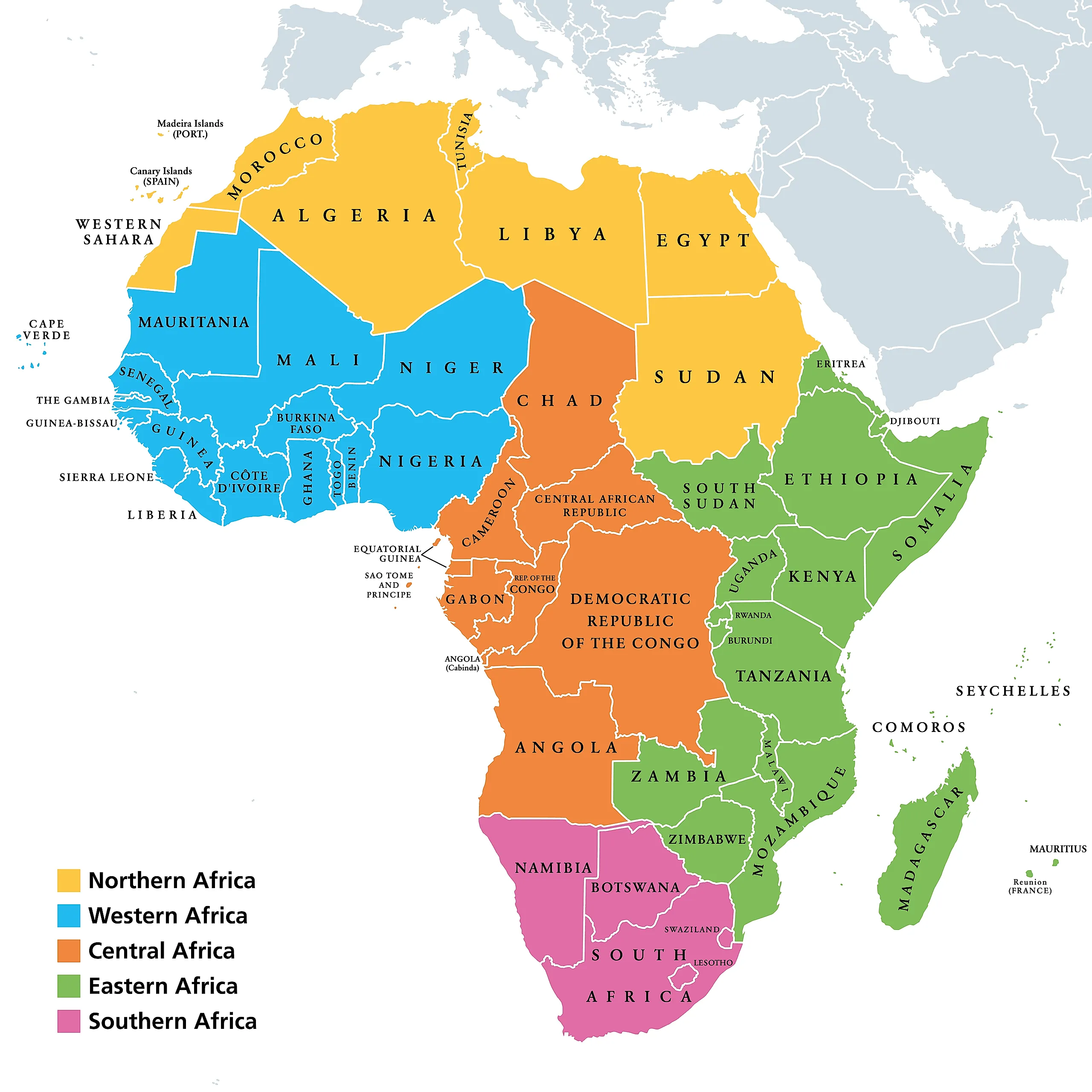
This is where the four major regional groupings can become strategically significant in a way that goes well beyond their current, largely trade-focused mandates. The EAC has an unusually valuable combination of agricultural production, Indian Ocean access, natural gas, emerging oil production, electricity resources, industrial markets and major transport corridors, all sitting within one relatively coherent regional bloc. COMESA provides a much larger economic geography connecting Eastern and Southern Africa, and already has institutions covering trade, payments, financial cooperation and early warning across its 21 member states, more than 640 million people and an estimated combined GDP of about $1 trillion. ECOWAS contains major energy and agricultural capacities of its own, including Nigeria’s enormous hydrocarbon base, West Africa’s power pool and its already-established regional food security mechanisms, while SADC contains some of Africa’s largest mineral, energy, agricultural and industrial capabilities, alongside the Southern African Power Pool and increasingly developed regional financial infrastructure.
The point here is not that each bloc should aim to become completely self-sufficient in every category, which would be genuinely inefficient and would waste scarce capital that could be better deployed elsewhere. The real strategic opportunity lies in complementary capacity instead: one region may have gas, another may have oil refining, another may have fertiliser, another may have grain, another may have hydropower, another may have manufacturing capacity, and another may have deep financial markets, with regionalisation allowing all of these distinct capabilities to become connected systems rather than remaining isolated national assets that never quite reach the scale needed to matter regionally.
Africa Should Measure Regional Integration Differently
The conventional metrics used to measure regional integration, tariffs, trade volumes and investment flows, remain genuinely important, but they are insufficient on their own for an era defined by this much geopolitical uncertainty. Africa should develop something more like a Regional Economic Resilience Index, measuring, among other things, energy import concentration, refining capacity, strategic fuel storage, electricity interconnection, food reserve capacity, fertiliser dependence, regional production of essential medicines, port and corridor redundancy, regional payment capacity, foreign exchange vulnerability, critical import concentration, regional manufacturing depth, cyber resilience, early warning capability, security of strategic infrastructure, availability of emergency trade finance, and the speed with which an essential product can actually be moved from one African country to another during a genuine crisis.
Adopting a measure like this would fundamentally change how regional integration gets understood and evaluated going forward. A region that trades heavily with itself but cannot move electricity across borders during a drought would, under this framework, have a real integration problem regardless of its trade statistics. A region with a comprehensive free trade agreement but no food reserves would have a food security problem hiding behind an otherwise impressive-looking trade relationship. A region with productive oil producers but no meaningful refining capacity would have an energy security problem no amount of crude output can paper over. A region with abundant minerals but no processing capacity would have an industrial security problem built into its very economic structure, and a region with sophisticated security institutions but no equivalent economic intelligence system would simply have an information problem nobody has gotten around to fixing yet. The objective throughout should be resilience, not integration measured and celebrated for its own sake.
Regionalisation Must Avoid Becoming Regional Protectionism
There is an important warning that has to accompany all of this, because regionalisation can fail badly if it curdles into another form of protectionism rather than genuine risk diversification. If countries impose export bans on each other whenever there is a shortage, regional food security can actually deteriorate rather than improve, since the whole point of pooled regional capacity collapses the moment members stop trusting each other to share it during exactly the crises it was designed for. If governments protect inefficient national industries indefinitely in the name of regional solidarity, regional production simply becomes expensive production instead of resilient production. If regional institutions create overlapping and inconsistent rules, businesses end up facing more bureaucracy rather than less, undermining the efficiency gains regionalisation is supposed to deliver alongside its resilience benefits. And if every country insists on building its own refinery, port, railway, power plant or industrial park regardless of actual regional demand, scarce capital simply gets fragmented across duplicated projects that individually never reach the scale needed to be genuinely competitive or resilient.
Africa already knows this problem intimately from experience. The 2025 African Integration Report identifies duplication, fragmented policies and weak coordination among continental and regional institutions as continuing, unresolved challenges rather than solved ones, and Richard Baldwin’s earlier work on regionalism offers a related warning worth taking seriously here too: regional arrangements can become complicated, tangled networks in their own right unless they are ultimately connected through broader, more universal rules that keep them coherent with each other and with the wider global trading system. Regionalisation, in other words, needs a genuine principle of openness built into its design from the start. The region should become more internally connected without becoming externally closed off, regional markets should help African companies become globally competitive rather than permanently sheltered from global competition, regional value chains should feed into global value chains rather than substitute for them, regional infrastructure should connect outward to global ports rather than turning inward, regional energy systems should trade with neighbouring regions beyond their own borders, and regional financial systems should remain genuinely connected to international capital rather than walling themselves off from it. The objective throughout is not a fortress. It is a stronger base from which to engage the rest of the world on better terms.
The Strategic Unit of Economic Security May No Longer Be the Nation State
This may be the most consequential conclusion to draw from everything above. The nation state remains, and will likely remain for a long time, the primary political and fiscal unit through which African governments actually operate. But many of the economic risks this piece has described have already become regional in scale, whatever the political map says. A drought does not respect a customs border. A cyberattack does not stop at a border post simply because the network happens to cross one. An armed group does not necessarily respect a national frontier when its operations threaten a shared transport corridor. A shipping disruption affects several countries simultaneously by definition, since they’re relying on the same route. A refinery outage can raise prices across several economies at once, a disease outbreak can move cleanly through a regional transport corridor before any single government has fully registered what’s happening, a currency crisis can affect neighbouring banks and companies well beyond the country where it originated, and a disruption in fertiliser supplies can affect agricultural production across an entire climatic zone that pays no attention to national boundaries. The geography of risk, in short, has become considerably larger than the geography of the state, and policy now has to catch up with that reality rather than continuing to operate as though national borders still contained the problems governments are actually trying to manage.
The regional organisation, under this view, should not merely negotiate tariffs, which is largely what these institutions have spent their energy on historically. It should monitor strategic dependencies as a matter of course. It should coordinate reserves across member states rather than leaving each to build its own in isolation. It should finance emergency responses when a shock hits, connect infrastructure across borders as a deliberate design choice rather than an afterthought, protect economic corridors as seriously as it protects political ones, facilitate intelligence sharing between member states, coordinate standards so businesses aren’t buried in inconsistent regulation, develop regional production deliberately rather than by accident, and provide genuine mechanisms for financial stabilisation when global conditions turn hostile. In other words, it should manage risk as a core function, not as an occasional side project layered on top of its trade negotiation work.
Africa Does Not Need to Choose Between Globalisation and Regionalisation
The argument for regionalisation should not be built around the assumption that globalisation is somehow ending, because it isn’t. Richard Baldwin’s recent analysis is useful here again: global value chains have not simply disappeared under geopolitical pressure. They are adapting, diversifying and increasingly incorporating services and digital activity into their structure, evolving rather than collapsing. The better question, then, is not whether Africa should turn inward, but how African economies can participate in globalisation without becoming excessively exposed to the risks that same globalisation generates as a byproduct of its own efficiency. That is precisely where Rodrik’s critique of hyperglobalisation and Farrell and Newman’s analysis of weaponised interdependence intersect and reinforce each other: one asks how economic integration can coexist with genuine policy autonomy, and the other asks what happens when economic networks themselves become instruments of geopolitical power that one government can wield against another. For Africa, the answer may lie substantially in regionalisation, understood correctly. Not withdrawal. Not isolation. Not autarky. Diversification, redundancy, scale, optionality and collective capacity instead, each building on the others rather than substituting for them. The World Bank’s newest work on African integration points in precisely this direction, arguing that regional production networks can connect mineral extraction with processing, agriculture with food industries, renewable energy with industrial hubs, and financial and digital services with firms across borders, a considerably more strategic conception of integration than simply reducing tariffs between neighbouring countries ever was.
The Region Should Become the Shock Absorber
Africa cannot prevent wars in other parts of the world. It cannot control the price of Brent crude, determine whether the Strait of Hormuz remains open, or decide whether the Red Sea stays safe for commercial shipping. It cannot control interest rates set in the United States, determine the trade policies of China, Europe or America, or prevent a global recession from happening when the underlying conditions for one align. But it can decide, through deliberate policy choices made at the regional level, how much of those external shocks actually get transmitted into African economies once they occur, and that is the real strategic choice this entire argument has been building toward. A region with interconnected energy systems, diversified food production, strategic reserves, regional payment systems, multiple trade corridors, local manufacturing, functioning economic intelligence and coordinated security will experience an external shock in a fundamentally different way than a collection of countries each facing that same shock entirely on its own.
That is the real meaning of regionalisation, properly understood. It is not the construction of a wall between Africa and the world. It is the construction of shock absorbers between Africa and the world, absorbers that let the continent stay connected to global markets while cushioning the blow when those same markets turn volatile. The strongest regional bloc, by this measure, will not necessarily be the one that trades the most with itself. It will be the one that can keep its essential economic systems functioning when the world outside it becomes unstable, which is a considerably harder and more valuable thing to build than trade volume alone. Africa has spent decades building institutions for regional integration. The next phase should be about building institutions for regional resilience instead, and the strategic question is no longer simply whether Africa can integrate. It is whether Africa can integrate deeply enough that a crisis beginning somewhere else in the world does not automatically become an economic crisis at home.
FAQ
What does regionalisation mean in the context of African economic security? Regionalisation means building stronger economic, financial, infrastructure and security connections among neighbouring countries so that a region can absorb external shocks more effectively than any single country could on its own. It does not mean economic isolation or a push toward complete national self-sufficiency.
Why is regionalisation becoming more important for Africa now? Africa remains highly exposed to external energy, food, financial, shipping and commodity shocks that originate almost entirely outside the continent. Regional integration can diversify sources of supply, create alternative trade routes, expand production networks and provide mechanisms for a genuinely collective crisis response, rather than leaving each country to absorb the same shock alone.
Can EAC realistically become an energy security system? The EAC already runs regional initiatives covering electricity interconnection, power trading, petroleum infrastructure, refineries and oil and gas pipelines. The strategic opportunity now is to connect these existing initiatives into one coherent regional energy security framework rather than leaving them to operate as separate, disconnected programmes.
Can regionalisation actually improve food security? Yes, particularly through regional food reserves, coordinated fertiliser production, shared agricultural intelligence, cross-border food trade, shared storage and genuinely regional agricultural value chains. ECOWAS already operates a regional food security reserve, and SADC is actively developing mechanisms involving cereal reserves, fertiliser reserves and joint procurement between member states.
What role does economic intelligence actually play in this argument? Economic intelligence allows a region to monitor external risks before they become domestic crises, tracking energy prices, shipping disruptions, fertiliser markets, commodity inventories, sanctions, tariffs, exchange rates, climate conditions, supply chain concentration and broader geopolitical developments continuously, rather than reacting only once a shock has already arrived.
Does regionalisation mean Africa should reduce its trade with the rest of the world? Not necessarily, and the stronger argument here is specifically for open regionalism, in which regional production and trade strengthen African firms while keeping them fully connected to global markets rather than sheltering them from competition. The World Bank’s 2026 integration research explicitly argues that regional and global integration can reinforce each other rather than working against one another.
What are the main risks of pursuing regionalisation the wrong way? Regionalisation can become genuinely inefficient if it produces protectionism, duplicated infrastructure, conflicting regulations between member states, or politically motivated industrial projects built for prestige rather than economic logic. The objective throughout should remain regional diversification and scale, not regional isolation dressed up in the language of solidarity.
What is the single most important strategic shift this argument is proposing? The shift is from viewing regional integration primarily as a trade policy exercise to viewing it as economic risk management in its own right. Under that reframing, regional institutions would be responsible not only for increasing trade between member states, but for actively reducing strategic vulnerabilities in energy, food, finance, infrastructure, technology and security across the region as a whole.
 Uchumi360
Business Intelligence
Uchumi360
Business Intelligence
- Core Intellectual References
- The intellectual foundation for this argument is deliberately broad
- Dani Rodrik provides the framework for thinking about the limits of hyperglobalisation and the relationship between global markets and national policy autonomy
- Richard Baldwin provides the framework for understanding geographically distributed production and the evolution of regional supply chains
- Henry Farrell and Abraham Newman provide the framework for understanding how economic interdependence itself can create strategic chokepoints and become an instrument of economic coercion between states
- For the African application specifically, the most important contemporary evidence comes from the 2024 UNCTAD Economic Development in Africa Report, the 2025 African Integration Report, the 2026 World Bank report Integrating Africa: From Threads to Hubs, the IMF’s 2026 Regional Economic Outlook for sub-Saharan Africa, the African Development Bank’s 2026 analysis of global shocks, the WTO’s 2026 World Trade Report, and the regional strategies and systems already developed and operated by EAC, COMESA, ECOWAS and SADC themselves
Uchumi360 covers business, investment, and economic policy across East, Central, and Southern Africa.
For the serious reader
You read to the end. That places you in a small group.
Uchumi360 is built for readers who demand precision over speed, structure over sentiment, and analysis that holds uncomfortable conclusions rather than softening them. If this work sharpens how you think about Africa's economy, help us keep building the infrastructure behind it.
Institutional Partners
Commission intelligence. Shape the conversation.
Uchumi360 works with development finance institutions, investment firms, sovereign bodies, and strategic organisations across the coverage region. Institutional partnership unlocks:
- Commissioned sector and country intelligence reports
- Branded research series under your institution's authority
- Exclusive data briefings for internal strategy teams
- Speaking and editorial presence at Uchumi360 events
- Co-published investment outlooks for your markets
Support Our Work
Independent analysis has a cost. Help us bear it.
Uchumi360 does not carry advertising. It does not take editorial direction from sponsors. Every article is produced without commercial compromise. Your contribution funds the reporting, research, and editorial infrastructure that keeps this analysis free from influence.
Secure checkout: One-time and monthly support are processed securely. Add payment credentials to enable checkout here.
Stay Connected
Keep up with every new insight.
Follow our latest analysis, policy coverage, and market intelligence as soon as it is published. If you need something specific, reach out directly and we will point you to the right research.
