
Rwanda Is Building a USD 2 Billion Airport. The IMF Has Already Flagged the Debt Risk. Both Things Can Be True.
Ready
Bugesera International Airport is Rwanda's most consequential infrastructure bet and its most financially exposed one. The project, a joint venture between the Government of Rwanda holding 40 percent and Qatar Airways holding 60 percent, is designed to replace the capacity-constrained Kigali International Airport with a facility capable of handling 7 million passengers annually in its first phase and 14 million by 2032. As of mid-2025, construction stood at approximately 25 to 30 percent completion. The runway, access roads, drainage systems, and utility infrastructure were completed by the end of 2024, and construction has since moved into the vertical phase covering the terminal buildings and associated facilities. The Rwandan government allocated USD 485.4 million from its 2025 to 2026 national budget to accelerate the project and has secured a 95 percent World Bank guarantee on a significant portion of the construction financing, enabling substantially lower interest rates than commercial borrowing alone would have produced. The IMF has simultaneously warned that the project will push Rwanda's public debt to 86.3 percent of GDP by 2026. The analytical task is not to choose between the optimistic and pessimistic readings of this data. It is to understand what Rwanda is actually trying to build and whether the economics justify the risk.
The Aviation Constraint That Bugesera Is Designed to Remove
Rwanda's existing Kigali International Airport has been operating at or near capacity for several years. Its single runway, limited terminal space, and constrained cargo handling capacity have become binding constraints on the aviation-dependent growth strategy that Rwanda's Vision 2050 requires. Tourism, conferences, business travel, and the high-value cargo that Rwanda's export economy generates all move through an airport whose physical limitations impose a ceiling on the sectors that depend on it.
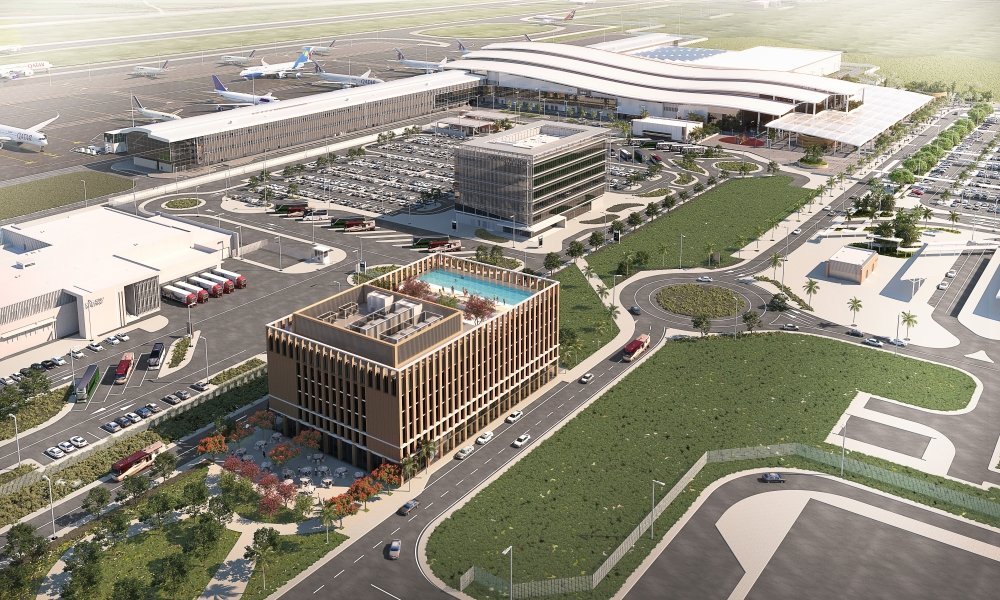
The project intends to replace the ageing and capacity-constrained Kigali International Airport, which has struggled to keep pace with Rwanda's rapid growth in tourism, business travel, and regional connectivity. At the heart of the project is a 3,750-metre runway capable of handling wide-body aircraft, a 120,000-square-metre passenger terminal, and a 14-kilometre express road linking the airport directly to Kigali.
The airport will also feature a dedicated cargo terminal capable of accommodating 150,000 tonnes of cargo annually. This cargo capacity is the dimension of the Bugesera investment that carries the most direct economic significance for Rwanda's structural transformation agenda. A country that is attempting to build export-oriented manufacturing, pharmaceutical production, and technology services exports requires air cargo infrastructure commensurate with those ambitions. The existing airport's cargo handling limitations are a direct constraint on the scale and reliability of air freight that Rwanda's export economy can support.
The Construction Reality and the Financing Innovation
Construction of the airport began in 2017, and the project is being built by a unified entity called UMC, a consortium comprising Mota-Engil of Portugal, UCC Holding of Qatar, and Consolidated Contractors Company of Greece, which holds the construction contract with the government.
In May 2025, Jules Ndenga, Chief Executive of Rwanda's aviation company, confirmed that major works including the runway, drainage systems, and other critical infrastructure were completed at the end of 2024, with construction having since continued on terminal buildings and related facilities.
Rwanda secured more favourable loan terms from development partners, with a 95 percent guarantee on funds allocated for the airport's construction, enabling the country to secure significantly lower interest rates and more flexible borrowing terms. This arrangement allows Rwanda to draw funds when needed, reducing the front-loaded financing cost that construction projects of this scale typically generate.
A consortium of Rwandan banks including Bank of Kigali, BPR Bank Rwanda, and the Development Bank of Rwanda issued guarantees exceeding USD 322 million in July 2025, backed by an USD 84 million counter-guarantee from the African Trade and Investment Development Insurance to facilitate contractor payments and bonds. This domestic banking consortium participation is analytically significant. It reflects Rwanda's financial system depth relative to its regional peers and its institutional credibility with domestic banks at a scale that requires them to take material exposure to the project's success.
The Debt Exposure That Cannot Be Dismissed
The IMF has warned that the cost of Bugesera Airport will significantly intensify Rwanda's debt service pressures and raise the country's public debt to 86.3 percent of GDP by 2026. The IMF commented that risks of overruns on large infrastructure projects need to be vigilantly monitored.
This warning cannot be dismissed as generic IMF conservatism. Rwanda's debt trajectory is real and the airport is the single largest driver of its near-term acceleration. The financing model, combining government equity, Qatar Airways equity, development bank loans, domestic bank guarantees, and World Bank-backed concessional financing, is sophisticated and has produced better terms than initial commercial borrowing assumptions suggested. But sophisticated financing does not eliminate the underlying fiscal exposure of a USD 2 billion commitment whose revenue will not begin flowing until operational launch in 2027 or 2028.
Rwanda's direct financial contribution to the project remains significant, and with a 40 percent stake, the Rwandan government would have to raise close to USD 1 billion taking into account other airport support infrastructure it will have to provide.
The IMF comparison with Euro Zone, UK, and US debt ratios in the same source provides context without providing comfort. Rwanda's debt servicing capacity, measured by export earnings, government revenue, and economic growth, is structurally different from the advanced economies whose higher debt ratios are sustained by deep capital markets, reserve currency status, and mature institutional frameworks. The airport bet is sized relative to a USD 2 billion project against an economy whose total GDP is approximately USD 15 billion, a ratio that would strain any developing economy's fiscal position regardless of the financing terms.
The Hub Competition That Bugesera Must Win
If and when the airport is finished, it will face the challenge of pitching for regional business and influence against the likes of Addis Ababa, which will get a brand new airport of its own eventually, and Nairobi.
This competitive framing is analytically important and consistently underweighted in the promotional narrative around Bugesera. Rwanda's aviation hub ambition is not contested only by its own construction delays and financing challenges. It is contested by Ethiopia's Bole International Airport expansion, by Nairobi's Jomo Kenyatta International Airport upgrade plans, and by the competitive dynamics of African aviation that are creating hub winners and hub losers across the continent simultaneously.
Rwanda's competitive advantages in this hub competition are specific and real. Kigali's geographic centrality relative to the Great Lakes region, the DRC's eastern provinces, Uganda, and Burundi makes it a natural transit point for the regional traffic that would generate the passenger volumes Bugesera requires to reach financial viability. RwandAir's role as the flag carrier anchoring traffic at the new hub is both an asset and a constraint, given its current fleet scale relative to the passenger volumes that a 7 million annual capacity airport implies.
Kigali is already a leading MICE destination hosting high-profile summits and corporate events. Limitations at the current airport, including congestion, limited expansion space, and challenges handling large conference arrivals, have constrained growth. Bugesera removes these constraints for the conference and business tourism market that Rwanda has most successfully developed, which is the near-term demand anchor whose growth trajectory is most credibly established.
The Bottom Line
Bugesera International Airport is Rwanda's highest-stakes infrastructure investment and its most consequential development wager. The construction is real, the financing is more sophisticated than initial commercial borrowing plans suggested, and the demand case for replacing Kigali's capacity-constrained airport is genuinely established. The IMF debt warning is equally real and reflects fiscal exposure at a scale that Rwanda's economic managers cannot afford to mismanage.
Rwanda's Minister of Finance stated in June 2025 that the 2025 to 2026 fiscal year marks the beginning of full implementation, with a firm commitment to complete the airport by 2028. That commitment will be tested by construction pace, financing draw-down efficiency, and the global economic conditions that affect construction costs, supply chains, and the aviation market that Bugesera needs to attract the moment its runway opens.
Rwanda is betting that aviation infrastructure drives economic development rather than simply serving it, and that the hub competition reward is worth the fiscal exposure the bet requires. The bet is coherent. Whether it pays off is the question that 2028 will begin to answer.
 Uchumi360
Business Intelligence
Uchumi360
Business Intelligence
- Sources: IGIHE Bugesera Airport Construction Progress Report May 2025
- CAPA Centre for Aviation Kigali Bugesera Airport Profile June 2025
- Rwanda Ministry of Finance Budget Press Briefing June 2025
- Routes Online Rwanda Bugesera Airport Analysis July 2025
- ATQ News Rwanda Qatar Airways Partnership February 2026
- Grokipedia Bugesera International Airport Entry January 2026
- Web Rwanda Bugesera Construction Update March 2026
- IMF Rwanda Article IV Consultation 2024
- African Development Bank African Economic Outlook 2025
Uchumi360 covers business, investment, and economic policy across East, Central, and Southern Africa.
For the serious reader
You read to the end. That places you in a small group.
Uchumi360 is built for readers who demand precision over speed, structure over sentiment, and analysis that holds uncomfortable conclusions rather than softening them. If this work sharpens how you think about Africa's economy, help us keep building the infrastructure behind it.
Institutional Partners
Commission intelligence. Shape the conversation.
Uchumi360 works with development finance institutions, investment firms, sovereign bodies, and strategic organisations across the coverage region. Institutional partnership unlocks:
- Commissioned sector and country intelligence reports
- Branded research series under your institution's authority
- Exclusive data briefings for internal strategy teams
- Speaking and editorial presence at Uchumi360 events
- Co-published investment outlooks for your markets
Support Our Work
Independent analysis has a cost. Help us bear it.
Uchumi360 does not carry advertising. It does not take editorial direction from sponsors. Every article is produced without commercial compromise. Your contribution funds the reporting, research, and editorial infrastructure that keeps this analysis free from influence.
Secure checkout: One-time and monthly support are processed securely. Add payment credentials to enable checkout here.
Stay Connected
Keep up with every new insight.
Follow our latest analysis, policy coverage, and market intelligence as soon as it is published. If you need something specific, reach out directly and we will point you to the right research.
