
The Isaka-Kigali SGR Is the Most Important Railway Rwanda Has Never Built. The Financing Gap Between the Vision and the Track Is the Honest Story.
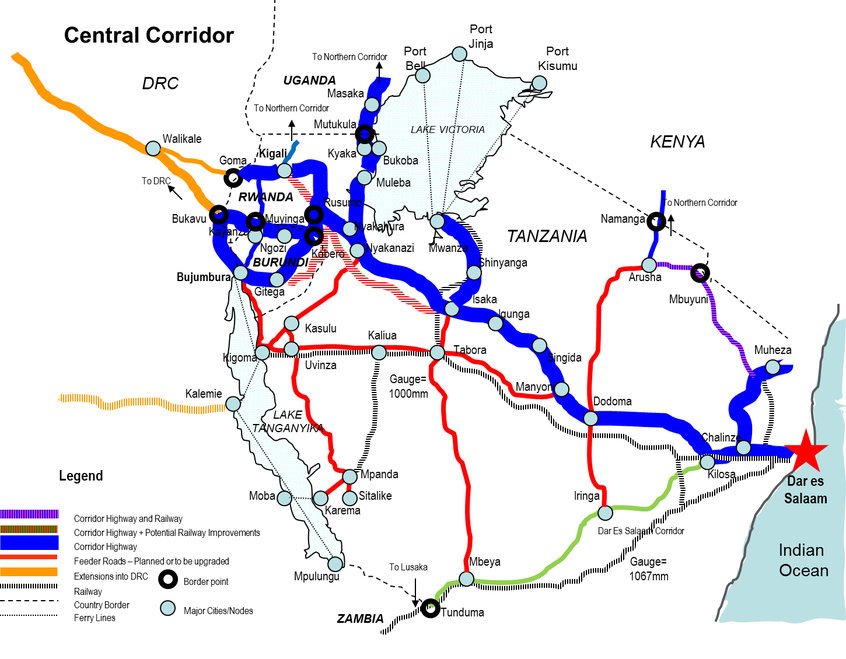
Rwanda has no railway network. Every container of imports arriving from the Port of Dar es Salaam travels the entire Central Corridor by truck, approximately 1,400 kilometres of road freight that imposes a logistics cost on every consumer product, raw material, and industrial input entering the Rwandan economy. A study commissioned for the project estimates that shifting this freight to rail could reduce logistics costs by approximately 40 percent, a reduction that would flow directly into manufacturing margins, consumer prices, and the export competitiveness of Rwanda's growing industrial sector. The Isaka-Kigali Standard Gauge Railway, connecting Isaka in Tanzania's Shinyanga Region to Kigali across approximately 571 kilometres, is the infrastructure project that would make this cost reduction real. It has been formally agreed, feasibility-studied, designed, and discussed at ministerial level between Tanzania and Rwanda for more than a decade. Construction was expected to begin in 2025. As of April 2026, the financing model that would allow construction to begin at scale has not been finalised. The gap between the vision and the track is the honest story.
What the Railway Is and What It Would Do
The Isaka-Kigali Standard Gauge Railway would start at the inland container depot at Isaka in the Kahama Rural District of Shinyanga Region in Tanzania. The line would travel northwestward to the border town of Rusumo in Rwanda's Eastern Province and continue westward to end in Kigali. The Isaka-Rusumo section, measuring approximately 371 kilometres in relatively flat Tanzanian terrain, is estimated to cost USD 942 million. The more mountainous Rusumo-Kigali section in Rwanda, measuring approximately 150 kilometres, is estimated at USD 847 million.
The Rwanda section construction timeline is projected as 2024 to 2028, with full operational capability across all Central Corridor segments expected by 2036. The Central Corridor context is essential: the Isaka-Kigali SGR is the western extension of Tanzania's domestic SGR network, and its commercial viability depends on the Tanzania SGR reaching Isaka at a functionality level that allows seamless intermodal transfer between the Dar es Salaam to Isaka section and the Isaka to Kigali extension.
Tanzania launched SGR freight services on the Dar es Salaam to Dodoma section in June 2025, marking a milestone for corridor logistics. This operational milestone on the Tanzanian domestic SGR is the most encouraging recent development for the Isaka-Kigali project, because it demonstrates that freight is moving on the network that the Isaka-Kigali extension would join. The more the Tanzania SGR develops operational depth and commercial freight relationships, the stronger the economic case for the Isaka-Kigali extension becomes.
The fourth phase covering Tabora to Isaka, a distance of 130 kilometres, was 6.87 percent complete in May 2025, meaning that the connection between the operational Dar es Salaam to Dodoma freight service and the Isaka container depot where the Rwanda extension would begin is itself still years from completion. The full Central Corridor SGR system is a multi-decade infrastructure programme whose individual components are at very different stages of development.
The Financing Challenge That Has Defined the Project's History
The 532-kilometre railway connecting Kigali to Isaka was officially announced in 2018. Construction was expected to begin in 2025 following the completion of feasibility and design studies. The gap between 2018 announcement and 2025 construction start expectation reflects the project's persistent financing challenge rather than engineering or political obstacles.
The total estimated project cost of approximately USD 1.8 billion for both the Tanzanian and Rwandan sections of the Isaka-Kigali link is a sum that exceeds Rwanda's annual national budget and represents a financing requirement that neither Rwanda nor Tanzania can meet from domestic resources alone. The project's financing model requires multilateral development bank participation, bilateral financing, and potentially private sector concessional involvement in a combination that has proven difficult to finalise at the pace that both governments' infrastructure timelines require.
The Isaka-Kigali project sits within a regional infrastructure architecture that is itself still being assembled. The Tanzania SGR's own financing challenges, documented in the Uchumi360 TAZARA analysis with the Yapi Merkezi financing difficulties and the USD 1.8 billion additional financing sought for lots 3 and 4, create uncertainty about the pace at which the Tanzania section will reach Isaka. A railway that ends at Isaka before the Tanzania SGR reaches Isaka from Dar es Salaam generates limited economic value, because the intermodal transfer that makes the full Central Corridor cost advantage over road freight viable depends on both sections operating at commercial freight capacity simultaneously.
The Economic Case That Makes the Financing Worth Pursuing
The economic case for the Isaka-Kigali SGR is not in doubt. It is the financing model that is contested, not the underlying logic.
Rwanda's landlocked geography imposes a structural logistics cost on its economy that no policy reform can eliminate without physical infrastructure improvement. Road freight from Dar es Salaam to Kigali costs approximately USD 3,000 to USD 4,000 per container by current estimates, reflecting fuel costs, driver costs, vehicle wear, multiple border crossing delays, and the time cost of three to four day transit times that make just-in-time manufacturing logistics difficult to achieve at competitive cost. Rail freight on a functional SGR connecting Dar es Salaam to Kigali through Isaka would reduce this cost by approximately 40 percent, bringing it to levels comparable with the logistics costs that competing manufacturing locations in coastal economies face.
Rwanda has plans to extend the SGR to Bugesera International Airport, which would create a multimodal logistics system connecting Dar es Salaam Port to Kigali's new airport through a single integrated infrastructure corridor. Cargo arriving at Dar es Salaam by sea could transit to Kigali by rail and depart for international markets by air, without the road freight segment that currently makes this multimodal system economically impractical. This integrated logistics proposition would materially change Rwanda's competitiveness as a location for export-oriented manufacturing and processing operations.
The 40 percent freight cost reduction, applied across Rwanda's import volumes and the industrial inputs that its manufacturing sector requires, would generate aggregate cost savings that compound across every producing sector of the Rwandan economy. For Rwanda's Vision 2050 ambition of becoming a knowledge and services economy with a significant manufactured goods export component, the logistics cost reduction that the SGR represents is not a marginal improvement. It is a structural competitiveness shift whose magnitude is comparable to a significant reduction in the corporate tax rate applied uniformly across all tradeable sectors.
What Honest Assessment Requires
The Isaka-Kigali SGR is a project whose economic case is sound, whose political commitment from both Tanzania and Rwanda is genuine, and whose construction timeline is uncertain in ways that the promotional framing around it consistently underweights.
The Tanzania SGR's own construction challenges, the Isaka-Kigali financing model's incomplete status, and the multi-decade timeline for the full Central Corridor SGR system to reach operational scale all mean that the 40 percent freight cost reduction that the project's economic case promises is not a near-term outcome. It is a medium to long-term development trajectory whose realisation depends on financing decisions, construction execution, and operational development across multiple countries and multiple project segments that are each individually complex and collectively more complex than any single one.
Rwanda's economy is growing at 7.8 percent and its institutional quality is the strongest in the coverage region. It will benefit from the Isaka-Kigali SGR when it is built. The question is how the financing model is structured, when construction begins at scale, and how the project's development is sequenced relative to the Tanzania SGR's own progress toward Isaka. Those questions remain open in April 2026, and honest economic analysis requires acknowledging their openness rather than treating project announcements as operational timelines.
 Uchumi360
Business Intelligence
Uchumi360
Business Intelligence
Sources: Wikipedia Isaka-Kigali Standard Gauge Railway Entry March 2026. Wikipedia Tanzania Standard Gauge Railway Entry January 2026. PIDA Investment Prospectus Central Corridor SGR Documentation. Construction Isaka-Kigali SGR Update July 2023. Mjengo Hub Rwanda Tanzania Railway Partnership January 2026. Central Corridor TTFA Official Documentation. African Development Bank Phase II Dar es Salaam-Isaka-Kigali Railway Project Appraisal. Uchumi360 TAZARA-Lobito Corridor Analysis April 2026. Data reflects information available to April 2026. Up to the time of this publication, Uchumi360 is working to understand the fnancing status and construction timeline figures against latest Rwanda Transport Development Agency and Tanzania Railways Corporation documentation.
Uchumi360 covers business, investment, and economic policy across East, Central, and Southern Africa.
