

East Africa Does Not Need to Become Singapore. It Needs to Build What Singapore Built First.
Ready
The question of whether Tanzania or Kenya can become East Africa's Singapore is asked frequently and answered superficially. The honest version of the question is more demanding: can either country build, within a decade, the institutional reliability that makes capital prefer their jurisdiction over alternatives at every stage of the investment lifecycle, from entry to deployment, from risk management to exit? Singapore took thirty years and a specific sequence of institutional investments to build that preference. Tanzania and Kenya have ten years, stronger starting points than Singapore had in 1965, and structural disadvantages that Singapore's city-state geography never faced.
Singapore's rise as a financial hub was not driven by ambition or regulatory frameworks alone but by a specific sequence: legal certainty preceded financial scale, enforcement preceded liberalisation, and institutional reliability compounded over decades into the systemic trust that capital pays a premium to access. Kenya is further along this path than Tanzania, with the NIFC framework, a deepening NSE, and mobile money infrastructure that has no peer in the region. Tanzania's DSE crossed TZS 34.52 trillion in market capitalisation in early 2026 and issued its first sovereign sukuk in February 2025. Neither country can replicate Singapore's city-state governance model. Both can pursue the institutional outcome Singapore achieved through a different path. This article identifies the five variables that will determine which country gets there first, and whether a decade is a realistic timeframe for either.
The comparison between East African financial ambition and Singapore's achievement is both useful and dangerous. Useful because Singapore's transformation from a colonial trading post with no natural resources, high unemployment, and genuine uncertainty about national survival in 1965 into the world's third-ranked financial centre by 2026 is the most compressed and most analytically legible example of what deliberate institutional investment in financial system credibility can produce. Dangerous because the comparison is so frequently invoked to justify ambition without examining the specific sequence of decisions, the governance conditions, and the institutional investments that Singapore's transformation actually required, most of which are structurally more difficult for Tanzania and Kenya than they were for a city-state with 734 square kilometres, a single jurisdiction, and a political leadership whose survival was directly tied to economic performance.
The starting point for an honest analysis is therefore not whether Tanzania or Kenya want to be Singapore, but what Singapore actually built and in what order, because the sequence matters as much as the destination.
What Singapore Actually Built, and When
Singapore's transformation from a colonial trading post to a global financial centre was driven by pragmatic policies and disciplined governance. Its leaders recognised that economic survival depended on trade, openness, and efficient administration rather than natural resources. By leveraging its strategic position along prominent shipping routes and maintaining political stability, Singapore established itself as a secure and reliable place for commerce.
The institutional sequence is more instructive than the outcome. The Singaporean dollar was floated in 1973 and exchange controls were liberalised in 1978, long before most other countries. The government was also key in establishing world-class institutions to regulate and run financial services, including the Monetary Authority of Singapore in 1971 and the Stock Exchange of Singapore in 1973. Legal certainty, established through an independent judiciary and contract enforcement that investors could price with confidence, preceded financial liberalisation rather than following it. Institutions such as the Corrupt Practices Investigation Bureau, established in 1952 and placed under the Prime Minister's Office in 1969, symbolise this commitment to clean governance. Low corruption translated into efficient resource allocation, high investor confidence, and strong foreign capital inflows.
The processing of licence applications for activities in the capital markets, banking, insurance, and payments sectors is expected to take only between six weeks and four months. That processing speed is not a feature of Singapore's regulatory system. It is a product of institutional investment in regulatory capacity that took decades to build and that reflects a governance culture in which regulatory decisions are made on the merits of applications rather than on the discretion of individual officials.
The result of this institutional sequence, applied consistently over three decades, is a financial system whose scale reflects the trust that consistency generates. The daily trading volume in FX instruments averaged almost USD 1 trillion in 2022, making Singapore the largest FX centre in Asia-Pacific and the third largest in the world. Additionally, 76 percent of funds managed in Singapore in 2022 were sourced from abroad. Capital does not route through Singapore because Singapore is the cheapest jurisdiction. It routes through Singapore because it is the most reliable one in its time zone and regional context.
The Africa Premium That Both Countries Are Paying
Before examining what Tanzania and Kenya have built, the structural cost of their current position deserves precise quantification, because it describes the financial penalty that insufficient institutional reliability imposes and therefore the return that closing the reliability gap would generate.
The Africa Finance Corporation describes the gap as a "prejudice premium," estimating that countries pay as much as USD 75 billion a year in additional costs. UNDP estimated that 16 African countries pay more in debt servicing costs than they should because credit ratings are lower than they could be, with the total estimated resulting loss over USD 74 billion. USD-denominated bond yields in Africa reached 9 percent in 2024, compared to 7 percent in 2007, and are now the highest among all regions.
This premium is not purely a function of genuine credit risk. Several studies suggest the premium is also inflated by limited data, inconsistent ratings, and low investor familiarity. African issuers form less than 10 percent of emerging-market hard-currency bonds, which reduces analyst coverage and slows buy recommendations. The implication is that a significant portion of the Africa premium is a market information failure rather than an accurate risk price, and that jurisdictions which close that information gap through institutional transparency, data quality, and regulatory consistency can reduce their cost of capital without changing their underlying economic fundamentals.
Tanzania and Kenya are both paying this premium. Between 2020 and 2024, the average bond yield for African countries reached 9.8 percent, compared to advanced countries like Germany that could borrow at below 1 percent. The cost of reducing that premium is the cost of the institutional investment that makes a jurisdiction reliably different from the regional average. The return is the compounding effect of cheaper capital on every investment decision the economy makes over the following decade.
Kenya's Position: The Most Advanced Case in the Region
Kenya is East Africa's furthest-advanced financial centre candidate and its progress is measurable in specific instruments rather than aspirational frameworks. This surge in capital, coupled with the official launch of the Nairobi International Financial Centre, has created an increasingly attractive environment for financial service providers and global investors. Today Kenya stands alongside Nigeria, South Africa, and Egypt as one of Africa's top four fintech hubs.
The NIFC aims to raise over USD 2 billion in targeted incremental cumulative investments by 2030. With technical assistance from the UK in its formative years, NIFC will target global and regional businesses that provide large pools of capital while driving innovation. The centre aims to attract private equity and venture capital firms, asset managers, insurance companies, and financial services companies with a focus on fintech and green finance.
The tax architecture that Kenya has built around the NIFC is the most specific signal of how seriously the framework is being operationalised. The Finance Bill proposes a preferential corporate income tax regime for certified NIFC companies with a 15 percent CIT rate for the first 10 years and 20 percent for the subsequent 10 years of operations. A 15 percent corporate tax rate for a decade is a direct attempt to create the tax arbitrage that has historically drawn financial services capital to hub jurisdictions, and it is calibrated against the Mauritius IFC regime rather than against Kenya's domestic tax environment.
Kenya's capital markets have started 2026 with a bang. With Kenya Pipeline Company's ongoing Initial Public Offering, the IPO drought on the Nairobi Securities Exchange is ending, and the rest of the year looks promising. The corporate bond market is deepening in ways that a functional financial hub requires. Both Safaricom PLC and East Africa Breweries Limited successfully launched multi-billion bond programmes in late 2025, sparking a resurgence in the corporate bond market. The NIFC has successfully facilitated the listing of three new green energy-focused REITs, attracting capital from ESG-focused European funds.
Kenya's mobile money infrastructure is the dimension of its financial system that has no regional peer and that creates a structural advantage in the digital finance component of the hub ambition. Kenya's mobile money usage has reached 91 percent penetration across the population. Regulators like the Central Bank of Kenya and the Capital Markets Authority are accelerating growth through regulatory sandboxes, open finance initiatives, and modernised licensing frameworks that support both established institutions and emerging fintech players.
Kenya's structural constraints are equally specific. The rise of Non-Performing Loans remains a shadow over the sector. The NPL ratio has ticked up to 15.3 percent. The crowding-out effect of government domestic borrowing is stifling the very enterprises that drive Kenya's 5.4 percent GDP growth target. A government that borrows aggressively in its own domestic market competes directly with the private sector for the capital that a deepening financial system should be deploying productively. This is the tension between Kenya's fiscal position and its financial hub ambition that the NIFC framework alone cannot resolve.
Tanzania's Position: The DSE Milestone and the Institutional Gap
Tanzania's capital markets are moving faster in 2026 than at any point in the DSE's history. During Week 6 of 2026, the Dar es Salaam Stock Exchange achieved a historic milestone as Total Market Capitalisation crossed the TZS 30 trillion mark. The stock market witnessed explosive growth in the banking sector. The bond market recorded a phenomenal turnover of TZS 258.61 billion. By Week 11 of 2026, Total Market Capitalisation expanded to TZS 34.52 trillion, with the Banks, Finance and Investment Index advancing by 5.18 percent and the bond market generating TZS 172.64 billion in turnover.
The DSE's ETF market is developing a regional dimension that is analytically significant. The Dar es Salaam Stock Exchange listed its second Exchange Traded Fund, the iTrust East African Community Large Cap ETF, on January 28, following a 540 percent oversubscription during the IPO. The ETF provides exposure to large-cap equities across East African markets through a locally listed product. A 540 percent oversubscription is not a routine capital markets event. It describes latent demand for investment products in Tanzania that the existing market infrastructure has not been providing, and its magnitude is a direct indicator of the capital that a more developed market could absorb.
Tanzania also completed a structurally significant first in February 2025. As documented in OMFIF's March 2026 analysis, Tanzania launched its first sovereign sukuk programme and followed this later with a quasi-sovereign sukuk, the first by a government in East and Central Africa, with proceeds tied to defined projects. A sukuk issuance linked to defined project proceeds is more than a financing instrument. It is a signal to Islamic finance capital pools in the Gulf, Malaysia, and Indonesia that Tanzania is building the regulatory and legal infrastructure required to access their USD 3.5 trillion in assets under management, a pool that Kenya has not yet formally opened for domestic capital market instruments.
Tanzania's institutional constraints are documented with unusual precision by the CAG's 2024/25 audit report, which Uchumi360 analysed in detail across April 2026. Thirty-four public institutions without boards of directors. Seventy-seven processing money outside the government's accounting system. TZS 72.55 billion in contracts awarded to unqualified vendors. These are not peripheral governance failures. They describe the conversion problem that Victory Attorneys' Ishabakaki identified in Uchumi360's April 2026 business environment analysis: the gap between what Tanzania's legal and regulatory frameworks require and what happens in practice. For a financial hub aspiration, that gap is the most consequential variable because financial capital is uniquely sensitive to the consistency between rule and practice. A mining investor can absorb some institutional friction. A financial services firm whose entire business model depends on contract reliability cannot.
The Five Variables That Will Determine the Outcome
The distance between where Tanzania and Kenya are in 2026 and where Singapore was at comparable development stages can be measured across five specific variables whose trajectory over the next decade will determine whether either country achieves the hub outcome.
The first is legal certainty at the contract enforcement level. Internationally recognised accounting standards, a well-established legal system, a strong local economy with a stable currency, and a harmonious political environment and effective government are essential prerequisites for a successful financial centre. Kenya's legal system is more developed than Tanzania's for financial contracts, with a Commercial Court whose case resolution speed has improved measurably in recent years. Tanzania's arbitration framework exists but its enforcement reliability, as Victory Attorneys documented, depends heavily on the quality of the contract being enforced rather than on the consistency of judicial application.
The second is regulatory speed and predictability. Singapore's six-week to four-month licence processing standard is a governance outcome, not a regulatory design choice. It requires institutional capacity, clear delegated authority, and a culture in which regulatory decisions are made on the merits of applications. Both Kenya and Tanzania have licensing processes that operate on longer and less predictable timelines, whose variance adds uncertainty costs that financial services firms price into their location decisions.
The third is capital markets depth and liquidity. The circular problem that the brief document this article was commissioned to analyse describes with precision applies directly to both countries. The DSE's TZS 34.52 trillion market cap and the NSE's 2026 IPO resurgence are both positive signals. Neither market yet has the depth, the liquidity, or the institutional investor participation that financial hub status requires. The African Development Bank estimates that Africa's institutional investors, including pension funds, insurers, sovereign wealth funds, and central banks, manage over USD 2.1 trillion in assets. The proportion of that capital deployed in East African domestic capital markets is a fraction of what a functional regional hub would attract and retain.
The fourth is currency stability and capital account management. The Singaporean dollar was floated in 1973 and exchange controls were liberalised in 1978, long before most other countries. Both Tanzania and Kenya maintain managed float regimes with capital account restrictions that limit the free movement of capital that deep financial markets require. Kenya's shilling stabilised between KES 128 and KES 132 against the dollar in Q1 2026, a significant improvement on recent volatility. Tanzania's shilling has been relatively more stable over the medium term. Neither has yet made the capital account liberalisation decision that full financial hub status eventually requires, because that decision carries short-term currency volatility risks that both governments are cautious about.
The fifth is the political economy of enforcement. Singapore's institutional framework required decisions that alter the balance between state control and market freedom, including the enforcement of rules against politically connected actors and the acceptance of market discipline in cases where firms fail. This is the hardest variable to assess externally and the one whose trajectory is most difficult to predict, because it depends on political decisions whose costs are visible and immediate while their financial hub benefits are diffuse and long-term.
The Regional Competition and the Window
The East African financial hub space has no dominant incumbent in 2026 in the way that Singapore dominated Southeast Asia and Dubai dominated the Middle East before either had serious regional competitors. This is both an opportunity and a signal of how far the entire region remains from hub status. Mauritius is the most developed offshore financial centre in Sub-Saharan Africa, having cultivated the private wealth market since the 1990s and positioned itself as an attractive destination for a growing number of Asian millionaires, including the adoption of banking secrecy laws and the establishment of high-security vault services. But Mauritius is an offshore jurisdiction whose model is tax arbitrage rather than financial depth, and its population of 1.3 million cannot generate the domestic economic activity that sustains a hub whose ambitions extend beyond wealth management.
Johannesburg is Sub-Saharan Africa's deepest financial market by market capitalisation and institutional investor presence, but its orientation is Southern African rather than East African, and South Africa's structural economic challenges, including an NPL ratio, currency volatility, and governance pressures, limit its attraction as the hub of choice for East and Central African capital flows.
The window in which either Tanzania or Kenya can establish the institutional credibility required to capture the regional hub position is not unlimited. As the AfCFTA integrates African economies more deeply, as digital payment infrastructure standardises across the region through PAPSS and PAPSSCARD, and as the investment capital flowing into East Africa's manufacturing, logistics, and mineral processing sectors demands increasingly sophisticated financial services, the economic foundation for a genuine regional hub is being built. The question is whether the institutional architecture required to serve that foundation will be ready when the demand reaches the scale that hub economics require.
The Honest Assessment
Neither Tanzania nor Kenya will be Singapore in ten years. The comparison is structurally misleading because Singapore is a city-state whose entire governance system operates within a single jurisdiction at a scale that allows institutional quality to be maintained with a consistency that neither Tanzania's 945,000 square kilometres nor Kenya's 580,000 require a governance architecture capable of delivering across a geographically dispersed economy.
What both countries can achieve in ten years is more specific and more consequential than the Singapore analogy suggests. They can become the jurisdictions in East and Central Africa whose capital markets are deep enough to price regional investment risk accurately, whose contract enforcement is reliable enough to reduce the risk premium that foreign capital currently requires, and whose regulatory frameworks are consistent enough to make them the preferred domicile for the financial services firms whose regional operations serve the USD 10.95 billion and growing annual investment that Tanzania alone is attracting.
Kenya is closer to that outcome than Tanzania across most variables, with the NIFC framework, the NSE's deepening, and the mobile money infrastructure providing a foundation that Tanzania's DSE and banking sector have not yet matched at the institutional level. Tanzania's sukuk issuance, its DSE milestone, and its manufacturing-led investment surge provide the economic foundation that capital markets development requires but that Kenya's more services-oriented economy generates differently.
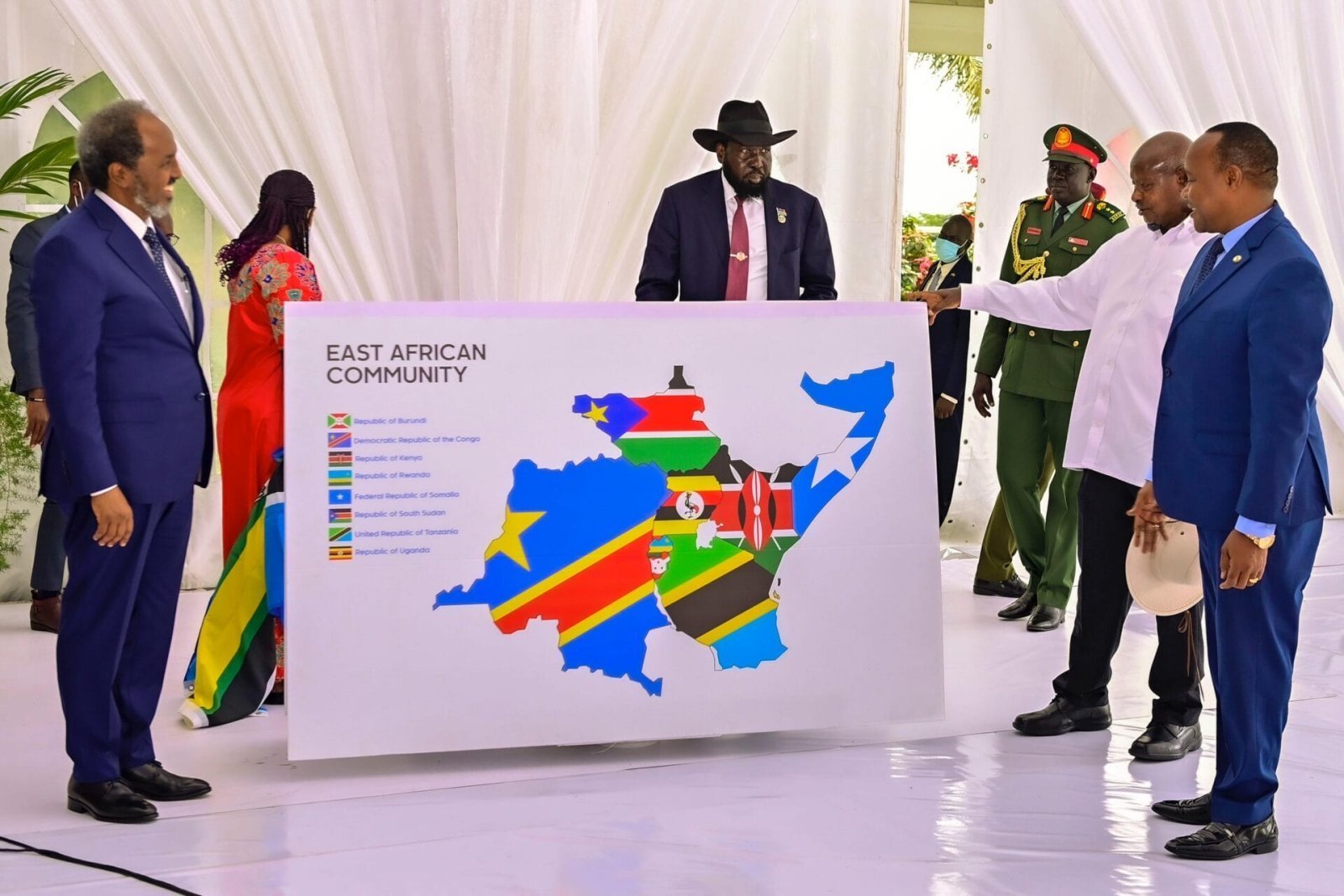
The more analytically interesting question is not which country wins the regional hub competition but whether the EAC's planned equity market integration, connecting the DSE, NSE, and Uganda Securities Exchange into a single bourse, could produce a combined market whose depth exceeds what either country can achieve independently. A combined East African market with Kenya's institutional depth, Tanzania's economic trajectory, and Rwanda's governance quality would be more credible as a regional financial hub than any single country in the bloc operating independently.
That combination, if the political will for genuine market integration exists across three governments with different economic interests and different timelines, is the East African version of Singapore's story. Not a single city-state's institutional achievement replicated in a larger economy, but a regional architecture that produces the depth, the liquidity, and the reliability that capital requires, built from the complementary strengths of three economies whose individual limitations the combination would transcend.
That is the more honest and more achievable aspiration for the region's financial decade. It is also, for precisely those reasons, the harder institutional and political challenge to deliver.
 Uchumi360
Business Intelligence
Uchumi360
Business Intelligence
Monetary Authority of Singapore Annual Reports and Development Framework. FEP Finance Club Singapore as a Global Financial Center Analysis 2024. Lee Kuan Yew School of Public Policy Singapore's Transformation into a Global Financial Hub. NUS Singapore Rise as Financial Hub Documentation. Nairobi International Financial Centre Authority nifca.go.ke 2026. Kenyan Wallstreet Kenya Capital Markets Momentum 2026. Capital Markets in Africa Kenya Market Awakens March 2026. EY Kenya Finance Bill 2025 Tax Incentives Analysis. WFIS Kenya 2026 Fintech Landscape. Dar es Salaam Stock Exchange Weekly Market Reports 2026. TanzaniaInvest DSE Capital Markets Coverage 2025/2026. Brookings Sovereign Credit Ratings and External Debt in Africa March 2026. UNDP Lowering the Cost of Borrowing in Africa 2023. OECD Africa Capital Markets Report 2025. Daba Finance Africa Bond Costs Premium Persists November 2025. OMFIF The Asset Side of African Debt March 2026. World Economic Forum How AfCRA Can Fix the African Premium November 2025. Boston University Global Development Policy Center Africa Debt Distress June 2025. Uchumi360 Tanzania Investment Surge Analysis March 2026. Uchumi360 Victory Attorneys Tanzania Business Environment Analysis April 2026. Uchumi360 Tanzania CAG Report Series April 2026. Uchumi360 Rwanda HCI World Bank Recognition April 2026. Uchumi360 Africa 54 Economies Aggregation Analysis April 2026.
Uchumi360 covers business, investment, and economic policy across East, Central, and Southern Africa.
For the serious reader
You read to the end. That places you in a small group.
Uchumi360 is built for readers who demand precision over speed, structure over sentiment, and analysis that holds uncomfortable conclusions rather than softening them. If this work sharpens how you think about Africa's economy, help us keep building the infrastructure behind it.
Institutional Partners
Commission intelligence. Shape the conversation.
Uchumi360 works with development finance institutions, investment firms, sovereign bodies, and strategic organisations across the coverage region. Institutional partnership unlocks:
- Commissioned sector and country intelligence reports
- Branded research series under your institution's authority
- Exclusive data briefings for internal strategy teams
- Speaking and editorial presence at Uchumi360 events
- Co-published investment outlooks for your markets
Support Our Work
Independent analysis has a cost. Help us bear it.
Uchumi360 does not carry advertising. It does not take editorial direction from sponsors. Every article is produced without commercial compromise. Your contribution funds the reporting, research, and editorial infrastructure that keeps this analysis free from influence.
Secure checkout: One-time and monthly support are processed securely.
Stay Connected
Keep up with every new insight.
Follow our latest analysis, policy coverage, and market intelligence as soon as it is published. If you need something specific, reach out directly and we will point you to the right research.
