
140 Years, 1,200 Kilometres: The Mercedes-Benz S-Class Discovers the Soul of Tanzania
Ready
The Mercedes-Benz expedition revealed Tanzania as an exceptional road-travel destination. Its expanding road network makes it possible to experience extraordinary geographical and cultural variety within one continuous journey. Travellers can move from semi-arid plains to mountain forests, Rift Valley landscapes, vineyards, savannas and cool agricultural highlands, all while encountering distinct communities and regional identities.
On 13 August 2026, a Mercedes-Benz global expedition crossed the Namanga border from Kenya into Tanzania. At the centre of the convoy was the new Mercedes-Benz S-Class, travelling the world as part of the brand’s celebration of 140 years of mobility innovation.
The official “140 Years. 140 Places.” campaign is taking three new S-Class saloons on a transcontinental journey through 140 destinations, celebrating Mercedes-Benz’s heritage, technology, global presence and pioneering spirit. Its African route includes Kenya, Tanzania, Zambia, Zimbabwe, Botswana, Namibia and South Africa.
The S-Class, in a Nutshell
The new S-Class is Mercedes-Benz’s flagship luxury saloon, extensively updated for the anniversary year with more than half of its components newly developed or refined. Its headline technologies include the AI-enabled MBUX Superscreen, intelligent air suspension that can adapt to road conditions, active rear-axle steering for greater stability and manoeuvrability, adaptive DIGITAL LIGHT and a new generation of driver-assistance systems. Inside, advanced air filtration, climate control and available heated, ventilated and massaging seats turn the cabin into both a long-distance machine and a mobile lounge. Equipment varies by market and vehicle specification.
But in Tanzania, this was more than another stage on a global itinerary.
Over six days, the expedition travelled approximately 1,200 kilometres through eight regions: Arusha, Kilimanjaro, Manyara, Dodoma, Iringa, Njombe, Mbeya and Songwe, before exiting into Zambia through the Tunduma border on 18 August.
I had the privilege of guiding the Mercedes-Benz global team throughout the Tanzania leg: from their arrival at Namanga to their departure at Tunduma. What unfolded was an extraordinary encounter between one of the world’s most celebrated luxury vehicles and one of Africa’s most visually diverse countries.
A Grand Entrance Through Namanga
Every cross-border journey has a moment when one country ends and another begins. At Namanga, that transition came with the movement, conversations and formalities of one of East Africa’s most important border crossings.
The border scenes provided the opening frames of Tanzania’s story: officials facilitating the convoy’s entry, travellers moving between Kenya and Tanzania, commercial vehicles carrying goods across the region and the Mercedes-Benz team preparing for the road ahead. The handover also carried the easy humour of neighbours, the familiar Kenyan–Tanzanian banter adding warmth to the moment as one national team welcomed the other.
Once the formalities were completed, the convoy set off towards Arusha beneath a vast northern Tanzanian sky.
As evening approached, the landscape began to glow. Warm sunlight swept across the plains, illuminating acacia trees, distant settlements and the imposing outline of Mount Longido. The sunset transformed the drive into a cinematic introduction to Tanzania: quiet, expansive and deeply beautiful.
It was the perfect welcome.
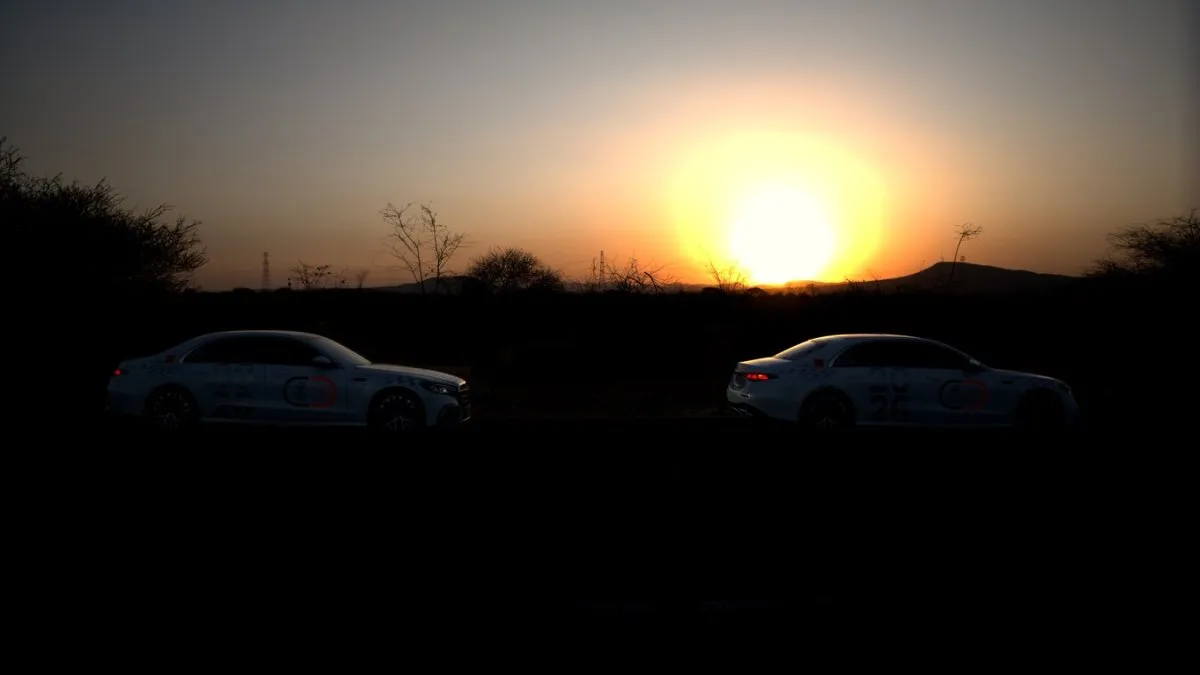 A beautiful sunset captured along the way from the Namanga border to Arusha
Tanzania: A Country Framed by Mountains
Northern Tanzania is shaped by some of Africa’s most recognisable mountains. Throughout the opening stages of the journey, the convoy encountered views of Mount Longido, Ol Doinyo Lengai, Mount Meru and Mount Kilimanjaro.
Each mountain carries a distinct identity.
Mount Longido rises above the dry plains near the Kenyan border. Ol Doinyo Lengai, known among the Maasai as the Mountain of God, stands within one of Tanzania’s most culturally and geologically remarkable landscapes. Mount Meru dominates the skyline around Arusha, while Mount Kilimanjaro needs little introduction: Africa’s highest mountain and one of Tanzania’s greatest national symbols.
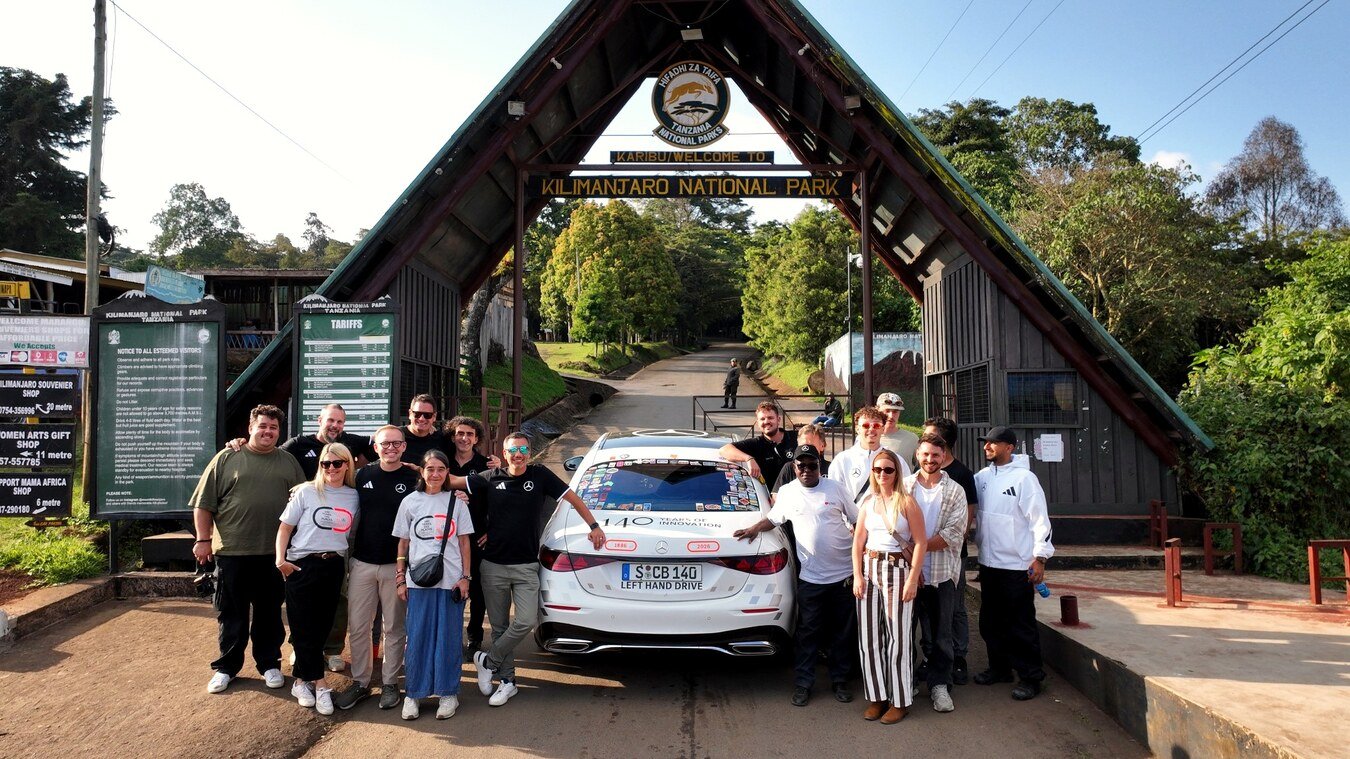
The expedition travelled closer to Kilimanjaro, visiting areas offering views towards the Lemosho climbing route and later stopping at Marangu Gate.
Lemosho is known for its beautiful western approach to the mountain, passing through forest, heath and high-altitude terrain. Marangu Gate, meanwhile, is one of Kilimanjaro’s most historic and active entry points—a place filled with guides, porters, climbers and the unmistakable excitement of journeys about to begin.
Against this legendary mountain backdrop, the S-Class represented a different kind of journey: a machine shaped by 140 years of innovation meeting a landscape shaped over millions of years.
Lake Manyara and the Great Rift Valley
From the Kilimanjaro region, the journey continued towards Manyara.
The road opened to magnificent views of Lake Manyara and the Great Rift Valley escarpment, one of East Africa's defining geographical formations. The escarpment rises dramatically above the plains, while the lake stretches below, changing character with the light, season and movement of wildlife.
This part of Tanzania brings mountains, forests, wetlands, farms, wildlife habitats and human settlements together within a relatively compact area. It is one of the reasons the Northern Circuit remains among Africa’s most rewarding travel destinations.
However, one of the most memorable moments of the expedition did not happen at a conventional tourist attraction. It happened inside a Maasai settlement, an emanyata, near Mto wa Mbu.
When the S-Class Received a Maasai Blessing
At the emanyata, the Mercedes-Benz team was welcomed into a living cultural environment shaped by community, livestock, tradition and an enduring relationship with the land.
The S-Class received what the team affectionately described as a “Maasai baptism”: a ceremonial cultural welcome and blessing that brought together German automotive heritage and Maasai tradition.
For a vehicle travelling around the world, it was a uniquely Tanzanian moment.
The encounter was not simply about photographing a luxury car beside a traditional homestead. It reflected something deeper: global innovation does not travel through empty landscapes. It encounters people, histories, identities and ways of life.
The Maasai community gave the expedition a human connection, one that no highway or landmark could have provided on its own.
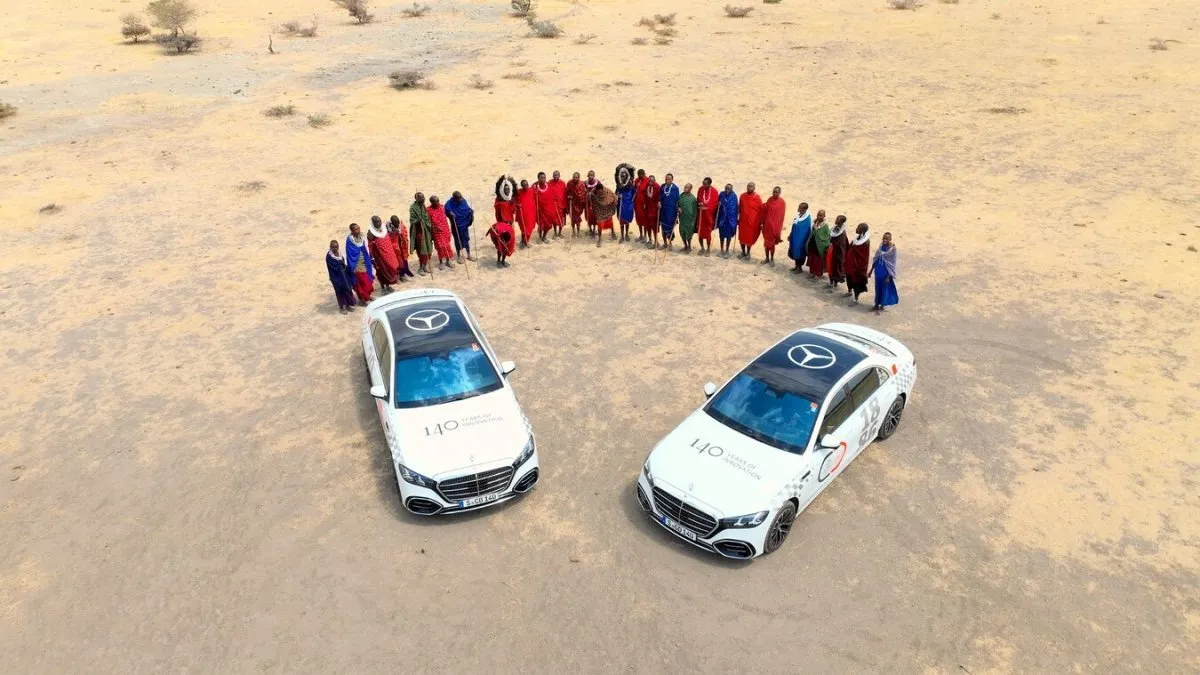 The S-Class receiving Maasai baptism at Mto wa Mbu area
Across Tanzania’s Administrative and Agricultural Heartland
The convoy continued southwards into Dodoma, Tanzania’s capital and an increasingly important administrative, commercial and agricultural centre.
The visit to Dodoma revealed another side of the country, one far removed from the familiar images of safaris and tropical beaches. Tanzania is also a country of farmers, producers, evolving industries and regional specialities. This diversity became clearer with every kilometre.
From Mtera to Iringa: Where the Road Becomes the Experience
South of Dodoma, the convoy reached the Mtera Hydroelectric Power Plant and reservoir near the boundary between the Dodoma and Iringa regions.
Mtera is more than an impressive piece of infrastructure. It is part of Tanzania’s national development story, demonstrating the relationship between water, energy, engineering and economic growth.
Beyond Mtera, the road towards Iringa became one of the expedition’s most dramatic sections.
The route passed through expansive savannas, rocky formations, changing elevations and demanding bends. At different points, the road revealed enormous views across valleys and distant hills. It required concentration but rewarded the team with some of the most striking scenery of the entire journey.
Here, driving was no longer simply a means of reaching the next destination. The road itself became the attraction.
The S-Class moved through a landscape that was beautiful, rugged, and constantly changing, demonstrating why Tanzania is a remarkable country for overland exploration.
Through the Southern Highlands
From Iringa, the expedition continued into Njombe and Mbeya, where Tanzania’s geography changed once again.
The dry central landscapes gradually gave way to cooler temperatures, greener hills and fertile highlands. Njombe’s elevated terrain introduced sweeping ridgelines, agricultural communities and winding roads before the convoy descended deeper into the Southern Highlands.
The transition through Iringa and Njombe was also marked by vast planted forests and woodlots, particularly pine and eucalyptus. Their ordered green slopes are not merely scenic: they form part of a major forestry economy that supplies timber, supports local enterprise and has made the Southern Highlands one of Tanzania’s most important tree-growing zones.
Mbeya revealed an even broader agricultural landscape. Its fertile soils, dependable rainfall and varied elevations support maize, rice, beans, bananas, potatoes, tea, cocoa, coffee and other crops, reinforcing the region’s reputation as one of Tanzania’s major food-producing areas.
Across the highlands, cultivated fields, market activity and produce moving towards urban centres showed that agriculture here is not a single-crop story. It is a living regional economy that feeds households, sustains rural communities and links southern Tanzania with markets across the country and neighbouring states.
Then came Mbeya city itself: energetic, commercial and constantly in motion. The team jokingly compared its bustle to Bombay as bajaji, Tanzania’s three-wheeled taxis, threaded assertively through the traffic. Their colour, agility and sheer presence gave the S-Class a vivid encounter with the city’s everyday transport culture, and a distinctly urban counterpoint to the quiet farms and highland scenery beyond it.
This was Tanzania beyond the postcard, a productive landscape where agriculture, trade, culture and everyday life remain closely connected.
A 1,200-Kilometre Showcase of Tanzania
By the time the convoy reached Songwe and approached Tunduma, Tanzania’s busiest transit and entry point for regional trade, the expedition had driven approximately 1,200 kilometres across the country.
The journey demonstrated that Tanzania cannot be understood through a single destination.
It is not only Serengeti, Kilimanjaro or Zanzibar, important as those icons are. Tanzania is also found along its highways, inside its communities, across its farms, beside its reservoirs and within the changing landscapes that connect one region to another.
Tanzania Belongs on the Global Road-Travel Map
The Mercedes-Benz expedition revealed Tanzania as an exceptional road-travel destination.
Its expanding road network makes it possible to experience extraordinary geographical and cultural variety within one continuous journey. Travellers can move from semi-arid plains to mountain forests, Rift Valley landscapes, vineyards, savannas and cool agricultural highlands, all while encountering distinct communities and regional identities.
For tourism, this creates an important opportunity.
Tanzania can offer more than destination-based holidays. It can develop premium overland journeys, self-drive experiences, automotive expeditions, cultural road trips and luxury touring routes connecting the north, central corridor and Southern Highlands.
The country has the landscapes. It has the roads. It has the hospitality. Most importantly, it has stories worth travelling for.
More Than a Passage Through Tanzania
On 18 August, the Mercedes-Benz global team crossed the Tunduma border into Zambia, continuing the African chapter of its worldwide expedition.
But Tanzania had not been merely a transit country between Kenya and Zambia.
For six days, it became a living stage for the Mercedes-Benz story: a place where innovation met heritage, engineering met landscape, and global luxury met authentic Tanzanian hospitality.
Guiding the team across the country allowed me to see familiar places through new eyes. From the sunset near Longido and the cultural encounter at Mto wa Mbu, to the winding road from Babati to Dodoma and beyond Mtera, the planted forests of Iringa and Njombe, and Mbeya’s fertile farms and energetic city streets, every region contributed something different.
After 1,200 kilometres, one conclusion was unavoidable:
“Tanzania is not simply a destination to arrive at. It is a country to journey through, slowly, curiously and with the road unfolding ahead.”
And for the Mercedes-Benz S-Class, Tanzania became one of those rare places where the journey itself was every bit as memorable as the destination.
 Uchumi360
Business Intelligence
Uchumi360
Business Intelligence
Uchumi360 covers business, investment, and economic policy across East, Central, and Southern Africa.
For the serious reader
You read to the end. That places you in a small group.
Uchumi360 is built for readers who demand precision over speed, structure over sentiment, and analysis that holds uncomfortable conclusions rather than softening them. If this work sharpens how you think about Africa's economy, help us keep building the infrastructure behind it.
Institutional Partners
Commission intelligence. Shape the conversation.
Uchumi360 works with development finance institutions, investment firms, sovereign bodies, and strategic organisations across the coverage region. Institutional partnership unlocks:
- Commissioned sector and country intelligence reports
- Branded research series under your institution's authority
- Exclusive data briefings for internal strategy teams
- Speaking and editorial presence at Uchumi360 events
- Co-published investment outlooks for your markets
Support Our Work
Independent analysis has a cost. Help us bear it.
Uchumi360 does not carry advertising. It does not take editorial direction from sponsors. Every article is produced without commercial compromise. Your contribution funds the reporting, research, and editorial infrastructure that keeps this analysis free from influence.
Secure checkout: One-time and monthly support are processed securely. Add payment credentials to enable checkout here.
Stay Connected
Keep up with every new insight.
Follow our latest analysis, policy coverage, and market intelligence as soon as it is published. If you need something specific, reach out directly and we will point you to the right research.
