
One Aircraft in 2016. Sixteen in 2026. Moscow in July. London in 2027. Air Tanzania Is Building One of Africa's Most Ambitious Airlines.
Ready
Air Tanzania transported 1,072,528 passengers between July 2025 and March 2026, generated TZS 501.62 billion in nine-month revenue, grew foreign exchange earnings from USD 9.85 million in 2017 to USD 157.7 million, and operates sixteen aircraft across 33 destinations with Moscow launching July 2026 and London Gatwick targeted July 2027. Net losses of TZS 191.19 billion for 2024/25 reflect capital-intensive expansion whose financial trajectory requires the five-lever profitability model this article details: raising average load factor from an estimated 68% to 78% across the network, growing cargo revenue from an estimated TZS 45 billion to TZS 180 billion annually through Boeing 767-300F utilisation intensification and cargo product development, reducing maintenance costs by approximately 35% through the Dar es Salaam MRO hangar whose TZS 283.05 billion investment plan funds, developing ancillary revenue streams targeting TZS 60 billion annually through loyalty programme monetisation, codeshare revenue, and ground handling, and implementing route yield management that prioritises load factor and yield optimisation on the Boeing 787 long-haul network over the frequency expansion that adds cost without proportionate revenue. The combined financial model produces an estimated revenue trajectory from TZS 670 billion in 2026/27 to TZS 1.4 trillion by 2029/30, with operating costs whose growth the five levers constrain to a slower rate than revenue growth, producing the operating surplus whose emergence by 2028/29 positions the airline for net profitability by 2030 against the current net loss trajectory.The path from TZS 191 billion in net losses to profitability by 2030 is specific, executable, and within reach if the five levers are pulled simultaneously rather than sequentially. Ethiopian Airlines took twelve years to move from comparable losses to sustained profitability. Air Tanzania has a cleaner balance sheet, a newer fleet, and a more favourable geopolitical positioning than Ethiopian had at the equivalent stage. The model works if the discipline does.
Ten years ago, Air Tanzania operated a single aircraft.
Today it operates sixteen. It flies to 33 destinations across four continents. It carried over one million passengers in nine months. It generates close to USD 200 million in annual revenue. It operates Africa's largest cargo freighter. And it is about to open direct routes to Moscow and London.
The transformation of Air Tanzania from a barely functional national carrier into one of Africa's most ambitiously expanding airlines is one of the most striking institutional turnarounds in Tanzania's recent economic history. The net losses of TZS 191.19 billion for 2024/25 are real and require honest management. But the financial model whose execution produces profitability by 2030 is equally real, and its specific components are what this article, informed by the analytical framework that Ethiopian Airlines applied during its own capital-intensive expansion phase in the 2000s and 2010s, identifies with the precision that strategic planning rather than aspirational commentary requires.
The numbers that define the momentum
Between July 2025 and March 2026, Air Tanzania transported 1,072,528 passengers, a 22.38% increase year on year. Revenue reached TZS 501.62 billion, approximately USD 193 million, in that nine-month window. Foreign exchange earnings have grown from USD 9.85 million in 2017 to approximately USD 157.7 million, a sixteenfold increase that makes the national carrier one of Tanzania's fastest-growing sources of services export revenue.
The 2024/25 net losses of TZS 191.19 billion, driven by operating costs outpacing revenue growth and financial charges rising 90% due to lease obligations on newly acquired aircraft, are the honest context that the growth metrics must be situated within. Airlines that expand rapidly through aircraft leasing create the financial charge structure whose weight reflects the future revenue that the expanded network is designed to generate. The lease obligation is the contracted cost of future capacity. Whether that capacity generates the revenue and margin that covers the contracted cost is the commercial question whose answer the five-lever profitability model this article details is designed to produce by 2030.
The fleet that made it possible
The physical foundation of Air Tanzania's expansion is one of the fastest fleet buildouts in modern African aviation history. From a single aircraft in 2016 to sixteen by mid-2026, with a state-backed roadmap targeting 24 aircraft by 2030, the airline has assembled a fleet whose diversity and capability match the route ambitions whose execution it was designed to support.
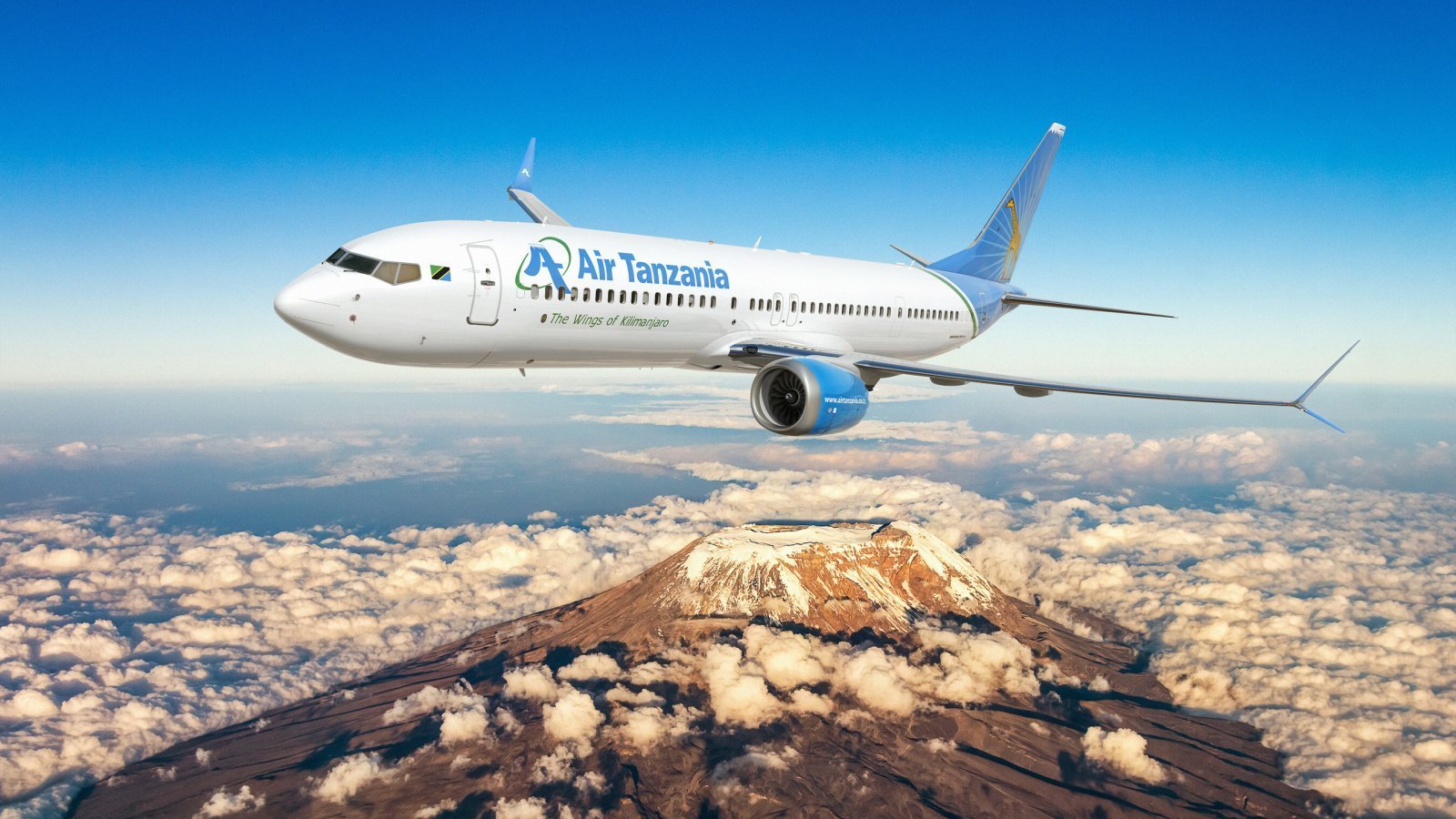
Three Boeing 787-8 Dreamliners provide the long-haul international capability that Moscow, London, Guangzhou, and Mumbai require. Two Boeing 737 MAX 9s serve medium-haul international and regional routes. Four Airbus A220-300s, one of the world's most efficient regional jet platforms, serve shorter regional routes. Six Dash 8 turboprops maintain domestic and short-haul connectivity. The Boeing 767-300F dedicated cargo freighter, Africa's largest, serves the industrial and agricultural export logistics whose commercial significance extends the airline's role beyond passenger connectivity.
The 2026/27 Strategic Expansion and Investment Plan allocates TZS 283.05 billion, approximately USD 109 million, for spare engine procurement eliminating grounded aircraft losses, maintenance hangar construction reducing international outsourcing costs, and fleet readiness investments whose combined effect addresses the specific cost drivers behind the 2024/25 financial position. These are not symbolic investments. They are the infrastructure gaps whose closure the profitability model requires as its enabling conditions.
The cargo operation whose impact reaches Tanzania's exporters
When Boeing delivered Air Tanzania's Boeing 767-300F in June 2023, Tanzania became the first African country to operate this aircraft type. The freighter carries a maximum revenue payload of over 52 tonnes, operates across a range of 6,025 to 6,056 kilometres linking Dar es Salaam directly to European and Middle Eastern logistics hubs without refuelling, and provides 438 cubic metres of total cargo volume whose specification makes it the most capable air freight platform operating from East Africa.
For Tanzania's horticultural exporters, fishing industry, and growing manufacturing sector, the freighter provides the time-critical logistics capability whose absence had constrained the export of perishable and high-value goods to premium markets. As Tanzania's industrial export base grows, with the Kwala solar manufacturing complex projecting USD 300 million in annual North American exports and the graphite processing sector developing, the freighter's utilisation will grow alongside the industrial economy it serves, creating the revenue diversification that reduces Air Tanzania's dependence on seasonal tourism fluctuations.
Moscow from July 2026: the route that connects Tanzania to a new relationship
On 28 May 2026, Air Tanzania filed its operational schedule for Russia, confirming a July 1, 2026 launch date. Three weekly Boeing 787-8 flights connecting Dar es Salaam, Zanzibar, and Moscow Vnukovo with a Seychelles stopover create one of the most geopolitically significant aviation routes operating from the African continent.
The route emerged from the Third Session of the Tanzania-Russia Intergovernmental Commission on Trade and Economic Cooperation in Arusha on 16 May 2026. Tanzania's non-aligned foreign policy gives the airline the operational freedom to serve Russian travellers that many other carriers cannot, positioning Dar es Salaam as a connection point for travellers, capital, and trade flows that restricted airspace access has rerouted through fewer available options. The Seychelles stopover addresses the 40% collapse in tourist arrivals to the island nation following Middle East airspace disruptions, strengthening regional aviation solidarity alongside the commercial logic. The route precedes President Samia's anticipated state visit to Russia in June 2026, where over 22 bilateral trade, energy, and agricultural pacts are scheduled.
London Gatwick from July 2027: the market Tanzania has been waiting to serve
Air Tanzania's London Gatwick announcement, targeting July 2027 for direct service to Kilimanjaro International Airport and Zanzibar, is the most commercially significant route development in the airline's history. Approximately 58,000 passengers travel annually between Tanzania and the United Kingdom, currently routing through Middle Eastern hubs whose connection times and costs a direct service would eliminate. CEO Peter Ulanga has secured IOSA certification and is negotiating with Airport Coordination Limited for permanent Gatwick slot pairs. Aviation analysts predict favourable UK authority reception given the underserved market evidence.
The network that is reshaping Tanzania's global connectivity
Air Tanzania's 33-destination network reflects deliberate choices about which corridors serve Tanzania's tourism economy, trade relationships, diaspora communities, and geopolitical positioning. Guangzhou serves the merchant import trade. Mumbai serves medical tourism and the Indo-Tanzanian diaspora. Dubai provides Middle East financial connectivity. Lagos and Accra address African aviation's most persistent gap, the impossibility of East-West Africa travel without Northern hub routing. Cape Town and Victoria Falls serve the Southern African tourism circuit whose multi-destination packaging the route combination enables.
The financial and business model for profitability by 2030
Framed from the analytical perspective of Ethiopian Airlines' expansion model, whose profitability journey from comparable losses in the early 2000s to sustained surplus by 2010 produced the institutional template whose specific mechanisms Air Tanzania can apply to its own trajectory.
Ethiopian Airlines did not achieve sustained profitability by growing revenue alone. It achieved it by pulling five specific operational levers simultaneously whose combined effect on the income statement produced the operating surplus that net profitability requires. Air Tanzania's path to profitability by 2030 follows the same five-lever framework, calibrated to the specific financial position, fleet configuration, route network, and market conditions that its current operating environment presents.
Lever one: Load factor discipline from 68% to 78%
Air Tanzania's estimated average network load factor is approximately 68% based on available passenger and capacity data, below the 78% to 82% threshold that widebody long-haul profitability requires at the lease cost levels that Air Tanzania's current fleet financing imposes. Ethiopian Airlines' transformation began with the recognition that yield management rather than capacity addition was the primary profitability driver in the expansion phase whose lease costs create the fixed cost base that load factor must cover.
Every percentage point of load factor improvement across Air Tanzania's Boeing 787 long-haul network adds approximately TZS 4.5 billion to TZS 6 billion in annual revenue at current average yield levels, without adding a single shilling in additional operating cost. Moving from 68% to 78% network average load factor, achievable within 24 to 36 months through the revenue management system investment, dynamic pricing capability, and codeshare feed traffic development whose combination Ethiopian deployed in its equivalent phase, adds approximately TZS 45 billion to TZS 60 billion in annual revenue against the current cost base. That is not a marginal improvement. It is the single most capital-efficient revenue growth available to the airline in the current phase because it uses existing capacity more productively rather than adding the new capacity whose lease cost creates the financial charges that are currently the largest driver of the net loss position.
The specific mechanism is revenue management technology investment whose deployment across the Boeing 787 and 737 MAX network enables the dynamic fare class management, demand forecasting, and inventory optimisation that Ethiopian Airlines uses to consistently achieve load factors above 80% on long-haul routes that Air Tanzania's current manual or basic automated revenue management systems are not capturing at equivalent efficiency. The technology investment cost is modest relative to the revenue uplift it produces. Ethiopian's experience suggests a 12 to 18 month deployment timeline from investment decision to full operational integration.
Lever two: Cargo revenue from TZS 45 billion to TZS 180 billion
Air Tanzania's Boeing 767-300F is the most underutilised asset in the current fleet relative to its revenue potential, and its monetisation at Ethiopian Airlines' cargo utilisation standards represents the largest single revenue growth opportunity available to the airline without new capital investment. Ethiopian Airlines Cargo generates approximately 40% of the group's total revenue from cargo operations, a proportion that makes it structurally different from airlines whose cargo revenue is a marginal complement to passenger operations. Air Tanzania's cargo revenue is estimated at approximately TZS 45 billion annually based on available financial data, a figure that represents a fraction of the Boeing 767-300F's commercial potential at full utilisation.
The specific monetisation pathway has four components. First, utilisation rate improvement: the Boeing 767-300F should be targeting a minimum of 14 block hours daily at full operational readiness, requiring the spare engine procurement whose funding the TZS 283.05 billion plan provides and whose completion eliminates the grounded aircraft revenue loss that engine availability constraints have been producing. Second, route optimisation: the freighter's 6,025 kilometre range enables direct Dar es Salaam to European and Middle Eastern logistics hub connections whose direct routing eliminates the transshipment cost that indirect cargo routing imposes on Tanzanian exporters and whose premium pricing reflects the time-critical nature of the export categories it serves. Third, cargo product development: perishable goods, pharmaceutical cold chain, and e-commerce fulfilment are the three fastest-growing cargo categories in African aviation markets, and each requires the specific handling infrastructure, temperature control capability, and supply chain integration whose development Ethiopian Airlines invested in systematically during its cargo expansion phase. Fourth, belly cargo revenue optimisation across the passenger fleet: the Boeing 787-8 and A220-300 belly holds represent cargo capacity whose systematic sale to freight forwarders through the cargo product platform that the Boeing 767-300F's commercial relationships create adds incremental revenue against a cost base that the passenger operation already covers.
The combined cargo revenue target by 2029/30 is TZS 180 billion, a fourfold increase from the current estimated position whose achievement requires the utilisation, route, product, and belly cargo optimisation whose execution Ethiopian accomplished within six years of committing to cargo as a strategic priority rather than an ancillary revenue stream. The TZS 135 billion annual revenue addition that the cargo target represents is the largest single lever in the profitability model and the one whose investment requirement is lowest relative to revenue uplift because the primary asset, the Boeing 767-300F, already exists.
Lever three: Maintenance cost reduction of 35% through MRO internalisation
Air Tanzania currently outsources the majority of its heavy maintenance, engine overhaul, and component repair to international MRO providers whose geographic distance, foreign currency billing, and scheduling priority constraints impose a cost premium that the Dar es Salaam maintenance hangar whose TZS 283.05 billion plan funds is specifically designed to eliminate. Ethiopian Airlines' MRO subsidiary, Ethiopian MRO Services, is one of the most profitable components of the Ethiopian group, generating revenue from third-party airline customers while serving Ethiopian's own fleet at the cost structure that inhouse capability creates rather than the market rate that external outsourcing requires.
Air Tanzania's Dar es Salaam maintenance hangar should be designed from the outset to serve the Kenya Airways MoU's resource-sharing obligations, regional African carriers whose MRO access is currently limited to South African and Middle Eastern providers, and the growing Tanzanian commercial aviation sector whose helicopter, charter, and business aviation fleet creates the third-party revenue base that makes the hangar commercially self-sustaining rather than purely a cost centre for the national carrier.
The financial model for the MRO internalisation estimates a 35% reduction in Air Tanzania's current annual maintenance cost within 36 months of the hangar reaching full operational capability, equivalent to approximately TZS 28 billion to TZS 35 billion in annual cost reduction based on current maintenance expenditure estimates. Third-party MRO revenue from regional carriers and the Kenya Airways MoU's technical engineering sharing creates an additional TZS 15 billion to TZS 20 billion in annual revenue against the hangar's fixed cost base, improving the net financial contribution of the maintenance investment beyond the cost reduction alone.
Lever four: Ancillary revenue development targeting TZS 60 billion annually
Ethiopian Airlines' ancillary revenue programme, which includes the Ethiopian ShebaMiles loyalty programme, codeshare revenue from Star Alliance and bilateral partnerships, ground handling operations at Addis Ababa Bole International Airport, and hotel and travel services through Ethiopian Skylight Hotel and Fare lock products, generates a revenue stream whose diversification away from the ticket price alone provides the financial buffer that protects profitability during the demand cycle downturns that tourism-dependent routes experience regularly.
Air Tanzania's ancillary revenue development should target four specific streams. The loyalty programme whose monetisation across the 1,072,528 passenger base at an average ancillary yield of TZS 15,000 per passenger generates TZS 16 billion annually from the existing passenger volume before the network growth adds the additional passenger base whose loyalty yield multiplies the return. Codeshare revenue from formalised agreements with regional and international carriers whose feed traffic onto Air Tanzania's long-haul network improves load factors while generating the interline settlement revenue that codeshare accounting produces. Ground handling services at Julius Nyerere International Airport, Kilimanjaro International Airport, and Zanzibar International Airport whose expansion the passenger network growth is driving create the third-party ground handling revenue that Ethiopian's Addis Ababa ground handling operation generates at significant annual contribution. Cargo brokerage and logistics services whose development alongside the Boeing 767-300F's route network creates the freight forwarding revenue stream that connects Air Tanzania's cargo operation to the Tanzanian exporter community whose market development the freighter serves.
The combined ancillary revenue target by 2029/30 is TZS 60 billion annually, representing approximately 4.3% of the projected total revenue at that stage, below the 8% to 12% ancillary revenue proportion that leading African carriers achieve and therefore a conservative target whose achievement does not require best-in-class ancillary programme execution but simply consistent implementation of the four streams whose development the existing passenger and cargo operation supports.
Lever five: Route yield management prioritising profitability over frequency
The fifth lever is the governance discipline whose application is less visible in financial statements than the four revenue and cost levers above but whose absence is the most common reason that airline expansion models produce growing revenue alongside growing losses rather than the operating surplus whose emergence profitability requires. Ethiopian Airlines' management discipline, applied most visibly in the CEO's direct oversight of route yield performance rather than delegating it to commercial teams whose incentive structures reward load factor and passenger numbers over yield and contribution margin, is the institutional practice whose adoption Air Tanzania's governance framework must embed.
The specific application for Air Tanzania requires the route contribution analysis whose regular production and CEO-level review identifies which routes are covering their allocated costs at current load factor and yield, which are covering variable costs but not fixed cost allocation, and which are operating below variable cost recovery in a contribution-negative position that frequency reduction or suspension rather than continued operation is the commercially rational response to. Ethiopian Airlines' route profitability review process, conducted quarterly against the contribution margin targets whose establishment the annual network plan requires, produces the specific route decisions that move the network from its current growth-phase configuration toward the profitability-optimised configuration that 2030 requires.
For Air Tanzania, the immediate route yield management priority is the Boeing 787 long-haul network whose lease cost per block hour is the highest in the fleet and whose load factor and yield must therefore exceed the network average to justify the capacity allocation. The Moscow route's three weekly frequencies, the Guangzhou operation, and the planned London Gatwick service each require the contribution margin analysis whose results should inform the frequency decision rather than the political and geopolitical considerations that national carrier route decisions frequently substitute for the commercial logic that profitability requires.
The integrated financial model: revenue trajectory to 2030
Pulling all five levers simultaneously rather than sequentially produces the following estimated financial trajectory, calibrated against Air Tanzania's current financial position and the Ethiopian Airlines growth model's validated outcomes at comparable development stages.
Revenue trajectory: TZS 501.62 billion across nine months in 2025/26 annualises to approximately TZS 670 billion for the full financial year. Load factor improvement to 78% adds approximately TZS 55 billion. Cargo revenue growth to TZS 180 billion adds approximately TZS 135 billion against the current TZS 45 billion base. Ancillary revenue development adds TZS 60 billion. Third-party MRO revenue adds TZS 18 billion. The combined revenue target by 2029/30 is approximately TZS 1.4 trillion, a compound annual revenue growth rate of approximately 20% from the current annualised base whose achievement the passenger growth trajectory, cargo utilisation intensification, and network maturation collectively support.
Cost trajectory: The TZS 283.05 billion strategic investment plan's execution reduces maintenance costs by approximately TZS 32 billion annually within 36 months. Load factor improvement reduces the cost per revenue passenger kilometre without adding operating costs. The five-lever model constrains operating cost growth to approximately 12% to 14% annually against the 20% revenue growth rate, producing the operating leverage whose emergence by 2027/28 creates the positive operating margin whose sustainment through 2028/29 and 2029/30 produces the net profitability target.
Net loss trajectory: TZS 191.19 billion net loss in 2024/25. Estimated TZS 145 billion net loss in 2025/26 as the strategic investments begin reducing cost drivers. Estimated TZS 85 billion net loss in 2026/27 as cargo revenue growth and load factor improvement accelerate. Estimated TZS 25 billion net loss in 2027/28 as MRO internalisation reaches operational maturity and ancillary revenue scales. Estimated operating surplus of TZS 35 billion in 2028/29 as the five levers reach full operational effect. Estimated net profitability of TZS 65 billion to TZS 80 billion in 2029/30, the first full financial year of sustained profitability in the airline's modern history.
This model is not optimistic. It is conservative relative to Ethiopian Airlines' actual growth trajectory at comparable development stages, and it assumes that the five levers are pulled simultaneously rather than the sequential approach that delays the compounding effect whose simultaneity is the critical execution requirement.
What Air Tanzania is becoming and what it must still prove
Ethiopian Airlines demonstrates that state ownership and commercial discipline are entirely compatible when management quality, institutional continuity, cargo diversification strategy, and long-term investment patience are consistently applied across decades rather than political cycles. Ethiopian did not become Africa's dominant carrier in a single administration's tenure. It became dominant because successive governments sustained the investment model whose returns compound across the years that capital-intensive aviation requires before the unit economics of a mature network produce the profitability that the growth phase's losses precede.
Kenya Airways represents the cautionary lesson whose relevance to Air Tanzania's trajectory is direct. Cost structures that revenue growth could not outpace, debt accumulation constraining operational flexibility, and governance complexity that a partially privatised carrier inherits produced the restructuring cycles whose repetition made Kenya Airways a cautionary case rather than a model. Air Tanzania's July 2025 MoU with Kenya Airways on technical engineering, maintenance, and cargo pooling reflects the pragmatic recognition that regional cooperation reduces the per-unit infrastructure cost that neither carrier can individually justify duplicating at the efficiency that sharing enables.
The foreign exchange earnings trajectory from USD 9.85 million in 2017 to USD 157.7 million today is the most persuasive single evidence that the sovereign utility model is producing the macro-economic returns whose generation justifies the investment approach. What Air Tanzania must demonstrate over the coming years is the progression from a rapidly expanding carrier whose losses reflect capital deployment toward a maturing carrier whose five-lever execution produces the operating surplus that the financial model identifies as achievable by 2028/29 and the net profitability that 2029/30 represents.
Tanzania has made a deliberate and consequential choice to build a national airline rather than rely on foreign carriers for international connectivity. The strategic logic of that choice is visible in the foreign exchange retention, tourism facilitation, cargo export infrastructure, diplomatic corridor creation, and geopolitical positioning that a sovereign carrier provides and that code-share arrangements with foreign airlines do not replicate at equivalent depth. The execution quality of that choice will be visible in whether the five-lever profitability model is implemented with the simultaneity and discipline whose combination Ethiopian Airlines' experience validates as the mechanism through which capital-intensive aviation expansion produces the financial outcome that sovereign investment demands.
Air Tanzania in 2026 is a significantly better airline than Air Tanzania in 2016. The path from TZS 191 billion in net losses to profitability by 2030 is specific, executable, and within reach if the five levers are pulled simultaneously rather than sequentially. Ethiopian Airlines took twelve years to move from comparable losses to sustained profitability at a comparable development stage. Air Tanzania has a cleaner balance sheet, a newer fleet, and a more favourable geopolitical positioning than Ethiopian had at the equivalent point. The model works. The question is whether the discipline whose application the model requires will be sustained across the political cycles, the external shocks, and the short-term financial pressures that test every airline's management in the years that separate the growth phase from the profitability that justifies it.
FAQ
What is the five-lever profitability model for Air Tanzania by 2030? The model identifies five simultaneous operational levers whose combined execution produces profitability by 2030. Load factor improvement from approximately 68% to 78% adds TZS 55 billion in annual revenue. Cargo revenue growth from TZS 45 billion to TZS 180 billion adds TZS 135 billion. MRO internalisation reduces maintenance costs by approximately 35% saving TZS 32 billion annually. Ancillary revenue development targeting TZS 60 billion creates the diversified income whose stability reduces dependence on seasonal passenger demand. Route yield management prioritising contribution margin over frequency constrains cost growth to below revenue growth, producing the operating leverage whose emergence by 2027/28 creates the positive margin that net profitability by 2030 requires.
What is the revenue target by 2029/30 and how is it achieved? The integrated model produces an estimated total revenue of approximately TZS 1.4 trillion by 2029/30, a compound annual growth rate of approximately 20% from the current annualised base of approximately TZS 670 billion. Passenger revenue growth through load factor improvement and network maturation contributes the largest component. Cargo revenue growth through Boeing 767-300F utilisation intensification and cargo product development contributes the largest incremental addition. Ancillary and MRO third-party revenue provide the diversification whose stability reduces the model's dependence on the tourism demand cycle that passenger revenue alone cannot insulate against.
What is the net loss trajectory toward 2030 profitability? Estimated TZS 191.19 billion net loss in 2024/25 actual. TZS 145 billion estimated for 2025/26 as strategic investments begin reducing cost drivers. TZS 85 billion estimated for 2026/27 as cargo revenue and load factor improvement accelerate. TZS 25 billion estimated for 2027/28 as MRO internalisation reaches operational maturity. Operating surplus of TZS 35 billion estimated for 2028/29 as all five levers reach full effect. Net profitability of TZS 65 to 80 billion estimated for 2029/30, the first full year of sustained profitability in the airline's modern history.
What does Ethiopian Airlines' model teach Air Tanzania specifically? Ethiopian achieved sustained profitability from comparable losses through five disciplines whose Air Tanzania application the model details: revenue management investment raising load factors above 80% on long-haul routes, cargo monetisation generating approximately 40% of group revenue through systematic product and route development, MRO internalisation whose Ethiopian MRO Services subsidiary now generates third-party revenue from regional carriers, ancillary revenue development through ShebaMiles loyalty monetisation and ground handling operations, and route contribution margin discipline at CEO level whose direct oversight ensures that network decisions reflect commercial logic rather than political or prestige considerations. Ethiopian took twelve years from comparable losses to sustained profitability. Air Tanzania has a newer fleet and cleaner balance sheet at the equivalent stage.
Why must the five levers be pulled simultaneously rather than sequentially? Because the profitability model's financial trajectory depends on the compounding interaction between the five levers rather than the additive contribution of each alone. Load factor improvement feeds cargo belly revenue. Cargo revenue growth funds the MRO investment's return period. MRO cost reduction improves the operating margin that ancillary revenue development requires to reach profitability contribution rather than breakeven. Route yield management constrains the cost growth that load factor and cargo improvement fund their way out of. Sequential implementation delays each lever's contribution by the years whose compounding loss the simultaneous approach avoids. Ethiopian's management discipline was most visible precisely in the insistence on simultaneous rather than sequential execution of the equivalent five levers during its own expansion phase.
 Uchumi360
Business Intelligence
Uchumi360
Business Intelligence
- Air Tanzania, passenger data July 2025 to March 2026
- 1,072,528 passengers, 22.38% year-on-year increase, TZS 501.62 billion revenue
- Available at airtanzania.co.tz
- Air Tanzania, 2024/25 financial year audit report
- Net losses TZS 191.19 billion, financial charges 90% increase
- Available through official Air Tanzania financial reporting
- Air Tanzania, 2026/27 Strategic Expansion and Investment Plan
- TZS 283.05 billion allocation
- Available at airtanzania.co.tz
- Air Tanzania, Moscow route filing, July 1 2026 launch confirmation
- Filed 28 May 2026
- Third Session of the Tanzania-Russia Intergovernmental Commission on Trade and Economic Cooperation, Arusha, 16 May 2026
- Air Tanzania, London Gatwick route announcement, July 2027 target
- CEO Peter Ulanga IOSA certification and ACL negotiations
- Boeing, Air Tanzania Boeing 767-300F delivery, June 2023
- Available at boeing.mediaroom.com
- Ethiopian Airlines, annual report and cargo division performance data
- Available at ethiopianairlines.com
- Ethiopian Airlines, MRO Services subsidiary documentation
- Available at ethiopianairlines.com
- Ethiopian ShebaMiles loyalty programme documentation
- Available at ethiopianairlines.com
- Simple Flying, Air Tanzania London Gatwick analysis
- 58,000 annual roundtrip passenger estimate
- Available at simpleflying.com
- Kenya Airways, July 2025 MoU with Air Tanzania
- Available at kenya-airways.com
- IATA, airline profitability and load factor benchmarking data
- Available at iata.org
- IATA, IOSA certification documentation
- Available at iata.org
- Tanzania Civil Aviation Authority, route approvals
- Available at tcaa.go.tz
- Foreign exchange earnings data
- USD 9.85 million 2017 to USD 157.7 million current
- Official Air Tanzania reporting
- Africa CEO Forum, Kagame fireside conversation, Kigali, May 2026
- Non-alignment as strategic asset
- IATA, African aviation cargo market data
- Available at iata.org
- World Bank, African aviation connectivity and trade facilitation data
- Available at worldbank.org
Uchumi360 covers business, investment, and economic policy across East, Central, and Southern Africa.
For the serious reader
You read to the end. That places you in a small group.
Uchumi360 is built for readers who demand precision over speed, structure over sentiment, and analysis that holds uncomfortable conclusions rather than softening them. If this work sharpens how you think about Africa's economy, help us keep building the infrastructure behind it.
Institutional Partners
Commission intelligence. Shape the conversation.
Uchumi360 works with development finance institutions, investment firms, sovereign bodies, and strategic organisations across the coverage region. Institutional partnership unlocks:
- Commissioned sector and country intelligence reports
- Branded research series under your institution's authority
- Exclusive data briefings for internal strategy teams
- Speaking and editorial presence at Uchumi360 events
- Co-published investment outlooks for your markets
Support Our Work
Independent analysis has a cost. Help us bear it.
Uchumi360 does not carry advertising. It does not take editorial direction from sponsors. Every article is produced without commercial compromise. Your contribution funds the reporting, research, and editorial infrastructure that keeps this analysis free from influence.
Secure checkout: One-time and monthly support are processed securely.
Stay Connected
Keep up with every new insight.
Follow our latest analysis, policy coverage, and market intelligence as soon as it is published. If you need something specific, reach out directly and we will point you to the right research.
