
Dege Eco Village: Twelve Years, Sh330 Billion, and Still No House
Ready
Dege Eco Village was conceived as one of Tanzania's most ambitious housing developments, 7,460 homes on land in Kigamboni that its private partner claimed spanned 20,000 acres. Twelve years, at least two failed buyers, a formal fraud admission to Parliament, and roughly Sh330 billion later, National Social Security Fund Director General Masha Mshomba told reporters this week that the Fund is now deciding whether to sell the project again or simply finish building it itself. The project's actual land area, once independently valued, turned out to be 3,503 acres. Its per-acre price had been inflated 32 times over. That gap between what Dege was supposed to be and what it verifiably was is the real story, and it says as much about Tanzania's housing economics as any completed development could.
DAR ES SALAAM — Twelve years after it began, Dege Eco Village remains what it has been for most of its existence: an unfinished satellite city on Kigamboni's Rasi Dege peninsula, its future still undecided. National Social Security Fund Director General Masha Mshomba told editors and reporters on 21 September 2026 that a second attempted sale of the project has failed, and that the Fund is now weighing whether to try selling it once more or to finish building it directly itself, a genuinely new option in a saga that has, until now, mostly cycled between construction and disposal.
What Was Dege Eco Village Actually Supposed to Be?
The project emerged from an unsolicited proposal by Azimio Housing Estate Limited, which offered land in Kigamboni for development. NSSF entered a joint venture with Azimio, forming Hifadhi Builders Limited as the project vehicle, with NSSF holding 45% and Azimio 55%, of which 20 percentage points represented Azimio's land contribution and 35 in cash. The Controller and Auditor General records 6 January 2014 as the project's formal inception date, with an estimated cost of $653.44 million, roughly Sh1.4 trillion at the time. The plan called for 7,160 apartments and 300 villas, 7,460 units altogether, alongside schools, health facilities, shopping, recreation and other amenities, delivered in three phases originally targeted for completion between 2016 and 2018. The World Bank later described it as one of Tanzania's most ambitious housing projects, and by December 2014, Hifadhi Builders was publicly marketing the development at Mlimani City, promising apartments, villas, a police station, a fire station and transport services, with completion targeted for 2018. Construction used tunnel-mould technology supplied by Turkish contractor Mutluhan Construction Industry Company, chosen specifically to support rapid, large-scale reinforced concrete construction.
Dege Eco Village promised to be the most well-planned urbanised satellite city in Tanzania
How Big Was the Land Claim, Really?
This is where the project's problems began, and where the gap between claim and reality turned out to be largest. Azimio's contract with NSSF described the development site as 20,000 acres in Rasi Dege, Kigamboni. When NSSF's own leadership investigated the claim, they found the actual project area was 3,503 acres, less than a fifth of what had been contracted. A separate CAG review of the specific documentation for Phase 1 found title covering approximately 286.74 acres, below even the 300 acres associated with that initial phase. Every layer of scrutiny applied to Dege's land claims revealed a smaller and smaller verified footprint than the one before it.
The valuation attached to that land was equally distorted. Under the joint venture contract, one acre had been priced at Sh800 million. NSSF's own independent valuation put the actual price at Sh25 million per acre, a 32-fold inflation. Because land was being contributed as equity rather than cash, that inflated valuation didn't just misstate the site's worth, it directly altered the ownership split between NSSF and Azimio, assigning Azimio a considerably larger stake in the joint venture than its genuine land contribution justified.
When Did This Actually Become a Fraud Case, Not Just a Delayed Project?
On 26 October 2016, then-NSSF Director General Prof. Godius Kahyarara told members of Parliament's Public Accounts Committee that the contract with Azimio had been "fraudulently entered into." Kahyarara laid out the specific findings directly to the committee: the true project area of 3,503 acres against the claimed 20,000, and the Sh800 million-per-acre contract price against NSSF's own Sh25 million valuation. Kahyarara said NSSF subsequently met with Azimio, which conceded some of the flaws, with management planning to restructure the contract to reflect the land's actual value and confirm NSSF as majority shareholder. Committee member Ezekiel Maige, the Msalala MP, put the political stakes in blunt terms: "It was clear the Kigamboni deal was dirty and all players were dirty as well. Why should the NSSF continue partnering with Azimio? By doing so, wouldn't the Fund be contaminated?" Kahyarara's response revealed just how entangled NSSF already was: pulling out entirely, he told the committee, would put the Fund at risk of losing the roughly Sh270 billion (about $129 million) it had already invested, against Azimio's contribution of only about $5.5 million.
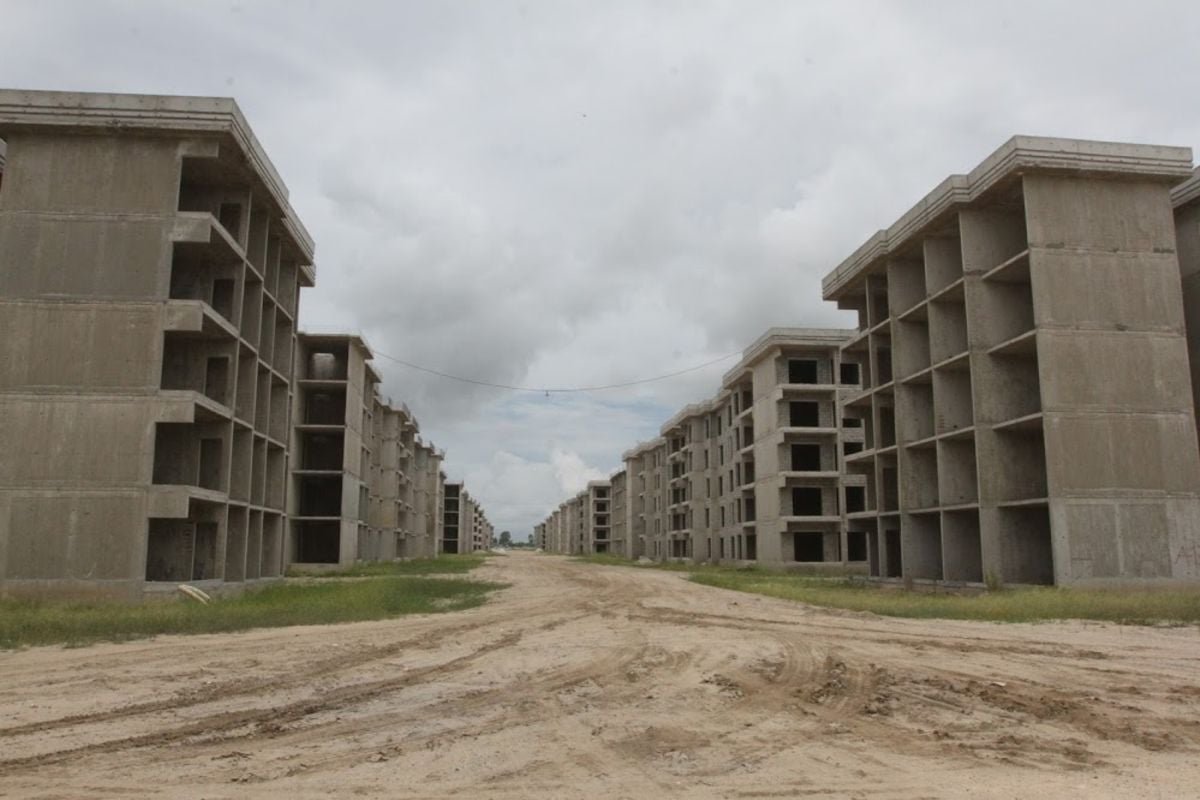
The Dege Eco Village promise still lies in ruins, as the project has stalled for nearly a decade as the debate to revive the project continues
That admission didn't arrive out of nowhere. Three months earlier, in July 2016, NSSF had suspended and later dismissed 12 officials, including six directors, five managers and an engineer, pending investigation into embezzlement allegations and abuse of office connected to its property investments, Dege among them. Separately, by January 2016 construction had already stopped amid disagreements between NSSF and Azimio, with NSSF citing cash flow problems in February and a formal regulatory suspension following in March, driven by concerns from the Social Security Regulatory Authority and the Bank of Tanzania. By November 2016, Parliament heard that the Bank of Tanzania, SSRA, the Prevention and Combating of Corruption Bureau and other security institutions were actively investigating NSSF's property projects, including Dege, and the Public Accounts Committee subsequently established a dedicated subcommittee to examine the case.
What Did Parliament Actually Find When It Visited the Site?
On 20 January 2018, the Parliamentary Accounts Committee visited Dege directly and found approximately 156 blocks containing about 3,700 housing units at various stages of construction, against an original target of 7,460 completed units. None had reached a stage where the project could fulfil its original housing purpose. In November 2018, Prime Minister Kassim Majaliwa visited the site and raised concerns about theft and deterioration, concerns that proved well founded: NSSF had engaged SUMA JKT for site security by 2019, yet a later CAG physical inspection on 5 November 2022 found no security personnel present at all, alongside vandalism to the administration block, including damage to electrical fixtures, ceiling components, air conditioning equipment and plumbing fittings.
Former President of Tanzania, the late John Pombe Magufuli, described the project as “dubious and corrupt” and called on the government to find a way forward so that the project would not remain idle and result in losses to the government.
The Controller and Auditor General's property investment performance audit records 12 March 2020 as Dege's formal termination date, meaning the project sat unresolved for four full years between its 2016 suspension and its eventual, official closure, years during which capital remained tied up in the venture while the physical structures continued deteriorating.
How Much Money Has Actually Gone Into This Project?
Several different figures have circulated across Dege's history, and reconciling them matters for understanding what actually happened to the money rather than treating the numbers as contradictory. NSSF's own 2016 testimony to Parliament put its cash contribution at approximately $129 million, roughly Sh270 billion at the exchange rate of the time, against Azimio's roughly $5.5 million. The CAG's 2016/17 audit separately identified about TSh220 billion in outstanding work-in-progress specifically, the accounting value of construction on the books at that particular audit date, which required an impairment assessment NSSF had not yet performed. A 2021 Citizen report cited a Sh179 billion "embezzlement" figure, likely describing a narrower fraud-specific loss estimate rather than the project's total cost. The CAG's later, broader review of NSSF's suspended property investments found TSh323.57 billion tied up across that entire portfolio, with Dege alone accounting for TSh314.52 billion in that specific table. NSSF's current public figure, repeated consistently from early 2023 through this month's briefing, is approximately Sh330 billion in cumulative investment. Read together, these figures describe the same underlying story from different vantage points and different dates, rather than genuinely conflicting accounts: an initial cash contribution around Sh270 billion in 2016 that continued growing through ongoing security, maintenance and carrying costs during the years the project sat suspended, eventually settling around the Sh314-330 billion range NSSF and the CAG have both used more recently.
None of these figures should be confused with the original $653.44 million (roughly Sh1.4 trillion) projected development cost. That number represented what completing the full 7,460-unit project was expected to cost at inception. It was never actually spent, because the project never reached completion.
Why Did the 2023 Sale Attempt Fail?
NSSF formally announced its intention to dispose of Dege on 21 October 2022, inviting prospective buyers to inspect the property and submit tenders by 14 November 2022, with a winner to be announced the same day. No buyer emerged on that timeline; by February 2023, NSSF confirmed it had received no acceptable bids nearly five months after the announcement. NSSF Director General Masha Mshomba was direct about the Fund's reasoning at the time: "What we don't expect is to make a loss in the selling of the project." On 25 September 2023, Mshomba announced NSSF was "finalising talks" with a prospective buyer at a reported value of approximately $220 million, dramatically below the original $653 million projected cost, though the two figures represent genuinely different things, a projected development cost at inception versus a market value assigned to an unfinished asset years later, not a straightforward measure of value lost.
That deal never closed either. By March 2025, Mshomba confirmed the negotiation with the buyer, publicly identified only as "Hello," had ended without a completed transaction. The agreed value had settled at approximately $215 million, with Hello required to pay 50% of that value upfront, a condition it failed to satisfy. At that point, the matter went to Tanzania's Attorney General, who initially advised terminating the sales contract.
What's the Actual Current Status, as of This Week?
The government formally terminated the contract with Hello in December 2025, a firmer and more definitive step than the March 2025 advisory stage. Speaking to editors on 21 September 2026, almost exactly a decade after Kahyarara's original fraud admission to Parliament, Mshomba said NSSF's recommendations on next steps are now with the Attorney General's Office for review, with that process expected to conclude by the end of October 2026, after which the Fund will proceed according to whatever legal advice it receives. For the first time in the project's history, NSSF is weighing an option beyond simply finding another buyer: alongside re-advertising the property to new investors, the Fund is also considering developing the project directly itself, a materially different proposition from the pure-disposal strategy pursued since 2022. Mshomba framed the review explicitly around fiduciary duty, describing it as part of ensuring that "investments made using members' contributions" are ultimately protected rather than further eroded.
Even the land underlying the project isn't fully secure while these decisions get made. A 2026 CAG audit found that 92,770.39 square metres of Dege's land had been illegally occupied by encroachers, valued by the Government Valuer at approximately $547,044.50, roughly TSh1.41 billion. NSSF told auditors it was working with Kigamboni Municipal Council to recover the land, and the CAG recommended NSSF accelerate demarcation and repossession efforts. More than a decade after its inception, the institution responsible for this asset is still defending the ground it sits on.
What Did the World Bank Actually Conclude About Dege as a PPP Case Study?
The World Bank has cited Dege directly in its own analysis of public-private partnership failures, identifying the absence of adequate due diligence and approval processes as among the central lessons. Specifically, the Bank's case study notes that the project bypassed both the PPP Financing Unit within Tanzania's Ministry of Finance and the separate PPP Coordination Unit, meaning Dege moved into full implementation before the institutional questions surrounding land, valuation, approvals and overall project structure had been properly resolved through the channels that existed specifically to catch exactly these kinds of problems. The institutional failure, in other words, preceded the construction failure. The land dispute and the funding collapse were downstream consequences of a project that was allowed to bypass its own required oversight process from the outset.
What Does Dege Actually Reveal About Tanzania's Housing Market?
The deeper lesson from Dege isn't that Tanzania lacks housing demand. The country's housing deficit is commonly estimated at roughly 3 million units, with annual demand of approximately 200,000 units, figures the Bank of Tanzania attributes to the National Housing Corporation. Dar es Salaam's urban population has grown accordingly, the Centre for Affordable Housing Finance in Africa estimated Tanzania's urban population at 25.7 million in 2024, roughly 38% of the national total, and the World Bank has separately estimated that around 70% of Dar es Salaam's development has occurred informally, frequently without corresponding infrastructure. That combination, enormous unmet housing demand alongside extensive informal construction, isn't really a contradiction. It's evidence that Tanzania's formal housing sector, of which Dege was meant to be a flagship example, has struggled to supply enough planned, financeable housing at prices that actually match household incomes, leaving informal self-construction as the rational alternative for millions of households the formal market simply doesn't reach.
Tanzania's mortgage market illustrates the scale of that affordability gap directly. The Bank of Tanzania reported outstanding residential mortgage debt of TSh683.03 billion at the end of March 2025, rising to TSh720.81 billion by September 2025, spread across 31 reporting banks and financial institutions, with average mortgage debt of roughly TSh118-124 million and typical interest rates between 15% and 19%. Mortgage debt represents just 0.42% of GDP. At those rates, a TSh100 million mortgage over 20 years carries a monthly repayment of roughly TSh1.39 million at 16% interest, rising to about TSh1.54 million at 18%, a payment well beyond what most Tanzanian households can sustain, which is precisely why the formal mortgage market has developed as a narrow upper slice of the overall housing need rather than a mass-market financing tool.
Is There Evidence Formal Housing Can Actually Work in Tanzania?
Yes, and the contrast with Dege is instructive. The National Housing Corporation's Samia Housing Scheme at Kawe, containing 560 apartments in its first phase, sold out completely after completion, with prices starting from TSh38 million. That outcome suggests the constraint on formal housing in Tanzania isn't demand or a cultural preference for informal construction. It's whether a specific project's location, product design, infrastructure and pricing are genuinely aligned with what the intended market can actually afford, exactly the alignment Dege's 20,000-acre land claim, inflated valuation, and bypassed institutional oversight never achieved.
What Should Tanzania's Next Housing Strategy Actually Look Like?
Dege's history argues for distributing the risks that this single joint venture concentrated into one structure: land assembly, infrastructure provision, housing construction and housing finance functioning as separate, properly governed components rather than being bundled into one contract between one pension fund and one private landholder. Government and local authorities are better positioned to handle planning and serviced land; developers are better positioned to build against verified demand; banks and mortgage refinancing institutions like the Tanzania Mortgage Refinance Company are better positioned to finance completed housing assets; and pension funds and insurers are better positioned to hold diversified portfolios of completed rental housing rather than concentrated exposure to a single unfinished development. NHC's own experience, both its historical struggles and Kawe's recent success, suggests the institution's most valuable role going forward may be as a platform that assembles land, sets standards and structures partnerships, rather than as the sole developer expected to build every unit itself. Every one of those functions existed in some form around Dege. None of them was properly separated, verified or governed before construction began, and that, more than the $653 million price tag or the 3,503 disputed acres, is the lesson Tanzania's next major housing project actually needs to learn.
FAQ
How big was Dege Eco Village actually supposed to be? The original plan called for 7,460 units, 7,160 apartments and 300 villas, on land Azimio Housing Estate Limited claimed as 20,000 acres in Kigamboni.
Was the 20,000-acre land claim accurate? No. NSSF's own valuation found the actual project area was 3,503 acres, and a separate audit found only 286.74 acres actually titled for the project's first phase.
When did NSSF admit the contract was fraudulent? On 26 October 2016, then-Director General Prof. Godius Kahyarara told Parliament's Public Accounts Committee the joint venture contract had been "fraudulently entered into," citing the inflated land area and per-acre pricing.
How much money has NSSF actually invested in Dege? Figures vary by date and accounting scope: approximately Sh270 billion ($129 million) as of 2016, TSh220 billion in work-in-progress per the 2016/17 audit, TSh314.52 billion in a later broader CAG review, and approximately Sh330 billion as NSSF's current stated figure as of September 2026.
Did NSSF successfully sell Dege in 2023? No. NSSF announced it was "finalising talks" with a buyer at roughly $220 million in September 2023, but the deal, later confirmed at $215 million with a buyer named "Hello," collapsed by March 2025 when the buyer failed to pay 50% of the agreed value upfront.
What is the current status of the project as of September 2026? The government formally terminated the contract with "Hello" in December 2025. NSSF's recommendations on next steps are currently with Tanzania's Attorney General for review, expected to conclude by the end of October 2026, with NSSF considering both re-advertising the project and developing it directly itself.
Is there a positive example of formal housing working in Tanzania? Yes. The National Housing Corporation's Samia Housing Scheme at Kawe, 560 apartments starting from TSh38 million, sold out completely after completion, suggesting the constraint on formal housing is alignment between location, price and household affordability rather than a lack of underlying demand.
 Uchumi360
Business Intelligence
- The Citizen (Tanzania), "NSSF admits fraud in Dege Eco Village project," 26 October 2016
- Primary source for Prof
- Godius Kahyarara's Parliamentary Public Accounts Committee testimony, the 3,503-acre land finding, the Sh800 million/Sh25 million per-acre valuation gap, and MP Ezekiel Maige's remarks
- The Chanzo, "NSSF Stays Mum About the Sale of Its Dege Eco Village Project," 14 December 2022
- Confirmation of the October 26, 2016 PAC testimony date and the October 21, 2022 disposal announcement with its 14 November tender deadline
- The Citizen (Tanzania), "NSSF clears air surrounding Sh1.3tr Kigamboni project," 17 April 2021
- Sh179 billion embezzlement figure and July 2016 dismissal of 12 NSSF officials
- The Citizen (Tanzania), "No bidder yet as NSSF struggles to sell its Dege housing project," 9 February 2023
- Confirmation of the Sh330 billion cumulative investment figure and construction suspension since January 2016
- The Chanzo, "NSSF Boss Speaks Out About Dege Eco Village," 8 February 2023, and "NSSF Is 'Finalising Talks' With Buyer of Its Dege Eco Village," 25 September 2023
- Director General Masha Mshomba's direct quotes and the ~$220 million prospective sale figure
- The Chanzo, "NSSF Is Yet to Find a Buyer for Its Dege Eco Village Project, Waits for Govt's Way Forward," 17 March 2025
- Confirmation of the failed sale to buyer "Hello," the $215 million agreed value, and the Attorney General's initial advice to terminate
- The Citizen (Tanzania), "NSSF's Dege Eco Village project now back on the drawing board," 21-22 September 2026
- Primary source for the December 2025 formal contract termination, the ongoing Attorney General review (expected completion end of October 2026), and NSSF's current options under consideration
- Wikipedia, "National Social Security Fund (Tanzania)," accessed September 2026
- Project overview and confirmation of the site's approximate 350-acre developed footprint
- World Bank, case study on public-private partnership lessons from Dege Eco Village
- PPP Financing Unit and PPP Coordination Unit bypass findings
- Controller and Auditor General of Tanzania, property investment performance audit and 2016/17 annual audit report
- Formal project inception (6 January 2014) and termination (12 March 2020) dates, TSh220 billion work-in-progress figure, and TSh314.52/323.57 billion suspended investment figures
- Bank of Tanzania, residential mortgage market data, March and September 2025
- Mortgage debt figures, interest rates and GDP share
- Centre for Affordable Housing Finance in Africa, Tanzania housing sector data, 2024
- Urban population and housing deficit estimates
- National Housing Corporation, Samia Housing Scheme, Kawe
- Unit count and pricing data
Uchumi360 covers business, investment, and economic policy across East, Central, and Southern Africa.
For the serious reader
You read to the end. That places you in a small group.
Uchumi360 is built for readers who demand precision over speed, structure over sentiment, and analysis that holds uncomfortable conclusions rather than softening them. If this work sharpens how you think about Africa's economy, help us keep building the infrastructure behind it.
Institutional Partners
Commission intelligence. Shape the conversation.
Uchumi360 works with development finance institutions, investment firms, sovereign bodies, and strategic organisations across the coverage region. Institutional partnership unlocks:
- Commissioned sector and country intelligence reports
- Branded research series under your institution's authority
- Exclusive data briefings for internal strategy teams
- Speaking and editorial presence at Uchumi360 events
- Co-published investment outlooks for your markets
Support Our Work
Independent analysis has a cost. Help us bear it.
Uchumi360 does not carry advertising. It does not take editorial direction from sponsors. Every article is produced without commercial compromise. Your contribution funds the reporting, research, and editorial infrastructure that keeps this analysis free from influence.
Secure checkout: One-time and monthly support are processed securely. Add payment credentials to enable checkout here.
Stay Connected
Keep up with every new insight.
Follow our latest analysis, policy coverage, and market intelligence as soon as it is published. If you need something specific, reach out directly and we will point you to the right research.
