
Kenya's Finance Bill 2026: A Comprehensive Analysis for Citizens, Businesses & Investors
Ready
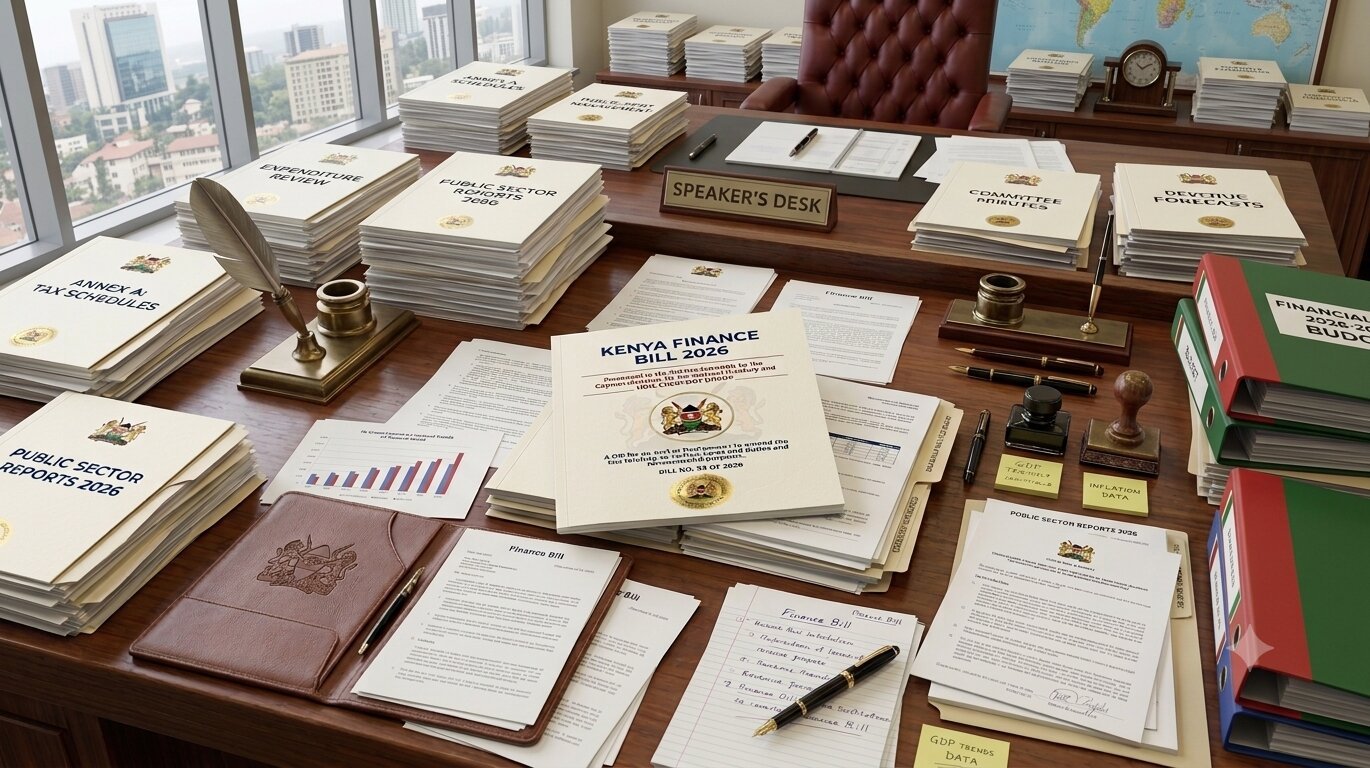
Kenya's Finance Bill 2026 promises lower costs — VAT removed on electric motorcycles, Mitumba, dialysis equipment, solar batteries, and bioethanol stoves. But read the fine print: mobile phones attract a new 25% excise duty, fruit juices enter the tax net, crypto traders face sweeping reporting obligations, and Visa and Mastercard fees are being recharacterised as taxable royalties. Uchumi360 breaks down every provision — winners, losers, and the hidden risks buried deep in the Bill.
By Uchumi360 | Policy & Economics Desk
"Lower costs. More access. Greater opportunities." — National Assembly, Finance Bill 2026 Public Communications
Introduction: A Bill That Touches Every Kenyan
The Finance Bill 2026, tabled before the National Assembly by the Cabinet Secretary for the National Treasury and sponsored by the Finance and National Planning Committee under Hon. Kimani Kuria MP, is not just another bureaucratic document. It is a sweeping reconfiguration of Kenya's tax architecture, touching the Income Tax Act (Cap. 470), the Value Added Tax Act (Cap. 476), the Excise Duty Act (Cap. 472), the Tax Procedures Act (Cap. 469B), the Miscellaneous Fees and Levies Act (Cap. 469C), and the Stamp Duty Act (Cap. 480).
If enacted, its provisions will reshape what you pay at the pump, on your phone, for secondhand clothes, for dialysis, and for gambling while simultaneously tightening the state's grip on digital asset traders, expanding Kenya's international tax information-sharing regime, and introducing new disciplines on tax avoidance.
This article breaks down what the Bill proposes, who gains, who pays, and what it signals about the direction of fiscal policy in Kenya heading into 2027.
Part I: The VAT Overhaul, What Becomes Cheaper (and What Doesn't)
The VAT Exemptions: Green Transport, Healthcare & Second-Hand Economy
The most publicly communicated feature of the Finance Bill 2026 is its proposal to zero-rate or exempt a slate of goods from VAT, as highlighted in the National Assembly's own infographic. But what does the actual legal text say?
Section 32 of the Bill amends the First Schedule to the VAT Act (Cap. 476), adding paragraphs 158 through 170 to the list of VAT-exempt supplies. Here is a precise breakdown:
| Item | Tariff/HS Code | What This Means |
| Dialyzers (kidney dialysis equipment) | 8421.29.00 | Cheaper dialysis care for renal patients |
| Scrap metal | — | Relief for informal jua kali metal trade |
| Locally sold worn clothing (Mitumba) | 6309 (local supply only) | Cheaper secondhand clothes for consumers |
| Motorcycles (electric) | 8711.60.00 | Cheaper electric boda bodas |
| Electric bicycles | — | Cheaper e-bikes |
| Solar and lithium-ion batteries | — | Cheaper off-grid energy storage |
| Electric buses | 87.02 | Cheaper electric mass transit |
| Bioethanol stoves | 7321.12.00 | Cheaper clean cooking appliances |
| Mobile phones (cellular & wireless) | — | Cheaper handsets (with a major caveat, see Excise section) |
| Animal feed raw materials | — | Relief for livestock farmers |
| Pharmaceutical raw materials | — | Relief for local drug manufacturers |
| Sugarcane transportation | — | Relief for sugarcane farmers |
| PPP infrastructure goods & services | — | Relief for public-private partnership projects |
Critical nuance: The exemption on worn clothing (Mitumba) applies only to local supply, not upon importation. This means importers of secondhand clothes will still face VAT on the import leg. The tax benefit flows primarily to the domestic retail layer, which should reduce final consumer prices for locally sold Mitumba but will not necessarily eliminate all levies at the import stage.
What Is Being Removed from the VAT Exemption List
The Bill simultaneously deletes several existing VAT exemptions, a move that has received far less publicity than the new ones:
- Paragraph 49 — deleted (details not specified in publicly available text, but signals a tightening of previously granted reliefs)
- Paragraph 58 — deleted
- Paragraph 62 — deleted
- Paragraph 109 — deleted
- Paragraph 153 — deleted
- Second Schedule (Part A), paragraphs 11, 21, 29–35 — all deleted
These deletions are consequential and deserve public scrutiny. Where exemptions are removed without replacement, the cost of previously zero-rated goods or services will rise. Parliament and civil society should demand a full schedule of what these deleted paragraphs covered before the Bill is passed.
The Money Transfer and Payment Services Carve-Out
Section 32 also amends the financial services exemption (Part II, paragraph 1 of the First Schedule). The revised definition of exempt money services explicitly excludes from exemption:
- Carriage of cash, restocking of cash machines, and sorting/counting money
- "Money transfers, payment processing, settlement, merchants acquiring, gateway or aggregation services supplied over a software or platform for a fee or commission by a payment service provider"
This is a significant and deliberately targeted provision. It means that fintechs, payment aggregators, mobile money platforms (operating as payment service providers) and merchant acquiring services will no longer enjoy blanket VAT exemption on their fees. VAT at 16% will potentially apply to transaction fees charged by digital payment intermediaries, a change that could increase the cost of digital payments for merchants and, by extension, consumers.
Part II: Income Tax, The Hidden Revenue Drivers
Scrap Metal and Gambling Winnings: New Withholding Tax Streams
Two new withholding tax streams stand out:
Scrap metal sales are brought into the withholding tax net under Section 35 of the Income Tax Act, at a rate of 1.5% of gross amount, a final tax for residents. This formalises the scrap metal trade, which has historically operated largely outside formal tax compliance. For the jua kali sector, this represents both a cost and a formalisation imperative.
Gambling winnings attract a 20% withholding tax, to be deducted at source by licensed gambling operators. This aligns with the newly enacted Gambling Control Act, 2025, and signals an effort to extract revenue from Kenya's expanding gambling economy. The definition of "winnings" is carefully crafted to exclude the staked amount, so tax applies only to net payouts, not total withdrawals.
The Royalty Definition Expansion: Targeting Digital Platforms and Payment Networks
One of the most technically significant and least discussed provisions of this Bill is the wholesale redefinition of "royalty" in the Income Tax Act. The new definition includes:
"...a proprietary digital platform, payment network, payment‑card scheme, payment processing system, switching system, clearing system or settlement system, including access, participation or usage rights in such system through a card, whether the consideration is periodic or transaction‑based and whether or not the payment is described as a service fee, transaction fee, network fee, assessment fee, processing fee or similar charge."
This is directed squarely at international card schemes (Visa, Mastercard), global payment networks, and digital platform operators. By recharacterising fees paid to these entities as "royalties," Kenya can subject such payments to withholding tax, currently 20% for non-residents, rather than treating them as exempt service fees.
The inclusion of "interchange fees and merchant service fees" within the definition of "management or professional fees" reinforces this direction: the government intends to tax cross-border payments to global payment infrastructure operators as if they were royalty or management fee income.
For Kenyan businesses using international payment gateways, card networks, or paying platform access fees to foreign companies, the practical implication is potentially higher withholding obligations and the prospect of disputes with multinational payment networks about treaty eligibility.
Non-Resident Rental Income Tax: A New Final Tax Regime
The Bill inserts a new Section 6B into the Income Tax Act, establishing a Non-Resident Rental Income Tax, a final tax on income earned by non-residents from property situated in Kenya. Non-residents must:
- Register through a simplified KRA framework
- File returns and pay by the 20th of the month following the month in which rent is received
This addresses a longstanding gap: non-resident landlords (including diaspora investors and foreign-owned real estate holding companies) have often avoided full compliance with Kenyan rental income tax. The simplified registration approach suggests the government aims for administrative ease over complexit, a pragmatic move.
Capital Gains on Offshore Share Transfers: The Indirect Transfer Rule
Paragraph 2(d) of the Eighth Schedule (Capital Gains Tax) is expanded to capture gains from:
"...the alienation of shares by a non-resident person where the shares derive their value from Kenya or the alienation results in a change of the group membership of a company resident in Kenya..."
This is Kenya's implementation of an indirect transfer tax rule, a measure recommended by the OECD and African Tax Administration Forum (ATAF) to prevent multinationals from selling Kenyan subsidiaries via offshore holding company transactions that escape Kenyan CGT entirely. It brings Kenya in line with similar provisions in Uganda, Tanzania, and South Africa.
Tax Filing Deadlines Brought Forward
A less-noticed but operationally important change: the deadline for filing income tax returns is moved from six months after year-end to four months after year-end. For a business with a December year-end, this means filing by 30 April instead of 30 June.
Nil returns (where no tax is due) must be filed within one month of year-end.
Taxpayers and their tax advisors need to restructure their compliance calendars immediately if this Bill passes.
Gratuity and Employee Benefits: A Modest Pro-Employee Provision
Gratuity paid by employers is made deductible, subject to three conditions:
- The contract of service runs for a continuous period of at least three years
- Total contributions do not exceed 31% of basic salary
- The employee is not already eligible for deductions under Section 22A (NSSF/pension contributions)
Additionally, interest on Central Bank of Kenya housing loans (up to KSh 360,000 per year) is now deductible for employees. This is targeted relief for civil servants and employees accessing CBK-backed affordable housing finance.
Part III: Excise Duty, The Mobile Phone Surprise, Coal Tax & Antique Vehicles
Mobile Phones: Zero VAT, 25% Excise: A Double Move
Here is where policy communication gets complicated. The government is simultaneously:
- Removing VAT on mobile phones (cellular and wireless networks)
- Imposing 25% excise duty on those same phones
The excise duty liability will arise, crucially, at the time of activation (not importation), a novel and administratively complex change. The Cabinet Secretary is empowered to make regulations on how this activation-trigger mechanism works in practice.
The net effect on consumer prices will depend on the base value used to calculate excise at activation. At 25% excise versus the 16% VAT previously applicable, the overall tax burden on handsets is likely to increase rather than decrease, despite the VAT removal headline.
Coal: A New 5% Excise
Coal is brought into the excise net at 5% of excisable value. Kenya does not produce significant coal domestically, so this falls primarily on industrial coal importers, particularly cement manufacturers and thermal energy users. This may nudge some industries toward cleaner energy alternatives, but could also raise input costs in energy-intensive manufacturing.
Antique, Vintage & Classic Vehicles: 50% Excise
A new definition is introduced: a vehicle is "antique, vintage or classic" if it is at least 30 years old and valued at at least KSh 10 million (excluding depreciation). Such vehicles will attract excise duty of 50% of excisable value.
This targets a niche but visible market, high-value vintage car collectors and enthusiasts. While the revenue impact is marginal at the macro level, it signals the government's intent to tax luxury consumption categories that have historically escaped.
Fruit Juices: Excise Raised
Previously exempt from excise, fruit juices and vegetable juices now face:
- KSh 14.14 per litre (unfermented, no added sugar)
- KSh 20 per litre (with added sugar or sweetening matter)
This is a significant reversal of a health-oriented exemption. The juice industry, including Kenyan producers like Kevian and Del Monte, will face increased costs, likely passed on to consumers. It may also disadvantage the Kenyan juice industry relative to imported concentrates processed locally (depending on how the tariff interplay works).
Gambling Excise: Broader Definition of "Deposited Amount"
The Bill clarifies that excise duty on betting and gambling applies to the total value of money made available for betting or gambling purposes, not just amounts deposited into a "betting wallet." This broader definition plugs a loophole that had allowed some operators to narrow their excise base.
EAC Goods: Removing the Preferential Carve-Outs
Across numerous categories, printed paper, glass, furniture, plastic plates, packaging materials, the Bill removes the EAC Rules of Origin carve-outs that had previously exempt goods from EAC Partner States from excise duty. This makes Kenyan-imported goods from Uganda, Tanzania, Rwanda, and Burundi subject to the same excise as goods from outside the EAC.
This is potentially inconsistent with EAC Treaty obligations and may invite trade disputes. Industry players sourcing from EAC neighbours should take note.
Part IV: Virtual Assets & Crypto, Kenya's Regulatory Tightening
The Finance Bill 2026 introduces Kenya's most substantive crypto and virtual asset tax compliance framework to date, cross-referencing the Virtual Asset Service Providers Act, 2025 (No. 20 of 2025).
New Obligations for VASPs
Section 6C (new) of the Tax Procedures Act requires every Virtual Asset Service Provider (VASP) to:
- File annual information returns with the KRA Commissioner on all virtual asset users
- Cover users who are "reportable persons" or whose controlling persons are reportable persons
- Report on exchange transactions, trading platform access, and counterparty services
Penalties for non-compliance are severe:
- False statement: KSh 100,000 per false statement or 3 years imprisonment, or both
- Omission: KSh 100,000 per omission
- Failure to file at all: KSh 1,000,000 per failure
Section 6D further empowers Kenya to enter into automatic exchange of information agreements with other countries regarding virtual asset transactions, aligning Kenya with the OECD's Crypto-Asset Reporting Framework (CARF), which is becoming the global standard.
For crypto exchanges, DeFi platforms, and digital asset brokers operating in Kenya, this is a watershed moment. The era of anonymous crypto trading in Kenya is effectively over or at least, that is the legislative intent.
Part V: Tax Procedures, Strengthening KRA's Hand
Anti-Avoidance: The General Anti-Avoidance Rule (GAAR)
New Section 18A introduces a formal General Anti-Avoidance Rule into the Tax Procedures Act. Where the Commissioner determines that:
- A person has entered into a tax avoidance scheme
- That person obtained a tax benefit from the scheme
- The scheme's purpose was to enable that benefit
...the Commissioner may determine tax liability as if the scheme had never been carried out, with a five-year assessment window.
The definition of "scheme" is deliberately broad covering "any agreement, arrangement, promise, plan, proposal, or undertaking, whether express or implied, and whether or not legally enforceable." The definition of "tax benefit" is equally expansive, covering not just reduced tax liability but also accelerated input tax deductions, refunds, and postponed payments.
This is powerful and open to abuse. The GAAR's breadth could capture legitimate tax planning alongside genuine avoidance. Strong taxpayer safeguards and clear KRA guidance will be essential.
Prepopulated Tax Returns: A Welcome Modernisation
Section 75 is amended to allow the KRA Commissioner to generate prepopulated tax returns using information technology and available taxpayer data. Taxpayers may rely on these prepopulated returns to file.
This is a significant step toward reducing compliance costs for individual taxpayers and small businesses. Countries that have implemented similar systems (Estonia, Sweden, Denmark) report dramatically higher compliance rates and reduced administrative burden. Kenya should proceed quickly with the operational infrastructure to support this.
Penalty Waiver for Electronic System Errors
A new provision allows the Commissioner to waive penalties and interest of up to KSh 2,000,000 where the liability arose from errors generated by KRA's own electronic tax systems. This addresses a long-standing grievance among taxpayers penalised due to eTIMS, iTax, or other system glitches beyond their control.
Reinstating Deregistered Taxpayers
Taxpayers who were previously deregistered by KRA may now be reinstated with the same PIN number upon reapplication, provided they qualify for re-registration. This removes a bureaucratic barrier that had prevented formerly non-compliant but reformed businesses from re-entering the formal economy.
Part VI: Miscellaneous Fees, Levies & Stamp Duty
Railway Development Levy and Import Declaration Fee
Section 9 of the Miscellaneous Fees Act is amended to clarify that the section covers all fees and levies under Part III of the Act, a housekeeping amendment but one that removes ambiguity that had allowed some importers to contest applicability.
Stamp Duty and REITs
Section 60 amends the Stamp Duty Act to clarify that stamp duty applies to instruments that convey or transfer beneficial interest in property to a Real Estate Investment Trust (REIT), not just legal title transfers. This closes a structuring loophole used by some REIT sponsors to avoid stamp duty by structuring transfers as beneficial interest assignments rather than formal conveyances.
Part VII: Commencement,When Does This Kick In?
The Bill is structured to come into force in two tranches:
| Date | Provisions |
| 1 January 2027 | Sections 19, 20, 25, 35, 36, 37(a)(i), 59(a)(ii), 59(b)(ii), 32(a)(x), covering key income tax filing deadline changes, excise duty adjustments, and the mobile phone VAT exemption |
| 1 July 2027 | All other sections |
Businesses and compliance teams should plan accordingly. The January 2027 provision, particularly the accelerated filing deadlines and the phone excise duty activation mechanism, require early preparation.
Part VIII: Uchumi360 Scorecard, Winners, Losers & Watch Areas
🟢 WINNERS
1. Dialysis patients and renal healthcare providers: VAT exemption on dialyzers directly reduces the cost of life-sustaining treatment.
2. Electric mobility sector: Exempting electric motorcycles, bicycles, and buses from VAT aligns tax policy with Kenya's climate commitments and reduces the price barrier for boda boda operators looking to go electric.
3. Clean cooking advocates: Bioethanol stove exemption reduces a key barrier to adoption of cleaner cooking fuels.
4. Mitumba traders and consumers: VAT exemption on locally sold secondhand clothes benefits an estimated 3 million Kenyans employed in the Mitumba trade and millions more who depend on affordable clothing.
5. Off-grid energy users: Solar and lithium-ion battery exemptions lower the cost of electricity access in underserved communities.
6. Animal feed and pharma manufacturers: Input cost relief supports domestic value-addition in strategic sectors.
7. Compliant taxpayers harmed by KRA system errors: The new penalty waiver provision is long overdue.
8. Simple taxpayers (eventually): Prepopulated tax returns represent a meaningful step toward a simpler compliance environment.
🔴 LOSERS
1. Mobile phone consumers: The 25% excise duty on phones (activated, not imported) is likely to outweigh the VAT removal benefit. Kenyans already paying some of the highest mobile data costs in Africa may face higher handset prices.
2. Digital payment and fintech companies: Removal of VAT exemption on platform-based money transfer and payment processing services increases their VAT exposure and may raise merchant fees.
3. Juice manufacturers and consumers: New excise on fruit and vegetable juices contradicts health-promotion goals and increases costs for producers and buyers.
4. Crypto traders and VASPs: New reporting obligations and penalties represent a significant compliance burden, even if long-anticipated.
5. Businesses with offshore group structures: The expanded royalty definition and indirect transfer CGT rule increase tax exposure for multinationals and diaspora investors with holding company structures.
6. EAC regional supply chains: Removal of EAC carve-outs on excise duty may increase costs and invite trade tensions.
7. Industries reliant on now-deleted VAT exemptions: Until the deleted paragraphs (49, 58, 62, 109, 153, and Second Schedule paragraphs 11–35) are fully disclosed and debated, uncertainty reigns.
🟡 WATCH AREAS
1. The mobile phone excise activation mechanism: How will KRA track activation across millions of handsets? Smuggling incentives will increase if excise is substantially higher than neighbouring countries.
2. The GAAR's implementation: A broad anti-avoidance rule without clear guidance creates legal uncertainty for legitimate tax planning. The line between avoidance and evasion matters enormously.
3. Deleted VAT exemptions: Parliament must publish a comprehensive schedule of what is being removed, not just what is being added.
4. EAC Treaty consistency: The removal of EAC Rules of Origin excise carve-outs deserves legal scrutiny before enactment.
5. Payment network withholding tax disputes: Reclassifying Visa/Mastercard interchange fees as royalties will invite litigation from those networks. Kenya should prepare its legal position carefully.
6. VASP reporting infrastructure: The crypto reporting regime is legislatively sound but operationally demanding. KRA will need specialist capacity to process and analyse VASP information returns.
Conclusion: A Bill of Ambition and Detail
The Finance Bill 2026 is arguably the most technically ambitious Finance Bill Kenya has tabled in a decade. It signals several clear policy directions:
First, Kenya is serious about green transition, the slate of VAT exemptions for electric mobility, solar batteries, and clean stoves constitutes a coherent, if incomplete, push toward decarbonisation through the tax system.
Second, the state is determined to tax the digital economy through the payment network royalty provisions, the VASP reporting regime, and the payment platform VAT changes. Global digital players and local fintechs are firmly in KRA's sights.
Third, compliance infrastructure is being modernized, prepopulated returns, electronic system penalty waivers, and GAAR provisions all point toward a more data-driven, less adversarial tax administration, in theory.
Fourth, revenue pressure remains intense, the excise on phones, coal, fruit juices, and gambling expansions tell a story of a government seeking every available revenue stream as it grapples with debt service obligations.
The Bill has cleared its public participation phase — the constitutional window under Article 118(1)(b) that required Parliament to invite memoranda from Kenyans and stakeholders. That window closed in late May 2026. The Finance and National Planning Committee is now reviewing submissions before presenting its report to the full House, where second and third readings — and the Committee of the Whole House — await.
This is the most consequential stage. It is where clauses get amended, deleted, or survive intact. It is where the 25% phone excise mechanism will be tested. Where the deleted VAT exemptions must be explained. Where the EAC carve-out removals need to face scrutiny from MPs whose constituents trade across regional borders. History offers a clear lesson here: the Finance Bill 2024 passed second reading with 204 ayes — and was still withdrawn days later after Kenyans made the cost of silence impossible to ignore.
This Bill is less combustible than its predecessor. It carries fewer outright tax increases and more technical restructuring. But "less explosive" is not the same as "without consequence." Several provisions, the phone excise activation mechanism, the broad GAAR, the payment platform VAT changes, and the unannounced deleted exemptions could quietly impose significant costs on ordinary Kenyans and businesses with little public awareness of what was lost.
Civil society, industry associations, professional bodies, and citizens still have a role to play. Written memoranda submitted to the Committee are on record. MPs can and should be held to account for how they vote on specific clauses. The Committee report, when published, deserves line-by-line public scrutiny, not just headlines.
Presidential assent is not automatic even after a third reading pass. President Ruto retains the constitutional power to refer the Bill back with reservations. That remains a last check before any provision becomes law.
At Uchumi360, we will follow every reading, every amendment, every regulation, and every implementation development that flows from this Bill through to the Finance Act and beyond. Because the work of fiscal accountability does not end when Parliament votes, it begins there.
The devil, as always in fiscal legislation, is not just in the detail. It is in who is paying attention once the cameras leave the chamber.
 Uchumi360
Business Intelligence
Uchumi360
Business Intelligence
Uchumi360 covers business, investment, and economic policy across East, Central, and Southern Africa.
For the serious reader
You read to the end. That places you in a small group.
Uchumi360 is built for readers who demand precision over speed, structure over sentiment, and analysis that holds uncomfortable conclusions rather than softening them. If this work sharpens how you think about Africa's economy, help us keep building the infrastructure behind it.
Institutional Partners
Commission intelligence. Shape the conversation.
Uchumi360 works with development finance institutions, investment firms, sovereign bodies, and strategic organisations across the coverage region. Institutional partnership unlocks:
- Commissioned sector and country intelligence reports
- Branded research series under your institution's authority
- Exclusive data briefings for internal strategy teams
- Speaking and editorial presence at Uchumi360 events
- Co-published investment outlooks for your markets
Support Our Work
Independent analysis has a cost. Help us bear it.
Uchumi360 does not carry advertising. It does not take editorial direction from sponsors. Every article is produced without commercial compromise. Your contribution funds the reporting, research, and editorial infrastructure that keeps this analysis free from influence.
Secure checkout: One-time and monthly support are processed securely. Add payment credentials to enable checkout here.
Stay Connected
Keep up with every new insight.
Follow our latest analysis, policy coverage, and market intelligence as soon as it is published. If you need something specific, reach out directly and we will point you to the right research.
