
Somalia Is Becoming a Battle for the Horn’s Ports, Trade Corridors and Economic Geography
Ready
Somalia is becoming part of a wider competition for the trade of Ethiopia and the Horn of Africa. With 96.71 percent of Ethiopian maritime cargo still moving through Djibouti, the development of Berbera and other Somali gateways creates a potentially important challenge to an established trade geography. The competition extends beyond ports into roads, customs, logistics, industrial zones and the businesses that capture value along each corridor. For Tanzania, the lesson is direct: Dar es Salaam's future as a regional gateway will depend not only on port capacity, but on how efficiently the entire Central Corridor moves and generates economic activity.
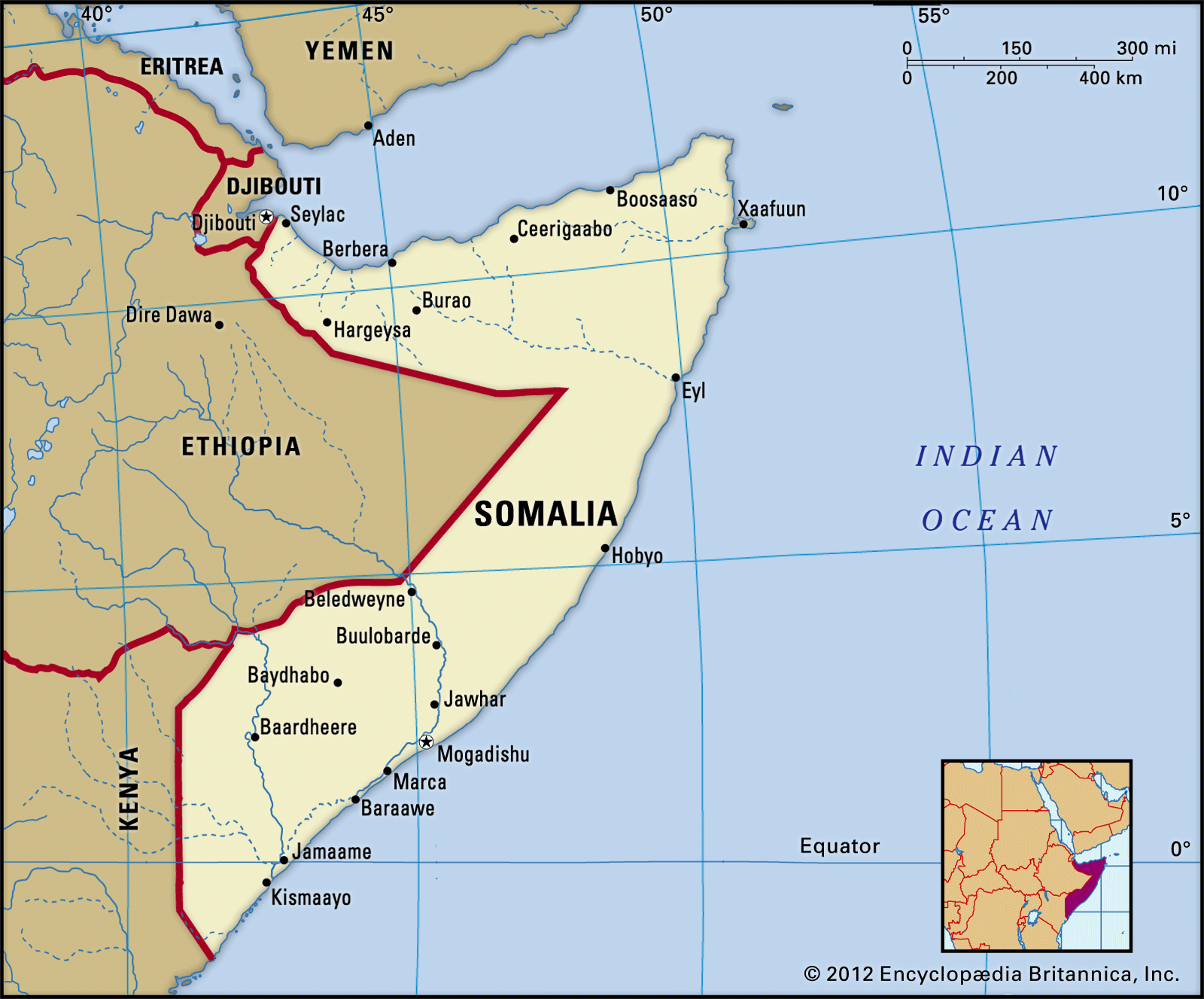
Somalia is usually discussed as a security problem. Piracy, Al Shabaab, federal disputes, foreign military partnerships and the long struggle to rebuild a functioning central state dominate the conversation, while the country's economic geography receives considerably less attention. Yet the strategic importance of Somalia is becoming increasingly difficult to understand without looking at the commercial map surrounding it. Somalia has one of Africa's longest coastlines, sits beside the Gulf of Aden and close to the Bab el Mandeb, and occupies territory that can potentially connect the Indian Ocean and Gulf of Aden to Ethiopia and the wider Horn of Africa. That geography has always existed, but the economic value of geography depends on whether a country has the infrastructure, security and institutions required to turn location into commerce. The question now emerging across the region is whether Somalia can do that, and whether its attempt will alter the balance between Djibouti, Somaliland, Ethiopia, Kenya and the other economies competing to control the movement of goods through the Horn.
The scale of the opportunity is best understood through Ethiopia. During the 2025/26 Ethiopian fiscal year, Ethiopia moved 17.57 million tonnes of import and export cargo through maritime gateways, of which 96.71 percent passed through Djibouti. Imports accounted for 15.93 million tonnes and exports for 1.64 million tonnes. Alternative routes through Berbera, Tadjourah and the Mombasa to Moyale corridor remained very small by comparison. This concentration is the economic fact around which the region's port competition is developing. Ethiopia is a large economy without a coastline, which means that the cost and reliability of its access to international markets are determined partly by infrastructure and political relationships in neighbouring countries. A port that captures Ethiopian cargo therefore does not merely earn a port handling fee. It can attract trucking companies, warehouses, customs services, freight forwarders, insurers, banks, fuel suppliers, manufacturers and distributors along the route connecting the ship to the Ethiopian customer. The country that becomes the preferred gateway can therefore capture economic activity far beyond the physical boundary of the terminal.
The Value of a Port Is Determined by What Happens Beyond the Port
This is why the economic significance of Berbera cannot be measured by the port itself. A modern terminal becomes commercially consequential when it begins to alter the cost and organisation of trade beyond its own perimeter. If Ethiopian importers can move cargo through Berbera at a competitive cost, demand follows for trucks, warehouses, freight forwarding, insurance, customs services, finance and fuel along the corridor connecting the port to the Ethiopian market. As those volumes become more predictable, businesses have an incentive to establish distribution and processing operations closer to the route because the cost and reliability of moving imported inputs and finished goods have improved. The economic effect can therefore extend from the terminal into the transport corridor and then into the locations where companies decide to build warehouses, factories and distribution centres. A port does not create all of that activity by itself. It changes the relative cost of reaching markets, and businesses respond to that change.
Berbera is being developed with precisely this logic in mind. DP World completed the first major expansion of the port with a 400 metre quay, a 17 metre draft and container capacity of 500,000 TEUs a year. Its stated second phase would increase capacity to two million TEUs, while the wider development includes the Berbera Economic Zone and the corridor linking the port towards Ethiopia. DP World says it has committed up to US$442 million to the port development. The company's model is explicitly based on combining maritime infrastructure with logistics, warehousing, manufacturing and other businesses around the corridor rather than treating the port as an isolated terminal.
That distinction is important because the economic return from infrastructure depends heavily on whether businesses can use it as part of a predictable supply chain. A port with modern cranes but poor roads behind it does not provide the same commercial service as a port connected to a reliable inland corridor. Importers ultimately care about the cost and time required to move goods from the ship to the warehouse or factory, not simply how quickly a container is lifted from a vessel. If Berbera can reduce the total cost of reaching parts of Ethiopia, then its importance will rise with every additional shipment that moves through it. If it cannot, the existence of a modern terminal will not be enough to displace established routes.
Ethiopia Is the Market Behind the Competition
The reason Ethiopia sits at the centre of this competition is straightforward. Its economy needs maritime access on a scale that Somalia, Somaliland, Djibouti and Kenya can all potentially serve, but Ethiopia has no coastline of its own. For decades, Djibouti has benefited from this structural dependence by becoming the overwhelmingly dominant gateway for Ethiopian external trade. The latest figures show just how difficult that position will be to challenge. Of the 17.57 million tonnes of Ethiopian maritime import and export cargo recorded in 2025/26, 96.71 percent moved through Djibouti.
That does not mean Ethiopia is preparing to abandon Djibouti. It means the economic value of alternative routes is becoming clearer. From Ethiopia's perspective, additional gateways reduce dependence on a single corridor and create greater choice over freight costs, transit times and commercial negotiations. From the perspective of neighbouring countries, even a relatively small share of Ethiopian cargo can justify substantial investment because each tonne moving through a corridor supports more than the port operator. It creates business for the road network, transporters, warehouses, border posts, financial institutions and industrial companies positioned along the route.
This is why the competition should not be understood simply as Djibouti versus Berbera. It is a competition for access to an inland market whose trade requirements are much larger than the economies surrounding any individual port. Berbera has the geographical advantage of providing a relatively direct route from the Gulf of Aden toward eastern Ethiopia. Mombasa has an established logistics system and a large existing customer base. Djibouti has decades of infrastructure and commercial relationships behind it. Somalia's other ports have the potential to develop their own hinterlands if roads, customs systems and security improve. The economic question is which of these routes can combine cost, speed and reliability well enough to persuade companies to change established supply chains.
Berbera Is Being Developed Around the Corridor
The development of Berbera illustrates why the port itself is only one part of the commercial proposition. DP World and Ethiopian authorities have previously described the Berbera Corridor as an effort to diversify Ethiopia's access to international trade, with road infrastructure connecting the port towards the Ethiopian border and the Ethiopian road network. The stated objective has been to create a more efficient route for Ethiopian cargo while attracting businesses and investment along the corridor.
The development of the Berbera Economic Zone follows the same logic. The zone is positioned along the corridor and is intended to attract warehousing, logistics companies, traders and manufacturers. The commercial calculation is relatively straightforward. A company importing goods into Ethiopia does not only need a ship and a port. It needs storage, inland transportation, customs clearance and eventually a location from which those goods can be distributed or processed. If those services can be provided efficiently around one corridor, the route becomes more attractive to businesses and additional investment can follow.
This is how infrastructure begins to influence economic geography. Companies do not relocate because a government announces a port expansion. They relocate when the expansion changes the economics of operating from a particular location. A manufacturer may find that imported machinery can be delivered more cheaply. A distributor may find that warehousing closer to the corridor reduces inventory costs. A logistics company may find that a larger and more predictable cargo base justifies investment in a fleet. Over time, these private decisions can concentrate commercial activity around the infrastructure that made them possible in the first place. That is the economic significance of Berbera.
Somalia Has a Port Network, But Not Yet a Unified Commercial Corridor
Somalia's opportunity is broader than Berbera. The Somalia Investment Promotion Office identifies four deep water ports at Mogadishu, Berbera, Kismayo and Bossaso, although it says that Mogadishu and Berbera currently handle significant volumes of traffic. It also identifies potential corridors connecting Kismayo and Mogadishu with Ethiopia and Kenya, a central corridor connecting Mogadishu and Bossaso with Ethiopia, and routes linking Ethiopia with Berbera and Djibouti.
The existence of several ports gives Somalia a potentially important geographical advantage, but the ports do not yet constitute a unified national logistics system. For that to happen, each gateway would have to be connected to reliable roads, predictable border procedures, efficient customs, adequate warehousing and commercial services capable of handling growing cargo volumes. A truck operator needs to know how long a journey will take. An importer needs to know when goods will clear customs. A manufacturer needs confidence that raw materials will arrive consistently. A foreign investor needs to know that a corridor will continue operating even when political relationships change.
This is where Somalia's state building challenge intersects directly with its economic development. A country can possess excellent maritime infrastructure and still fail to become a major trading economy if the institutions connecting that infrastructure to the inland market remain unreliable. The port is therefore only one component of the proposition. The commercial value comes from the reliability of the entire route.
Türkiye's Role Extends Into Maritime Economics
Türkiye's growing role in Somalia is normally presented through the language of defence, but its economic significance is increasingly maritime. The ten year defence and economic cooperation framework signed in February 2024 commits Türkiye to build, train and equip the Somali navy while strengthening maritime security against piracy, illegal fishing and other threats. The Somali government describes the agreement as also deepening bilateral economic cooperation, particularly around marine resources.
The economic connection is direct. Somalia has a long coastline and potentially valuable marine resources, but the ability to generate sustained economic value from those resources depends on the capacity of the state to monitor and enforce activity in its waters. Illegal fishing reduces the value available to legitimate Somali operators. Piracy increases the risk associated with shipping and raises the cost of insurance and maritime operations. Weak enforcement also makes long term investment in maritime industries more difficult because investors cannot easily assess the security of their assets and operations.
A stronger Somali maritime security capacity would therefore have implications beyond defence. If it eventually enables Somalia to secure its waters more effectively, regulate fishing, protect shipping and enforce national jurisdiction, it could create conditions for greater investment in fisheries, shipping services, port operations and other marine industries. The defence relationship with Türkiye is not itself an economic development strategy, but maritime security is one of the conditions without which a maritime economy cannot develop at scale.
The UAE Has Approached the Region Through Commercial Infrastructure
The UAE's role presents a different model of influence. Through DP World, Emirati capital has been directed heavily toward ports and logistics infrastructure, with Berbera representing the clearest example. The investment has not stopped at the terminal. The port, economic zone and corridor have been developed as connected parts of a broader commercial proposition designed to attract cargo and businesses serving the Horn.
That model matters because control of a trade gateway can create influence over the economic activity surrounding it. A port operator that handles cargo also becomes connected to shipping lines, freight forwarders, transport companies, importers and exporters. If the port is linked to an economic zone, the relationship extends into industrial investment. If the corridor reaches a large inland market, the commercial importance becomes regional rather than local.
The emerging competition around Somalia is therefore partly a competition between different forms of economic organisation. One approach has placed substantial emphasis on commercial infrastructure and logistics networks. Another is centred on strengthening the Somali federal state and its capacity to control its territory and maritime space. These approaches do not necessarily have to conflict, but they produce different questions about who controls infrastructure, who regulates it, who collects the resulting revenues and how much of the economic activity generated by the ports remains within Somalia.
Those questions will become increasingly important as the value of the country's ports increases.
Djibouti Has the Advantage of Being Established
There is a tendency in discussions about Berbera to assume that the emergence of an alternative gateway automatically threatens Djibouti. The available data do not support that conclusion. Djibouti remains overwhelmingly dominant in Ethiopian maritime trade, handling 96.71 percent of Ethiopia's external cargo during the 2025/26 fiscal year. Its advantage is not simply geographical. It has accumulated infrastructure, roads, rail connections, logistics companies, customs processes and commercial relationships around Ethiopian trade over many years.
That accumulated advantage matters because logistics networks benefit from scale and familiarity. A shipping company, importer or manufacturer is less likely to change a route simply because another port exists. The alternative has to offer a meaningful improvement in total cost, reliability or access to a particular market before a supply chain is reorganised.
This is why the development of alternative corridors should be understood as a process of increasing commercial choice rather than an immediate displacement of existing gateways. Ethiopia does not necessarily need to replace Djibouti. It needs alternatives that are sufficiently credible to reduce the risks associated with having almost all maritime trade concentrated through one route. For Berbera, Mombasa and potentially other ports, capturing even a modest share of Ethiopian cargo could therefore have strategic significance because it would establish commercial viability and provide a basis for further investment.
Kenya Is Competing for the Same Hinterland
Kenya is already part of this contest because Mombasa serves a large regional hinterland and the country has also been developing Lamu and northern transport corridors. Somalia's own investment authorities identify a southern corridor linking Kismayo and Mogadishu with Ethiopian markets and Kenya's Lamu, Isiolo, Wajir and Mandera corridor.
The commercial implications are substantial because the same cargo can potentially move through different national corridors depending on the relative cost and reliability of each route. A shipment destined for Ethiopia does not carry a political preference for Djibouti, Berbera or Mombasa. The importer wants the goods delivered at an acceptable cost and within a predictable period. If a competing corridor can offer a better proposition, cargo can gradually move.
This is why port competition should not be measured only by the number of containers handled. The more meaningful measure is the total cost of moving goods between the international shipping network and the final market. Port charges matter, but so do road quality, border delays, customs procedures, fuel costs, truck utilisation, security, warehousing and the availability of return cargo. A port with a lower handling charge can still be the more expensive route if everything beyond the terminal is inefficient.
Tanzania Is Already in the Same Competition
The Somali story is therefore directly relevant to Tanzania, even though the two countries sit at different ends of the East African coastline. Dar es Salaam is already a major gateway for landlocked economies, and its performance demonstrates the value that can be captured when a port is connected to a large and diversified hinterland. Transit cargo through Dar es Salaam increased 17 percent during the 2025/26 financial year to 14.61 million tonnes, up from 12.52 million tonnes the previous year. Cargo destined for the Democratic Republic of Congo alone increased 30 percent to 7.77 million tonnes and accounted for 53 percent of total transit cargo.
These numbers show why Tanzania should pay attention to the competition emerging further north. The Central Corridor is not valuable simply because Dar es Salaam has a port. Its value comes from the commercial relationship between the port and the markets beyond Tanzania's borders. Every tonne of DRC cargo moving through Dar es Salaam supports transport companies, warehouses, fuel suppliers, clearing agents, rail and road operators and other businesses along the route. The economic value therefore extends across several countries.
But the same logic means that Tanzania cannot assume that geography will permanently protect its position. Alternative corridors are being developed precisely because landlocked countries want more choice. The more reliable those alternatives become, the more pressure there will be on every established gateway to reduce costs and improve service.
Tanzania's response should therefore be to strengthen the entire Central Corridor rather than concentrate only on the physical expansion of Dar es Salaam port. The question is whether cargo can move efficiently from ship to border and from border to final destination. A port can increase its capacity while the wider corridor remains constrained by roads, railways, customs processes, border congestion or limited logistics capacity. In that situation, additional port capacity does not necessarily translate into proportional growth in regional trade.
The Competition Is Between Corridors, Not Quays
The economic geography of the Horn and East Africa is therefore being shaped by the performance of complete corridors. Dar es Salaam competes through the Central Corridor. Mombasa competes through the Northern Corridor and its connections to inland markets. Djibouti competes through the established Addis Ababa trade route. Berbera is being developed around a corridor into Ethiopia. Somalia's other ports are being considered as gateways into Ethiopia, Kenya and the wider region. This changes how governments should measure infrastructure.
The relevant question is not simply how many tonnes a port can handle. It is how cheaply and reliably a business can move a tonne of cargo from a vessel to its destination. That calculation includes everything between the two points. A modern terminal loses some of its advantage if cargo then encounters expensive trucking, poor roads, long border delays or unpredictable customs procedures. Conversely, an efficient corridor can make an otherwise ordinary port commercially attractive because the total cost of reaching the final market is competitive.
The countries that understand this will have an advantage over those that continue to treat ports, roads, railways and industrial zones as separate infrastructure projects. The economic value is created by the connection between them. A port can bring cargo into a country, but the larger question is whether that cargo generates domestic transport activity, warehousing, manufacturing, processing, finance and employment before it leaves again.
The Real Prize Is Not Cargo. It Is the Economic Activity Around Cargo
This is where Somalia's opportunity becomes much larger than the competition between Berbera, Mogadishu, Bosaso and Kismayo. If foreign cargo simply passes through Somalia on its way to Ethiopia, the country receives some port and transport income, but much of the higher value activity can remain elsewhere. If Somalia develops logistics companies, warehouses, cold storage, processing plants, trade finance and manufacturing around those corridors, the same cargo can generate a substantially larger domestic economic return.
The distinction is particularly important for a country trying to rebuild its productive economy. Foreign investment in a port is useful, but its long term development value depends partly on how many domestic businesses are created around it and how much local capacity develops alongside the infrastructure. A successful port should eventually generate demand for Somali transport operators, engineers, construction companies, financial institutions, technology providers, suppliers and skilled workers. Otherwise the country risks becoming a transit location in which infrastructure is modern but the domestic economy remains disconnected from the value moving through it.
The same issue applies to Tanzania. The objective should not simply be to move more DRC cargo through Dar es Salaam. It should be to increase the amount of economic activity Tanzania and the wider Central Corridor capture from that trade. Warehousing, processing, manufacturing, logistics and financial services can generate considerably more value than port handling alone.
This is why the competition for African trade routes is ultimately also a competition for industrialisation.
Somalia's Geography Is an Asset, But Geography Does Not Build an Economy
Somalia possesses an extraordinary geographic advantage. Its coastline faces one of the world's most important maritime regions, while its position gives it potential access to Ethiopia and the broader Horn. The country's investment authorities already identify ports and transport corridors as major areas of opportunity and list infrastructure projects designed to connect Somali gateways with Ethiopia and Kenya. But geography is only an asset once institutions make it commercially usable.
A coastline without maritime security cannot fully support a maritime economy. A port without reliable roads cannot efficiently serve an inland market. A road without customs efficiency cannot create a competitive corridor. A corridor without sufficient cargo cannot support commercial investment. And cargo passing through a country without domestic businesses capable of serving it will generate less local economic value than it could.
This is why the evolution of Somalia's state matters so much to its economic future. A stronger federal government that can secure territory, regulate ports, enforce maritime jurisdiction and provide predictable commercial rules could change the economic value of the country's geography. It would not guarantee development, but it would remove some of the constraints that have prevented private capital from treating Somalia's coastline as a normal commercial asset.
Türkiye's involvement in maritime security, the development of Berbera's port and corridor infrastructure, the continued dominance of Djibouti and the expansion of competing East African corridors are therefore parts of a much larger story. They are changing the conditions under which businesses decide where to move cargo, where to build warehouses and where to locate productive capacity.
The Next Contest Will Be About Who Captures the Value
The Horn of Africa is entering a period in which landlocked economies will have more potential choices over how they reach international markets. Ethiopia remains overwhelmingly dependent on Djibouti, but Berbera is being expanded and connected to an economic zone and an Ethiopian corridor. Kenya has established gateways and new infrastructure ambitions. Somalia has several ports and a long coastline but is still building the institutions required to integrate them into a functioning commercial network. Tanzania is strengthening the Central Corridor while its transit trade with the DRC is growing rapidly.
The eventual winners will not necessarily be the countries with the largest ports. They will be the countries whose corridors make trade cheaper, faster and more predictable and whose domestic economies are capable of capturing a meaningful share of the activity generated by that trade.
For Somalia, that means converting its coastline into an economic asset rather than allowing it to remain merely a strategic prize. For Ethiopia, it means securing greater choice over its maritime access. For Djibouti, it means defending an established position through efficiency rather than dependence. For Kenya, it means ensuring that Mombasa and Lamu remain commercially competitive. For Tanzania, it means treating the Central Corridor as an economic production system rather than a transport route.
The implications extend far beyond ports. Once a corridor becomes commercially reliable, it can influence where companies build factories, where warehouses are established, where workers move, where financial services expand and where governments invest in infrastructure. Those decisions can change the economic geography of entire regions because private capital tends to follow predictable reductions in the cost of reaching markets. That is why Somalia's changing position matters.
The country is not simply trying to secure its coastline. It is trying, whether deliberately or through the accumulation of infrastructure and institutional capacity, to determine whether that coastline can become a gateway into one of Africa's most important inland markets.
The strategic question for Somalia is no longer simply who controls its coastline. It is whether Somalia can turn control of that coastline into control of a meaningful share of the economic activity that moves through the Horn.
FAQ
Why are Somalia's ports becoming economically important? Somalia has four deep water ports identified by its investment authorities at Mogadishu, Berbera, Kismayo and Bossaso. Their potential importance comes from their location along the Gulf of Aden and their possible connections to Ethiopia and other inland markets.
How dependent is Ethiopia on Djibouti? During the 2025/26 Ethiopian fiscal year, 17.57 million tonnes of Ethiopian import and export cargo passed through maritime gateways, with 96.71 percent moving through Djibouti.
How large is Berbera's planned port capacity? Berbera's first major expansion increased container capacity to 500,000 TEUs annually. DP World lists a second phase capacity of two million TEUs. The port's wider development includes an economic zone and corridor toward Ethiopia.
What is Türkiye's economic role in Somalia? Türkiye's ten year defence and economic cooperation framework includes building, training and equipping the Somali navy, strengthening maritime security and deepening economic cooperation around marine resources.
How does Tanzania fit into this competition? Tanzania is already a major regional gateway. Transit cargo through Dar es Salaam increased to 14.61 million tonnes in 2025/26, with DRC bound cargo accounting for 7.77 million tonnes, or 53 percent of total transit cargo.
Will Berbera replace Djibouti as Ethiopia's main gateway? There is currently no evidence that this is happening. Djibouti handled 96.71 percent of Ethiopia's maritime import and export cargo in 2025/26. The more immediate significance of Berbera is that it provides Ethiopia with an additional route and therefore greater choice in the long term.
 Uchumi360
Business Intelligence
Uchumi360
Business Intelligence
Uchumi360 covers business, investment, and economic policy across East, Central, and Southern Africa.
For the serious reader
You read to the end. That places you in a small group.
Uchumi360 is built for readers who demand precision over speed, structure over sentiment, and analysis that holds uncomfortable conclusions rather than softening them. If this work sharpens how you think about Africa's economy, help us keep building the infrastructure behind it.
Institutional Partners
Commission intelligence. Shape the conversation.
Uchumi360 works with development finance institutions, investment firms, sovereign bodies, and strategic organisations across the coverage region. Institutional partnership unlocks:
- Commissioned sector and country intelligence reports
- Branded research series under your institution's authority
- Exclusive data briefings for internal strategy teams
- Speaking and editorial presence at Uchumi360 events
- Co-published investment outlooks for your markets
Support Our Work
Independent analysis has a cost. Help us bear it.
Uchumi360 does not carry advertising. It does not take editorial direction from sponsors. Every article is produced without commercial compromise. Your contribution funds the reporting, research, and editorial infrastructure that keeps this analysis free from influence.
Secure checkout: One-time and monthly support are processed securely. Add payment credentials to enable checkout here.
Stay Connected
Keep up with every new insight.
Follow our latest analysis, policy coverage, and market intelligence as soon as it is published. If you need something specific, reach out directly and we will point you to the right research.
