

Tanzania’s Football Economy: What IFFHS Rankings Reveal About Value Creation and Growth Potential
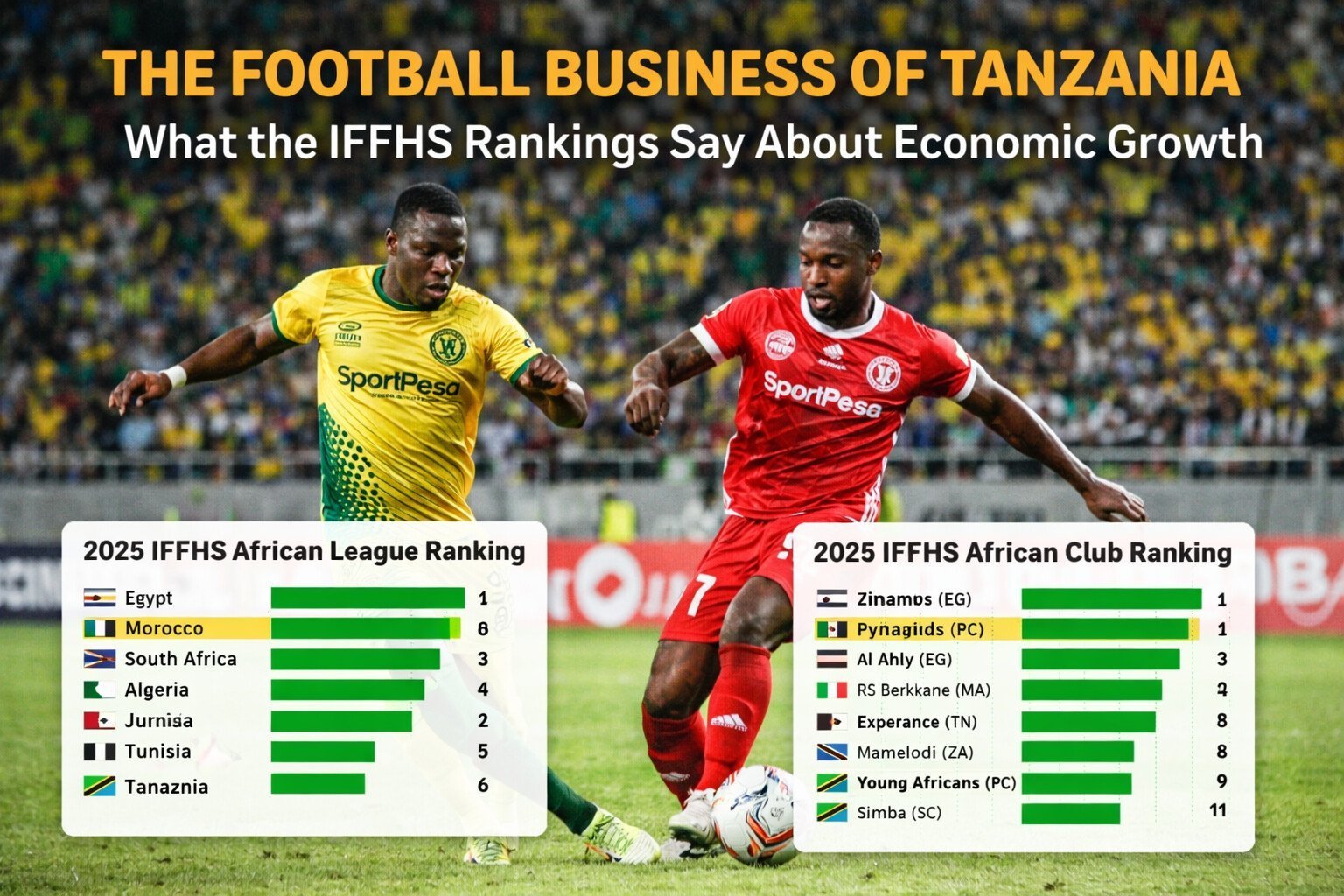
Tanzania’s rise in the IFFHS football rankings is more than a sporting milestone. It signals growing commercial value in the domestic league and clubs like Simba and Young Africans. This analysis explains what the rankings mean for broadcasting, sponsorship, player markets, and the wider football economy.
In global sport today, ranking is not just prestige, it is an economic indicator that reflects institutional strength, market appeal, revenue potential, and international brand visibility. In January 2026, the International Federation of Football History & Statistics (IFFHS) released its annual world ranking of the strongest national leagues and clubs, and Tanzania’s presence in these lists carries economic signals worth unpacking.
Tanzania’s Football Footprint in the IFFHS Rankings
According to IFFHS, the Tanzanian Mainland Premier League (NBC Premier League) ranks sixth in Africa and around 54th globally among national leagues, a position that has improved in recent years amidst competition from much larger markets.
On the club side, two of Tanzania’s most commercially visible clubs, Simba SC and Young Africans SC (Yanga), consistently appear in continental ranking tables alongside top African franchises. In the IFFHS Continental Club Rankings, both clubs were placed among the top tier of African sides; at one point Simba was around #11–#12 and Yanga close behind.
This is not trivial. IFFHS ranks aggregate performance, continental competitiveness, and consistency against hundreds of clubs worldwide. For Tanzanian clubs to appear near the top of these lists means they are punching above historical weight in competitive performance and this performance underpins commercial value.
Why Rankings Matter Economically
Global football rankings matter for several interconnected economic reasons:
1. Visibility drives commercial revenue.
Higher ranked leagues and teams attract better sponsorship deals, merchandise sales, and broadcasting contracts. International media partners are more willing to bid for rights where there is viewership interest. In Kenya and South Africa, for example, strong league performance correlates with multi-year broadcast deals that inject millions into club coffers.
2. Competitive success accelerates market growth.
When Simba SC regularly progresses in CAF competitions, it generates international fixtures that drive ticket revenue, hospitality sales, and secondary market spending in Dar es Salaam and across East Africa. Consistent continental visibility expands fan bases, including diaspora fans paying for streaming and merchandise.
3. Rankings affect talent markets.
Players from higher ranked leagues have stronger bargaining positions. Scouts from North Africa, Europe, and the Middle East are more likely to monitor clubs that consistently perform well. This increases potential transfer fees — a direct revenue stream for clubs and the Tanzania Football Federation (TFF).
4. Economic spillovers into local communities.
Derbies like Simba vs Yanga in Kariakoo are economic events. Beyond ticket sales, they drive hospitality, vendor activity, transport, and informal commerce. In larger cities like Dar es Salaam’s Msimbazi area, football match days create micro-economic hubs that ripple into local employment.
Market Growth and Future Potential
The broader Tanzanian football market is projected to grow at a compound annual rate close to 11% by 2027, according to industry market reports, reflecting strong fan demand, sponsorship interest, and commercialisation potential.
This growth trajectory aligns with the league’s improved competitive status. Success breeds value: stronger performance in continental competitions raises the league’s coefficient, which in turn attracts better foreign players, increases merchandise appeal, and strengthens the bargaining position in sponsorship negotiations.
Challenges That Temper the Opportunity
Despite the positive momentum, there are structural constraints that limit the immediate translation of rankings into broad economic impact:
Weak stadium infrastructure outside Dar es Salaam constrains matchday revenues in regions like Mwanza or Arusha where fan base is strong but facilities are outdated. However, that is already been addressed with the ongoing construction of the new stadium in Arusha and another one planned in Dodoma. It seems, Mwanza will have to wait.
Limited broadcast monetisation means that domestic rights are undervalued relative to other African leagues, even though viewership is competitive.
Governance gaps in club management can undercut investor confidence, making foreign capital hesitant to enter. Local entrepreneurship in club ownership remains fragmented compared to more commercially attractive markets.
These bottlenecks suggest that rankings signal potential, but without institutional reforms, the economic upside may be limited to a handful of clubs rather than the entire ecosystem.
Narratives and Anecdotes: From Kariakoo to the Pitch
Dar es Salaam’s Kariakoo ward is not just a transport hub. On match days, it becomes an economic microcosm, where businesses ranging from barbershops to street food vendors rely on the footfall generated by major fixtures. A derby day; the Kariakoo Derby between Simba and Yanga is an event that stimulates informal trade, local transport revenues, and mobile money transactions, often showing localised GDP bumps reflective of wider economic activity.
Likewise in Tabora, clubs like TRA United illustrate that football’s economic value is not confined to urban cores. Regional fan bases and local corporate sponsors are beginning to invest in club infrastructure, signaling grassroots demand ready to be monetised.
Policy and Investment Implications
Ranking achievements create a compelling argument for targeted public and private investment:
- Infrastructure development — investment in stadia and digital broadcast facilities can unlock new revenue streams.
- Brand optimisation — leveraging international rankings in marketing campaigns can grow merchandise and sponsorship deals.
- Youth development — structured academies tied to league clubs can create exportable talent, increasing transfer income.
These are the same levers that transformed leagues in North Africa and parts of Southern Africa into regional economic engines.
Uchumi360 Bottom Line: Rankings as Economic Signals
The IFFHS rankings are more than ordinal lists. They are leading indicators of commercial viability, institutional capacity, and growth potential within Tanzania’s football sector.
Tanzania’s position in these rankings with a top-tier national league and clubs visible among Africa’s competitive elite signals latent economic value that can be activated through better governance, broadcast monetisation, infrastructure investment, and strategic partnerships.
For policymakers, sponsors, and entrepreneurs, the question is no longer whether football in Tanzania has economic potential. It is how to convert competitive visibility into sustainable revenue models that benefit communities far beyond the stadium gates. That is the real economic story behind the rankings.