
East Africa Is Building Railways. AFCON 2027 Shows Why They Must Connect
Ready
AFCON PAMOJA 2027 will bring Kenya, Tanzania and Uganda together for Africa’s first three country tournament, but the region still lacks a seamless railway linking its host economies. With East Africa already investing billions in SGR projects, completing the missing cross border connections could transform freight, tourism, passenger travel and regional trade long after the tournament ends.
East Africa is preparing to host the most geographically ambitious Africa Cup of Nations in the competition’s history. Kenya, Tanzania and Uganda will jointly stage AFCON PAMOJA 2027 from June 19 to July 17, bringing 24 national teams and, according to CAF, an expected 1.5 million supporters into a tournament spread across three countries rather than one. The event has already forced the region to think beyond national infrastructure because stadiums, airports, hotels, roads, border posts and security systems will have to function as parts of one tournament. Yet the most obvious regional transport question remains unresolved: the three host countries still do not possess a seamless railway network that allows a supporter to board a train in one host country and continue efficiently into another. AFCON will last only a month, but it exposes a much larger economic problem. East Africa has been investing billions of dollars in railways, ports and corridors, yet much of that investment still works primarily as national infrastructure. The greater return would come from connecting those systems into a genuine regional railway market capable of moving passengers, containers, minerals, agricultural products and manufactured goods across borders without repeatedly changing transport modes.
The scale of the economic case extends far beyond football. The East African Community now represents more than 331 million people and a combined GDP of roughly US$357 billion, yet trade among member states remains a relatively small share of the region’s overall commerce. EAC data show intra-regional trade of US$19.7 billion in 2025 against total trade of US$156.7 billion, while the Community itself has identified infrastructure bottlenecks, regulatory differences and border delays among the reasons trade remains below its potential. At the same time, trade among EAC countries is growing quickly: it expanded from about US$14.2 billion to US$18 billion between June 2024 and June 2025, while intra-EAC trade reached US$19.3 billion for 2025, according to later regional reporting. These numbers suggest that the economic demand for integration already exists, but physical connectivity is still being built around corridors whose strongest links often stop at national borders.
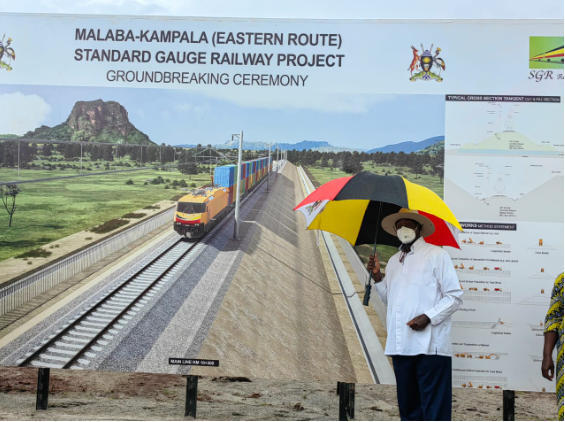
The region has not lacked a railway vision. The East African Railway Master Plan has existed for years and explicitly envisages rejuvenating railways in Tanzania, Kenya and Uganda, extending them to Rwanda and Burundi, and eventually connecting South Sudan, Ethiopia and the wider region. The current EAC development strategy still describes an interoperable railway network as a regional priority, with Kenya and Tanzania making the largest investments so far. Kenya’s Mombasa to Nairobi SGR, extended to Naivasha, has already demonstrated the scale rail can achieve, with the EAC reporting that it was carrying around six million tonnes of cargo annually by 2023. Tanzania, meanwhile, has invested more than US$7 billion in its Central Corridor SGR programme, with Dar es Salaam to Dodoma already operating and construction continuing west towards Tabora, Isaka and Mwanza. Uganda has committed €2.7 billion to the 273-kilometre Malaba to Kampala SGR, designed as the next link westwards from Kenya. Individually, these are enormous projects. Collectively, they begin to resemble the skeleton of a regional railway system, but only if governments finish the cross-border connections and agree that trains, passengers and freight should move through the network as seamlessly as possible.
AFCON Makes the Missing Links Easy to See
A three-country AFCON is precisely the kind of event that makes the difference between national infrastructure and regional infrastructure visible to ordinary people. CAF has described PAMOJA 2027 as the first Africa Cup of Nations hosted by three countries and expects more than 1.5 million fans to attend across the tournament. If a supporter watches a match in Nairobi and wants to follow the same team to Uganda or Tanzania, the practical options today are overwhelmingly air or road transport. Flying is fast but expensive, and airport capacity is finite. Long-distance buses are cheaper but consume substantial time, depend on road conditions and still have to cross borders. A functioning international passenger railway would create a third option capable of carrying large numbers of supporters at predictable prices while allowing overnight or daytime movement between major host centres.
Europe provides a useful comparison, not because East Africa should reproduce European infrastructure exactly, but because major sporting events show what becomes possible when rail networks already exist. During UEFA Euro 2024 in Germany, ticket holders received local public transport access for 36 hours around matches and could buy discounted long-distance and international train tickets to move between host cities. UEFA and German transport authorities expected around 70 per cent of stadium spectators in some host cities to use public transport. The tournament could be distributed across ten cities because supporters did not have to treat each venue as a separate aviation destination. Railways turned multiple cities into one transport system.
East Africa is attempting something similarly regional without yet having the railway equivalent. AFCON 2027 will still succeed because governments are investing in roads, aviation and tournament infrastructure, but it illustrates how much more efficient future regional events could become if Nairobi, Kampala, Arusha, Moshi and Dar es Salaam were connected through reliable intercity rail. A railway would not eliminate aviation, especially for teams and supporters arriving from West, North and Southern Africa, but it could take over a meaningful share of movement once people are inside the host region. That would reduce pressure on airports, highways and border parking areas while allowing supporters to spend money in more than one country during the same trip. A fan arriving in Nairobi could potentially attend matches in Kenya, continue by train towards Uganda, or move south through the Kenya-Tanzania rail connection towards northern Tanzania rather than buying separate flights for each leg.
The railway gaps are especially striking because several pieces of that system either already exist or are being revived. Kenya completed its SGR from Mombasa through Nairobi to Naivasha and in March 2026 launched construction of the extension towards Kisumu and Malaba, including a 264-kilometre Naivasha to Kisumu section and another 107 kilometres from Kisumu to Malaba on the Ugandan border. Uganda has already launched construction of its 273-kilometre Malaba to Kampala SGR, creating the possibility that the Mombasa-Nairobi-Kampala corridor can eventually operate as one continuous standard-gauge route.
The Kenya-Tanzania connection is less developed, but even there the logic is becoming clearer. Kenya in April 2026 launched a KSh5.5 billion rehabilitation of the Voi to Mwatate and Taveta metre gauge railway, describing the line as part of the historic Mombasa-Voi-Taveta-Moshi-Arusha trade route. Kenya’s own government says the revived corridor is intended to reconnect with Tanzania through the Taveta Holili border and reduce the distance between Mombasa and Bujumbura by 358 kilometres. Tanzania, for its part, has been preparing rehabilitation work on the Tanga Moshi Arusha network, while official project documents identify the northern railway as serving Tanzania’s northern regions and neighbouring Kenya, Rwanda, Burundi and Uganda. The two governments have also signed cooperation commitments around reviving the Voi Taveta connection into Tanzania.
This is where AFCON becomes more than a sporting example. If the region already had a dependable passenger railway between Kenya and northern Tanzania, the tournament could distribute spectators across Nairobi, Arusha and other participating centres without treating an international border as the end of the transport system. Hotels outside the immediate stadium cities would become more useful. Tourism packages combining football with Kilimanjaro, Zanzibar, the Serengeti, Masai Mara or Uganda’s tourism destinations would become easier to organise. Border towns could capture spending from passengers instead of serving primarily as places where buses queue for clearance. The economic geography of the event would become wider because travel time and uncertainty would fall.
The Larger Case Is Freight, Not Football
The strongest justification for an East African railway network is still freight, because football tournaments happen occasionally while cargo moves every day. The Northern Corridor alone demonstrates the volumes involved. Transit cargo through Mombasa destined for Uganda reached about 2.84 million tonnes in 2025, while the Democratic Republic of Congo accounted for nearly 557,000 tonnes, South Sudan 422,000 tonnes and Rwanda more than 223,000 tonnes. Total transit volumes in the fourth quarter based reporting rose sharply, and more than 89 per cent of cargo for these markets consisted of imports. The Northern Corridor therefore already functions as a regional economy in commercial terms even though much of the inland journey continues by road.
Rail changes the economics of this freight because the largest savings come from moving heavy cargo over long distances repeatedly. Kenya’s SGR was already moving around 6.5 million tonnes of freight in 2024, while the older metre gauge system carried another 1.2 million tonnes. The EAC says the SGR reduced Mombasa to Nairobi freight transit from more than 24 hours to roughly eight hours. These figures explain why completing the railway beyond Kenya matters so much. A container travelling from Mombasa to Kampala does not receive the full benefit of a modern railway if it has to be unloaded at the end of one system and placed onto trucks for the remaining journey. The capital expenditure produces a larger regional return when the same train or compatible rolling stock can continue towards the final market.
The same principle applies to Tanzania’s Central Corridor. Tanzania has built an electrified SGR designed for passenger speeds of up to 160 kilometres per hour and freight speeds of up to 120 kilometres per hour, with the network intended eventually to extend towards Rwanda, Burundi and the DRC. TRC says the wider Tanzanian SGR plan is designed to connect landlocked neighbouring countries while the current construction programme pushes west from Dar es Salaam towards Mwanza and Kigoma. Tanzania is also preparing cross border SGR development towards Burundi and the DRC. If those projects connect to Rwanda and eventually interact with Uganda’s network, East Africa could begin to possess two strong port gateways, Mombasa and Dar es Salaam, feeding a shared inland rail market rather than two parallel systems competing only through road corridors.
That competition between corridors would actually be healthy. Uganda, Rwanda, Burundi and eastern DRC would not need to depend entirely on one port or one country. Exporters and importers could choose between Mombasa and Dar es Salaam based on price, congestion, shipping schedules and final destination. Tanzania could capture more transit cargo while Kenya would have an incentive to keep its corridor efficient. The landlocked economies would gain bargaining power because they would have more than one reliable route to the sea. A regional railway network therefore does not require countries to surrender commercial competition. It makes that competition more productive by giving businesses genuine alternatives.
The World Bank’s broader work on African integration supports this logic. It argues that transport corridors, customs systems, standards, payment systems and other regional public goods determine whether formal trade agreements actually reduce the cost of doing business. Africa already has the AfCFTA and the EAC has operated a customs union and common market for years, yet goods still face repeated inspections, infrastructure gaps and administrative delays. Building a railway without fixing border procedures would therefore reproduce the same inefficiencies on steel rails. The physical network must be accompanied by customs systems capable of clearing freight before arrival, interoperable digital documentation, common safety standards and immigration procedures that allow passenger trains to cross borders without spending hours standing at stations.
The Network Already Exists on Paper. The Problem Is That Countries Are Building It in Pieces
The EAC’s railway plans already contain many of the routes required for a regional system. The Northern Corridor vision runs from Mombasa through Nairobi, Malaba and Kampala, with extensions towards Kigali, Bujumbura, Juba and eastern DRC. Tanzania’s Central Corridor runs from Dar es Salaam through Dodoma, Tabora and Isaka towards Mwanza, Kigoma, Rwanda and Burundi. Older EAC plans also identify the Taveta Moshi Arusha railway as a link between the Kenyan and Tanzanian networks. These routes could eventually be reinforced by Lake Victoria rail ferry connections between Mwanza, Kisumu and Port Bell, creating additional redundancy within the system.
The problem is sequencing. Kenya built Mombasa Nairobi before Uganda was ready to construct Malaba Kampala. Tanzania pushed rapidly ahead with its central SGR while the international extensions remained at earlier stages. Rwanda and Burundi cannot realise the full benefit of proposed SGR connections until the lines on the Tanzanian or Ugandan sides reach them. South Sudan and eastern DRC face the same problem. Every government makes investment decisions through its own budget, debt constraints and political timetable, yet railway economics frequently depend on traffic originating in another country.
This creates a classic regional infrastructure dilemma. Kenya bears much of the cost of pushing rail towards Malaba, but Uganda captures some of the resulting benefit. Uganda can justify Malaba Kampala more easily if Rwanda, DRC and South Sudan eventually feed cargo into it. Tanzania can justify extensions west from Isaka more easily if Rwanda and Burundi commit traffic. Rwanda benefits enormously from access to the sea but cannot build the entire corridor itself. If each government calculates the railway only through the traffic generated within its own borders, some cross border links may appear marginal even when the combined regional system produces a strong economic return.
That is why East Africa needs to move from coordinating railway projects to financing a railway network. The EAC already provides the institutional platform, but the next stage should involve joint corridor investment frameworks in which countries agree on construction sequencing, technical standards, border stations, rolling stock interoperability, access charges and revenue sharing before each national section is built. Regional development banks, the African Development Bank, World Bank, pension funds and private infrastructure investors could then evaluate entire corridors rather than disconnected national lots.
There is also no economic requirement that every kilometre immediately use the same technology. East Africa already has both standard gauge and metre gauge networks, and some older routes can be rehabilitated much faster than entirely new SGR lines can be financed. Kenya’s decision to revive the Voi Taveta metre gauge line illustrates this point. The immediate objective should be connectivity, reliability and interoperability, with transshipment facilities used where gauges differ and standardisation pursued over time where freight volumes justify it. Refusing to connect two countries until a perfect SGR is affordable could leave useful corridors dormant for another decade.
A Regional Passenger Market Could Become Economically Important in Its Own Right
Freight will pay a large part of the railway’s economic bill, but East Africa should not underestimate passenger demand. The region is becoming increasingly urbanised, its largest cities are growing rapidly and cross border movement for business, education, tourism, family visits and events is substantial. Long distance travel between Nairobi, Kampala, Arusha, Dar es Salaam and other regional centres is currently divided mainly between buses and aircraft, leaving a wide middle market for travellers who value reliability and comfort but cannot or do not want to fly.
Tanzania’s experience already shows how quickly passenger behaviour can change when an attractive railway service becomes available. Its modern SGR now operates between Dar es Salaam and Dodoma, with the line designed for passenger speeds of up to 160 kilometres per hour. Kenya’s passenger SGR has likewise demonstrated sustained demand between Mombasa and Nairobi. Uganda’s planned SGR is explicitly intended for both passenger and freight services. A regional service linking national systems would therefore not be creating passenger rail culture from nothing. It would connect markets in which people have already shown willingness to use modern trains.
AFCON gives this passenger argument an unusually visible demonstration. CAF expects more than 1.5 million fans over one month. Even if only a modest share travelled between host countries by rail, the numbers would be large enough to justify additional services. More importantly, those trains would not disappear after the final on July 17. The same capacity would continue serving students, tourists, traders, families and business travellers for decades. This is one reason major events make infrastructure more valuable when they accelerate investments that remain useful afterwards rather than encouraging temporary spending whose economic life ends when the tournament does.
A regional rail ticketing system could deepen that effect. Imagine a passenger buying one Nairobi Kampala ticket, or eventually one Dar es Salaam Nairobi ticket, without separately navigating two railway companies, two booking platforms and unpredictable border procedures. Immigration could be completed at departure stations or during the journey, similar to arrangements used on some international rail systems elsewhere. EAC citizens already benefit from regional mobility rights, but transport systems have not fully caught up with the political idea of a common market. Rail could turn that principle into something physically experienced.
The tourism potential is particularly strong because East Africa’s major attractions are geographically complementary. Kenya and Tanzania already sell safari circuits to many of the same international travellers, while Uganda and Rwanda offer additional wildlife and conference destinations. A connected railway could make multi country tourism easier for middle income African travellers and international visitors who currently face high regional air fares. AFCON visitors are a useful example: a supporter travelling to Nairobi for football could add Arusha or Moshi to the journey, while a visitor entering through Tanzania could continue towards Kenya or Uganda without returning to an airport. Infrastructure that allows tourists to spend one additional night in another city can distribute economic benefits far beyond the stadium.
AFCON 2027 Should Be Treated as a Preview of the Region East Africa Says It Wants to Build
The symbolism of PAMOJA 2027 is unusually appropriate. CAF deliberately chose the Swahili word meaning “together” for the first Africa Cup of Nations hosted by three countries. Yet the economic value of cohosting will depend partly on whether the region behaves as one destination or three adjacent national markets. A traveller should ideally be able to enter the tournament region, move between cities efficiently and experience border crossing as a short administrative procedure rather than a major transport decision.
Roads and aviation will remain essential, and rail should not be treated as a universal replacement. Aircraft are indispensable for long distances and international arrivals. Trucks provide the final kilometres between factories, farms, warehouses and customers. Buses reach towns that cannot justify railway stations. The case for rail is strongest on dense corridors where large numbers of passengers or tonnes of freight repeatedly move between the same centres. East Africa increasingly has those corridors.
The economic mistake would be to evaluate each railway only through its national balance sheet. A line from Mombasa to Malaba is more valuable when it reaches Kampala. Malaba Kampala becomes more valuable when traffic can continue towards Rwanda, DRC or South Sudan. Tanzania’s Dar es Salaam SGR becomes more valuable when Isaka connects to Kigali and Burundi. The Voi Taveta line becomes more valuable when passengers and freight can continue through Moshi and Arusha rather than stopping at the Kenyan border. Each additional connection increases the number of origins and destinations available to the entire network.
This is the same network effect that makes ports, airlines, telecommunications and digital payment systems more useful as they connect more users. A railway between two cities serves two markets. Add a third city and passengers can now travel across three city pairs. Add more countries, ports and industrial centres and the combinations multiply. The regional return can therefore rise faster than the physical size of the network itself.
The Uchumi360 Insight
East Africa does not suffer from a shortage of railway projects. It suffers from too many railway projects being evaluated as though national borders were the natural end of the railway.
Kenya is spending heavily to extend its SGR towards Malaba. Uganda is building from Malaba towards Kampala. Tanzania is pushing its SGR westwards from Dar es Salaam and has plans towards Rwanda, Burundi and the DRC. Kenya is reviving the old railway towards Taveta while Tanzania is rehabilitating its northern rail corridor. The EAC Railway Master Plan already envisages linking these networks. The strategic question is no longer whether the region understands the map. It is whether governments can coordinate investment quickly enough to make the map operational.
AFCON 2027 gives the public a simple way to understand why that matters. Three countries are hosting one event, yet moving between those countries will still feel like moving between separate transport systems. A connected railway would allow the tournament to operate more naturally as a regional event, bring more supporters into multiple host countries, reduce pressure on roads and airports and spread tourism spending across a larger geographic area.
But football is only the demonstration. The real prize is a railway network serving more than 330 million people, connecting the ports of Mombasa and Dar es Salaam with the inland markets of Uganda, Rwanda, Burundi, eastern DRC and South Sudan, and eventually providing additional links towards Ethiopia and the rest of the continent. Such a system would give landlocked countries competing routes to the sea, give ports larger hinterlands, reduce the number of heavy trucks damaging highways, make regional manufacturing supply chains more practical and turn the EAC common market from a legal arrangement into a physical one.
East Africa already trades across borders, works across borders, studies across borders and increasingly hosts major events across borders. Its railways should eventually do the same. AFCON 2027 will last four weeks. The railway network it makes the case for would shape the regional economy for the next fifty years.
FAQ
Could fans travel between the three AFCON 2027 host countries by railway? Not seamlessly today. Kenya and Tanzania operate modern passenger rail services domestically, while Uganda is developing its SGR connection from Malaba to Kampala. The cross border links required for continuous rail travel among the three AFCON hosts are still incomplete.
When will AFCON 2027 take place? CAF has scheduled AFCON PAMOJA 2027 from June 19 to July 17, 2027, with Kenya, Tanzania and Uganda jointly hosting the tournament. CAF expects more than 1.5 million supporters to attend.
Is Kenya extending its SGR to Uganda? Kenya launched construction of the Naivasha to Kisumu and Malaba extension in March 2026. The planned route includes approximately 264 kilometres from Naivasha to Kisumu and 107 kilometres from Kisumu to Malaba, where it would connect with Uganda.
Is Uganda building a Standard Gauge Railway? Yes. Uganda launched construction of the approximately 273 kilometre Malaba to Kampala SGR after signing a €2.7 billion contract with Yapı Merkezi.
Can Kenya and Tanzania be connected by railway? Yes. Kenya is rehabilitating the Voi Mwatate Taveta metre gauge line, which historically linked towards Moshi and Arusha in Tanzania. Both governments have identified revival of the cross border railway corridor as a regional connectivity objective.
How far has Tanzania’s SGR progressed? Passenger operations currently run from Dar es Salaam to Dodoma, while construction continues westward towards Tabora, Isaka and Mwanza. Tanzania’s wider plan includes connections towards Rwanda, Burundi and the DRC.
Why would a regional railway matter beyond AFCON? The main economic case is freight. East African ports already handle millions of tonnes of transit cargo for landlocked regional markets, while intra EAC trade continues to grow. A continuous railway could reduce transshipment, road congestion and logistics costs while giving inland economies better access to Mombasa and Dar es Salaam.
 Uchumi360
Business Intelligence
Uchumi360 covers business, investment, and economic policy across East, Central, and Southern Africa.
For the serious reader
You read to the end. That places you in a small group.
Uchumi360 is built for readers who demand precision over speed, structure over sentiment, and analysis that holds uncomfortable conclusions rather than softening them. If this work sharpens how you think about Africa's economy, help us keep building the infrastructure behind it.
Institutional Partners
Commission intelligence. Shape the conversation.
Uchumi360 works with development finance institutions, investment firms, sovereign bodies, and strategic organisations across the coverage region. Institutional partnership unlocks:
- Commissioned sector and country intelligence reports
- Branded research series under your institution's authority
- Exclusive data briefings for internal strategy teams
- Speaking and editorial presence at Uchumi360 events
- Co-published investment outlooks for your markets
Support Our Work
Independent analysis has a cost. Help us bear it.
Uchumi360 does not carry advertising. It does not take editorial direction from sponsors. Every article is produced without commercial compromise. Your contribution funds the reporting, research, and editorial infrastructure that keeps this analysis free from influence.
Secure checkout: One-time and monthly support are processed securely. Add payment credentials to enable checkout here.
Stay Connected
Keep up with every new insight.
Follow our latest analysis, policy coverage, and market intelligence as soon as it is published. If you need something specific, reach out directly and we will point you to the right research.
