
Kenya Confirms First Imported Bundibugyo Ebola Case as Regional Risk Rises
Ready
Kenya has confirmed its first imported case of Bundibugyo Ebola Virus Disease after a traveller arrived from the DRC through Uganda. Twenty eight contacts have been identified and 27 passengers and crew are being traced as East Africa strengthens regional surveillance.
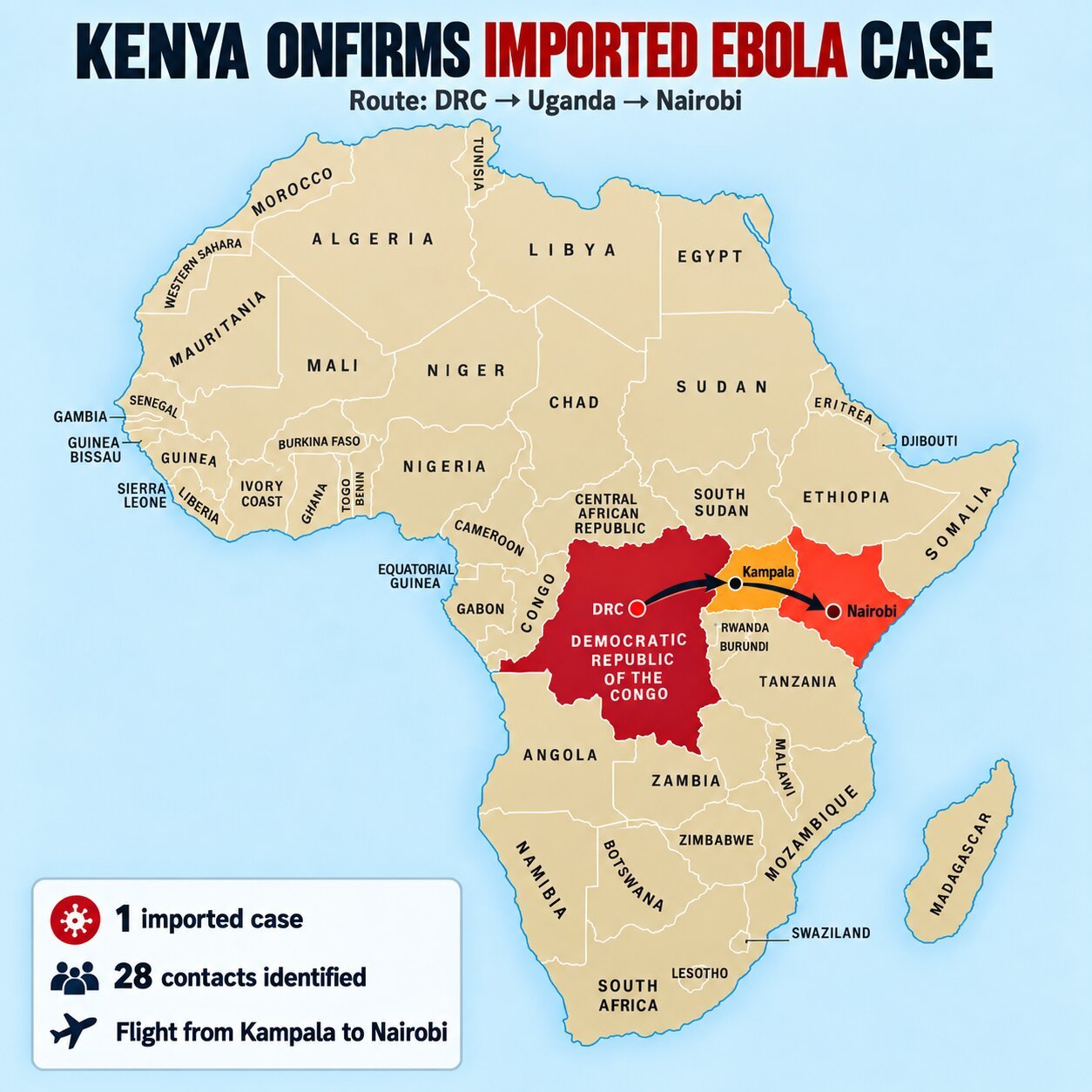
Kenya has confirmed its first imported case of Bundibugyo Ebola Virus Disease, extending the regional footprint of an outbreak that has already spread across large parts of the Democratic Republic of the Congo and previously crossed into Uganda. In a statement dated 6 October 2026, Kenya’s Ministry of Health said the patient was a Kenyan citizen who had lived in the DRC for seven years, travelled by road from the DRC to Kampala and then flew to Nairobi on Jambojet flight 8523 on 3 October. He was later isolated at Nairobi Hospital after presenting with symptoms consistent with viral haemorrhagic fever, tested positive at both the National Virology Reference Laboratory and KEMRI, and subsequently died. The Ministry said 28 contacts had already been identified, while another 23 passengers and four crew members from the same flight were still being traced.
The Kenyan case arrives while the Bundibugyo outbreak in the DRC remains unusually large and geographically dispersed. The World Health Organization reported on 25 September that the DRC had recorded 7,890 confirmed cases and 3,799 deaths across 63 health zones in seven provinces, with the outbreak continuing to expand geographically. WHO has repeatedly warned that sustained transmission in eastern and northern DRC increases the risk of cross border spread, particularly because affected areas are connected by road, trade and population movement to several neighbouring countries.
Kenya’s case therefore matters less because it proves widespread domestic transmission, which the Ministry has not reported, and more because it shows how quickly an active Ebola outbreak in the Great Lakes region can move through ordinary regional transport routes.
How Did the Ebola Case Reach Kenya?
According to the Kenyan Ministry of Health statement, the patient had been ill for about a month and had received treatment at several hospitals while still in the DRC. He then travelled by road from the DRC to Kampala before boarding Jambojet flight 8523 to Nairobi, arriving at approximately 1:10 p.m. on Saturday, 3 October.
He passed through normal public health screening and immigration procedures at the airport before being transported by a relative and friend to Nairobi Hospital. There, doctors isolated him after noting symptoms including fever, chills, severe fatigue, weakness, muscle pain, painful swallowing, sore throat and bleeding under the skin at injection sites. Laboratory testing subsequently confirmed Bundibugyo virus disease.
The sequence exposes the limitations of border screening during outbreaks involving diseases whose symptoms can overlap with malaria, typhoid and other febrile illnesses. WHO notes that Bundibugyo virus disease can be difficult to distinguish clinically from other common infections without laboratory confirmation.
Screening therefore reduces risk but cannot guarantee that every infected traveller will be detected at the border, particularly if symptoms are mild, evolving or not recognised during transit.
How Many People May Have Been Exposed in Kenya?
The Ministry of Health said it had listed 28 contacts, including family members and health workers who attended to the patient. It was also tracing 23 passengers and four crew members who travelled on the same flight.
Those numbers should not be interpreted as confirmed infections. Contact tracing identifies people who may have been exposed so they can be monitored, tested where necessary and isolated quickly if symptoms develop.
The Ministry said quarantine arrangements were being made for people considered at risk and that Kenya had notified the World Health Organization under the International Health Regulations.
This is the central public health task now. Ebola outbreaks are controlled by finding cases early, isolating patients, tracing contacts, using strict infection prevention procedures, conducting safe burials and maintaining strong community surveillance. WHO’s latest DRC assessment emphasises exactly those measures because there is no licensed vaccine for Bundibugyo virus disease and no approved specific treatment for the infection.
Is This the Start of an Ebola Outbreak in Kenya?
The available information does not establish community transmission in Kenya. The Ministry has confirmed one imported case and is tracing contacts. It also said that among 267 samples tested across five laboratories since preparedness activities began, only one had tested positive.
That distinction matters. An imported case means an infected person entered the country. Local transmission begins when another person becomes infected inside Kenya through contact with that case or another infected person.
Kenya’s preparedness levels are also significantly higher than they were before the outbreak began in the region. The Ministry said 652,584 travellers had been screened as of 6 October and 4,971 health workers had been trained in Ebola prevention and management. Testing is being carried out through the National Virology Reference Laboratory, KEMRI laboratories in Nairobi and Kisumu and mobile laboratories at Busia and Lwakhakha border points.
The next several weeks will therefore be determined by whether contact tracing captures all significant exposures and whether any secondary infections are detected quickly.
Why Does the DRC Outbreak Matter So Much to East Africa?
The current Bundibugyo outbreak has expanded far beyond a localised health event. WHO reported that by 23 September it had reached 63 health zones across Bas Uélé, Haut Uélé, Ituri, North Kivu, South Kivu, Sud Ubangi and Tshopo. That geographical spread increases the number of transport corridors through which infected people can cross national borders.
Uganda had already reported imported and secondary cases earlier in the outbreak. WHO recorded 20 confirmed Ugandan cases by early September, although no new cases had been reported there since June.
Kenya does not share a land border with the DRC, but regional mobility means geography alone provides limited protection. A traveller can move from eastern DRC into Uganda by road and then connect to Nairobi by air within a relatively short period. That is exactly the route described in the Kenyan case.
The regional public health system must therefore operate as one surveillance space even though national governments retain responsibility for their own responses.
What Does This Mean for Regional Travel and Trade?
WHO currently advises against general restrictions on travel or trade with affected countries. Its September risk assessment continued to classify the risk as very high within the DRC, high for countries sharing land borders with the DRC and low for the rest of the African region and globally.
That makes targeted surveillance more important than blanket border closures. East Africa’s transport system is deeply interconnected through road corridors, aviation hubs and cross border trade. Broad restrictions can impose large economic costs while also encouraging informal movement through routes that are harder to monitor.
The more effective approach is intensive screening at high risk entry points, rapid information sharing between countries, contact tracing, laboratory capacity and infection prevention inside health facilities.
For airlines and airports, the Kenyan case will also raise operational questions around passenger information, contact tracing and the speed at which flight manifests can be shared with health authorities.
Why Health Workers Are Particularly Important
Health workers are among the most exposed groups during Ebola outbreaks because they may encounter infected patients before a diagnosis is confirmed. The Kenyan Ministry specifically included health workers among the 28 contacts already identified and urged medical staff to maintain the highest infection prevention standards regardless of the condition being treated.
The experience in the DRC and Uganda shows why this matters. Healthcare associated transmission can amplify outbreaks when infection prevention measures fail, particularly during the early stages when a patient is being treated for another suspected disease.
Kenya’s training of 4,971 health workers gives the country a preparedness advantage, but training becomes valuable only when protective equipment, isolation protocols and testing are consistently available at the facilities where patients first present.
Why Bundibugyo Ebola Is Different From the Ebola Most People Know
Ebola disease is caused by several related viruses. Bundibugyo virus is distinct from the Ebola virus responsible for many of the better known outbreaks in West and Central Africa.
The difference has practical consequences. The currently licensed Ervebo vaccine is designed for Ebola virus disease caused by the Zaire Ebola virus species. WHO states that there is currently no licensed vaccine for Bundibugyo virus disease. Research is continuing, but outbreak control currently depends primarily on surveillance, isolation, supportive clinical care, contact tracing and infection prevention. That places even greater importance on early detection.
Why Kenya’s Case Is a Regional Warning
Kenya had already maintained heightened Ebola surveillance since the DRC outbreak began in May. The fact that an infected traveller still passed through several stages of movement before diagnosis does not necessarily indicate failure. It illustrates the difficulty of managing infectious disease risk inside a region where people travel continuously for work, trade, family and medical reasons.
The outbreak is also much larger than it was earlier in the year. WHO reported just 515 confirmed cases in the DRC in early June. By late September, the total had risen to 7,890. That scale increases the probability that infected people will travel before they are diagnosed.
Africa CDC and WHO launched a $518 million continental preparedness and response plan in June precisely because the risk was never confined to one country. The plan covers surveillance, laboratories, clinical care, infection control, community engagement and logistics across African countries. Kenya’s first imported case is now evidence of why that regional approach is necessary.
What Happens Next?
Kenya’s immediate priority will be to complete the tracing of passengers, crew members, relatives and health workers who may have been exposed to the patient, monitor them for symptoms and rapidly test any suspected cases.
The Ministry has urged the public to continue frequent hand washing, avoid close contact with sick people arriving from areas with active Ebola transmission and seek care at recognised health facilities when unwell. It has also asked health workers to remain highly vigilant.
For the wider region, the case reinforces a simple reality. The DRC outbreak is no longer only a Congolese public health problem. Regional transport networks mean the risk moves with people.
There is currently no evidence in the Kenyan statement of widespread local transmission, and panic would be unjustified. But the case demonstrates that surveillance, laboratory capacity and cross border coordination must remain at a high level for as long as sustained transmission continues in the DRC.
In a region where people can travel from eastern DRC to Kampala and Nairobi within days, Ebola control can no longer be treated as a national border problem. It is a regional surveillance problem.
FAQ
Has Kenya confirmed an Ebola case? Yes. Kenya’s Ministry of Health confirmed its first imported case of Bundibugyo Ebola Virus Disease on 6 October 2026.
Where did the patient travel from? The Ministry said the patient had been living in the Democratic Republic of the Congo, travelled by road to Kampala and then flew to Nairobi on Jambojet flight 8523.
Did the patient die? Yes. According to the Ministry statement, the patient received supportive treatment but later died.
How many contacts are being traced? Kenya said it had identified 28 contacts and was also tracing 23 passengers and four crew members from the same flight.
Is there community transmission in Kenya? The statement does not report community transmission. One imported case has been confirmed and contacts are being monitored.
Is there a vaccine for Bundibugyo Ebola? No licensed vaccine is currently available specifically for Bundibugyo virus disease, according to WHO.
How large is the DRC outbreak? WHO reported 7,890 confirmed cases and 3,799 deaths in the DRC as of 23 September 2026, with 63 health zones affected across seven provinces.
Does WHO recommend closing borders or stopping travel? No. WHO currently advises against general travel or trade restrictions and instead emphasises surveillance, contact tracing and rapid response.
 Uchumi360
Business Intelligence
Uchumi360
Business Intelligence
Uchumi360 covers business, investment, and economic policy across East, Central, and Southern Africa.
For the serious reader
You read to the end. That places you in a small group.
Uchumi360 is built for readers who demand precision over speed, structure over sentiment, and analysis that holds uncomfortable conclusions rather than softening them. If this work sharpens how you think about Africa's economy, help us keep building the infrastructure behind it.
Institutional Partners
Commission intelligence. Shape the conversation.
Uchumi360 works with development finance institutions, investment firms, sovereign bodies, and strategic organisations across the coverage region. Institutional partnership unlocks:
- Commissioned sector and country intelligence reports
- Branded research series under your institution's authority
- Exclusive data briefings for internal strategy teams
- Speaking and editorial presence at Uchumi360 events
- Co-published investment outlooks for your markets
Support Our Work
Independent analysis has a cost. Help us bear it.
Uchumi360 does not carry advertising. It does not take editorial direction from sponsors. Every article is produced without commercial compromise. Your contribution funds the reporting, research, and editorial infrastructure that keeps this analysis free from influence.
Secure checkout: One-time and monthly support are processed securely. Add payment credentials to enable checkout here.
Stay Connected
Keep up with every new insight.
Follow our latest analysis, policy coverage, and market intelligence as soon as it is published. If you need something specific, reach out directly and we will point you to the right research.
