
Benjamin Fernandes Says America Closed the Door That Built His Dream. East Africa Should Pay Attention.

Ready
Benjamin Fernandes has spent a decade building exactly the kind of success story America has historically wanted associated with it: a young immigrant arrives with ambition, studies there, builds relationships, becomes an entrepreneur, creates a company with international reach. In a New York Times opinion piece published on 2 September, the Tanzanian founder of NALA says the United States has effectively closed the door that once let people like him in, and that America may ultimately pay an economic price for it. His argument matters in East Africa for a reason well beyond visas: it is about the economic value of letting ambitious people cross borders, and what happens when immigration policy starts treating nationalities as statistical risk categories rather than judging people by their own record.
DAR ES SALAAM — Benjamin Fernandes has spent the past decade building exactly the kind of success story America has historically wanted the world to associate with the country. A young immigrant arrives with ambition. He studies there. He builds relationships. He becomes an entrepreneur. He creates a company with international reach.
In a New York Times opinion piece published on 2 September, the Tanzanian founder of fintech company NALA says the United States has effectively closed the door that once allowed people like him to enter. He is warning that America may ultimately pay an economic price for doing so.
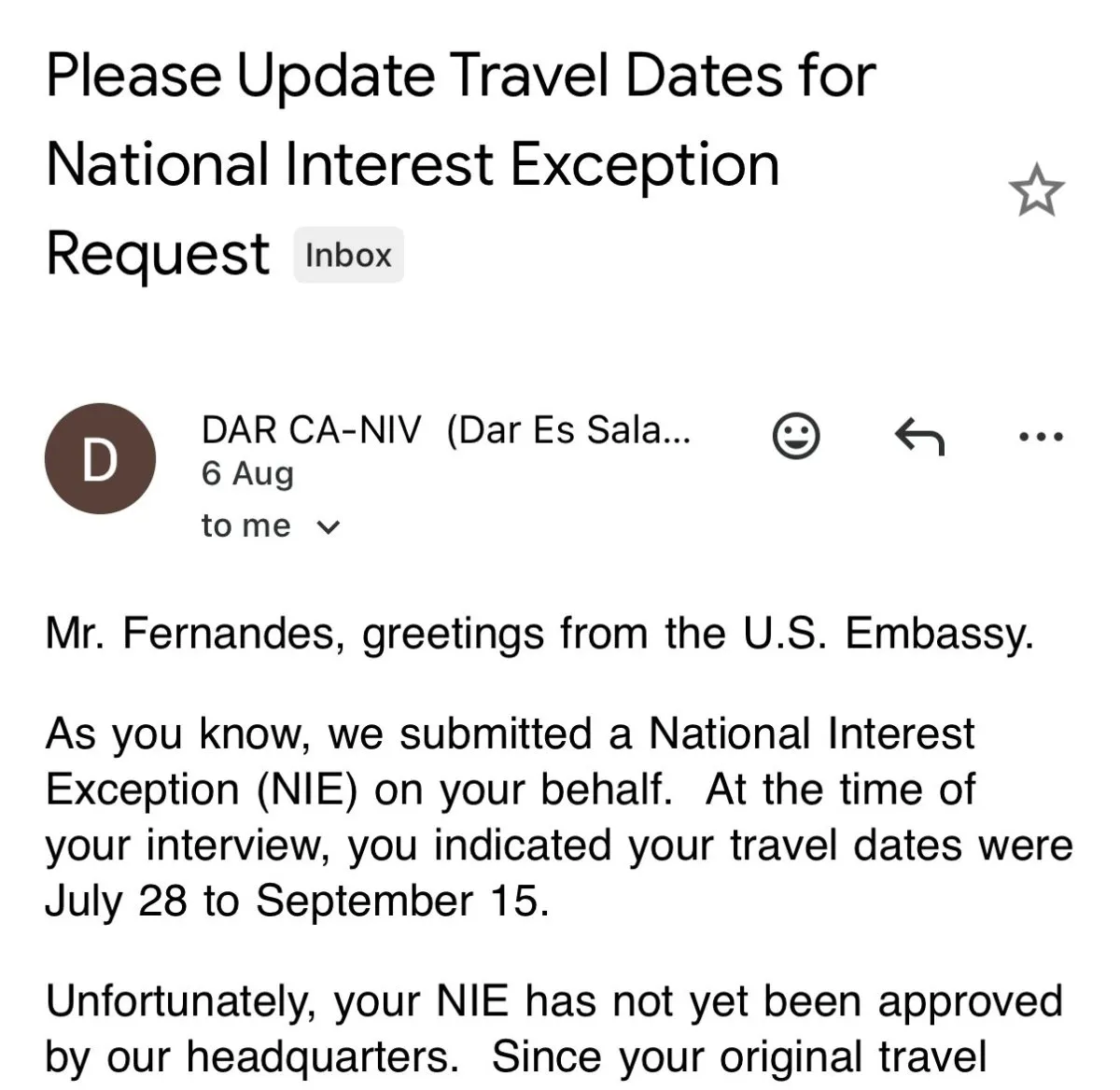 Benjamin Fernandes of NALA shared a screengrab of a visa refusal email from the US Embassy in Dar es Salaam
His argument deserves attention in East Africa for a reason that goes well beyond whether a Tanzanian can obtain an American visa. It is about the economic value of allowing ambitious people to cross borders, study, build relationships and create companies. It is also about what happens when immigration policy begins treating nationalities as statistical risk categories rather than judging people by their individual record.
A National Average Is Not a Person
Fernandes makes the argument from personal experience. "The government's reason is a statistic: Tanzanians overstay at a rate above 8%," he wrote in a series of posts accompanying his New York Times article. "I've crossed that border 17 years in a row. Left on time every single time. A national average is not a person. A blanket ban punishes the compliant for the record of strangers.", he wrote.
That is the central contradiction Fernandes wants Americans to confront. The United States has identified a measurable immigration compliance problem among Tanzanian nationals. It has responded with restrictions that affect people who have never overstayed a visa. Fernandes is one of those people.
The underlying US government data confirms the overstay issue is real. The Department of Homeland Security's FY2024 Entry/Exit Overstay Report recorded an overall Tanzanian overstay rate of 10.24% among the relevant nonimmigrant traveller category, with the rate excluding suspected in-country overstays at 9.57%. The United States subsequently included Tanzania among the countries affected by Presidential Proclamation 10998, which partially suspended visa issuance for Tanzanian nationals, including B1/B2 visitor visas and F, M and J student and exchange visas.
Fernandes is not arguing that the government's underlying statistic is false. His argument is that a national statistic can produce a policy that catches people whose individual behaviour bears no resemblance to that statistic. That distinction becomes economically significant once the people being excluded include students, entrepreneurs, researchers and business executives.
Zoom Doesn't Close the Deal
Fernandes says he can continue running NALA despite the restrictions. "I have to run NALA over video. We're fine," he wrote. But he immediately explains why "fine" is not the same thing as unaffected. "Fundraising with top VC's and enterprise sales are relationship businesses. Trust is built in the room, over dinner, in the hallway after the meeting. You do not Zoom your way to a deal.", he added.
That observation matters for an East African technology industry increasingly dependent on international capital. A company may be incorporated in Tanzania, Kenya, Uganda or Rwanda and employ people locally, while its investors sit in New York, San Francisco, London, Dubai or Singapore. Its largest customers may be multinational corporations. Its strategic partners may be international banks. Its founders may need to attend conferences, meet investors, negotiate contracts and build relationships across several jurisdictions.
The digital economy has reduced the importance of geography in some areas. It has not eliminated the importance of physical proximity in high-value relationships. For Fernandes, the visa restriction doesn't simply inconvenience a Tanzanian businessman travelling to America. It creates friction between an African company and the international financial and commercial networks required to scale it.
The Door That Mattered Most
Fernandes says the bigger problem sits elsewhere. "Here's what actually concerns me," he wrote. "The door that mattered most is the one shut hardest: the student visa." That sentence reframes the entire argument.
Fernandes himself entered the United States on a student visa. He argues the student visa is not merely an immigration pathway. It is part of the machinery through which future companies, scientific discoveries and jobs get created. "I arrived on one," he wrote. "So did 234 founders of America's billion-dollar companies. Each creates ~1,000 American jobs on average."
The latest research supports the broader point, even though the precise figure in Fernandes's post differs slightly from the most recent published dataset. A 2026 National Foundation for American Policy analysis found that 233 international students had become founders or cofounders of 183 US billion-dollar startups. Those companies had created an average of 1,123 jobs each. Across the entire sample, immigrants were founders or cofounders of 455 of 775 privately held US billion-dollar companies, equivalent to 59%.
Fernandes gives the argument a Tanzanian face directly. "I have a friend in Tanzania who was admitted to Harvard University this year on scholarship. They can't get a visa, so they can't board the plane." The significance isn't limited to one student. "A student turned away today is a company that never gets built, and the jobs that never come with it."
Counting What Never Happens
That is the economic calculation missing from a purely enforcement-based approach to immigration. Governments are accustomed to counting violations: overstays, illegal entries, rejected applications, deportations. They are much less accustomed to counting opportunities that disappear before they become visible.
How many companies would have been founded by students who couldn't enter? How many researchers would have developed technologies that never reached the market? How many founders would have met investors in university corridors? How many businesses would have employed American workers? These are counterfactuals, and cannot be measured with the precision of a visa overstay rate. That doesn't make the underlying economic mechanism imaginary.
Fernandes's argument is essentially that America has historically benefited from betting on people before their economic value was obvious. That is what makes his own story powerful. He didn't arrive in America as the founder of NALA. He arrived as a Tanzanian teenager with potential. The institution had to make the investment before there was a company, before there were employees, customers or a valuation. The economic return came later. That is how talent-based economies work. The difficulty for policymakers is that the return isn't visible at the border.
"Because Britain Let Them In"
Fernandes also rejects a common counter-argument: that countries from which America receives fewer migrants simply don't produce major entrepreneurs. He answers with a list. "'But those countries don't produce founders.' here's a quick list: Nigeria: Calendly ($3B), Global Infrastructure Partners (sold to BlackRock, $12.5B). Somalia: WorldRemit ($5B). Sudan: Celtel ($3.4B)."
There's a common thread running through those examples. "They were built in Britain," Fernandes writes of WorldRemit and Celtel. "Not because Britain is better at innovation. Because Britain let them in."
That sentence is arguably the most important one for an East African audience. The geography where an African entrepreneur is born doesn't determine where that entrepreneur's economic value gets captured. A Nigerian can build a billion-dollar company in America. A Somali can build a multibillion-dollar remittance business in Britain. A Sudanese entrepreneur can build a telecommunications company in Britain that transforms mobile communications across Africa. The question for East Africa isn't whether its people can create globally significant companies; there's already abundant evidence they can. The real question is where those companies get built, financed, headquartered and taxed.
What This Means for East Africa
For decades, African governments have focused on stopping brain drain, generally assuming the solution is persuading educated Africans to return home. Fernandes's argument suggests a different framing: Africa doesn't only need to bring its people back. It needs to build environments where people from anywhere can come to Africa to build companies.
Imagine Dar es Salaam not simply as a city Tanzanian students leave for Harvard, Stanford or Oxford, but as a place ambitious students from Kenya, Uganda, Rwanda, Nigeria, Ghana, India and Europe come to study, research and build companies. Imagine Nairobi competing with London for African technology founders, or Kigali competing with Singapore for African technology talent. That would require more than tax incentives. It would require universities, venture capital, reliable infrastructure, international connectivity, predictable regulation, intellectual property protection, research institutions, and immigration systems designed to attract talent rather than merely control it.
East Africa has real foundations to build on: a young population, rapidly urbanising economies, widespread mobile money adoption, expanding digital businesses, a growing middle class, and a geographic position linking the Indian Ocean to the Great Lakes and Central Africa. It also has a significant unresolved problem, fragmentation. Kenya, Tanzania, Uganda, Rwanda, Burundi, Ethiopia, South Sudan and the DRC operate under different currencies, regulatory systems, tax structures, financial institutions and market rules. For entrepreneurs, that fragmentation is a problem. For entrepreneurs who solve fragmentation, it's a market, exactly why companies like NALA matter: a Tanzanian founder building financial technology for international transactions is demonstrating how a company can emerge from an East African problem and address a global one.
The Window Closing Elsewhere Too
The opportunity is sharper because the United States isn't the only country reconsidering its immigration model. Across developed economies, immigration is becoming politically harder, with governments under pressure over border control, housing, public services, labour markets and national identity. Skilled migration remains valued, but the political environment around it has grown more restrictive.
That creates a strategic opening for countries willing to compete for talent, and East Africa should be one of them. A student who can't study in America still needs a university. A founder who can't meet investors in America still needs capital. A researcher shut out of one laboratory still needs somewhere to work. Talent doesn't disappear because a border closes. It moves, and countries compete for where that talent ultimately creates value.
Fernandes understands the personal risk in making this argument, and says so directly. "I know writing this may make my own return harder," he wrote. "But silence is exactly what lets a policy like this pass without anyone counting its cost."
None of this requires denying that America can legitimately enforce its immigration laws, that Tanzania can legitimately care about its citizens' reputation abroad, or that visa overstays are a real governance concern. Fernandes's argument is about proportionality. A national average can tell a government where a problem exists. It cannot tell a government what any individual will do, and when the policy response gets broad enough, it can exclude people whose future economic contribution vastly exceeds the statistical risk they represent.
The student denied a visa today doesn't appear in tomorrow's employment statistics. The entrepreneur who never meets an investor doesn't appear as a failed company. The investment that moves to another country doesn't come with a label saying where it would otherwise have gone. The costs of restrictive mobility are largely invisible. The benefits of openness are visible only after people have had the chance to create them. That is the lesson East Africa should take from Fernandes's fight with the American immigration system: the region has spent a long time asking how to stop its brightest people from leaving. The more ambitious question is whether it can become the place they, and the world's next generation of ambitious people, want to come to.
FAQ
Who is Benjamin Fernandes? A Tanzanian entrepreneur and founder of NALA, a cross-border fintech company, who entered the United States on a student visa and later wrote a New York Times opinion piece arguing that current US visa restrictions on Tanzanians are disproportionate and economically costly.
What restriction is Fernandes responding to? Presidential Proclamation 10998, which partially suspended US visa issuance for Tanzanian nationals, including visitor visas (B1/B2) and student and exchange visas (F, M, J), following a Department of Homeland Security report recording a Tanzanian visa overstay rate of 10.24%.
What is Fernandes's central argument? That a national overstay statistic doesn't describe any individual's behaviour, and that a blanket restriction based on that statistic can exclude students, entrepreneurs and researchers whose personal record and future economic contribution bear no resemblance to the risk the policy is designed to address.
Why does Fernandes focus so heavily on student visas specifically? Because he sees the student visa as a pipeline for future company formation, citing research showing 233 international students became founders or cofounders of 183 US billion-dollar startups, each creating over 1,000 jobs on average.
What does Fernandes want East African countries to do? Move beyond focusing solely on preventing brain drain, and instead build the universities, capital markets, infrastructure and immigration systems needed to attract global talent, so that companies excluded from the US or other restrictive markets have somewhere else to be built.
Does Fernandes deny that Tanzania has a real visa overstay problem? No. He accepts the underlying government statistic as accurate. His argument is about proportionality, that the policy response should be able to distinguish between the national average and an individual's actual compliance record.
 Uchumi360
Business Intelligence
- Benjamin Fernandes, opinion piece, The New York Times, 2 September 2026, and accompanying social media posts
- Primary source for all direct quotes and personal account
- US Department of Homeland Security, FY2024 Entry/Exit Overstay Report
- Tanzanian nonimmigrant overstay rate figures (10.24% overall
- 9.57% excluding suspected in-country overstays)
- Presidential Proclamation 10998
- Basis for the partial suspension of visa issuance for Tanzanian nationals, including B1/B2, F, M and J visa categories
- National Foundation for American Policy, 2026 analysis of immigrant founders of US billion-dollar startups
- Figures on international-student founders (233), billion-dollar companies founded (183), average jobs created (1,123), and immigrant founders' overall share (59% of 775 companies)
Uchumi360 covers business, investment, and economic policy across East, Central, and Southern Africa.
For the serious reader
You read to the end. That places you in a small group.
Uchumi360 is built for readers who demand precision over speed, structure over sentiment, and analysis that holds uncomfortable conclusions rather than softening them. If this work sharpens how you think about Africa's economy, help us keep building the infrastructure behind it.
Institutional Partners
Commission intelligence. Shape the conversation.
Uchumi360 works with development finance institutions, investment firms, sovereign bodies, and strategic organisations across the coverage region. Institutional partnership unlocks:
- Commissioned sector and country intelligence reports
- Branded research series under your institution's authority
- Exclusive data briefings for internal strategy teams
- Speaking and editorial presence at Uchumi360 events
- Co-published investment outlooks for your markets
Support Our Work
Independent analysis has a cost. Help us bear it.
Uchumi360 does not carry advertising. It does not take editorial direction from sponsors. Every article is produced without commercial compromise. Your contribution funds the reporting, research, and editorial infrastructure that keeps this analysis free from influence.
Secure checkout: One-time and monthly support are processed securely. Add payment credentials to enable checkout here.
Stay Connected
Keep up with every new insight.
Follow our latest analysis, policy coverage, and market intelligence as soon as it is published. If you need something specific, reach out directly and we will point you to the right research.
