
Kenya Targets December 1 First Oil From $6 Billion Turkana Project After 14 Years of Delays
Ready
Kenya has begun production drilling in the South Lokichar Basin, with Gulf Energy targeting December 1, 2026 for the start of commercial crude oil production. The project is expected to initially produce 20,000 barrels per day, with crude transported by road to Mombasa before a larger development phase. However, the costs of moving oil from landlocked Turkana, outstanding community compensation issues and uncertainty surrounding export schedules will determine whether the long delayed project becomes a sustainable source of government revenue.
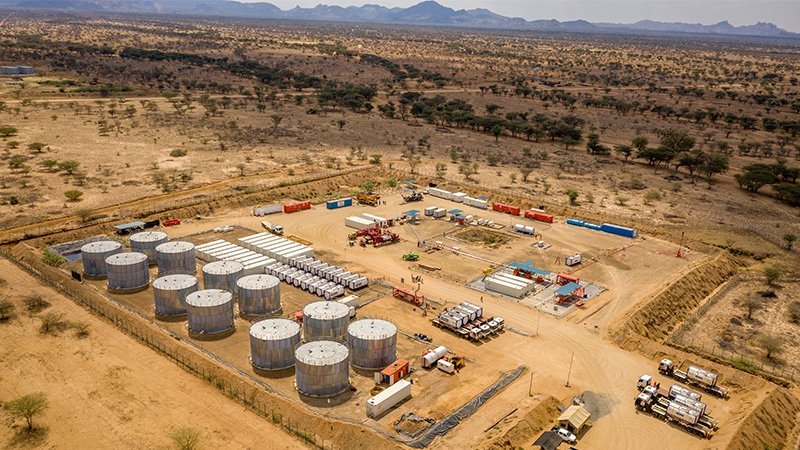
Kenya has commenced production drilling at the South Lokichar oilfields in Turkana County, marking the latest attempt to commercialise crude oil discovered in 2012, with the government and project operator Gulf Energy targeting December 1, 2026 for the start of production under a development programme estimated at $6 billion. Energy and Petroleum Cabinet Secretary Opiyo Wandayi presided over the commencement of drilling at the Amosing oilfield on November 20, signalling the beginning of the first phase of a project expected to produce 20,000 barrels per day before potentially expanding to 50,000 barrels per day in a subsequent development phase.
The drilling programme is being implemented by Gulf Energy E&P BV SEZ, which acquired the Kenyan oil assets previously operated by Britain's Tullow Oil. The company is developing Blocks T6 and T7, formerly known as Blocks 10BB and 13T, under a Field Development Plan ratified by Kenya's National Assembly in February 2026. The initial development will concentrate on the Ngamia and Amosing fields, with subsequent production planned from Twiga, Ekales, Agete and Etom, depending on additional drilling, reservoir performance and commercial investment decisions. According to the Energy and Petroleum Regulatory Authority's 2026 annual statistics report, the first phase targets 48 production and injection wells, while initial crude will be transported from Turkana to the Kenya Petroleum Refineries Limited storage facility in Mombasa.
The development has gained momentum after years of delayed investment decisions, unsuccessful efforts to attract strategic partners and uncertainty surrounding the infrastructure required to transport crude from northwestern Kenya to international markets. Kenya first discovered commercially promising oil in Turkana in 2012, but the project struggled to progress from exploration and pilot production to a commercially sustainable operation. Tullow's former partners, TotalEnergies and Africa Oil Corporation, withdrew in 2023, leaving the British company searching for alternative financing and buyers before agreeing in April 2025 to sell its Kenyan interests to Gulf Energy in a transaction initially valued at at least $120 million. The transfer placed the project under a Kenyan-controlled energy company and created an opportunity to restructure its development strategy around smaller initial production volumes and road transportation.
The December target nevertheless requires careful distinction from the commencement of drilling and the export of commercially produced oil. The November 20 ceremony marked the spudding of the first production well under the new development programme; it did not establish that the planned 20,000 barrels per day was already being produced. The regulator and project operator have identified December 1 as the target for the first oil, while Gulf Energy Country Manager Frankline Juma told the Kenya News Agency on November 19 that the first crude shipment was expected on March 1, 2027. Other statements have suggested an earlier ceremonial flagging off in December, but a presidential ceremony, the start of production and the loading of an export vessel represent different milestones and should not be treated as interchangeable.
Kenya Has Exported Oil Before but Has Never Established Sustained Commercial Production
The December 2026 target is not Kenya's first experience of producing or exporting crude oil. Under the Early Oil Pilot Scheme operated by Tullow, crude was transported by truck from Turkana to Mombasa, with President Uhuru Kenyatta presiding over the country's first export shipment of 200,000 barrels on August 26, 2019. The cargo was sold to ChemChina for approximately $12 million, equivalent to $60 per barrel, demonstrating that Kenya could produce, transport and market its crude internationally. However, the pilot scheme was designed partly to gather operational and commercial information ahead of a larger development programme, and it did not establish sustained commercial production or the transport infrastructure required for regular exports.
This distinction is important because describing December 2026 as Kenya's first oil without qualification would overlook the 2019 export. The current programme represents an attempt to begin a new phase of commercial production following years of interruptions, with substantially greater production ambitions and a revised approach to financing and transportation. The 2019 shipment demonstrated technical feasibility on a limited scale, but the project's later difficulties showed that the ability to extract and sell individual cargoes does not necessarily establish a commercially sustainable oil industry.
Tullow's experience exposed the challenges of developing a relatively remote petroleum resource without an established export pipeline. The original project depended heavily on attracting international partners capable of financing field development, processing facilities and a proposed pipeline connecting Turkana to the coast. Those requirements involved substantial upfront expenditure before sufficient production revenue could be generated, while changing oil prices, financing conditions and investor priorities complicated the commercial case. The exit of TotalEnergies and Africa Oil in 2023 further weakened the consortium's capacity to advance the project under its earlier structure.
Gulf Energy's development plan is intended to address some of those constraints by separating the project into phases and using existing transport infrastructure during initial production. Rather than requiring the completion of a major crude oil pipeline before exports begin, the operator intends to move oil by road to Mombasa, accumulate sufficient volumes in storage and load cargoes through existing port facilities. The arrangement reduces dependence on a new pipeline during the earliest stage, although it introduces substantial transportation, storage and operational requirements.
Gulf Energy Plans 600 Trucks to Move Turkana Crude to Mombasa
One of the project's most consequential economic features is its initial reliance on road transportation. According to the approved Field Development Plan and EPRA's 2026 report, Gulf Energy intends to move approximately 20,000 barrels of oil daily from Turkana to Mombasa using 100 tanker truckloads per day. The operator estimates that approximately 600 trucks will be required to maintain the operation because a complete journey, including loading, transportation, unloading and the return trip, is expected to take six days.
The plan assumes that each truck will carry approximately 180 to 200 barrels of crude, with oil transported to the former refinery facilities at Changamwe, now used for petroleum storage. The facility will require capacity for approximately 900,000 barrels, while the associated loading infrastructure is intended to support exports through the Kipevu Oil Terminal II. The regulator's plan envisages cargoes of approximately 750,000 barrels, although the exact size and frequency of shipments will depend on production volumes, storage availability and commercial export arrangements.
South Lokichar commercial development targets
20,000
Barrels per day, initial target
50,000
Barrels per day, later phase
600
Trucks planned for initial logistics
48
Production and injection wells are planned in phase one.
Source: Kenya EPRA, Energy and Petroleum Statistics Report 2026, and Gulf Energy South Lokichar Field Development Plan. Figures are development targets, not current operating output.
The use of road tankers is commercially significant because crude oil production must generate sufficient revenue to cover extraction, processing, transport, storage, financing and other operating costs before meaningful returns are available to investors and the government. Moving thousands of barrels daily over a long road corridor requires extensive coordination involving vehicle availability, road conditions, fuel costs, insurance, security and the reliability of unloading and storage facilities. Any prolonged disruption along the route could affect the movement of crude and potentially require production to be reduced if available storage capacity is exhausted.
Turkana crude also presents particular handling requirements. The oil contains wax, which can complicate movement and storage when temperatures fall below the conditions required to maintain flow. The development plan therefore includes insulated storage and heating arrangements, with technical measures intended to prevent the product from becoming difficult to pump or transport. These requirements add to the importance of reliable logistics and infrastructure, particularly when crude must travel from inland production facilities to coastal storage and export terminals.
The project's later phase is intended to reduce dependence on road transportation as production increases. Gulf Energy's approved plan envisages a central processing facility capable of supporting a production plateau of approximately 50,000 barrels per day, potentially using rail transportation to Mombasa. EPRA identifies the possible extension of railway infrastructure to Lokichar by around 2032, together with additional investment in specialised rolling stock, railway sidings and facilities for loading and unloading crude. These investments are not yet completed and would require further financing, engineering and commercial decisions.
The transport strategy also raises questions about the longer-term role of a dedicated crude oil pipeline. Kenya has previously considered an export pipeline between Turkana and Lamu, a potentially more efficient arrangement for sustained large volumes of crude. However, building a pipeline requires substantial upfront investment, and its commercial justification depends on the quantity of oil expected to move through it over many years. The current phased plan prioritises road transport for initial production and a possible railway solution for later expansion, while pipeline proposals remain subject to separate financial and strategic considerations.
The $6 Billion Project Must Generate Revenue Beyond Its Transport and Production Costs
The reported $6 billion development envelope illustrates the scale of investment envisaged for South Lokichar, but it should not be interpreted as expenditure already incurred or financing that has been fully deployed. The development covers multiple phases, including wells, production facilities, water supply, transport arrangements, storage and associated infrastructure. The financial requirements will evolve as the operator completes drilling, gathers reservoir data and makes decisions concerning additional fields and export facilities.
At the initial targeted production rate of 20,000 barrels per day, the project would produce approximately 7.3 million barrels annually if that level were sustained throughout a full year. Using an illustrative crude price of $60 per barrel, the gross market value would be approximately $438 million annually. At the later target of 50,000 barrels per day, the equivalent annual volume would be approximately 18.25 million barrels, with an illustrative gross value of $1.095 billion at the same price.
| Production scenario | Annual volume at full operation | Illustrative gross sales at $60/barrel |
| 20,000 barrels daily | 7.30 million barrels | $438 million |
| 50,000 barrels daily | 18.25 million barrels | $1.095 billion |
These are arithmetic illustrations rather than production forecasts or projected government revenue. They assume the stated daily production levels are sustained every day of the year and use a hypothetical realised crude price of $60 per barrel. Actual sales values will depend on the quality of Turkana crude, international prices, contractual discounts, operating performance and the timing of shipments.
The distinction between gross oil sales and government income is especially important. Revenue from crude sales must cover eligible production and transportation costs and be distributed according to the project's production sharing agreements and applicable tax arrangements. Kenya's fiscal benefit will depend on the structure of cost recovery, the government's share of production, corporate taxes and other contractual obligations. A gross oil sales estimate therefore cannot be treated as money accruing directly to the National Treasury.
The approved development plan identifies a best estimate of approximately 326 million barrels of contingent recoverable resources across the development programme. This figure is different from the much larger estimate of oil initially in place and should not be described as proved reserves. Its commercial significance depends on the extent to which the resources can be extracted economically under the project's technical conditions and the financing arrangements eventually implemented.
The plan also anticipates that production will initially concentrate on the more mature Ngamia and Amosing reservoirs before expanding to other discoveries. Additional exploration and appraisal are intended to extend the period during which output can be maintained at commercially attractive levels. Reservoir performance will therefore become one of the most important factors determining whether the development can recover its capital costs and justify investment in larger processing and transportation facilities.
Kenya's commercial prospects also depend on how South Lokichar crude is priced internationally. Crude oils differ in density, sulphur content, wax characteristics and the processing requirements of refineries, meaning that the international benchmark price does not necessarily equal the amount received for a particular shipment. Transportation and handling requirements can further affect the effective value of oil at the production site, especially where crude must travel long distances before reaching an export terminal.
Turkana's Share of Oil Revenue and Unresolved Land Claims Remain Critical
The commercialisation of South Lokichar has also renewed questions about how petroleum revenue will be shared with Turkana County and communities living near the oilfields. Kenya's Petroleum Act establishes a framework for sharing the government's petroleum revenue between national authorities, the producing county and local communities, subject to statutory conditions and the applicable production sharing arrangements. During parliamentary consideration of the development plan in February 2026, legislators described the intended distribution as 75% for the national government, 20% for the county government and 5% for the local community.
These percentages must be understood as shares of the government's relevant petroleum revenue rather than percentages of the total international selling price of crude. The actual amounts will depend on production, realised prices, eligible costs, contractual entitlements and the operation of the statutory framework. Community and county revenue cannot therefore be estimated simply by multiplying the market value of all oil produced by the stated percentages.
The issue is particularly sensitive because Turkana has experienced disagreements over land acquisition, compensation, employment and the benefits expected from oil extraction since the earliest exploration activities. Communities located near the Ngamia and Amosing fields have raised concerns about access to grazing land, water resources and the compensation provided for land used by petroleum companies. The project operates in a predominantly arid region where pastoral livelihoods depend on access to land and water, meaning that the expansion of petroleum infrastructure can generate competing demands over resources.
In April 2026, the Kenya News Agency reported that Turkana County authorities had begun structured negotiations with Gulf Energy concerning revenue sharing and the implementation of the development plan. County officials emphasised the need for legal guidance and arrangements addressing the interests of local communities. Separately, reporting by the Daily Nation documented continuing concerns over compensation and land access as the project prepared to resume development.
These matters carry commercial implications because petroleum projects depend on predictable land access, secure operations and sustained cooperation between operators, public institutions and communities. Disputes that interrupt drilling, road transport or the construction of production facilities can increase costs and delay revenue generation. Conversely, clearly documented compensation arrangements, credible grievance mechanisms and transparent reporting of community benefits can reduce uncertainty and improve the accountability of public and private institutions responsible for the project.
Water supply is another substantial consideration. Oil production requires water for drilling, reservoir management and other operations, while Turkana's existing communities face longstanding challenges associated with water availability. The government's published project information records commitments to develop boreholes and improve water access, while the Field Development Plan includes proposals for a water supply pipeline associated with production activities. The long term effectiveness of these arrangements will depend on environmental assessment, actual water demand, the rights of existing users and the capacity to operate the infrastructure reliably.
Kenya's New Oil Production Will Not Automatically Reduce Petrol Prices
The prospect of commercial petroleum production has also generated expectations that Kenya could reduce its dependence on imported fuel. However, exporting crude oil from Turkana does not automatically mean that petrol and diesel will become cheaper for Kenyan consumers. Crude oil must be processed into usable petroleum products, and Kenya currently relies heavily on imports of refined fuel because its former refinery at Mombasa stopped processing crude in 2013.
Kenya could earn foreign exchange from crude exports while continuing to spend substantial amounts importing petrol, diesel, aviation fuel and other petroleum products. The net economic benefit would depend on the value of crude exports, the cost of imported refined products and the wider financial arrangements governing the upstream project. Even where petroleum exports improve the country's balance of payments, domestic pump prices may continue to be influenced by international product markets, exchange rates, taxation, freight and distribution costs.
The proposed development of a major refinery at Lamu could eventually change that relationship, but the project remains separate from the immediate South Lokichar production programme. Nigerian industrialist Aliko Dangote has promoted plans for a large refinery in Kenya as part of a wider effort to increase African petroleum processing capacity. However, questions remain concerning the financing, timing, crude supply and commercial viability of the proposed investment. A September 2026 Reuters investigation identified crude availability among the principal challenges confronting the refinery proposal, particularly because planned processing capacity would be much larger than the initial volumes expected from Turkana.
A refinery requires a sustained supply of crude oil, substantial capital, suitable processing technology and access to markets for its products. Kenya's initial targeted output of 20,000 barrels per day would represent only a relatively small source of feedstock for a large regional refinery. Consequently, any refinery project would likely require imports or additional regional crude supplies, depending on its eventual capacity and commercial structure.
South Lokichar's more immediate contribution would be through petroleum exports, investment in production and logistics, employment associated with field development and potential fiscal revenue. Its effects on domestic fuel prices would be indirect and should not be overstated.
Kenya Joins a New Phase of East African Petroleum Development
Kenya's move towards sustained commercial production also comes as East Africa's petroleum industry undergoes substantial investment. Uganda is developing the Tilenga and Kingfisher oilfields alongside the East African Crude Oil Pipeline, which is intended to transport crude through Tanzania to the Indian Ocean. South Sudan remains an established oil producer, although its exports have been affected by insecurity and interruptions to pipelines passing through Sudan.
The developments position Kenya within a region where petroleum production, transport infrastructure and refining proposals are attracting increasing attention from governments and investors. However, the scale of the respective projects differs considerably. Uganda's development programme is designed around substantially larger production volumes than Kenya's initial South Lokichar phase, while South Sudan already possesses an established export industry. Kenya's immediate commercial ambition is more modest, involving a phased development that can begin generating revenue without requiring a dedicated export pipeline from the outset.
The comparison also illustrates how geography influences petroleum economics. Uganda has committed substantial capital to a long distance heated export pipeline through Tanzania, while Kenya intends to begin production using road tankers and later consider more permanent logistics infrastructure. Each approach has different upfront costs and operating requirements. Pipeline infrastructure can support large and sustained volumes but requires substantial investment before oil can be exported, whereas trucking can permit smaller initial production at the cost of higher recurring logistical complexity.
For Kenya, beginning with road transport could provide operating data and early revenue that inform subsequent investment decisions. It also creates an opportunity to test the commercial performance of the fields under sustained production conditions. However, maintaining larger output over time will require decisions concerning the capacity and cost of road, railway or pipeline infrastructure.
December First Oil Will Begin a Longer Test of Commercial Viability
The commencement of drilling at Amosing represents a measurable advance for a petroleum project whose development has been delayed for more than a decade. Gulf Energy has taken over the assets, secured parliamentary approval of a revised development plan and commenced the drilling programme intended to support commercial production. The government's December 1 first oil target provides a near term milestone against which progress can be assessed, while the reported March 2027 shipment target indicates that the accumulation and export of commercially meaningful volumes may take longer.
The project nevertheless faces several tests before its economic contribution can be established. Production must reach and sustain commercially viable volumes, road transportation must operate reliably, storage and export facilities must accommodate the crude, and realised selling prices must support the costs associated with extraction and delivery. The operator must also manage reservoir performance, financing and the transition towards any larger development phase, while public authorities will need to address land, compensation, environmental and revenue sharing obligations.
The $6 billion investment envelope and proposed production capacity indicate the scale of the ambition, but they do not represent guaranteed future expenditure, revenue or profit. Kenya's first export in 2019 demonstrated that crude could be extracted from Turkana and sold internationally. The current development programme is intended to establish whether that activity can become a sustained industry capable of generating commercially viable production and predictable benefits for the country.
For Kenya, the December milestone will therefore be significant if achieved, but the stronger measure of success will emerge over the following months and years through actual production, export receipts, operating costs, government revenue and the economic benefits realised by Turkana County and surrounding communities.
 Uchumi360
Business Intelligence
Uchumi360 covers business, investment, and economic policy across East, Central, and Southern Africa.
For the serious reader
You read to the end. That places you in a small group.
Uchumi360 is built for readers who demand precision over speed, structure over sentiment, and analysis that holds uncomfortable conclusions rather than softening them. If this work sharpens how you think about Africa's economy, help us keep building the infrastructure behind it.
Institutional Partners
Commission intelligence. Shape the conversation.
Uchumi360 works with development finance institutions, investment firms, sovereign bodies, and strategic organisations across the coverage region. Institutional partnership unlocks:
- Commissioned sector and country intelligence reports
- Branded research series under your institution's authority
- Exclusive data briefings for internal strategy teams
- Speaking and editorial presence at Uchumi360 events
- Co-published investment outlooks for your markets
Support Our Work
Independent analysis has a cost. Help us bear it.
Uchumi360 does not carry advertising. It does not take editorial direction from sponsors. Every article is produced without commercial compromise. Your contribution funds the reporting, research, and editorial infrastructure that keeps this analysis free from influence.
Secure checkout: One-time and monthly support are processed securely. Add payment credentials to enable checkout here.
Stay Connected
Keep up with every new insight.
Follow our latest analysis, policy coverage, and market intelligence as soon as it is published. If you need something specific, reach out directly and we will point you to the right research.
