
Tanzania Wants 8,000 MW of Electricity by 2030. Where Is the Demand?
Ready
Tanzania plans to increase electricity generation capacity to 8,000 MW by 2030, building on the completion of the Julius Nyerere Hydropower Project. However, the country's latest reported electricity demand stands at approximately 2,815 MW, while its official power system master plan projects peak demand of 6,571 MW by the end of the decade. The gap raises questions about industrial consumption, transmission investment, electricity exports and whether planned generation projects will produce sufficient economic returns.
Tanzania is preparing to expand its installed electricity generation capacity to 8,000 megawatts by 2030, a target that would require the country to add more than 3,300 MW within four years despite already having substantially more generating capacity than its current maximum electricity demand. The ambition reflects the government's intention to support industrialisation, expand electricity access and position Tanzania as an exporter of power to neighbouring countries, but the scale of the proposed investment raises a financial question: whether electricity consumption will increase sufficiently to justify the additional capacity, and whether the transmission network, industrial base and regional electricity markets will develop quickly enough to use it.
According to the Energy and Water Utilities Regulatory Authority (EWURA), Tanzania had installed generating capacity of 4,688.89 MW by September 2026, compared with reported gross electricity demand of 2,815.42 MW. This represents a difference of approximately 1,873 MW between installed capacity and the reported demand measure, although the difference should not be treated as electricity that can necessarily be supplied or exported at any moment. Hydropower output varies with water availability, thermal power stations require maintenance and fuel, and electricity must be transported through networks capable of delivering it where customers need it. The regulator's latest figures nevertheless indicate that Tanzania has entered a different phase of electricity development following years in which insufficient generation was among the country's main infrastructure constraints.
The government's ambition was reaffirmed in October by Energy Minister Juma Homera, who said Tanzania needed 8,000 MW of generating capacity by 2030 to support economic development and the industrial objectives contained in Development Vision 2050. Finance Minister Khamis Mussa Omar also told Reuters that Tanzania intended to roughly double its electricity capacity while increasing the share supplied from energy sources the government classifies as clean, including hydropower, solar, wind and natural gas. In November, TANESCO presented the energy ministry with a generation expansion programme identifying 3,856.5 MW of additional projects at different stages of implementation and preparation, including hydropower, solar, gas, wind and the proposed 2,000 MW Mchuchuma coal power development.
The target is supported by an official demand forecast, but that forecast depends on substantial changes in electricity consumption over the next four years. Tanzania's Power System Master Plan 2024 Update projects peak demand reaching 6,571 MW in 2030, up from 2,508 MW forecast for 2025, alongside an increase in annual electricity requirements from approximately 16,008 gigawatt hours to 40,933 gigawatt hours. Achieving those figures would require rapid expansion in electricity connections, household consumption, industrial activity and other uses of power. It would also require the financial capacity to deliver electricity to customers at prices they can afford and that allow utilities to recover the costs of supply.
Tanzania's electricity capacity has expanded faster than its existing market.
Capacity is a measure of generating equipment, while peak demand is the maximum load over a defined interval. Their difference is not equivalent to available export capacity. The 2030 demand figure is a forecast, not realised consumption.
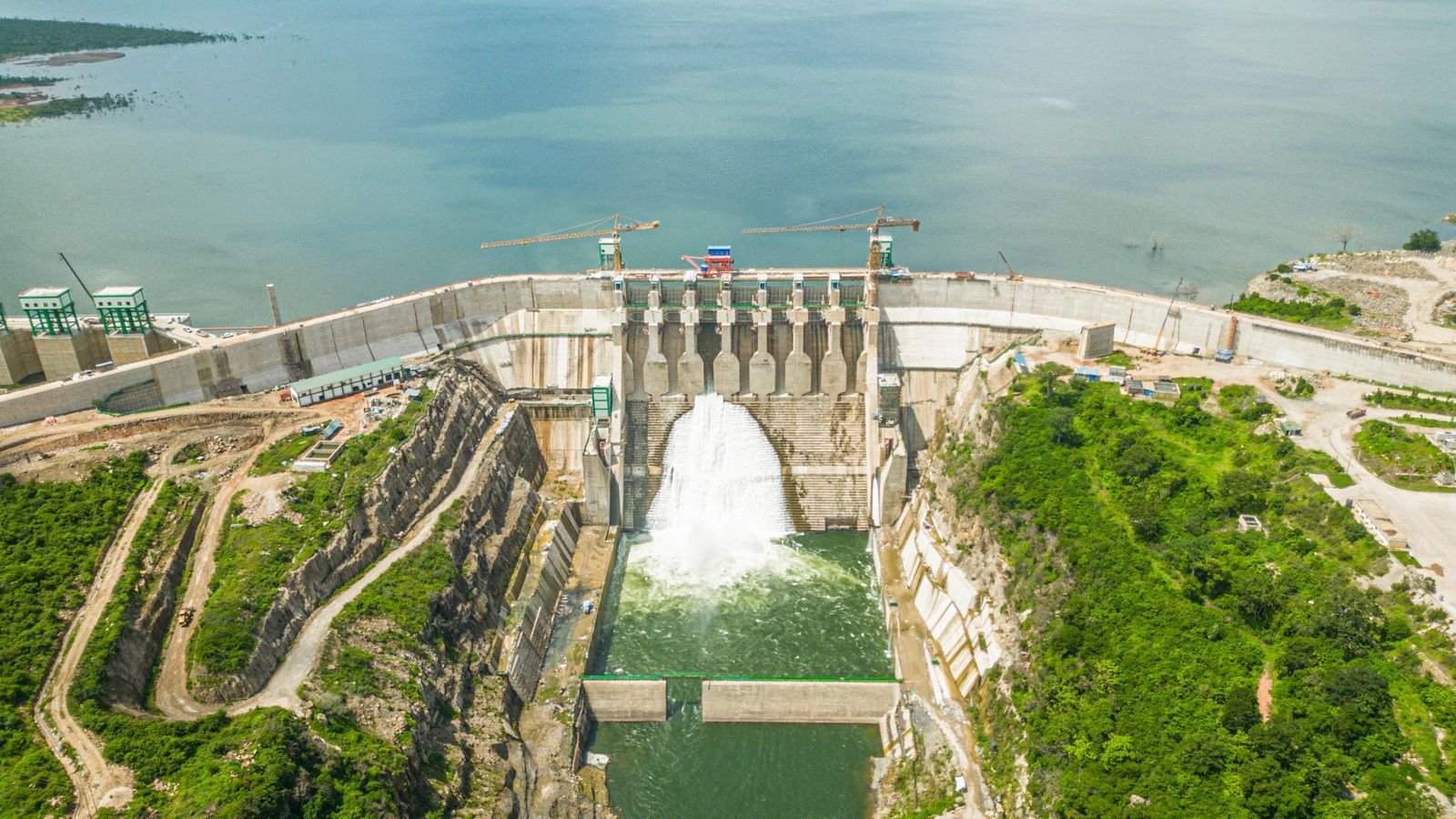
The scale of Tanzania's electricity expansion has been shaped primarily by the completion of the 2,115 MW Julius Nyerere Hydropower Project on the Rufiji River, one of the largest infrastructure developments undertaken in the country. The project significantly increased hydropower capacity within the national system and contributed to a shift away from the historical dependence on gas and other thermal generation during periods of high demand. It has also improved the government's ability to plan for additional industrial electricity consumption, although the contribution of its installed capacity to actual electricity supply depends on hydrological conditions, operating requirements and the ability of the national transmission network to distribute the generated power.
The latest EWURA data illustrate the changing composition of electricity supply. During the first quarter of the 2026/27 financial year, hydropower contributed approximately 48.2% of reported generation and imports, followed by natural gas at 27.7%, with the remainder distributed among other domestic sources and cross border electricity supplies. The figures establish the dominant position of hydro and gas in the current system, even as the government promotes solar, wind and geothermal investment. A larger installed renewable capacity could improve diversification, but different generating technologies have different operating characteristics, making their contribution to meeting demand dependent on more than their nameplate capacity.
The recent expansion also means Tanzania is no longer planning future generation exclusively to overcome an immediate shortage of available power stations. In August 2026, the energy ministry reported generating capacity of 4,646 MW against peak demand of approximately 2,271 MW and announced plans to pursue electricity exports to Zambia, Kenya and the Democratic Republic of Congo. EWURA's subsequent September figures reported higher demand of 2,815 MW, suggesting that both the timing and definition of the demand measures matter when comparing announcements. The substantial difference between installed capacity and prevailing load nevertheless creates a new planning challenge: future investments must be justified by expected growth in consumption, the need for reliable reserve capacity and viable electricity sales, rather than by capacity shortages alone.
The most revealing evidence comes from the government's own electricity planning documents. The Power System Master Plan projects peak demand of 3,204 MW in 2026, rising to 4,415 MW in 2027, 5,256 MW in 2028 and 6,571 MW by 2030. These projections imply that Tanzania expects demand to more than double over the remaining years of the decade, a trajectory considerably faster than the country's projected economic growth of approximately 6% annually. Electricity consumption can expand faster than GDP during industrialisation, particularly where factories replace diesel generators, households gain electricity connections and new industries begin operating, but the forecast requires a rapid increase in demand from identifiable customers and economic activities. Source: Ministry of Energy, Power System Master Plan 2024 Update, executive summary, page 20. The September 2026 EWURA report places actual gross demand at 2,815 MW and main grid maximum demand at 2,241 MW, using separately defined indicators.
The regulator's September 2026 report provides an early indication that electricity demand is developing differently from the trajectory projected in the master plan. EWURA records gross demand of 2,815 MW, including main grid, isolated systems and electricity generated for own use, while maximum demand on the main grid alone reached approximately 2,241 MW. The master plan's 2026 forecast of 3,204 MW exceeds the regulator's reported gross demand by about 388 MW, or 12.1%, although differences in measurement scope and the fact that September represents an observation before the end of the year prevent this from being treated as a definitive forecasting error. The gap is nevertheless large enough to justify examining whether the assumptions behind the country's generation expansion programme remain realistic, particularly as TANESCO prepares to commit additional capital to projects expected to operate for several decades.
The updated regulatory findings also show that having substantial installed capacity does not mean the entire amount is continuously available for consumption. Average power plant availability stood at 80.62% during the reporting period, below EWURA's regulatory target of 88%, while plant utilisation averaged 47.49%. Lower utilisation is not necessarily evidence of waste, since a power system must retain capacity for maintenance, unexpected outages, variations in demand and changes in hydroelectric output. However, these figures provide a more commercially relevant basis for assessing generation investment than the nameplate capacity of power stations alone. As Tanzania expands towards 8,000 MW, improving the availability and efficient operation of existing plants could reduce the amount of additional investment required to satisfy some categories of demand, while investment in more flexible generation may still be necessary to manage fluctuations and protect system reliability.
Where will the additional electricity demand come from?
Tanzania's official demand forecast depends partly on a major expansion of electricity access. The Power System Master Plan projects that the number of electricity customers will increase from approximately 6.65 million in 2025 to 13.5 million by 2030, while electricity consumption per person rises from 243 kilowatt hours to 528 kilowatt hours annually. This implies that the country expects both the number of electricity consumers and the average quantity consumed to increase substantially. However, EWURA reported 6.50 million customers by September 2026, indicating that the system would need to add approximately seven million customers over the remaining four years to reach the master plan's 2030 assumption. This would require average additions of approximately 1.75 million customers annually, compared with a reported increase of about 174,000 customers between the 2025/26 year end and September 2026. The periods are not directly comparable, but the difference illustrates the scale of acceleration required.
Tanzania has made substantial progress in extending electricity infrastructure through the Rural Energy Agency and TANESCO, but the distinction between having electricity available in a locality and being connected to the network remains economically important. EWURA's September 2026 figures place electricity accessibility at 85.5%, compared with actual connectivity of 52.1%. This indicates that electricity infrastructure reaches a considerably larger share of the population than the proportion currently connected, creating opportunities to increase demand by converting access into active customers. Yet connections alone do not guarantee high consumption. Households with modest incomes may initially use electricity for lighting, charging phones, televisions and a limited number of appliances, generating relatively small volumes of demand compared with industrial facilities or businesses operating machinery throughout the day.
The government's National Energy Compact targets universal electricity accessibility and 75% connectivity by 2030, supported by investment in grid expansion, distributed generation and utility reforms under the World Bank and African Development Bank's Mission 300 initiative. These targets are themselves ambitious, although they are less demanding than the 87% connectivity assumption incorporated into the Power System Master Plan's base case forecast. The difference suggests that Tanzania's electricity development documents are not using identical assumptions about the speed of new connections. That matters because the number of connected customers, their expected consumption and the associated investment costs determine how much electricity generation the national system must support.
Industrial expansion offers another potential source of demand, particularly from mining, mineral processing, manufacturing, construction materials, commercial agriculture and other activities requiring substantial quantities of electricity. Tanzania's investment in the Standard Gauge Railway, industrial facilities and transport corridors could also increase consumption as new equipment, logistics infrastructure and associated enterprises become operational. However, the growth of industrial electricity demand is closely connected to investment decisions that may depend on financing, permits, market conditions and the availability of complementary infrastructure. A proposed steel plant, mineral refinery or industrial park does not become a substantial electricity consumer until its financing is secured, construction is completed and commercial operations begin.
The proposed $42 billion liquefied natural gas development illustrates why industrial demand forecasts require careful treatment. The project could support additional electricity consumption through gas processing, liquefaction, supporting infrastructure and related industrial activity, but the scale and timing of demand depend on the project's eventual design and implementation schedule. As of November 2026, Tanzania was still working towards finalising key agreements associated with the development, meaning that electricity demand attributed to the project should be treated as conditional rather than guaranteed. Similar considerations apply to planned mineral processing operations, industrial estates and other major investments whose electricity requirements may be included in national forecasts before their commercial development is certain.
Electric cooking and transport are further sources of potential growth. The government's clean cooking strategy seeks to reduce dependence on charcoal and firewood, while the expansion of electric vehicles and electrified railway infrastructure could create new categories of electricity consumption. However, replacing biomass with electricity requires households to purchase suitable appliances and receive reliable power at affordable prices. The commercial adoption of electric vehicles also depends on vehicle costs, charging infrastructure and the availability of financing. These activities could produce substantial demand over time, but their contribution before 2030 will depend on how quickly households, transport operators and businesses change their equipment and consumption patterns.
The underlying challenge is that much of the demand expected by 2030 depends on economic developments that are themselves targets rather than completed investments. Building sufficient generation ahead of demand can be economically justified because power projects require long development periods, but consistently overestimating the speed of industrialisation or household electricity consumption can leave the utility carrying generation assets and payment obligations before sufficient revenue is available to support them.
The proposed 2,000 MW Mchuchuma plant raises questions about investment priorities
The generation projects presented by TANESCO in November demonstrate the scale of investment under consideration and the importance of sequencing new capacity against actual demand. According to Daily News, the utility identified projects expected to add 3,856.5 MW, including the 49.5 MW Malagarasi hydropower development, solar projects at Kishapu and Zuzu, wind and gas installations, and the proposed 2,000 MW Mchuchuma coal power plant in Njombe. The Mchuchuma project alone was assigned an estimated investment cost of $2.5 billion, making it one of the largest proposed additions to Tanzania's electricity system. However, several developments remain at the preparation or negotiation stage, and their inclusion in the expansion programme does not establish that financing, construction contracts or final power purchase agreements have been completed.
Mchuchuma illustrates the commercial exposure associated with investing ahead of confirmed demand. A 2,000 MW power station would represent approximately 43% of Tanzania's September 2026 installed capacity and more than 70% of its reported gross electricity demand at that time. Such a development could supply major industrial customers and reduce future shortages if electricity consumption increases as projected, but its commercial viability would depend on construction costs, coal supply, operating expenses, transmission arrangements and the ability to sell sufficient electricity throughout its operating life. The proposed plant also introduces environmental and financing considerations because international lenders and investors increasingly differentiate between fossil fuel generation technologies when assessing long term projects.
The financial implications extend beyond the initial $2.5 billion investment estimate. Depending on the contractual arrangements, a large power project may require payments that cover financing and fixed operating costs even during periods when the plant is not generating at full capacity. Such obligations can affect the utility's financial position if electricity demand grows more slowly than expected or if lower cost generation sources are available. Conversely, inadequate investment in dependable generation could expose Tanzania to costly electricity shortages during periods of industrial expansion or reduced hydropower output. Determining whether Mchuchuma represents the most economical option would require comparing its expected delivered electricity cost and operating flexibility with natural gas, renewables, storage and alternatives that combine smaller projects developed in stages.
There is also an emerging tension between Tanzania's proposed generation mix and its renewable energy ambitions. On November 12, Ministry of Energy Permanent Secretary James Mataragio said the government expected renewable sources including solar, biomass and wind to contribute 1,892 MW towards the 2030 capacity target, while the country's longer term electricity strategy envisaged substantially greater development of renewable resources. The same announcement confirmed that 50 MW of the Kishapu solar project was already supplying the grid, with a further 100 MW planned for 2027, while the 130 MW Zuzu solar project remained at the procurement stage. These developments would diversify electricity generation, but solar and wind projects require careful integration with hydropower, gas and storage facilities because their output varies with weather conditions.
The government's stated objective of obtaining approximately 75% of its power from sources classified as clean also requires consistent definition. Official statements have sometimes included natural gas within the category of cleaner energy sources, while conventional renewable energy classifications distinguish gas from hydropower, solar, wind and geothermal. The distinction matters when assessing investment commitments, environmental performance and the actual composition of electricity supplied to customers. Equally, a target referring to the share of installed capacity is different from one measuring the share of electricity generated, particularly because solar, wind, hydro and gas facilities have different operating patterns.
Electricity exports could provide a market, but the transmission network must develop
Tanzania's geographical position creates opportunities to supply electricity to neighbouring countries, including those experiencing shortages, high generation costs or growing demand from mining and manufacturing. The country is connected to regional energy cooperation arrangements involving the Eastern Africa Power Pool and Southern African Power Pool, while existing and planned interconnections could support sales to Kenya, Zambia, the DRC and other markets. Energy officials have increasingly identified exports as a potential destination for Tanzania's growing power supply following the commissioning of the Julius Nyerere Hydropower Project. A commercially successful export strategy could improve the utilisation of generating assets and create an additional source of revenue for TANESCO, particularly where neighbouring utilities can purchase electricity at prices below their domestic generation costs.
However, regional electricity demand does not automatically become a market for Tanzanian generation. Cross border sales require adequate transmission capacity, technically compatible networks, agreed commercial tariffs, dependable settlement arrangements and credible counterparties capable of meeting payment obligations. Long term export contracts may also need to establish how electricity delivery will be managed during hydrological shortages, plant outages or periods of high domestic demand. A country can have substantial installed generation capacity and still be unable to export the corresponding amount because transmission lines, substations and system operating arrangements are insufficient.
EWURA reported that Tanzania's transmission network reached approximately 8,632 kilometres by September 2026, compared with 8,500 kilometres at the end of the preceding financial year. The distribution network also expanded to more than 244,000 kilometres, reflecting continuing investment in connections and electricity delivery infrastructure. Nevertheless, the pace and location of transmission development will determine how effectively generating plants can serve industrial customers and regional markets. Electricity generated on the Rufiji River or at a coal plant in Njombe cannot be assumed to reach mining customers in Zambia or the DRC without the required transmission infrastructure and suitable operating agreements.
The economics of exports are also affected by competition. Zambia, Kenya and other regional markets can pursue their own generation investments or purchase electricity from alternative suppliers, making the price and reliability of Tanzanian power central to future contracts. Tanzania's advantage will depend on whether it can offer dependable electricity at a delivered cost that remains competitive after transmission charges, system losses and other transaction expenses. Export revenues could help support investment in generation and transmission, but they should not be counted as guaranteed income before binding supply agreements and the infrastructure required to honour them are in place.
Regional power trade may become increasingly attractive as neighbouring economies expand mining, manufacturing and electricity access. However, Tanzania would need to manage the relationship between export commitments and domestic security of supply, particularly when hydropower production is affected by drought or when unexpected growth in industrial demand increases national consumption. A well structured export market can create value from additional capacity, but an export strategy built mainly on anticipated demand would expose the utility to the same commercial risk as domestic generation projects that are developed before sufficient customers are secured.
The financial question is how much electricity Tanzania can sell profitably
The Power System Master Plan provides an ambitious forecast for electricity demand, but meeting that forecast requires significant growth in the number of customers and the quantity of electricity they consume. Its base case expects annual demand to reach approximately 40,933 GWh by 2030, compared with 16,008 GWh projected for 2025. This represents an increase of about 156% over five years, equivalent to approximately 20.7% annual compound growth. The projection assumes a rapid expansion of electricity consumption associated with new connections, industrial development, transport electrification and other economic activity. Such growth is possible during a period of substantial structural change, but its achievement should be monitored against actual consumption and changes in the investment projects expected to generate demand.
Tanzania's projected annual electricity requirements
Ministry of Energy Power System Master Plan base case, gigawatt hours. Forecasts rather than actual sales.
Source: Ministry of Energy, Power System Master Plan 2024 Update. The projected 2030 annual electricity requirement is approximately 2.56 times the 2025 planning baseline.
Actual demand growth and electricity sales are therefore essential for assessing the viability of the capacity expansion programme. EWURA's September report recorded 5,482.86 GWh of electricity generation and cross border imports during the first quarter of 2026/27, although that figure includes electricity generated for own use and does not represent TANESCO's billed electricity sales. If the quarterly volume were simply annualised, it would imply approximately 21,931 GWh, but seasonal conditions and differences between gross generation, imports and consumption mean the result should be treated only as a scale comparison, not an annual demand forecast. The regulator's reported plant utilisation rate of 47.49% further indicates that the quantity of generating equipment installed is considerably greater than the amount being operated on average. The financial implications depend on which facilities have fixed contractual payments, how capital expenditure is financed and whether electricity tariffs recover the costs incurred.
Tanzania's electricity investment strategy must also account for the difference between adding generating capacity and delivering reliable electricity to customers. EWURA's September report recorded average plant availability of 80.62%, below its 88% regulatory target, while customer electricity restoration times remained above the applicable performance benchmark. These findings indicate that operational efficiency and reliability continue to require investment even as the country records substantial generation capacity. For industrial consumers, the economic value of electricity depends not only on whether supply is sufficient in aggregate but also on voltage stability, the frequency and duration of interruptions, and the cost of maintaining backup systems. A manufacturing business may be located in a country with excess generation capacity and still face production losses if the local distribution network is unreliable.
Expanding electricity access creates further investment requirements because rural and lower income consumers may initially purchase relatively small amounts of electricity. New connections are valuable for education, communications, household welfare and the development of small enterprises, but the revenue generated from each customer may be modest compared with the capital required to extend lines, install transformers and maintain distribution facilities. TANESCO's financial position therefore depends on balancing commercially viable customers with the government's objective of extending electricity services to communities where the immediate financial return may be insufficient to cover the full investment cost. Public financing and concessional development support can help close that gap, but it remains necessary to distinguish the economic and social benefits of electrification from the revenues available to repay generation and network investments.
The sequencing of new projects will consequently be as important as the final capacity target. A large industrial customer with a confirmed investment decision and a credible electricity supply agreement can provide a clearer basis for financing generation than a project whose demand is based on an anticipated industrial development. Similarly, an interconnection supported by a binding export arrangement can offer a more reliable commercial justification than an investment dependent on unspecified future regional buyers. The most efficient expansion programme would allow new capacity to enter service as demand develops while retaining sufficient reserves to maintain reliability during outages, droughts and unexpected increases in consumption.
The 2030 ambition depends on industrialisation happening at the same pace as power investment
Tanzania's 8,000 MW target is consistent with the government's wider ambition to build an industrial economy capable of supporting substantially higher incomes by 2050. Reliable electricity is a foundation for manufacturing, mineral processing, modern agriculture, transport and the expansion of commercial services, and historical shortages have imposed substantial costs on Tanzanian businesses. The addition of the Julius Nyerere Hydropower Project and subsequent investments in generation have improved the country's ability to support economic expansion, making it possible for policymakers to plan for industries that previously faced uncertainty over electricity availability.
However, the government's own figures demonstrate that future demand is expected to grow exceptionally quickly. EWURA's September 2026 data place installed capacity at approximately 4,689 MW and gross demand at 2,815 MW, while the Power System Master Plan projects peak demand exceeding 6,500 MW by 2030. Achieving that trajectory requires millions of additional electricity connections, higher household consumption, new industrial investment and growth in activities such as electric transport and clean cooking. Some of these developments are already underway, but others remain dependent on financing, commercial decisions, infrastructure completion and the ability of households and businesses to afford additional electricity.
The planned generation projects introduce their own uncertainties. TANESCO's proposed portfolio includes developments that have reached construction, procurement and preliminary preparation stages, while some of the largest investments still require financing and contractual decisions. The inclusion of a 2,000 MW coal plant alongside solar, wind, gas and hydroelectric projects makes the economic sequencing of future capacity particularly consequential. Different technologies impose different financing, fuel and operating costs, while the timing of electricity demand will determine how extensively those assets can be used.
The government's electricity programme can support Tanzania's industrial ambitions if generation investment is matched by productive demand, affordable tariffs, reliable networks and commercially sustainable electricity exports. The available evidence does not establish that 8,000 MW would necessarily constitute excessive capacity by 2030, because a growing power system needs reserves and different generating technologies contribute different amounts of dependable supply. It does establish that the country's demand forecasts are ambitious and that the financial case for additional generation will depend on developments beyond the electricity sector itself.
Tanzania's next electricity challenge will therefore be to convert its expanding generating capacity into reliable and economically productive consumption. The success of the 2030 target will be determined not only by the number of megawatts installed, but by the factories, mines, businesses, households and regional customers able to use and pay for the electricity.
 Uchumi360
Business Intelligence
Uchumi360 covers business, investment, and economic policy across East, Central, and Southern Africa.
For the serious reader
You read to the end. That places you in a small group.
Uchumi360 is built for readers who demand precision over speed, structure over sentiment, and analysis that holds uncomfortable conclusions rather than softening them. If this work sharpens how you think about Africa's economy, help us keep building the infrastructure behind it.
Institutional Partners
Commission intelligence. Shape the conversation.
Uchumi360 works with development finance institutions, investment firms, sovereign bodies, and strategic organisations across the coverage region. Institutional partnership unlocks:
- Commissioned sector and country intelligence reports
- Branded research series under your institution's authority
- Exclusive data briefings for internal strategy teams
- Speaking and editorial presence at Uchumi360 events
- Co-published investment outlooks for your markets
Support Our Work
Independent analysis has a cost. Help us bear it.
Uchumi360 does not carry advertising. It does not take editorial direction from sponsors. Every article is produced without commercial compromise. Your contribution funds the reporting, research, and editorial infrastructure that keeps this analysis free from influence.
Secure checkout: One-time and monthly support are processed securely. Add payment credentials to enable checkout here.
Stay Connected
Keep up with every new insight.
Follow our latest analysis, policy coverage, and market intelligence as soon as it is published. If you need something specific, reach out directly and we will point you to the right research.
