
Uganda's Oil vs Tanzania's $42 Billion LNG: Who Earns What?
Ready
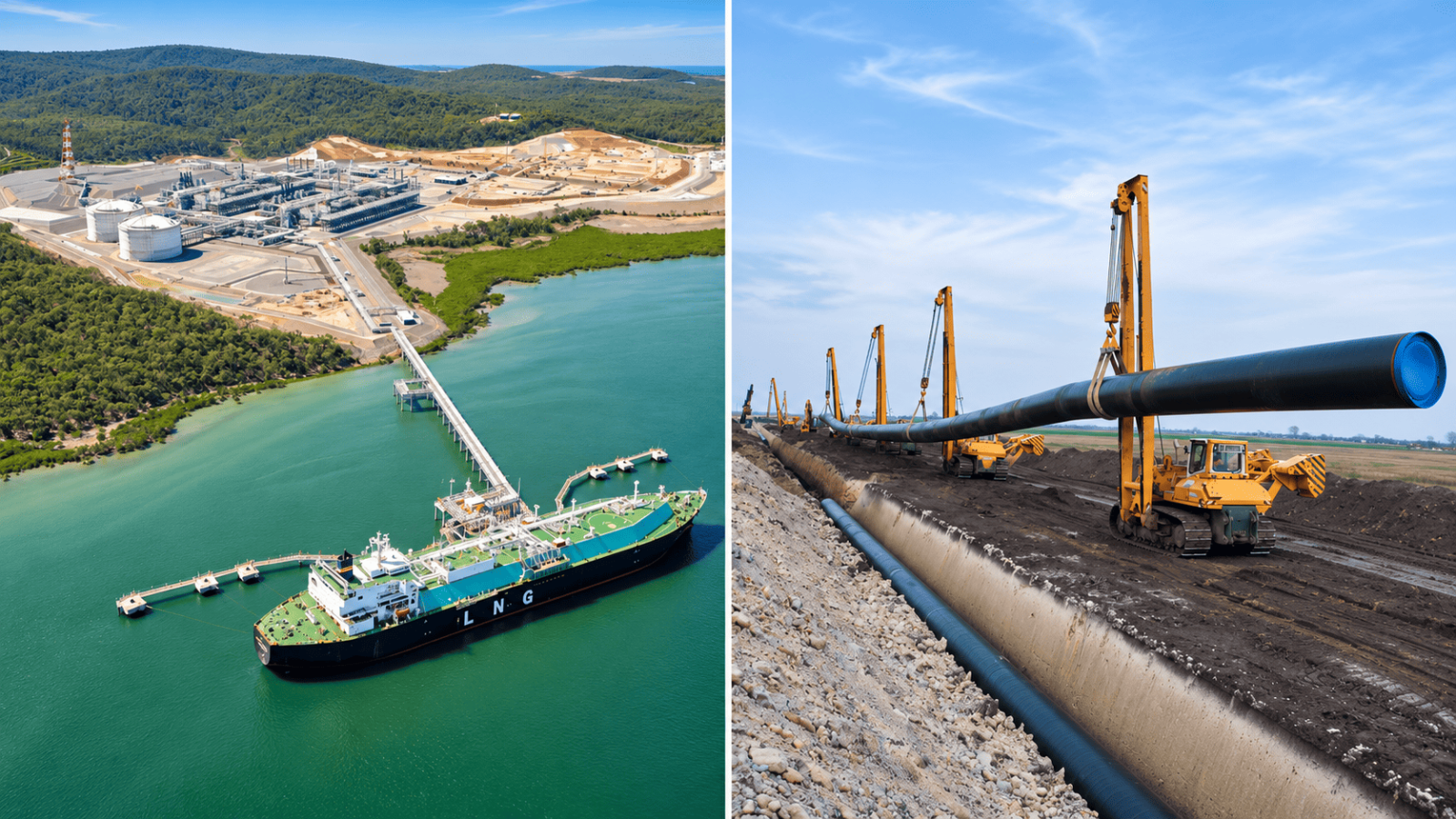
Uganda is approaching its first commercial oil exports through Tanzania's Tanga port, while Tanzania is negotiating the final legal framework for a $42 billion liquefied natural gas development in Lindi. Both promise major public revenues, but their economics differ sharply. Uganda's near term earnings depend on crude prices, production costs and a $12.77 per barrel pipeline tariff. Tanzania faces a much larger investment decision, substantial cost recovery obligations and uncertain LNG prices before its offshore gas can generate significant fiscal income.
East Africa is approaching two major milestones in the commercial development of its hydrocarbon resources. Uganda expects to begin exporting crude oil through Tanzania by June 2027 after years of delayed production, while Tanzania is attempting to conclude the legal and commercial agreements required for a $42 billion liquefied natural gas project that has remained under negotiation for more than a decade.
The projects represent different opportunities for the two governments. Uganda's Lake Albert oilfields and the East African Crude Oil Pipeline (EACOP) are already under construction, with the pipeline reported to be 93.9% complete during the November 18 meeting between Presidents Yoweri Museveni and Samia Suluhu Hassan. Tanzania's LNG project, involving offshore gas discoveries and a proposed liquefaction facility at Likong'o in Lindi, had completed substantial commercial and fiscal negotiations by September 2026 but had not reached a final investment decision.
The economic distinction matters because large hydrocarbon investments do not automatically generate equivalent government revenue. Before petroleum proceeds reach a national treasury, operators must finance production facilities, recover eligible costs, pay transportation charges, service project debt and meet contractual obligations. The amount ultimately retained by the state depends on production volumes, commodity prices, taxation, profit sharing, government equity and the timing of those payments.
Uganda's oil development offers the nearer opportunity for substantial new fiscal revenue. Research by the Natural Resource Governance Institute (NRGI) and Rystad Energy estimates that Uganda could receive an average of $1.9 billion annually under a slow global energy transition, falling to approximately $1 billion under a moderate transition scenario. These are long term modelling estimates rather than guaranteed annual receipts, and the country's latest production delays mean revenues will begin later than earlier projections assumed.
Tanzania's LNG investment offers a different scale of opportunity. A 2022 macroeconomic study commissioned by Stanbic Bank modelled cumulative government income of approximately $71 billion to $223 billion across four LNG price scenarios for a hypothetical operating period extending to 2059. The estimates are highly sensitive to gas prices, fiscal assumptions and the project's investment structure. They were produced before the latest $42 billion cost estimate and cannot be treated as agreed fiscal outcomes under the 2026 negotiations.
The commercial challenge for both countries is to convert resources underground into government income without allowing development costs, financing arrangements and delays to absorb an excessive share of their economic value.
Uganda's Recoverable Oil Resources Have Increased to 1.65 Billion Barrels
Uganda's petroleum development is centred on the Albertine Graben, where commercial discoveries began in 2006. The country's petroleum resource assessment has historically identified approximately 6.5 billion barrels of oil in place, with earlier estimates suggesting that roughly 1.4 billion barrels could be recovered.
In November 2025, the Petroleum Authority of Uganda reported that recoverable resources had increased to approximately 1.65 billion barrels following updated assessments. The revision matters because recoverable resources, rather than the total volume of petroleum originally present underground, provide the more relevant starting point for evaluating potential production and economic returns.
Uganda is developing its resources through two principal upstream projects: Tilenga, operated by TotalEnergies, and Kingfisher, operated by CNOOC. The production facilities are designed to process crude oil from numerous wells before directing it towards domestic refining or the export pipeline.
EACOP's official technical description identifies processing capacities of 204,000 barrels per day for Tilenga and 42,000 barrels per day for Kingfisher. These facilities would feed a 1,443 kilometre heated pipeline running from Hoima in Uganda to Tanzania's coast near Tanga. The project also provides for a proposed domestic refinery with the right of first call on up to 60,000 barrels per day.
Recoverable oil resources
1.65B
Barrels
Combined field processing capacity
246,000
Barrels per day
Resource assessment reported in November 2025; processing facilities as described by EACOP. Nameplate processing capacity does not equal actual sustained production.
At a hypothetical sustained production rate of 230,000 barrels per day, Uganda would produce approximately 84 million barrels annually. At an illustrative international benchmark price of $70 per barrel, that volume would have a gross benchmark value of approximately $5.88 billion before crude quality discounts, transportation costs, operating expenses, capital recovery, taxes and profit sharing.
That calculation is useful for understanding the scale of the opportunity, but it is not an estimate of government revenue. Actual realised oil prices may differ from international benchmarks, and production will not necessarily remain at peak levels throughout the fields' commercial lives.
The revised resource estimate also does not establish that every recoverable barrel will be developed under existing investment plans. Commercial production depends on the approved development areas, well performance, future investment and economic conditions.
Uganda's Oil Revenue Could Vary by Nearly $1 Billion Annually Under Different Energy Scenarios
A major source of uncertainty in Uganda's oil economy is the international price at which its crude will be sold.
Uganda does not produce sufficient oil to influence global benchmark prices. Its exports will compete in international markets where prices are determined by global supply, consumption, inventories and geopolitical developments. Ugandan crude will also be priced according to its physical characteristics and the costs of transporting it to buyers.
NRGI's analysis, developed with Rystad Energy, provides two contrasting government revenue scenarios for the period to 2050.
Uganda's modelled average annual government oil revenue
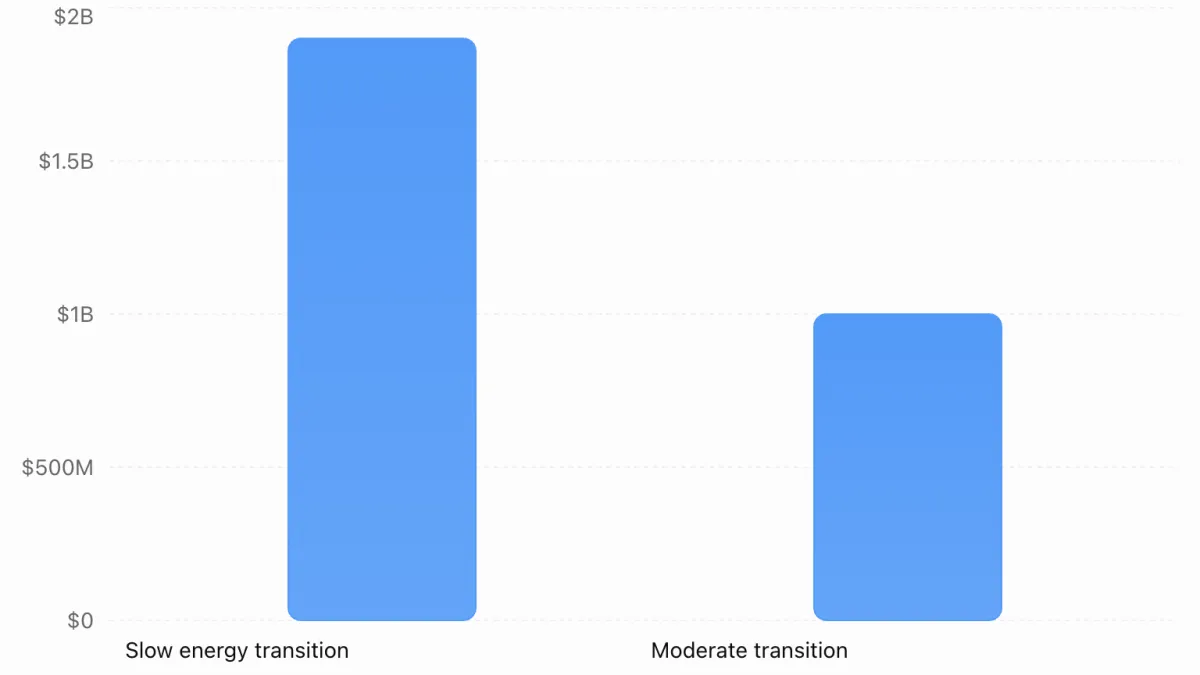 NRGI and Rystad Energy modelling, published in 2025. Scenario averages refer to the modelled 2026 to 2050 period and are not annual budget forecasts for 2027.
| Scenario | Average annual government revenue | Approximate cumulative amount over 25 years |
| Slow energy transition | $1.9 billion | $47.5 billion |
| Moderate energy transition | $1.0 billion | $25.0 billion |
The cumulative amounts are simple annual average extrapolations, not independently verified totals of discounted fiscal receipts. Source: NRGI, Strengthening Uganda's Management of Uncertain Oil Revenues.
The difference between the scenarios is approximately $22.5 billion over 25 years, illustrating how assumptions about long-term oil demand and prices can substantially change the public finances of a producing country.
The timing of production also matters. Uganda's first commercial oil had previously been anticipated in 2026, but the Petroleum Authority of Uganda and Uganda National Oil Company indicated in November that production and exports were now targeted for the end of June 2027. Outstanding work on processing facilities, pumping stations and supporting pipeline systems was among the reported constraints.
The delay has implications for fiscal planning. Uganda's 2026/27 budget had incorporated anticipated petroleum income, but a later production start reduces the amount of revenue that can realistically be collected during the financial year.
In its 2026 Article IV consultation, the International Monetary Fund warned that a further delay in oil production could weaken growth and public finances. The Fund also identified rising debt servicing obligations and weaknesses in budget execution as important fiscal constraints.
This creates a policy challenge before the first barrel is exported. If governments increase spending or borrowing in anticipation of petroleum income that has not yet materialised, project delays can create immediate budget pressures.
Uganda's Petroleum Fund and associated investment arrangements are intended to govern the collection and use of oil revenue. NRGI has recommended clearer withdrawal rules, greater transparency over revenue flows and stronger safeguards against excessive dependence on future petroleum receipts.
EACOP's $12.77 Tariff Reveals How Oil Transport Costs Reduce Upstream Returns
One of the most important financial features of Uganda's oil development is the cost of transporting crude to international markets.
Because Uganda is landlocked, the oil must travel through a dedicated export system before it can be loaded onto ships. The heated EACOP pipeline runs from Hoima through Tanzania to the marine terminal at Chongoleani, near Tanga.
The legal framework establishing EACOP's tariff provides for a baseline transportation charge of $12.77 per barrel for an initial cumulative volume of 1.046 billion barrels. The tariff is adjusted annually from the first commercial delivery by the lower of US consumer price inflation or 2%.
The arrangement is established in Uganda's EACOP Special Provisions legislation. A 2021 parliamentary committee report also documented how the tariff was originally calculated.
The economics of the $12.77 tariff
| Component | Share | Amount per barrel |
| Recovery of capital expenditure | 48.9% | $6.24 |
| Operating expenditure | 33.8% | $4.31 |
| Senior debt interest | 6.8% | $0.88 |
| Corporate taxes and related taxes | 4.9% | $0.62 |
| Shareholder dividends | 5.6% | $0.72 |
| Total | 100% | $12.77 |
Source: Parliament of Uganda, Committee Report on the East African Crude Oil Pipeline (Special Provisions) Bill, 2021, pages 12 to 13. The figures are the original tariff assumptions, not audited expenditure or current realised distributions.
The structure shows that the largest portions of the tariff were designed to recover construction expenditure and cover ongoing operations. Approximately $10.55 of each $12.77 charge was allocated in the original model to capital and operating expenditure, with smaller amounts attributed to interest, taxes and dividends.
At a hypothetical pipeline throughput of 200,000 barrels per day, the baseline tariff would generate approximately $932 million in annual gross transportation charges before escalation. That amount would be earned by the pipeline company, not paid entirely to Tanzania or Uganda as government revenue.
The distinction is central to understanding the project. EACOP's transportation tariff must cover infrastructure costs, operations, financing obligations and shareholder returns. Governments benefit through applicable taxes, public equity interests and related economic activities. The transportation charge itself is a cost borne by the upstream oil shippers.
A higher tariff can reduce the net proceeds available from oil production, particularly where crude prices are weak. Uganda's parliamentary committee explicitly raised concerns about the effect of annual tariff escalation on upstream returns.
The original tariff calculation also should not be confused with the actual order in which cash will be distributed under financing agreements. Capital cost recovery, operating costs, interest, taxes and dividends are accounting categories used to justify the tariff. The detailed cash distribution waterfall is governed by the project's financing and contractual documents, which have not been fully disclosed publicly.
Tanzania's EACOP Revenue Comes From Taxes, Equity and Services, Not the Full Pipeline Tariff
Tanzania's economic position in EACOP differs from Uganda's. Uganda owns the oil resources and receives the fiscal benefits associated with upstream production. Tanzania supplies most of the physical export corridor, providing the route, pumping infrastructure, marine terminal and associated services required to move Ugandan crude to international buyers.
EACOP's current project description places approximately 1,149 kilometres of the pipeline in Tanzania, compared with 298 kilometres in Uganda. Earlier project documents commonly refer to an overall length of 1,443 kilometres and 1,147 kilometres within Tanzania, reflecting revisions in the route specification.
The pipeline company is owned by TotalEnergies with 62%, the Uganda National Oil Company with 15%, Tanzania Petroleum Development Corporation with 15%, and CNOOC with 8%.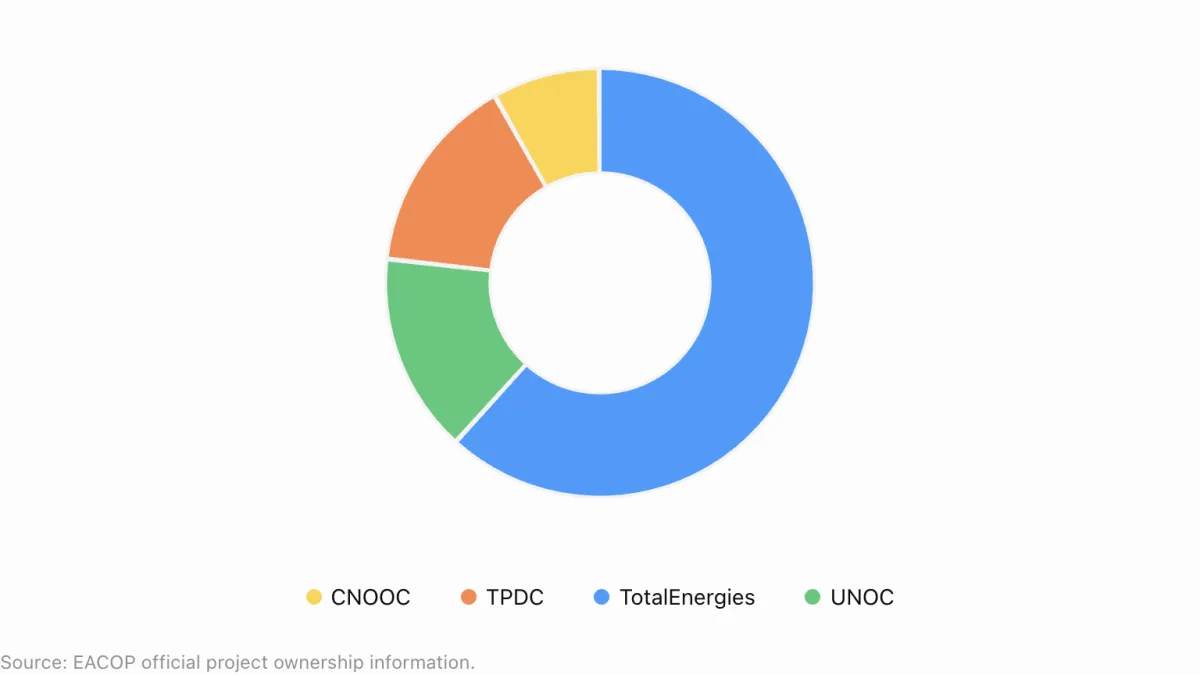 Tanzania's 15% equity participation creates the potential for dividends if the pipeline generates distributable profits after operating expenses, taxes, debt service and other obligations.
Tanzania can also collect applicable corporate taxes, employment related taxes, fees and other receipts associated with activities undertaken within its jurisdiction. Local contractors, logistics companies and suppliers may receive payments during construction and operation.
However, the amount of revenue accruing directly to Tanzania requires careful assessment. An earlier report by Tanzania's Treasury Registrar projected approximately TSh 2.3 trillion in direct government income over 25 years of EACOP operations. That historical estimate is substantially different from the $3.2 billion to $3.5 billion claimed in the original draft, and the reviewed public documentation does not provide a sufficiently reconciled basis for treating the higher figure as an agreed government forecast.
The original claim that Tanzania receives 60% of pipeline corporate income taxes and Uganda 40% also requires direct verification against the applicable fiscal agreements. It should not be treated as established solely because approximately 80% of the pipeline crosses Tanzanian territory.
Tanzania's role remains economically consequential, but its benefits must be separated into distinct categories: public tax receipts, TPDC equity distributions, payments to Tanzanian enterprises, wages and associated infrastructure activity.
The value of the pipeline to Tanzania is therefore broader than direct treasury collections, although the total economic benefit cannot be calculated by adding every payment made within the project without accounting for costs, imports and overlapping transactions.
EACOP's Financing Structure Has Shifted as Construction Costs Increased
EACOP's capital requirements have increased substantially since its early planning stages. Initial estimates commonly placed the pipeline investment near $3.5 billion to $4 billion. More recent reporting has placed the project cost at approximately $5.6 billion, reflecting the larger financing requirement confronting shareholders.
The project was originally expected to rely more heavily on debt financing, but difficulties obtaining external loans resulted in greater equity contributions from shareholders. By late 2024 and 2025, reporting indicated a revised financing structure of approximately 52% equity and 48% debt.
In March 2025, EACOP announced the closure of its first external financing tranche. The transaction confirmed that the project had secured some external lending, although the announcement did not establish that the full debt requirement had been financed.
A financing structure with a greater equity component changes the project's economics. Shareholders must contribute more capital upfront, and their eventual returns depend on future dividends and the value of their investments. Debt financing requires repayment and interest, while equity investors bear greater exposure to the commercial performance of the project.
For Uganda and Tanzania, participation through their national oil companies also creates financing obligations. Government owned companies may need capital injections, borrowing or other arrangements to maintain their ownership positions.
EACOP has faced opposition from environmental and human rights organisations, with several international financial institutions declining involvement. Project developers maintain that the infrastructure is being implemented under established environmental and social standards, while critics have raised concerns about climate effects, land acquisition and impacts on affected communities.
The financing debate illustrates a larger issue affecting hydrocarbon investment. Even when resources are commercially recoverable, the cost and availability of capital can influence project timelines, expected returns and the eventual division of economic benefits.
Tanzania's $42 Billion LNG Project Has Larger Resource Potential but a Longer Investment Horizon
Tanzania's proposed liquefied natural gas development is substantially larger in announced capital expenditure than the individual projects comprising Uganda's oil development.
The project would commercialise offshore natural gas discoveries in Blocks 1, 2 and 4 through subsea production infrastructure, pipelines and an onshore liquefaction facility near Likong'o in Lindi. Shell and Equinor are principal operators, with ExxonMobil, Medco Energi, Pavilion Energy and TPDC involved in the wider development arrangements.
Tanzania's energy regulator reports approximately 57.54 trillion cubic feet (TCF) of discovered natural gas resources nationally. Of this amount, approximately 47.13 TCF is offshore and 10.41 TCF is onshore.
These estimates require a distinction between gas initially in place, technically recoverable resources and commercially recoverable reserves. The 47.13 TCF offshore figure should not automatically be treated as the volume available for export through the proposed LNG plant.
The actual recoverable quantity depends on geological conditions, reservoir performance, extraction technology, field development economics and the volumes reserved for domestic consumption.
The proposed LNG plant has commonly been described as having an initial capacity of approximately 10 million tonnes annually, although other industry assessments discuss a potential development scale of 10 million to 15 million tonnes. The final plant configuration remains subject to engineering, commercial agreements and investment approval.
The $42 billion investment estimate is also broader than the cost of constructing a liquefaction plant alone. The project would require offshore production facilities, wells, subsea systems, transmission pipelines, processing equipment, export infrastructure and associated development activities.
The scale creates a different commercial structure from EACOP. A crude oil pipeline earns a transportation fee once shipments begin. An integrated LNG development must extract natural gas, transport it, process it, cool it to liquid form, load it onto carriers and sell it to buyers under contracts or prevailing market conditions.
The investment must therefore support a longer sequence of capital intensive operations before generating commercial returns.
Tanzania Has Completed Commercial Talks but Still Awaits the Agreements Needed for FID
Tanzania entered 2026 anticipating progress towards a final agreement with the international gas companies. However, earlier timelines were repeatedly revised.
In September, TPDC Managing Director Mussa Makame said negotiations on key commercial, taxation and revenue sharing matters had been completed. Legal teams were continuing work on the Host Government Agreements and the legislative arrangements required to implement the development.
In October, Finance Minister Khamis Mussa Omar told Reuters that Tanzania expected to finalise agreements on the $42 billion project in the coming months. The statement confirmed continuing government commitment, but did not establish that all binding project agreements had been signed.
The distinction is important for assessing the project's commercial maturity. Completing negotiations on fiscal principles does not necessarily mean the final legal documents are enforceable. Government approval, legislative processes, environmental requirements, engineering design and financing must still be addressed before shareholders can commit fully to construction.
The final investment decision (FID) is particularly consequential because it represents the point at which investors formally approve the capital commitment required to develop the project.
As of November 2026, no independently verified final investment decision had been announced. A 2027 or 2028 FID remains a possible planning scenario, but it should not be presented as an agreed timetable. First LNG exports in the early or middle 2030s would also depend on when the investment decision occurs and how long engineering, construction, commissioning and offshore development subsequently require.
Equinor's own September 2026 discussions about expanding its LNG portfolio in the early 2030s excluded Tanzanian production, with the company citing continuing delays in negotiations. This reinforces the need to distinguish the country's aspirations from volumes that international producers have incorporated into committed supply plans.
Why Tanzania's LNG Revenue Could Arrive Much Later Than Its Investment
Tanzania's fiscal benefit from LNG will depend on the production sharing arrangements, applicable taxes, TPDC participation and the price received for exported gas. The underlying economics are shaped by the large amount of capital that must be spent before production begins.
International companies generally expect to recover eligible exploration, development and operating costs from future hydrocarbon production under the terms of their agreements. In production sharing systems, a portion of production or its value is allocated to cost recovery, while the remaining profit petroleum is shared according to agreed formulas.
A 2022 macroeconomic study commissioned by Stanbic Bank modelled Tanzania's LNG project using an assumption that investors could recover costs from up to 70% of annual production. It also assumed a 5% royalty, 30% corporate income tax and government participation through TPDC.
Those are modelling assumptions based on the fiscal framework and information available at the time. They cannot be treated as disclosure of the final negotiated terms of the 2026 Host Government Agreement.
The difference is important because cost recovery can materially affect the timing of public revenue. Consider an illustrative project generating $5 billion in annual sales. If a fiscal agreement permits substantial cost recovery, a large portion of the revenue may initially be allocated to reimbursing eligible development and operating expenditure. Taxes, royalties and government profit shares may still be payable, but the amount available for distribution as profit petroleum can be constrained during the early years.
As recoverable investment costs decline, a larger portion of production value may become available for profit sharing, depending on the contractual formula and ongoing capital expenditure.
This pattern is one reason LNG projects can generate substantial cumulative public income over several decades without producing equally large treasury receipts immediately after first exports.
It also explains why the headline $42 billion investment estimate should not be confused with revenue accruing to Tanzania. The capital expenditure represents costs that investors and participating public entities must finance. Those costs must ultimately be supported by the project's commercial returns.
What the Stanbic Study Actually Projects for Tanzania's Government
The most useful published financial model identified during this research is Stanbic Bank's 2022 study, Tanzania LNG: A Macroeconomic Study. The report examines alternative LNG prices and models the distribution of project income between investors and the Tanzanian government, including assumed TPDC participation. It provides four principal scenarios.
Tanzania LNG: Modelled government income under different export prices
| LNG price per MMBtu | Government income, 2030 to 2059 |
| $5.50 | $71.1 billion |
| $7.00 | $106.5 billion |
| $10.00 | $177.4 billion |
| $12.00 | $223.2 billion |
Stanbic Bank, Tanzania LNG: A Macroeconomic Study, Table 2.8, “GoT Total Income.” These are undiscounted model results incorporating assumed fiscal and commercial arrangements, not agreed future government receipts or current project valuations. 
The difference between the lowest and highest price scenarios exceeds $150 billion in modelled cumulative government income. This demonstrates how sensitive the project's long term financial outcomes could be to the price received for LNG exports.
However, the results require considerable qualification. The study used assumptions prepared in 2022, including an earlier investment estimate and a hypothetical production schedule extending from 2030 to 2059. The proposed project's cost has subsequently been described as $42 billion, and the original operating timetable is no longer achievable.
The modelled government income also includes amounts associated with assumed TPDC participation. Equity returns require capital contributions and may involve financing expenses, making them economically different from taxes collected directly by the treasury.
The figures are undiscounted cumulative amounts. A dollar collected twenty years after production begins is not financially equivalent to a dollar collected immediately, because of inflation, investment returns and the time value of money.
The IMF examined the Stanbic model in its 2023 analysis of Tanzania's LNG development and cited annual government revenue scenarios ranging from approximately $2.2 billion at a gas price of $5.50 per MMBtu to approximately $6 billion at $12 per MMBtu. The Fund also cautioned that available project specific information was limited and that modelling assumptions would affect the results.
The analysis supports the possibility of substantial long term revenue, but it does not justify stating that Tanzania is guaranteed $70 billion, $100 billion or any other cumulative fiscal amount under the agreement currently being negotiated.
TPDC's Equity Participation Could Create a Multibillion Dollar Financing Requirement
Another major question concerns how Tanzania would finance its participation in the LNG project. Previous studies have assumed that TPDC would exercise participation rights equivalent to approximately 10% to 15% of the development, although the precise ownership structure and terms of the proposed project have not been publicly confirmed in a final investment agreement.
Stanbic's 2022 study used an illustrative 12% TPDC interest in the upstream project and LNG plant. Under its assumed investment structure, it identified a potential borrowing requirement of approximately $3.9 billion for TPDC to exercise its participation rights.
The amount is substantial for a state owned energy company and raises questions about the financing arrangement that would best protect Tanzania's fiscal position.
A direct government capital contribution could require budget allocations or borrowing. Financing arranged through commercial lenders could expose TPDC to interest and repayment obligations. An arrangement under which private partners finance the state's initial investment could reduce the immediate cash requirement but create claims on future distributions.
These alternatives have different implications for government income. An equity share can produce substantial dividends once a project becomes profitable, but the state must also account for the cost of acquiring and maintaining that ownership. Gross dividends cannot be treated as a net fiscal benefit without considering financing expenses and any contractual deductions.
There is also no verified basis for claiming that the Bank of Tanzania has been selling gold reserves to finance TPDC's LNG participation.
In 2026, the central bank explicitly stated that its gold reserve transactions were part of foreign reserve management and were not linked to government infrastructure expenditure. The original draft's suggestion that gold monetisation was being undertaken to finance LNG investment is therefore unsupported and has been excluded from this analysis.
The outstanding fiscal question is how TPDC's participation will be financed under the eventual agreements and what financial obligations the government will assume before LNG exports begin.
Global LNG Supply Could Affect Tanzania's Eventual Export Earnings
Tanzania's LNG project will enter an international market undergoing substantial expansion. The International Energy Agency's October 2026 Global LNG Capacity Tracker indicates that more than 330 billion cubic metres of additional annual LNG export capacity is scheduled to enter operation between 2025 and 2030 from projects that had already reached final investment decisions and were under construction.
The expansion includes substantial investment in the United States, Qatar and other exporting economies. Some projects have been affected by construction delays and geopolitical disruptions, but the overall scale of committed supply remains substantial.
The implications for Tanzania depend on when its LNG project reaches commercial operation. If Tanzania enters the market during a period of abundant supply, international prices could be weaker than those assumed in optimistic financial models. If supply disruptions persist or demand grows more rapidly, conditions could be more favourable.
LNG prices also differ by destination, contract structure, delivery terms and the relationship between long term supply agreements and short term trading markets. A project selling most of its output under long term contracts linked to international energy benchmarks would face different risks from one relying more heavily on spot market sales.
Tanzania's geographical position provides access to Asian LNG markets through the Indian Ocean, but the country would be competing with established exporters possessing operating facilities, shipping relationships and supply contracts.
The commercial case will therefore depend partly on construction costs, shipping distance, buyers' willingness to sign long term agreements and the price at which Tanzania can profitably supply LNG.
The global energy transition introduces another uncertainty. Natural gas may continue to play a role in industrial production and electricity generation, but its long term demand depends on energy policy, renewable power development, storage technologies, emissions regulations and the relative economics of competing fuels.
The IEA's 2026 World Energy Outlook assesses several scenarios in which supply and demand conditions differ materially. In some, additional LNG capacity creates downward pressure on international prices; in others, supply disruptions and investment uncertainty sustain tighter market conditions.
A project requiring tens of billions of dollars and operating for several decades must remain commercially viable across a range of such outcomes.
Domestic Gas Consumption Could Be as Important as LNG Exports
Tanzania's LNG project has implications beyond foreign exchange earnings from exported gas. Domestic natural gas can support electricity generation, manufacturing, fertilizer production, industrial heating and other economic activities that depend on reliable fuel supplies.
Tanzania already has an established domestic gas industry centred on Songo Songo and Mnazi Bay. Natural gas is used extensively for electricity production and increasingly in industrial and transport applications.
The development of offshore resources could expand domestic supply if commercial agreements provide for the allocation of economically recoverable gas to Tanzanian consumers.
However, domestic gas obligations must be designed carefully.
Gas supplied to domestic industries at prices substantially below the economic cost of production and transport could reduce the income available to the project. Conversely, prices that are too high may discourage the industrial investment the government hopes to support. The economic benefits will depend on the quantity supplied, applicable tariffs, industrial demand and investment in pipelines and distribution infrastructure.
For Tanzania, the opportunity is to use a portion of its gas resources to support productive economic activity while earning export revenue from international markets. This could be particularly relevant to fertilizer manufacturing, mineral processing and industries requiring continuous thermal energy.
Yet the benefits are not automatic. Factories and industrial facilities must be commercially viable, and their production must be competitive against imports and other energy sources.
The eventual LNG agreements will therefore need to balance export economics, domestic supply requirements and the government's interest in developing local industries.
Uganda's Oil and Tanzania's LNG Present Different Fiscal Risks
Comparing the two hydrocarbon developments
| Measure | Uganda oil and EACOP | Tanzania LNG |
| Principal resource | Approximately 1.65 billion recoverable barrels of oil | 47.13 TCF offshore gas initially in place, not all necessarily recoverable |
| Investment scale | Multibillion dollar upstream fields and approximately $5.6B pipeline | Proposed $42B integrated development |
| Commercial status | Under construction, first oil targeted by June 2027 | Legal agreements being finalised; no verified FID |
| Revenue model | Royalties, taxes, profit oil, government equity and pipeline returns | Royalties, taxes, profit gas, domestic sales and potential equity dividends |
| Published fiscal scenarios | $1.0B to $1.9B average annual government revenue in NRGI scenarios | $71.1B to $223.2B cumulative government income across Stanbic's historical LNG price scenarios |
| Principal exposure | Crude prices, output, transport costs and fiscal management | Financing, LNG prices, construction costs and delayed returns |
Different modelling periods and assumptions make the fiscal scenarios unsuitable for direct ranking. Figures represent published scenarios rather than committed revenues.
The comparison shows why neither project's economic value can be judged simply by its headline investment cost or the size of the underlying resource.
Uganda has advanced further through construction and is approaching the stage at which petroleum production can begin. Its main fiscal uncertainties concern the timing of first oil, production performance, the realised selling price and the amount of revenue remaining after eligible costs and contractual distributions.
Tanzania faces a longer period before LNG exports can begin. It must complete the commercial and legal framework, obtain final investment approval, mobilise capital and build a highly complex offshore and onshore production system.
The large investment could generate substantial revenue and industrial activity, but it also creates significant exposure to cost escalation, financing conditions and international gas prices.
Tanzania occupies a separate position in EACOP because it provides the export route for Ugandan crude and participates through TPDC. The country could therefore begin receiving pipeline related taxes, equity income and associated economic activity before its own LNG project enters production.
However, those revenue streams are different from the returns on the much larger LNG investment and should be accounted for separately.
The Fiscal Returns Will Depend on How the Two Governments Manage Hydrocarbon Income
The development of Uganda's oil industry and Tanzania's LNG resources could increase public revenue and generate demand for transport, engineering, construction, professional services and domestic suppliers.
The longer term economic contribution will depend on how the revenues and investments affect the rest of the economy.
Uganda's petroleum receipts could provide additional resources for infrastructure, public services and debt reduction. But the timing and volatility of those receipts make fiscal discipline essential, particularly given the country's existing borrowing requirements.
In its 2026 Article IV consultation, the IMF urged Uganda to strengthen fiscal management and maintain safeguards around petroleum revenue. NRGI has similarly recommended clearer rules governing the use of oil income, including stronger arrangements for saving, spending and managing volatility.
Tanzania faces a different challenge because the LNG project could require substantial public investment and may take many years to generate significant fiscal receipts.
The investment could support economic activity during construction, but the extent of domestic benefit will depend partly on the share of goods and services supplied by Tanzanian enterprises, the employment of local workers and the contribution of gas resources to domestic industries.
In its assessment of Tanzania's LNG prospects, the IMF cautioned that large hydrocarbon developments can generate substantial investment and export income without necessarily producing sustained economic growth outside the resource sector. Managing expectations, maintaining fiscal discipline and investing in productive activities would therefore remain central to the development's wider economic value.
The two projects also create opportunities for greater cooperation between Uganda and Tanzania. EACOP has already required coordination on taxation, land administration, infrastructure, logistics and commercial regulation, while discussions about further petroleum refining and energy infrastructure could expand that relationship.
At the same time, both governments must manage the environmental and social implications of large hydrocarbon developments, including land acquisition, community livelihoods, emissions and long term decommissioning obligations.
The magnitude of the proposed investment makes these considerations financially consequential. Delays, disputes or unexpected environmental liabilities can increase costs and reduce the economic returns available to governments and investors.
Two Resources, Different Timelines and Uncertain Government Returns
Uganda's oil industry and Tanzania's LNG project offer substantial opportunities to expand East Africa's hydrocarbon production, but their fiscal economics are fundamentally different.
Uganda is approaching commercial production after two decades of exploration and development. Its recoverable oil resources have been assessed at approximately 1.65 billion barrels, and the infrastructure required to export crude through Tanzania is nearing completion. However, the latest delays have pushed first oil towards June 2027, while the government's eventual income will depend on prices, production costs, transportation charges and contractual fiscal arrangements.
Tanzania's LNG project has a potentially longer production life and a larger announced capital requirement. Its offshore discoveries provide the foundation for an integrated gas development, but the project remains subject to legal agreements, investment approval and financing. Historical financial models demonstrate the potential scale of government income, while also exposing the sensitivity of those returns to international gas prices and project assumptions.
The available evidence does not support a definitive claim that either country will receive a predetermined fiscal windfall. Uganda's published oil scenarios vary substantially, and Tanzania's LNG projections remain based on modelling assumptions rather than a final investment agreement.
For both countries, the central economic challenge is to ensure that hydrocarbon development produces public revenue and supports productive activity without creating unsustainable financial obligations or excessive dependence on commodity income.
EACOP may begin generating commercial receipts comparatively soon. Tanzania's LNG project could eventually produce much larger cumulative revenues, but it faces a longer and less certain path to completion.
The distinction between those timelines, the costs required to reach production and the amount ultimately retained by each government will determine the real fiscal value of East Africa's two major hydrocarbon investments.
Sources:
- NRGI and Rystad Energy: Uganda Oil Revenue Scenarios
- Stanbic Bank: Tanzania LNG, A Macroeconomic Study, 2022
- IMF: Tanzania LNG Macroeconomic Analysis, 2023
- IMF: Uganda 2026 Article IV Consultation
- Parliament of Uganda: EACOP Tariff and Fiscal Arrangements
- EACOP: Official Project Description, Ownership and Infrastructure
- EACOP: First External Financing Tranche, March 2025
- Uganda Media Centre: Museveni and Samia Meeting, November 18, 2026
- Reuters: Tanzania's $42 Billion LNG Negotiations, October 2026
- IEA: Global LNG Capacity Tracker, October 2026
- Bank of Tanzania: Gold Reserve Transactions and Government Spending Clarification
 Uchumi360
Business Intelligence
Uchumi360 covers business, investment, and economic policy across East, Central, and Southern Africa.
For the serious reader
You read to the end. That places you in a small group.
Uchumi360 is built for readers who demand precision over speed, structure over sentiment, and analysis that holds uncomfortable conclusions rather than softening them. If this work sharpens how you think about Africa's economy, help us keep building the infrastructure behind it.
Institutional Partners
Commission intelligence. Shape the conversation.
Uchumi360 works with development finance institutions, investment firms, sovereign bodies, and strategic organisations across the coverage region. Institutional partnership unlocks:
- Commissioned sector and country intelligence reports
- Branded research series under your institution's authority
- Exclusive data briefings for internal strategy teams
- Speaking and editorial presence at Uchumi360 events
- Co-published investment outlooks for your markets
Support Our Work
Independent analysis has a cost. Help us bear it.
Uchumi360 does not carry advertising. It does not take editorial direction from sponsors. Every article is produced without commercial compromise. Your contribution funds the reporting, research, and editorial infrastructure that keeps this analysis free from influence.
Secure checkout: One-time and monthly support are processed securely. Add payment credentials to enable checkout here.
Stay Connected
Keep up with every new insight.
Follow our latest analysis, policy coverage, and market intelligence as soon as it is published. If you need something specific, reach out directly and we will point you to the right research.
