
Tanzania Puts Mineral Value Addition at Centre of 2026 Mining Investment Conference
Ready
Tanzania will bring more than 3,500 delegates, 500 investors and participants from over 80 countries to Dar es Salaam in November as the government shifts its mining agenda toward domestic processing, critical minerals and mineral based manufacturing. Mining contributed 10.1 percent of GDP in 2024 and mineral exports reached USD5.4 billion in 2025, giving the country a larger resource base from which to pursue value addition.
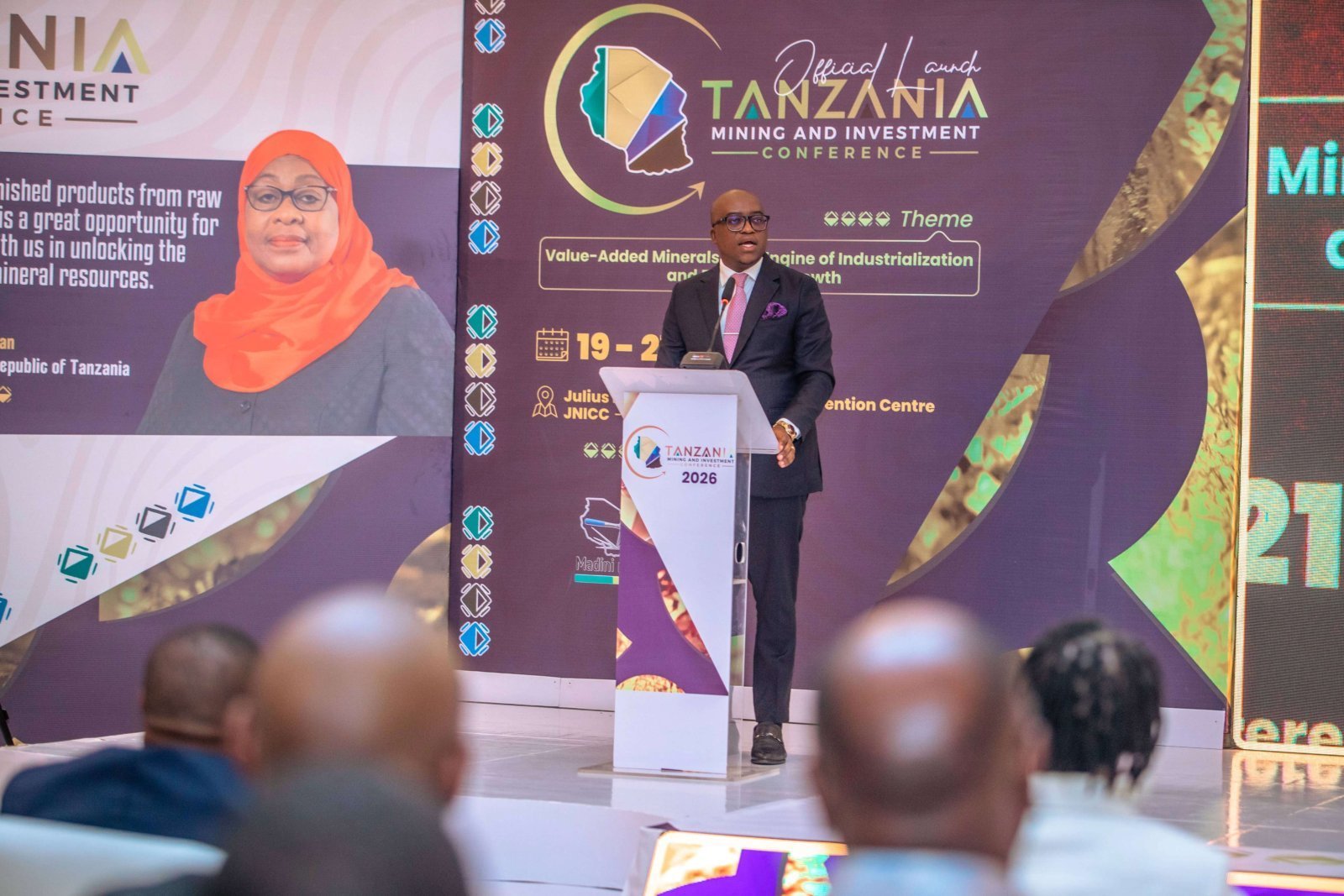
Tanzania will use the 2026 Tanzania Mining and Investment Conference to make a broader investment case for processing more of its mineral wealth at home, as the government seeks to move the sector beyond extraction and exports toward refining, manufacturing and industrial production. The three day conference will be held from November 19 to 21 at the Julius Nyerere International Convention Centre in Dar es Salaam under the theme, Value Added Minerals: The Engine of Industrial and Economic Growth, bringing together mining companies, mineral processors, investors, financial institutions, technology providers, regulators, researchers and policymakers. President Samia Suluhu Hassan is expected to officiate the opening ceremony, while Zanzibar President Hussein Mwinyi is scheduled to preside over the closing. The programme will cover gold, graphite, rare earths, nickel, mining finance, industrial infrastructure, mineral processing, technology, ESG and the integration of artisanal miners into formal value chains.
The conference comes at a point when mining has already become a much larger part of Tanzania’s economy, which is why the policy conversation is moving from how to increase extraction toward how much more value can be retained after minerals leave the ground. Ministry of Minerals data show that the sector’s contribution to GDP rose from 9.1 percent in 2023 to 10.1 percent in 2024 and continued to strengthen during 2025, while mineral export earnings reached USD5.40 billion in 2025, up from USD4.12 billion in 2024. Gold remained the dominant export, but Tanzania is increasingly trying to position graphite, nickel, rare earths and other critical minerals as the foundation of a broader industrial strategy rather than simply another source of raw commodity exports.
“TMIC 2026 reflects Tanzania’s commitment to transforming its mineral wealth into industrial growth, employment opportunities, technological advancement and sustainable economic prosperity,” Minerals Minister Anthony Mavunde said in the conference material. He added that the government wants investors and industry stakeholders to participate in shaping “the future of mining and mineral value addition in Tanzania and Africa.”
Tanzania Wants Mining to Feed Manufacturing
The central economic argument behind TMIC 2026 is that Tanzania’s mining sector has become large enough for policymakers to focus less narrowly on increasing production and more seriously on the industries that can be built around minerals once they have been extracted. The conference programme identifies value addition opportunities in graphite for battery anodes, nickel and cobalt products, gold bars and jewellery, fertilisers, steel, copper products, cement and ceramics, while also placing industrial parks, special economic zones, smelting, refining and mineral-based manufacturing within the same investment conversation. That represents a significant shift in emphasis because the government is no longer presenting mining simply as an export sector, but as one of the possible foundations of Tanzania’s industrialisation agenda under Vision 2050.
The economics behind that shift are straightforward. Extracting and exporting a mineral captures only a fraction of the total value created before that mineral becomes a finished industrial product. Additional value can be generated through beneficiation, refining, component manufacturing, engineering, logistics, equipment supply, research and industrial services, and those activities generally create more jobs, a larger domestic supplier base and more opportunities for technology transfer than extraction alone. Tanzania’s challenge is therefore not simply to produce more minerals but to determine which parts of the value chain can be developed competitively inside the country and which investments can realistically be supported by domestic power, transport, skills and financing conditions.
Critical Minerals Are Moving to the Centre of the Investment Story
Critical minerals will be one of the most important themes at the conference because Tanzania is trying to position itself within global supply chains that are being reshaped by electric vehicles, battery production, renewable energy and strategic competition over access to raw materials. The country has attracted growing interest because of deposits of graphite, nickel and rare earth elements, including praseodymium and neodymium, which are used in permanent magnets for electric vehicle motors and wind turbines. The programme includes discussions on Tanzania’s place in the global clean energy supply chain, the development of midstream and downstream infrastructure, and the possibility of processing minerals domestically before they enter international markets.
This matters because the global critical minerals debate is increasingly moving beyond questions of where minerals are found toward where they are processed. Major economies including China, the United States, European Union members, Japan and South Korea are competing to secure reliable supply chains, but African producers are trying to avoid a repeat of an older commodity model in which minerals are extracted locally while most downstream value is created elsewhere. Tanzania is explicitly using TMIC 2026 to push a different proposition, one in which critical minerals contribute not only export earnings but also domestic manufacturing, industrial capacity and technology development.
Gold Still Dominates the Sector
Despite the growing attention on critical minerals, gold remains the anchor of Tanzania’s mining economy and still accounts for the overwhelming majority of mineral export earnings. Official figures show gold exports rising sharply in 2025 and continuing to provide most of the country’s foreign exchange income from mining, while other minerals remain much smaller in commercial terms. This concentration explains why the conference programme separates discussions on gold from those on graphite, rare earths and battery metals, because Tanzania is simultaneously managing the sector that already generates substantial revenue and trying to develop the minerals that could define the next phase of investment.
The policy challenge is therefore one of diversification within mining itself. Tanzania has already established itself as a major gold producer, but the next stage requires converting potential in graphite, nickel, rare earths and other minerals into commercially operating projects, and then determining whether those projects can support processing and manufacturing industries locally. That progression is far more difficult than simply attracting exploration capital because it requires larger infrastructure, more sophisticated financing and a much deeper technical base.
Processing Requires Power, Transport and Industrial Infrastructure
The conference concept itself acknowledges that mineral value addition will depend on far more than mining licences or investor interest. Processing plants require reliable electricity, water, industrial land, transport connections, specialised technology and access to sufficiently large markets to justify investment. Smelting, refining and advanced processing can be energy intensive, while downstream manufacturing becomes commercially viable only when power costs, logistics and supply chain reliability are competitive enough to support production at scale.
This places Tanzania’s mining strategy directly inside the country’s wider infrastructure agenda. Reliable electricity will be critical if the country wants to process minerals rather than export concentrates, while railways, roads and ports will determine whether mineral-based industries can move inputs and finished products efficiently. Industrial parks and special economic zones could provide shared infrastructure for processors and manufacturers, but their success will depend on whether they are connected effectively to mines, power supply and export corridors. The value addition debate is therefore not a narrow mining policy issue; it is also a power, logistics, industrial policy and investment coordination issue.
Financing Will Decide How Far the Strategy Can Move
TMIC 2026 will also devote significant attention to financing because downstream mineral investment is considerably more capital intensive than many policymakers acknowledge. Mining projects can already require hundreds of millions or billions of dollars before production begins, and adding processing plants, smelters, industrial zones and manufacturing facilities introduces another layer of technology and market risk. The conference will examine public-private partnerships, development finance, de-risking mechanisms and the question of whether African countries can create financing structures specifically designed for mineral value addition projects.
The commercial case will be decisive. Foreign investors will compare electricity prices, taxation, logistics, labour productivity, regulatory predictability and access to financing before deciding whether to process minerals inside Tanzania or export them to established industrial centres elsewhere. This means value addition cannot rely only on policy directives or export restrictions. If Tanzania wants downstream investment to remain competitive, it will have to make the economics of processing locally strong enough to attract capital without creating projects that survive only because of regulatory protection.
Small-Scale Miners Are Being Brought Into the Value Chain Debate
The government is also trying to ensure that the value addition agenda is not limited to large international mining companies. TMIC 2026 will include discussions on how artisanal and small-scale miners can improve technology, increase recovery rates, access processing services and become more integrated into formal mineral value chains.
This reflects the increasingly important role that small-scale miners play in Tanzania’s mineral economy. The government has expanded mineral markets and buying centres across the country in an effort to formalise trade, improve traceability and increase revenue collection, but the next question is whether formalisation can extend beyond the sale of minerals toward participation in processing and higher value activities. For smaller operators, value addition may not mean building large industrial plants, but it could involve improved recovery technology, gemstone cutting, access to shared processing facilities, gold refining services and stronger commercial links with larger processors and manufacturers.
Tanzania Is Trying to Capture More From a Sector That Has Already Expanded
The push toward value addition is taking place after mining has already exceeded the government’s earlier target of contributing 10 percent of GDP by 2025. The sector reached that threshold before the target year and has since continued to expand, while government revenues from mining and mineral exports have also increased. That changes the policy question. The government no longer needs to prove that mining can become a major contributor to the economy; it now has to show that the sector can create stronger connections with manufacturing, technology, transport, finance and domestic suppliers.
TMIC 2026 is therefore being positioned less as a conventional mining conference and more as an investment platform for the next phase of sector development. The government wants investors to look beyond extraction licences and consider processing plants, manufacturing facilities, industrial services and infrastructure projects that can retain a larger share of mineral value inside Tanzania. Whether that ambition succeeds will depend less on the number of agreements announced during the conference than on what happens afterwards, particularly whether new mines are followed by processing facilities, whether mineral exports increasingly move up the value chain and whether Tanzanian companies and workers capture a larger share of the industrial activity created around the sector.
 Uchumi360
Business Intelligence
Uchumi360 covers business, investment, and economic policy across East, Central, and Southern Africa.
For the serious reader
You read to the end. That places you in a small group.
Uchumi360 is built for readers who demand precision over speed, structure over sentiment, and analysis that holds uncomfortable conclusions rather than softening them. If this work sharpens how you think about Africa's economy, help us keep building the infrastructure behind it.
Institutional Partners
Commission intelligence. Shape the conversation.
Uchumi360 works with development finance institutions, investment firms, sovereign bodies, and strategic organisations across the coverage region. Institutional partnership unlocks:
- Commissioned sector and country intelligence reports
- Branded research series under your institution's authority
- Exclusive data briefings for internal strategy teams
- Speaking and editorial presence at Uchumi360 events
- Co-published investment outlooks for your markets
Support Our Work
Independent analysis has a cost. Help us bear it.
Uchumi360 does not carry advertising. It does not take editorial direction from sponsors. Every article is produced without commercial compromise. Your contribution funds the reporting, research, and editorial infrastructure that keeps this analysis free from influence.
Secure checkout: One-time and monthly support are processed securely. Add payment credentials to enable checkout here.
Stay Connected
Keep up with every new insight.
Follow our latest analysis, policy coverage, and market intelligence as soon as it is published. If you need something specific, reach out directly and we will point you to the right research.
