
Tanga’s Oil Moment: How Tanzania, Uganda and Vitol Could Redraw East Africa’s Energy Map
Ready
The proposed Tanga Regional Energy Hub is about far more than Ugandan crude. If implemented, it could turn Tanzania into one of East Africa’s most important petroleum trading, refining and logistics centres—and give Uganda a powerful alternative to the Mombasa corridor.
The proposed Tanga Regional Energy Hub is about far more than Ugandan crude. If implemented, it could turn Tanzania into one of East Africa’s most important petroleum trading, refining and logistics centres, and give Uganda a powerful alternative to the Mombasa corridor.
For years, the strategic conversation around Uganda’s oil has largely been about one question: How will a landlocked country get its crude to the international market?
The answer has been the East African Crude Oil Pipeline, or EACOP, linking Uganda’s oilfields in the Lake Albert region to Tanzania’s Indian Ocean coast.
But a potentially much bigger story is now emerging.
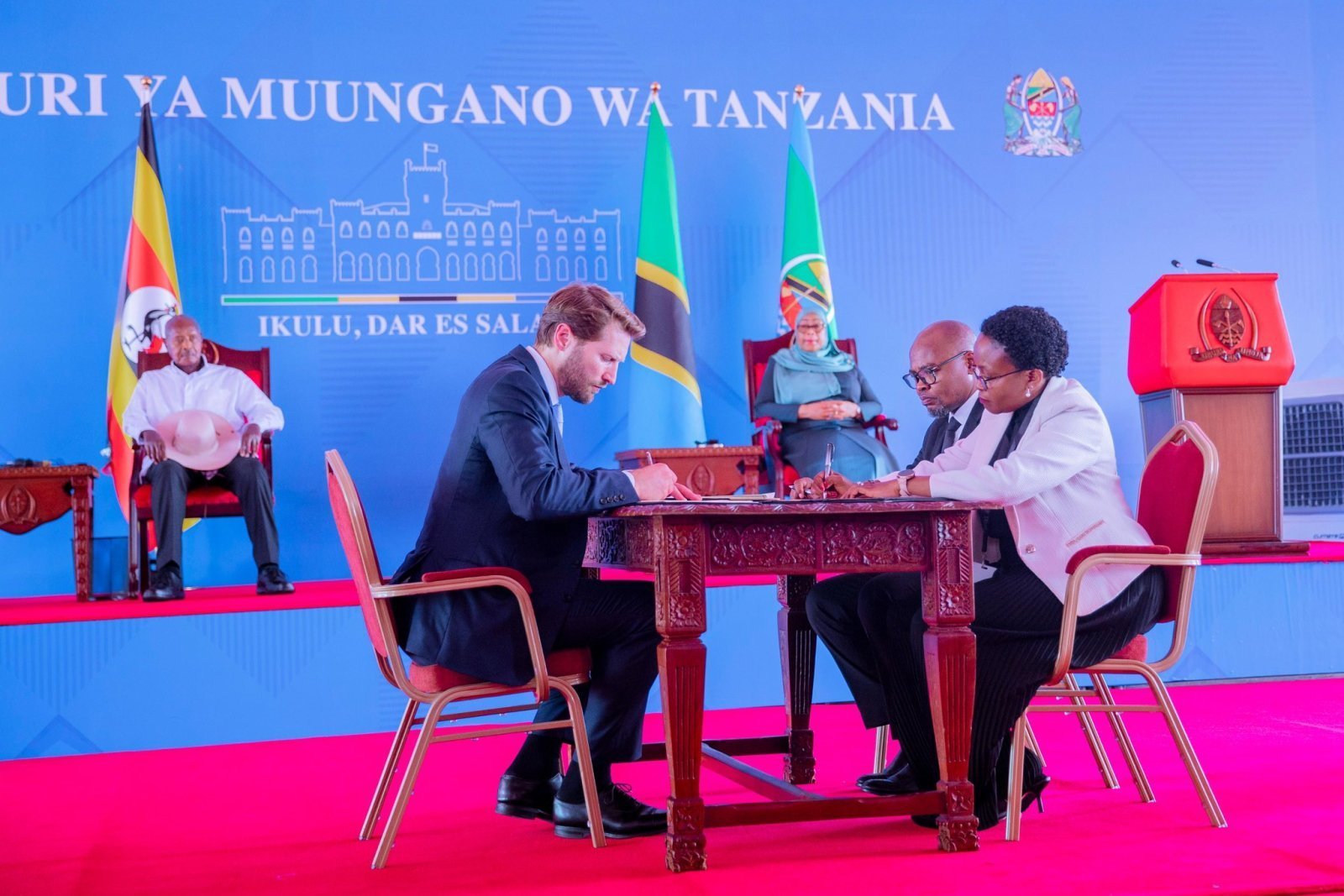
On August 6, 2026, Tanzanian President Samia Suluhu Hassan and Ugandan President Yoweri Kaguta Museveni witnessed the signing in Dar es Salaam of a Memorandum of Understanding between the Tanzania Petroleum Development Corporation (TPDC), Uganda National Oil Company (UNOC), and Vitol Bahrain E.C.
The agreement provides a framework for developing a Tanga Regional Energy Hub.
And if the vision eventually becomes reality, Tanzania will no longer simply be the country through which Uganda’s oil travels to the sea.
Tanzania could become the place where that oil—and the petroleum products associated with it, is stored, processed, traded and redistributed across the region.
That is a much bigger proposition.
From pipeline to petroleum ecosystem:
The significance of the agreement can only be understood in the context of EACOP.
The approximately 1,443-kilometre pipeline is designed to transport crude from Uganda’s Lake Albert oilfields to the Chongoleani area near Tanga.
The original model was relatively simple:
Ugandan oilfields → EACOP → Tanga → international markets.
The new vision potentially adds several layers:
Ugandan oilfields → EACOP → Tanga → storage → refining → trading → regional distribution and global exports.
In other words, the pipeline could become the backbone of a much larger regional petroleum ecosystem.
The proposed Tanga hub is expected to encompass petroleum storage, refining, logistics, trading and distribution.
That distinction matters because the greatest economic value in the petroleum industry is not necessarily created by moving crude from one point to another.
It is created by building businesses and industries around the commodity.
The US$20 billion question:
There has already been considerable excitement around reports that the wider Tanga energy-hub concept could attract more than US$20 billion in investment.
But this figure requires an important qualification.
The August 6 agreement is a Memorandum of Understanding, not a final investment decision.
There is no basis at this stage for saying that Vitol has committed US$20 billion, or that Tanzania and Uganda have already secured that amount.
The eventual investment could involve governments, private companies, international financial institutions, banks and other investors.
The US$20 billion figure should therefore be viewed as the potential long-term investment associated with the wider hub, rather than money already committed.
That distinction is important because major energy projects often move through several stages—concept, feasibility studies, commercial negotiations, financing, final investment decision and construction.
The real test will be what happens after the signing ceremony.
Why Vitol changes the equation:
The most intriguing party in the agreement may be Vitol.
Vitol is one of the world’s largest independent energy traders, with extensive experience in petroleum sourcing, trading, logistics and commodity financing.
Its participation therefore brings a different dimension to the project.
Vitol already has a significant relationship with Uganda.
Since 2023, Vitol Bahrain has been involved in supplying petroleum products to Uganda through UNOC. By early 2026, UNOC had reportedly imported approximately 1.75 billion litres of petroleum products with Vitol’s involvement.
There is also a separate financing relationship.
In late 2025, UNOC secured financing of up to US$2 billion from Vitol Bahrain over seven years to support strategic petroleum infrastructure and investments in Uganda.
That arrangement is separate from the August 2026 Tanga MoU, but together the two developments demonstrate how deeply Vitol is becoming embedded in Uganda’s emerging petroleum economy.
Vitol is therefore potentially more than an investor.
It can provide access to global petroleum markets, trading networks, logistics expertise, financing and risk-management capabilities.
That could become crucial if Tanga is to evolve from an oil terminal into a genuine regional energy marketplace.
Tanga versus Mombasa:
And this is where the story becomes geopolitical as well as economic.
For decades, Mombasa has been the dominant maritime gateway for Uganda’s petroleum supplies.
Uganda has historically relied heavily on Kenya’s northern corridor to bring imported petroleum products inland.
But Uganda has increasingly sought alternatives.
The Tanzania route provides one.
The significance of Tanga, therefore, is not simply that it gives Uganda another port.
It gives Kampala strategic choice.
A country that can access petroleum through both Mombasa and Tanga has greater leverage over costs, logistics, supply security and commercial negotiations.
For Tanzania, meanwhile, this represents an opportunity to capture a larger share of Uganda’s petroleum business.
The emerging competition is therefore not necessarily:
Tanzania versus Kenya.
It is more accurately:
Mombasa corridor versus Tanga corridor.
And competition between corridors can be good for the customer.
If both routes become efficient and commercially competitive, Uganda stands to benefit.
Uganda’s oil changes the equation:
Uganda is not merely a petroleum-importing country. It is becoming an oil producer.
The Tilenga and Kingfisher projects in the Lake Albert region are expected to produce a combined peak output of approximately 230,000 barrels per day.
Much of that crude will ultimately need to reach international markets through EACOP.
That means Tanga is acquiring strategic importance even before the wider energy hub is fully developed.
But Uganda will also need refined petroleum products.
This creates the possibility of a two-way energy corridor.
Crude could move:
Uganda → Tanga → international markets.
Refined petroleum products could move:
Tanga → Uganda → inland regional markets.
That is the foundation of a potentially powerful commercial relationship.
What about Uganda’s Hoima refinery?
The development of a Tanga energy hub also raises an obvious question: What happens to Uganda’s planned refinery at Hoima?
Uganda has been pursuing a refinery of approximately 60,000 barrels per day near its oil-producing region.
The emergence of a possible refining facility at Tanga does not necessarily make Hoima redundant.
The two could serve different strategic purposes.
Hoima is positioned close to Uganda’s oilfields and could serve Uganda and neighbouring inland markets.
Tanga, by contrast, has the advantage of being on the coast, close to EACOP’s terminus and connected directly to international shipping.
A Tanga facility could therefore be integrated into a larger system of storage, exports, imports, trading and regional distribution.
The final division of roles, however, remains to be determined.
Tanzania’s opportunity is bigger than oil:
For Tanzania, the greatest opportunity may not actually be the oil itself. It is the industrial ecosystem surrounding the oil.
A major regional petroleum hub can generate demand for:
• engineering and construction;
• logistics and trucking;
• port services;
• warehousing;
• banking and finance;
• insurance;
• maintenance;
• shipping;
• manufacturing;
• petrochemicals;
• storage and distribution.
This is how a petroleum project becomes an industrialisation project.
Tanga could eventually develop into a northern Tanzanian energy and logistics cluster, complementing Dar es Salaam’s role as the country’s principal commercial port.
The strategic objective should therefore be bigger than building storage tanks and pipelines.
Tanzania should be thinking about how to create local value chains around the energy hub.
That means Tanzanian companies participating in construction, engineering, logistics, financial services, maintenance, manufacturing and technology—not simply collecting transit revenues.
The regional implications:
The Tanga project could also strengthen Tanzania’s position as a gateway to landlocked East and Central Africa.
Uganda is only the beginning.
A sufficiently large and competitive petroleum hub could serve markets in:
• Rwanda;
• Burundi;
• eastern Democratic Republic of Congo;
• Zambia;
• and potentially other inland markets.
This would reinforce Tanzania’s broader strategy of positioning its ports and transport corridors as gateways to the wider region.
It also fits neatly with investments in roads, railways, ports and the Standard Gauge Railway.
The combination of EACOP + Tanga Port + SGR + road corridors + petroleum infrastructure could give Tanzania an increasingly powerful logistics platform.
But Tanzania must avoid the transit-economy trap
There is, however, a warning.
Tanzania should not measure the success of this project simply by how much oil passes through Tanga.
The real question should be:
> How much economic value remains in Tanzania because the oil passes through Tanga?
If Tanzania merely provides land, pipelines and port facilities while foreign companies capture most of the trading, engineering, financing and downstream value, the economic transformation will be limited.
But if Tanzania uses the project to develop domestic expertise, manufacturing, logistics, financial services and downstream industries, the benefits could be much larger.
This is the difference between being an oil corridor and being an energy hub.
The unanswered questions:
The ambition is enormous, but so are the questions.
The public still needs clarity on the eventual:
• investment value;
• ownership structure;
• Vitol’s equity or financing role;
• refinery capacity;
• storage capacity;
• project financing;
• construction timetable;
• annual throughput;
• refined-products pipeline infrastructure;
• relationship with Uganda’s Hoima refinery;
• fiscal and tax arrangements;
• environmental requirements;
• and final investment decisions.
Until these details are settled, the Tanga Regional Energy Hub should be viewed as an ambitious strategic framework rather than a completed US$20 billion project.
The real significance:
The August 6 agreement is important because it represents a change in the way Tanzania and Uganda are thinking about energy.
EACOP was fundamentally about transporting crude.
The Tanga Energy Hub is about creating an energy market around that crude.
That is a fundamentally different proposition.
For Uganda, it provides another strategic route to the sea and potentially strengthens its negotiating position with Kenya and other suppliers.
For Tanzania, it creates an opportunity to turn Tanga into a regional petroleum and industrial centre.
For Vitol, it offers a platform from which its existing relationship with Uganda could expand into a broader East African energy business.
And for Kenya, it introduces a serious new competitor to the historical dominance of the Mombasa corridor.
The strategic prize:
The biggest prize may ultimately be neither the oil nor the pipeline.
It is control over the infrastructure and commercial ecosystem through which East Africa’s future energy trade flows.
If Tanzania succeeds in turning Tanga into a genuine regional energy hub, the country could move from being Uganda’s transit partner to becoming one of Uganda’s most important long-term energy partners.
And if the proposed investments materialise at scale, Tanga could emerge as one of the most strategically important petroleum centres between the Indian Ocean and the Great Lakes.
The question, therefore, is no longer simply whether Ugandan oil will reach Tanzania.
The bigger question is whether Tanzania can turn Tanga into the place where East Africa’s petroleum economy meets the global market.*]
That is the real story behind the Tanzania–Uganda–Vitol agreement.
 Uchumi360
Business Intelligence
Uchumi360
Business Intelligence
Uchumi360 covers business, investment, and economic policy across East, Central, and Southern Africa.
For the serious reader
You read to the end. That places you in a small group.
Uchumi360 is built for readers who demand precision over speed, structure over sentiment, and analysis that holds uncomfortable conclusions rather than softening them. If this work sharpens how you think about Africa's economy, help us keep building the infrastructure behind it.
Institutional Partners
Commission intelligence. Shape the conversation.
Uchumi360 works with development finance institutions, investment firms, sovereign bodies, and strategic organisations across the coverage region. Institutional partnership unlocks:
- Commissioned sector and country intelligence reports
- Branded research series under your institution's authority
- Exclusive data briefings for internal strategy teams
- Speaking and editorial presence at Uchumi360 events
- Co-published investment outlooks for your markets
Support Our Work
Independent analysis has a cost. Help us bear it.
Uchumi360 does not carry advertising. It does not take editorial direction from sponsors. Every article is produced without commercial compromise. Your contribution funds the reporting, research, and editorial infrastructure that keeps this analysis free from influence.
Secure checkout: One-time and monthly support are processed securely. Add payment credentials to enable checkout here.
Stay Connected
Keep up with every new insight.
Follow our latest analysis, policy coverage, and market intelligence as soon as it is published. If you need something specific, reach out directly and we will point you to the right research.
