
Opinion: Africa Is Taxing Its Own Housing Crisis at 30%. Steel, Tiles, Windows, and Electrical Fittings Are Predominantly Imported. Two Things Would Fix It.
Ready
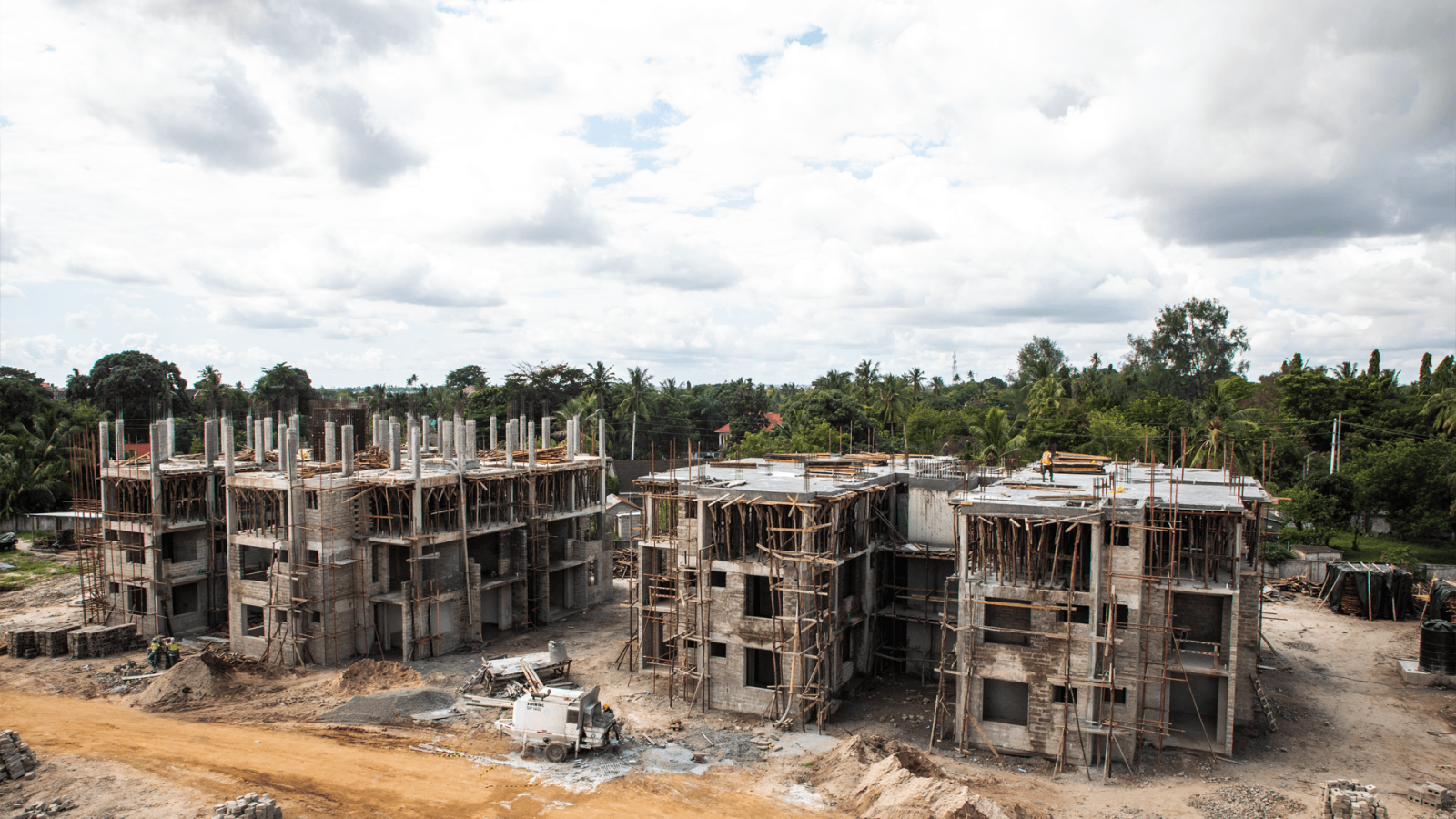
When you build in Africa, you pay a premium that has nothing to do with the quality of what you are building. The finishing and specialist materials that determine whether a structure looks and functions well, steel reinforcement, roofing sheets, tiles, aluminium window profiles, ceramics, electrical fittings, and plumbing, are predominantly imported across most of sub-Saharan Africa. China alone supplied over 60 percent of Africa's total steel imports in 2023, with Chinese construction material exports to Africa growing 25 percent that year. Kenya imported KSh 97 billion worth of iron and non-alloy steel in 2023, with China accounting for KSh 42 billion of that trade. Tiles, ceramics, and sanitary ware imports remain high across East and West Africa due to limited local production capacity. Every one of these materials enters most African countries through a customs gate charging 30 percent import duty before logistics costs, port handling, inland freight, and the contingency buffer that experienced contractors build into every African project are added. The result is a continent where housing costs more to build than the income of the people who need it can support. That is not a market outcome. It is a policy outcome. And policy outcomes can be changed.
Africa's housing affordability problem is substantially a construction cost problem whose root cause is import dependency and tax architecture. China supplied over 60 percent of Africa's steel imports in 2023. Tiles, ceramics, windows, and sanitary ware are predominantly imported in Kenya, Tanzania, Nigeria, and most of sub-Saharan Africa due to limited domestic production. Most African countries charge 30 percent import duty on these materials. Logistics adds 15 to 30 percent on top depending on the market's coastal or landlocked position. The African Development Bank estimates Africa's housing deficit at 51 million units growing by 2 million annually. Two policy responses can change the cost structure. Domestic manufacturing of construction materials, whose raw material base, limestone for cement, iron ore for steel, clay for tiles, silica sand for glass, exists across the continent, would remove the import cost layer entirely for domestically produced goods. Restructuring import taxes to zero-rate or reduce duties on materials Africa cannot yet produce domestically would provide immediate cost relief without waiting for manufacturing capacity to develop. Both are needed simultaneously. Neither is being pursued at the scale the housing deficit demands.
Africa is taxing its own housing crisis
There is a conversation that happens on construction sites across Africa that rarely makes it into housing policy discussions. It happens when the aluminium window frames ordered from China three months ago finally clear customs, when the tiles manufactured in India and transited through Dubai arrive with a landed cost forty percent above the factory gate price, when the project manager revises the budget upward for the third time because the contingency allowance was insufficient for a continent where hidden costs are not exceptional but structural.
The conversation goes something like this: building in Africa is supposed to be cheap. Why is everything so expensive?
The answer is not complicated, but its implications for housing policy are more demanding than most governments have been willing to confront.
The materials that determine whether a structure looks and functions well, steel reinforcement bars, roofing sheets, ceramic tiles, aluminium window and door profiles, electrical fittings, plumbing fixtures, and sanitary ware, are predominantly imported across most of sub-Saharan Africa. Every one of those materials enters most African countries through a customs gate that charges 30 percent import duty before logistics, port handling, and inland freight are added. The result is a continent where housing costs more to build than the income of the people who need it can support.
What the import data actually shows
The construction materials import picture varies significantly by category and country, and that variation matters for designing the right policy response.
Cement is the most important exception to the import dependency story. Kenya, Senegal, and Ghana have installed cement production capacity between 6.7 and 8.9 million tonnes per annum. Dangote recently opened factories in Cameroon, Tanzania, and Zambia, each now producing over 3 million tonnes per annum. Aggregates, sand, and stone are similarly local across most markets because their weight-to-value ratio makes importing them economically irrational. Timber and basic blockwork are predominantly domestically sourced.
These locally produced materials matter because they typically represent 35 to 45 percent of a standard residential construction cost. The housing cost crisis is not about cement and aggregate. It is about everything else.
China's construction material exports to Africa grew by 25 percent in 2023, accounting for over 60 percent of Africa's total steel imports. Kenya imported over KSh 97 billion worth of iron and non-alloy steel in 2023, with China accounting for KSh 42 billion of that trade. Imports of ceramics, tiles, and sanitary ware also remain high due to limited local production capacity, a trend industry players say continues to inflate housing prices.
In Nigeria, whose construction market provides some of the most detailed practitioner-level data available, imported materials including windows, doors, ceramics, tiles, plumbing appliances, and sanitary ware represent approximately 23 percent of materials in the building market, according to industry practitioners quoted in the Guardian Nigeria. For higher-specification residential construction using premium finishes, that import share rises significantly, with some practitioners estimating import dependency at 60 to 80 percent of material cost by value for mid-to-high specification builds where finishing quality is the primary cost driver.
The practical implication is that while Africa produces its own cement and aggregates, the materials whose quality most visibly determines a building's liveability, the steel that makes it structurally sound, the tiles and fittings that make it functional, and the windows that make it secure and weatherproof, are arriving predominantly from China, India, Turkey, and the UAE, passing through African customs at 30 percent duty, and adding logistics costs at every stage of the journey.
Industry experts at the Big 5 Construct Kenya 2025 exhibition were direct: "We cannot keep relying on overseas materials and external supply chains if we are to build sustainably and at scale."
The 30 percent tax on finishing a home
Import duty is a legitimate fiscal instrument. The argument for 30 percent import duty on consumer goods and products with domestic alternatives is standard public finance reasoning.
The argument for 30 percent import duty on steel reinforcement, roofing sheets, ceramic tiles, aluminium window profiles, and electrical fittings in countries where those materials cannot be produced domestically at sufficient volume or quality is harder to defend. These are not luxury imports. They are the inputs without which decent housing cannot be built. Taxing them at 30 percent is equivalent to taxing the act of finishing a home at 30 percent, before labour, land, or financing costs are considered.
Consider the arithmetic for a modest three-bedroom house in Dar es Salaam or Nairobi whose finishing materials, steel, tiles, windows, and electrical fittings, carry a pre-duty import value of USD 15,000. Apply 30 percent import duty and the cost rises to USD 19,500. Add logistics at 15 percent of landed value and the figure reaches USD 22,425. Add the contingency buffer that any experienced East African contractor factors in for supply chain uncertainty, typically 10 to 15 percent for delayed shipments, damaged goods, and quality inconsistencies, and the finishing material cost approaches USD 26,000 from a USD 15,000 starting point.
That arithmetic compounds across the full construction cost stack. It is a primary explanation for why housing in Africa carries what the Frontiers in Built Environment research describes as the highest price-to-income ratio of any global region, higher than Asia, higher than the Americas, higher than Europe, and higher than Oceania. Africa has the world's most unaffordable housing relative to incomes. The import tax architecture on finishing materials is a material contributor to that outcome.
The logistics problem that tax reform cannot solve alone
Import duty is the visible cost layer. Logistics is the structural one, and it affects domestically produced and imported materials alike, though its impact on imports is substantially larger.
The cost of moving finishing materials from a manufacturer in China, India, or Turkey to a construction site in Nairobi, Dar es Salaam, Kampala, or Kigali includes international shipping, port handling, customs clearance, inland freight, and the time cost of a supply chain whose reliability is less predictable than manufacturer delivery schedules suggest. For landlocked cities like Kigali, Kampala, and Addis Ababa, logistics costs on imported construction materials can equal or exceed the import duty burden.
Turner and Townsend's Global Construction Market Intelligence 2025 identifies labour and logistics as the primary challenges for African construction stakeholders, noting that making sure skills and materials are directed to where they are needed is the central challenge rather than overall cost levels. That framing understates the import cost problem for residential construction specifically, but it correctly identifies logistics as a structural constraint rather than an incidental one.
Tanzania's SGR freight service, the Port of Dar es Salaam's DP World concession, and the One Stop Border Post programme across EAC crossings are all infrastructure investments whose logistics cost reduction effect directly benefits construction material importers alongside every other importer. Faster, cheaper, more reliable logistics reduces both the per-unit cost of imported materials and the contingency buffer that contractors build into project budgets for supply chain uncertainty, which is itself a material reduction in housing construction costs.
What domestic manufacturing would actually change
The most durable solution to construction material import costs is domestic manufacturing whose existence removes the import cost layer entirely for the categories it covers.
Africa has the raw material base for most of what it imports. Limestone and gypsum, critical for cement production, are widely available in Kenya, Tanzania, South Africa, Nigeria, Ethiopia, and Zambia. Silica sand and soda ash, crucial for glass manufacturing, are found in Botswana, Egypt, Algeria, Namibia, and Tunisia. Clay and kaolin, key ingredients for ceramics and tiles, are abundant in Ghana, Cameroon, Uganda, Morocco, Sudan, and Madagascar. Iron ore, essential for steel production, sits in large reserves in Guinea, Mauritania, South Africa, and Sierra Leone.
The continent is not importing construction materials because it lacks the natural resources to produce them. It is importing them because the manufacturing investment to convert those resources into finished products has not been made at sufficient scale.
Given the huge infrastructure and housing deficits, the abundance of raw materials, and the large construction-related import bills faced by African countries, it is clear that the construction and building materials sector can be a gateway for Africa's industrialisation. The current model based on importation of construction and building materials is not sustainable.
Tanzania's A1 Iron and Steel plant at Nala, Dodoma, announced in mid-2026 at TZS 600 billion, is the clearest current expression of what domestic manufacturing can do. When operational, every roofing sheet, wire product, and nail from that plant avoids the import duty and logistics cost layer that currently adds 40 to 50 percent to the cost of the imported equivalent. The precedent matters as much as the individual plant: if iron ore in Liganga can become steel in Dodoma, clay in Uganda can become tiles in Kampala, silica in Botswana can become glass in Gaborone, and bauxite in Guinea can become aluminium profiles somewhere on the continent rather than in China.
The evidence from countries that have developed domestic cement industries is instructive. Cement prices in Ethiopia were reduced by more than half as local production increased. In Zambia, cement prices dropped by 40 percent between 2014 and 2015 following the opening of the Dangote Cement factory. In Cameroon, the new Dangote plant commissioned in August 2015 led to a swift decline in cement prices of 15 percent in less than a month. These are not projections. They are measured outcomes from the same policy logic applied to a single material category. Extending that logic to steel, tiles, glass, and aluminium profiles would replicate those price effects across the materials whose import cost most inflates housing construction budgets.
What tax reform can do immediately
Domestic manufacturing cannot be built overnight. In the interim, tens of thousands of housing units will be built using imported materials whose cost structure the current tax architecture makes unnecessarily expensive.
The interim solution is construction material tax reform whose design distinguishes between materials with credible domestic alternatives and materials without them.
For materials with established domestic production, specifically cement in Tanzania, Kenya, Nigeria, and Ethiopia, import duty serves a legitimate protective function. Local cement production has demonstrably reduced prices wherever it has been developed, and protecting that industry from subsidised foreign competition is a rational policy position.
For materials without credible domestic production at commercial scale, steel reinforcement in most East African markets, aluminium window profiles, float glass, specialist electrical components, and ceramic tiles in countries where domestic clay quality or manufacturing investment is insufficient, the case for 30 percent import duty is the fiscal revenue argument alone. That argument should be weighed honestly against the housing affordability cost it imposes.
A tiered reform whose structure reduces import duty to zero or five percent on construction materials with no domestic alternative, maintains duty at current levels for materials with established domestic production, and creates a preferential rate for materials where domestic production is nascent and developing, would immediately reduce the construction cost burden without sacrificing the protective function of import duty where domestic industry justifies it.
Industry players at Big 5 Construct Kenya 2025 called for the government and private sector to strengthen local manufacturing capacity to keep the sector competitive and sustainable. That call addresses the supply side. Tax reform addresses the demand side. Both need to happen together.
The Zambia study that makes the case for local materials
Research published by Green Building Africa found that using local content in construction would potentially support a diversified economy which is more resilient. When there is a demand for a diverse range of locally made building components and materials, local economies become more resilient than those that rely mainly on imports and only produce one or two products locally. A town with window, door, furniture, truss, tile, and insulation manufacturing plants would be more resilient as only one sector would be affected by a downturn, compared to a town that only has a concrete block manufacturing plant.
The Zambia finding extends the argument beyond housing affordability into economic resilience. Import-dependent construction supply chains are vulnerable to the global price shocks, currency depreciation episodes, and shipping disruptions that sub-Saharan African economies experience more severely than their supply chain partners. Every percentage point of construction material produced domestically rather than imported reduces exposure to those shocks.
The COVID-19 pandemic and the Red Sea shipping disruptions of 2024 both demonstrated that global supply chains for construction materials are not as reliable as their normal-period economics suggest. African construction projects that depended on imported materials faced delays, cost overruns, and in some cases abandonment during both events. Projects using domestically produced materials did not.
What both approaches together would produce
The binary between domestic manufacturing and tax reform is false. Africa needs both, applied simultaneously rather than sequentially.
A practical combined framework has three components. Immediate tax reform that zero-rates or significantly reduces import duty on construction materials with no credible domestic alternative, effective from the next budget cycle. Simultaneous domestic manufacturing investment, funded through industrial development bank financing and facilitated by special economic zone infrastructure, targeting the construction material categories where domestic production is most commercially viable: steel, tiles, basic electrical components, glass, and eventually aluminium profiles. And a logistics infrastructure programme that reduces the port-to-site cost of both imported and domestically manufactured materials through port efficiency improvement, inland rail freight development, and border crossing time reduction.
The evidence from cement suggests what these three components could produce together. Countries that developed domestic cement manufacturing saw prices fall 15 to 50 percent within months of new capacity coming online. Applying the same logic to the finishing materials whose import cost most inflates East African housing budgets would not produce 80 percent cost reductions. But a 20 to 35 percent reduction in the finishing material cost for a standard residential unit, delivered through combined tax reform and domestic manufacturing development, is the difference between housing the middle class can afford to build and housing whose cost excludes all but the wealthy and the subsidised.
Africa's housing deficit is not primarily a financing problem, though financing matters. It is not primarily a land availability problem, though land tenure reform is important. It is substantially a construction cost problem whose root causes are the import tax architecture and the domestic manufacturing absence that make building in Africa more expensive than the incomes of the people who need housing can support.
The tiles came from India via Dubai. The windows came from China. The steel came via Mombasa from a mill in Guangdong. The duty was 30 percent. The logistics added another 20 percent. The contingency absorbed another 12 percent. And then everyone wondered why the house was so expensive.
It was not a mystery. It was arithmetic. And arithmetic can be changed.
Stay ahead of East Africa's economy on www.uchumi360.com and on the Uchumi360 Mobile App, available on the App Store and Google Play.
FAQ
Are all African construction materials imported? No. Cement is produced domestically at commercial scale across most of East and West Africa, with Kenya, Tanzania, Nigeria, Ethiopia, and Ghana all having significant domestic capacity. Aggregates, sand, and stone are similarly local. The import dependency problem is concentrated in finishing and specialist materials: steel reinforcement and roofing sheets, ceramic tiles, aluminium window profiles, glass, electrical fittings, and sanitary ware, which are predominantly imported from China, India, Turkey, and the UAE in most sub-Saharan African markets.
What does 30 percent import duty actually add to housing costs? Applied to the finishing materials whose import cost represents approximately 40 to 60 percent of a standard residential construction budget, 30 percent import duty adds approximately 12 to 18 percent to the total construction cost before logistics, port handling, and contingency are factored in. The combined effect of duty plus logistics can add 35 to 50 percent to the factory gate price of imported finishing materials before they reach the construction site.
Has domestic manufacturing actually reduced construction costs in Africa? Yes, with documented evidence from cement specifically. Cement prices in Ethiopia fell by more than 50 percent as local production increased. In Zambia, prices dropped 40 percent between 2014 and 2015 following the opening of the Dangote Cement factory. In Cameroon, a new Dangote plant reduced cement prices by 15 percent within a month of commissioning. The same logic applied to steel, tiles, and glass would replicate these price effects in those categories.
Why doesn't Africa manufacture more of its own construction materials? Africa has the raw material base for most of what it imports. Limestone for cement, iron ore for steel, clay for tiles, and silica sand for glass are all available across the continent. The gap is manufacturing investment rather than natural resources. The sequence is challenging: manufacturing requires demand certainty, demand certainty requires policy signals, and policy signals have not consistently treated construction material manufacturing as a strategic industrial development priority alongside mining, energy, and transport infrastructure.
What would make the biggest immediate difference to housing affordability? Restructuring import taxes to zero-rate or significantly reduce duties on construction materials that Africa cannot yet produce domestically at sufficient scale, specifically steel reinforcement in most East African markets, aluminium profiles, float glass, and specialist electrical components. This is implementable in a single budget cycle without requiring new institutions or infrastructure. Combined with domestic manufacturing investment in the categories where raw material availability and market size make production commercially viable, the combined effect on construction costs would be material within five years.
 Uchumi360
Business Intelligence
Uchumi360
Business Intelligence
Uchumi360 covers business, investment, and economic policy across East, Central, and Southern Africa.
For the serious reader
You read to the end. That places you in a small group.
Uchumi360 is built for readers who demand precision over speed, structure over sentiment, and analysis that holds uncomfortable conclusions rather than softening them. If this work sharpens how you think about Africa's economy, help us keep building the infrastructure behind it.
Institutional Partners
Commission intelligence. Shape the conversation.
Uchumi360 works with development finance institutions, investment firms, sovereign bodies, and strategic organisations across the coverage region. Institutional partnership unlocks:
- Commissioned sector and country intelligence reports
- Branded research series under your institution's authority
- Exclusive data briefings for internal strategy teams
- Speaking and editorial presence at Uchumi360 events
- Co-published investment outlooks for your markets
Support Our Work
Independent analysis has a cost. Help us bear it.
Uchumi360 does not carry advertising. It does not take editorial direction from sponsors. Every article is produced without commercial compromise. Your contribution funds the reporting, research, and editorial infrastructure that keeps this analysis free from influence.
Secure checkout: One-time and monthly support are processed securely. Add payment credentials to enable checkout here.
Stay Connected
Keep up with every new insight.
Follow our latest analysis, policy coverage, and market intelligence as soon as it is published. If you need something specific, reach out directly and we will point you to the right research.
