
Tanzania Has a Housing Deficit of 3.8 Million Units, 51 Percent of Dar es Salaam Households Rent, and Almost Nobody Is Building Formal Rental Housing for the People Who Actually Live Here. That Is the Market Failure Worth Talking About.
Ready
Fifty-one percent of Dar es Salaam households rent, according to Tanzania's own urban housing data. The city has a housing deficit estimated at 3.8 million units, with annual demand for 200,000 new homes against approximately 200,000 units completed nationally each year, a supply-demand balance that appears neutral on paper but masks a severe mismatch in what is being built and for whom. Private developers are building for the expatriate market and the upper-middle-income segment. The premium rental market in Masaki and Oyster Bay offers apartments at USD 1,500 to 3,000 per month. The government builds for civil servants. What nobody is building at scale is formal rental housing for the teacher, the nurse, the junior bank officer, the market trader generating TZS 1.5 million monthly who constitutes the majority of Dar es Salaam's working population and who currently rents informally in conditions whose quality, security of tenure, and investment value are all inadequate. That is Tanzania's missing rental market. It is large, it is growing faster than the city, and it is the most consequential market failure in urban housing that nobody is talking about.
Tanzania has a housing deficit of 3.8 million units and annual housing demand of 200,000 units. Fifty-one percent of Dar es Salaam households rent. Mortgage rates of 15 to 19 percent exclude 93 percent of urban households from mortgaged housing, because a standard mortgage requires spending over 40 percent of monthly income, above the international affordability benchmark of 30 percent. Private developers focus on the premium segment. The government builds for civil servants. The middle market, households earning TZS 500,000 to 2 million monthly, has almost no formal rental supply built for it. Rental yields in Dar es Salaam's prime areas run at 6 to 9 percent annually, among the strongest in East Africa. The financial instrument whose absence explains the market failure is a rental housing finance product, a medium-tenure loan at rates viable for rental yield coverage, directed at the middle-income segment where demand is structural and growing. Tanzania requires 26.8 million housing units by 2050 to serve a projected population of 118.1 million. The FYDP IV targets adding 3.75 million housing units and raising the mortgage-to-GDP ratio from 0.5 to 2 percent. Neither target addresses the missing rental product unless the financial instrument architecture changes simultaneously.
The tenant economy
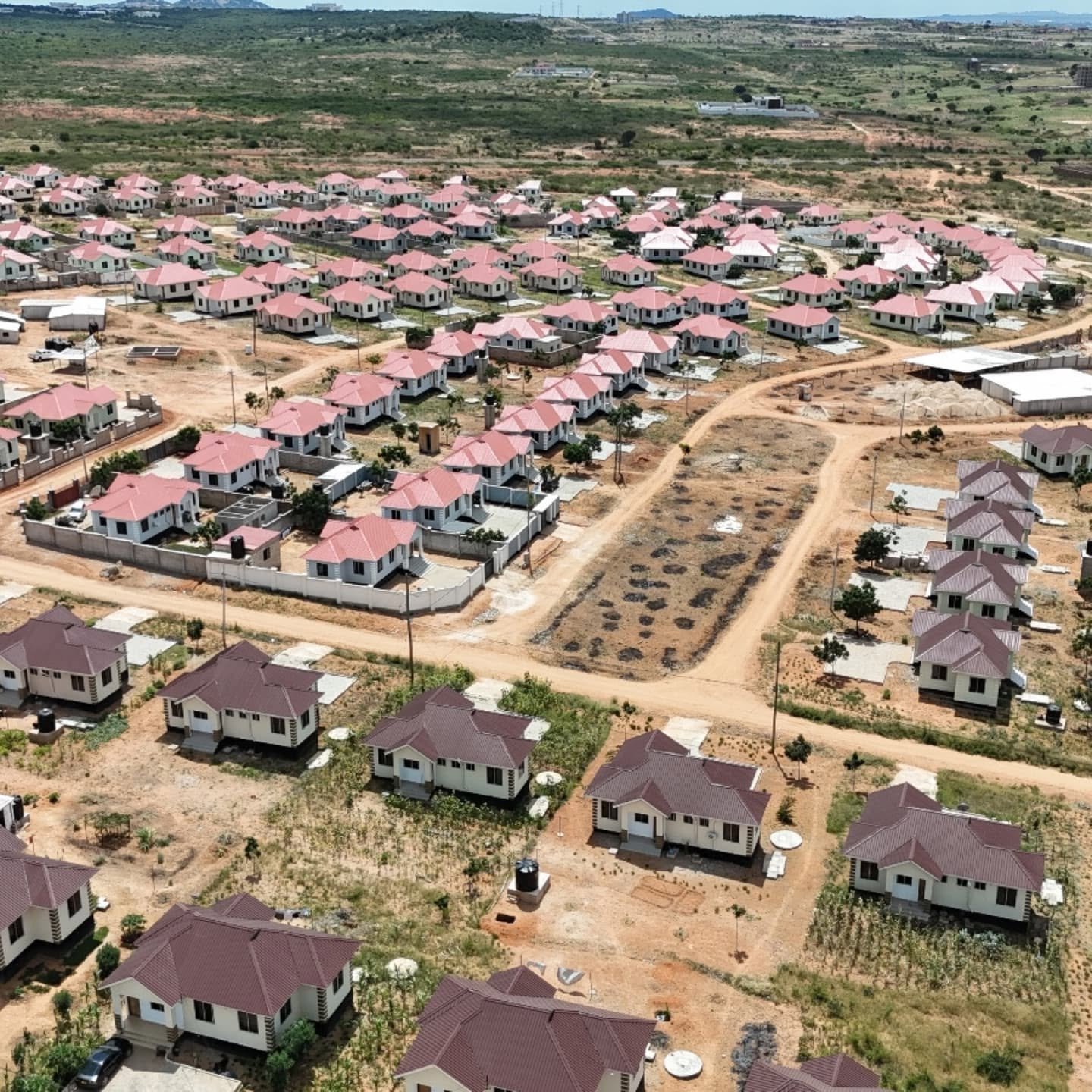
Walk through Kinondoni on a weekday evening. Most of the people coming home are tenants. Some live in concrete block structures rented from individual landlords. Some live in larger informal settlements where rental agreements are verbal and tenure is insecure. A small number live in purpose-built residential complexes whose quality is calibrated to the expatriate market rather than the population of the city.
Fifty-one percent of Dar es Salaam households rent, according to Tanzania's urban housing data. The figure is not unusual for a city at this stage of urbanisation. What is unusual is the absence of formal institutional landlords building for the majority of those renters.
In Nairobi, institutional landlords manage apartment blocks in Westlands, Kilimani, and Pangani specifically calibrated to the middle-income professional market. In Kigali, the Rwanda Housing Authority and private developers have produced mid-market rental stock whose supply and pricing reflect the demand from Rwanda's growing formal sector workforce. In Lagos, apartment blocks in Yaba and Surulere serve the working middle class at a quality and price point that sits between the informal and the premium.
In Dar es Salaam, the market has a premium segment that works and an informal segment that functions. Between them is almost nothing. The teacher earning TZS 800,000 monthly, the nurse earning TZS 950,000, the junior bank officer earning TZS 1.2 million, the small business owner generating TZS 1.5 million, these are not poor households. They are not expatriates. They are the formal economy's productive majority, and almost no formal rental supply is being built for them.
That gap is Tanzania's most consequential housing market failure. It is also its most commercially underexploited real estate opportunity.
The numbers that define the gap
Tanzania's housing situation is severe by almost every measure. The housing deficit stands at 3.8 million units as of the 2025 FYDP IV baseline, according to TICGL research. Three previous FYDPs have cited this deficit without resolving it. The National Housing Corporation estimates annual additional demand at 200,000 units, which when combined with the existing backlog produces a housing finance challenge whose scale is comparable to building a new Dar es Salaam from scratch every five years for the next twenty years.
Household formation is growing at 2.69 percent annually, reaching 14.1 million households in 2025, translating to roughly 350,000 new households formed each year, according to The Africanvestor's 2026 property analysis. Tanzania will require 26.8 million housing units by 2050 to serve a projected population of 118.1 million, according to TanzaniaInvest, citing government projections. The urbanisation wave is still in its early stages, with 59 percent of Tanzanians projected to live in cities by 2050 against approximately 35 percent today.
Against this demand, the mortgage market in Tanzania registered TZS 720.81 billion in outstanding residential mortgages as of September 2025, growing at 10.92 percent year on year across 29 reporting banks and financial institutions. Tanzania's mortgage-to-GDP ratio is 0.5 percent, according to TICGL. The FYDP IV target is 2 percent. The lower-middle-income country average is 8 to 12 percent. Kenya's mortgage-to-GDP ratio is approximately 3 to 4 percent. South Africa's is around 30 percent. Tanzania's 0.5 percent is near the bottom of the global range.
The mathematics of mortgage exclusion explain why. Mortgage rates in Tanzania average 15 to 19 percent, according to TanzaniaInvest's banking sector data. Research published by the Open University of Tanzania confirmed that ordinary Tanzanian households need to spend more than 40 percent of monthly income to finance a conventional mortgage, exceeding the international affordability benchmark of 30 percent. Most current mortgages are for products costing above USD 40,000, which means that unless housing finance is made much more widely available, 93 percent of all urban households are excluded from mortgaged housing, according to TanzaniaInvest's housing analysis.
The cost of building a basic mortgageable house in Tanzania is USD 60,689, higher than Uganda at USD 58,596 and Nigeria at USD 52,103, but comparable to Kenya at USD 65,300. The land cost on top of that construction cost makes the ownership model commercially inaccessible for the majority of formal sector workers at current wage levels and mortgage rates.
What is being built and who it is for
Tanzania's housing construction pipeline is real but badly targeted relative to the demand profile.
At the premium end, private developers are producing apartments in Masaki, Oyster Bay, and Msasani Peninsula for the expatriate and upper-income market. Average rent for a one-bedroom apartment in Dar es Salaam's city centre runs at USD 500 to 800 per month. In prime locations, three-bedroom apartments rent at USD 1,500 to 3,000. Gross rental yields in prime areas run at 6 to 9 percent annually. These are strong yields by East African standards, explained by the concentration of expatriate demand priced in USD, embassy and NGO housing allowances benchmarked to New York or London, and the supply shortage in those specific locations.
The premium market is not the problem. It functions. It generates revenue. It attracts private investment. It produces the Masaki Paradox whose property price analysis Uchumi360 published earlier in this series.
At the lower end, the National Housing Corporation, Watumishi Housing Company, and the Tanzania Building Agency are delivering units for civil servants and public servants. The TBA is constructing 10,000 affordable housing units for public servants in various administrative regions. Pension funds complete around 1,000 units per year. Cooperatives deliver approximately 1,000 units per annum. These collectively address a specific and important segment, but their output is far below the scale of the deficit they are targeting, and their income calibration serves government employment rather than the broader formal sector.
Between these two poles, the market for formal rental housing serving the urban middle-income segment, households earning TZS 500,000 to 2 million monthly, has almost no institutional supply. This is not an observation about housing quality in that income range, which varies from adequate to poor depending on neighbourhood. It is an observation about the absence of purposefully designed, institutionally owned and managed rental housing built to the standards, locations, and price points that this income segment would pay for if the product existed.
Why nobody builds for the middle
The market failure in middle-income rental housing has a specific financial architecture explanation rather than a vague market dynamics one.
Building formal rental housing for the middle market requires construction finance, which in Tanzania is available at commercial lending rates of 15 to 22 percent annually. It requires land, whose cost in Dar es Salaam's accessible urban areas has risen substantially following the SGR and BRT investment corridor improvements. It requires a holding period while the building is constructed and leased up, during which the developer is carrying cost without revenue. And it requires refinancing into a long-term asset-holding structure once the building is operational, which requires a financial instrument that provides patient, lower-cost capital against rental income rather than construction risk.
The rental yield economics make the business case viable if the financing cost is right. Gross rental yields of 6 to 9 percent in prime areas, and likely 8 to 12 percent in mid-market locations where construction costs are lower, are sufficient to cover financing costs in a market where that financing is available at 8 to 10 percent rather than 15 to 22 percent. The fundamental problem is that the development finance whose cost would make middle-income rental housing commercially viable in Tanzania does not exist at the rate and tenor required for the yields that segment generates.
This is a financial instrument problem, not a development capacity problem. The builders who could construct middle-market rental housing exist. The demand from tenants who would pay mid-market rents if the units were built exists. The land, while expensive, is available outside the premium corridor. What does not exist is the 15-year development finance product at 8 percent that would bridge the difference between a 10 percent gross rental yield and a 15 percent lending rate in ways that produce a commercially viable return.
The mortgage-to-GDP problem and what it reveals
Tanzania's mortgage-to-GDP ratio of 0.5 percent is the single most revealing number in the housing finance data because it quantifies the gap between the housing demand that exists and the financial system's capacity to convert that demand into financed transactions.
Fewer than 30 percent of urban properties have official titles, according to World Bank housing finance research. Without title, land cannot be mortgaged. Without a mortgage, most purchasers cannot buy. Without buyers, developers cannot sell completed units. Without sales, developers cannot repay construction finance. The loop is closed against itself: the absence of land titling at scale is the root cause of the mortgage market's failure to develop, and the mortgage market's failure to develop is one of the primary reasons housing supply has not grown to match demand.
Tanzania's FYDP IV sets a land survey expansion target as the foundational intervention: reducing informal settlements from 59 to 21 percent of general land is the most ambitious planning target in the plan. The Ministry of Lands received a TZS 164.1 billion budget in FY2025/26. Parliament approved the establishment of a national Land Commission to unify land sector governance. Tanzania's urban population has surged from 6.2 percent in 1967 to 34.9 percent in 2022, making land titling reform increasingly urgent.
The Tanzania Mortgage Refinance Company and Habitat for Humanity have launched housing microfinance products designed to expand access to affordable home financing for informal sector workers excluded from traditional mortgage markets. The direction is correct. The scale relative to a 3.8 million unit deficit and a 93 percent mortgage exclusion rate is the challenge.
The comparative case: Singapore built its way out
Singapore's public housing story is the most cited and least accurately understood comparison in the developing world housing debate. The Housing Development Board, established in 1960, did not solve Singapore's housing crisis by building cheap units and subsidising tenants indefinitely. It solved it by building at a quality and density that the market would pay for, at scale, with the financial instruments that allowed working-class Singaporeans to purchase units through the Central Provident Fund's mandatory savings contribution.
The critical element was the financial instrument. CPF created the mandatory savings pool that funded mortgage payments without requiring commercial bank lending at market rates. The result was an ownership society built not on commercial mortgage markets but on a dedicated savings and deployment mechanism whose design was specific to the housing problem it was solving.
Tanzania's pension system, which manages the National Social Security Fund and the PSPF, is the closest available analogue to Singapore's CPF in terms of its institutional scale and its mandatory contribution structure. NSSF's investment mandate has historically been oriented toward bonds and real estate, and it does produce approximately 1,000 housing units per year. The argument is not that NSSF should become NHC. It is that a pension system with TZS multi-trillion assets under management that is producing 1,000 units annually against a 200,000 unit annual deficit is significantly underperforming its institutional capacity in the housing sector.
Japan's post-war housing reconstruction offers a different lesson. After World War II, Japan faced a massive housing deficit whose scale dwarfed Tanzania's in proportion to its population. The Japan Housing Corporation and the Government Housing Loan Corporation combined public land development with subsidised mortgage products to produce what Dr. Izumi Hiroto, Executive Counsellor of the Building Centre of Japan, described at a July 2025 Tanzania housing conference as a managed resolution of the crisis over approximately twenty years. Japan today has an excess of eight million housing units. The mechanism was not the free market. It was deliberate institutional investment in the financial products that made rental and ownership viable for the majority, not the minority.
Rwanda's approach is more recent and more directly applicable. The Rwanda Housing Authority and the Rwanda Social Security Board have combined to produce mid-market residential supply in Kigali's Gasabo and Kicukiro districts at price points and quality levels that serve formal sector workers earning USD 300 to 600 per month. The financial architecture involves RSSB acting as the patient capital whose long investment horizon accepts lower initial returns than commercial developers require, subsidised by the implicit guarantee of a pension institution whose capital base does not require short-term liquidity.
Tanzania's REIT ambition in FYDP IV, targeting USD 1.5 billion in REIT assets by 2030, is the instrument whose development could most directly address the middle-income rental housing gap. A listed Real Estate Investment Trust whose assets are mid-market rental residential properties would allow pension funds, retail investors, and institutional capital to participate in the rental housing market with the liquidity and regulatory transparency that property investment without that structure cannot provide. The Dar es Salaam Stock Exchange has never listed a residential REIT. FYDP IV's target of doing so by 2030 is the most commercially significant housing policy proposal in the current planning cycle.
The financial arithmetic that works
A formal rental apartment in Mbagala, Kigamboni, or Mbezi built for a nurse earning TZS 950,000 monthly can charge TZS 250,000 to 350,000 per month in rent, representing 26 to 37 percent of gross income, within the international affordability range. At TZS 300,000 per month, an 80-unit building generates TZS 288 million annually. Construction cost for a modest quality 80-unit apartment building in a suburban Dar es Salaam location runs at approximately TZS 4 to 5 billion. At an 8 percent occupancy-adjusted gross yield, the building generates sufficient revenue to service a development loan at 10 to 12 percent over 20 years.
The gap between what the building can service at 10 to 12 percent and what commercial banks charge at 15 to 22 percent is the specific financial gap that a dedicated rental housing development facility, a concessional lending window from the Tanzania Mortgage Refinance Company, or a pension fund first-loss tranche within a REIT structure would need to close.
None of these mechanisms is technically complex. All of them exist in other markets. The TMRC already provides liquidity to mortgage lenders. Expanding its mandate to include development finance for rental residential projects would change the feasibility calculation for institutional landlords without requiring new legislation. NSSF's investment committee would need to approve residential REIT participation as a permissible asset class, which the FYDP IV framework and the capital markets authority's eight new product targets for FY2026/27 already contemplate.
The missing piece is not the investment case or the financial structure. It is the institutional decision that building for the middle market is a legitimate use of the financial instruments Tanzania already has or is actively developing.
Who would build it and what the market looks like
Tanzania's formal residential developers are small by regional standards and concentrated in the premium segment. South Africa's formal rental housing model, in which listed property companies like Growthpoint and Redefine manage large residential portfolios at institutional quality, does not exist here because the REIT structure that makes institutional residential investment commercially viable has not been established.
The developers who would build middle-market rental housing in Dar es Salaam under the right financial conditions are not the current premium developers. They are the construction companies whose track record is in civil works and infrastructure, whose balance sheets are growing with the SGR and roads programme, and whose skills are transferable to residential construction at the scale and specification that middle-market rental requires. The SGR construction has been employing 6,793 local people on the Mwanza-Isaka section alone, including engineers and skilled workers whose employment will need alternative destinations when construction phases complete. Residential building is the most obvious absorber.
International developers from China, Japan, the UAE, and South Africa, who are already active in Tanzania's premium segment and commercial real estate, could be attracted to mid-market residential development if the financial architecture makes it viable. China leads FDI in Tanzania's real estate sector, focused primarily on large residential complexes. The government's calling on international investors to support affordable housing delivery through incentives and legal reforms, reported by AllAfrica in July 2025, is the right signal. The specific financial instrument it needs to offer alongside the signal is the concessional development finance whose rate makes mid-market yield economics commercially workable.
You are right. It cut off before the conclusion. Here is the completion from where it stopped.
What 2050 looks like without this
Tanzania will require 26.8 million housing units by 2050. Its current trajectory produces approximately 200,000 units annually across all segments. The mathematics of that gap, run forward to 2050, describe a city in which the housing deficit deepens in proportion to population growth, informal settlements expand rather than contract, and the urban middle class that Vision 2050 is trying to create continues to rent informally in conditions that are inadequate for the stable household formation, children's education, and asset accumulation that a productive middle class requires.
The school postcode problem Uchumi360 examined in the second article of this series is partly a housing problem. Children whose families rent informally in insecure tenure in outer Dar es Salaam have less stable educational trajectories than children whose families have secure tenure in well-serviced neighbourhoods. The informal millionaire's lack of documented assets includes the absence of formal rental contracts that could serve as collateral or credit history. Every urban economic problem in Tanzania connects back to the housing market's structural failure to produce sufficient formal supply for the income range that constitutes the urban majority.
Tanzania has 70 million people and is heading toward 118 million by 2050. By then, the majority will be urban. What they rent, and what that renting costs them relative to their income, will determine the quality of the life they can build around that housing. A country growing at 5.9 percent annually with a Vision 2050 USD 1 trillion economy ambition cannot build that economy on a foundation where the majority of its urban workforce rents informally in tenure-insecure conditions whose quality the market has chosen not to improve because the financial instruments to make improvement commercially viable have not been built.
The Masaki Paradox showed why land in three postcodes costs more than property in Texas. The Oyster Bay Discount showed why Tanzania's wealthiest are moving their money out. The school postcode problem showed why a child's life chances are set at the school gate. The informal millionaire showed why the economy cannot see half of what it produces. The Mwanza Question showed why Africa's most undervalued secondary city has been waiting for thirty years.
The Tenant Economy is the thread connecting all of them. Where people live, at what cost, in what conditions, and with what security determines the quality of the choices available to them in every other domain. Tanzania is not short of people who need better housing. It is not short of land on which to build it. It is not short of the income to pay for it at the right price point.
It is short of one thing: the financial instrument that converts demand into supply for the majority rather than the minority. That is a solvable problem. Every country that has solved it has done so through deliberate institutional investment in the financial architecture of housing, not through waiting for the market to find it profitable enough to act.
Tanzania's market has decided the premium segment is profitable enough. It has not yet decided the middle segment is. That decision will not be made by developers. It will be made by pension funds, development finance institutions, the capital markets authority, and the Ministry of Finance, whose combined mandate covers every instrument required to change the calculation.
The question is not whether Tanzania can house its growing middle class. It is whether the institutions that manage Tanzania's capital will decide it is their job to make that possible.
FAQ
How large is Tanzania's housing deficit? Tanzania's housing deficit stands at 3.8 million units as of the 2025 FYDP IV baseline, with annual demand for 200,000 new homes. Tanzania will require 26.8 million housing units by 2050 to serve a projected population of 118.1 million. Three consecutive five-year development plans have cited this deficit without resolving it.
What percentage of Dar es Salaam households rent? Fifty-one percent of Dar es Salaam households rent, making it a predominantly tenant city whose rental supply quality and tenure security are the primary determinants of housing welfare for the majority of its residents.
Why are mortgage rates so high in Tanzania and who does this exclude? Mortgage rates average 15 to 19 percent because commercial banks rely on short-term deposits and price long-term housing loans to offset liquidity and default risk. Ordinary households need to spend over 40 percent of monthly income to finance a conventional mortgage, exceeding the international affordability benchmark of 30 percent. This excludes 93 percent of all urban households from mortgaged housing.
What is Tanzania's mortgage-to-GDP ratio and why does it matter? Tanzania's mortgage-to-GDP ratio is 0.5 percent, near the bottom of the global range against a lower-middle-income country average of 8 to 12 percent and a FYDP IV target of 2 percent. A low ratio means most housing demand cannot be converted into financed transactions, leaving the deficit structurally unresolvable through market mechanisms alone.
What financial instrument would change the middle-income rental housing market? Three instruments would collectively change the feasibility calculation. A concessional development finance window from the Tanzania Mortgage Refinance Company at 10 to 12 percent rather than commercial rates of 15 to 22 percent would make mid-market rental development viable. NSSF and pension fund participation in residential REITs as a permissible asset class would provide patient institutional capital. And FYDP IV's REIT listing target of USD 1.5 billion in assets by 2030 on the Dar es Salaam Stock Exchange would create the liquidity and transparency that institutional capital requires to participate in residential property at scale.
Who would build middle-income rental housing if the finance were available? The most likely builders are construction companies whose track record is in civil works and infrastructure, whose balance sheets have grown with the SGR and roads programme, and whose skills are transferable to residential construction at mid-market specification. International developers from China, Japan, the UAE, and South Africa already active in Tanzania's premium segment could be attracted to mid-market development if concessional development finance makes the yield economics viable. The government has publicly called on international investors to support affordable housing delivery through incentives and legal reforms.
 Uchumi360
Business Intelligence
Uchumi360
Business Intelligence
Uchumi360 covers business, investment, and economic policy across East, Central, and Southern Africa.
For the serious reader
You read to the end. That places you in a small group.
Uchumi360 is built for readers who demand precision over speed, structure over sentiment, and analysis that holds uncomfortable conclusions rather than softening them. If this work sharpens how you think about Africa's economy, help us keep building the infrastructure behind it.
Institutional Partners
Commission intelligence. Shape the conversation.
Uchumi360 works with development finance institutions, investment firms, sovereign bodies, and strategic organisations across the coverage region. Institutional partnership unlocks:
- Commissioned sector and country intelligence reports
- Branded research series under your institution's authority
- Exclusive data briefings for internal strategy teams
- Speaking and editorial presence at Uchumi360 events
- Co-published investment outlooks for your markets
Support Our Work
Independent analysis has a cost. Help us bear it.
Uchumi360 does not carry advertising. It does not take editorial direction from sponsors. Every article is produced without commercial compromise. Your contribution funds the reporting, research, and editorial infrastructure that keeps this analysis free from influence.
Secure checkout: One-time and monthly support are processed securely. Add payment credentials to enable checkout here.
Stay Connected
Keep up with every new insight.
Follow our latest analysis, policy coverage, and market intelligence as soon as it is published. If you need something specific, reach out directly and we will point you to the right research.
