
Tanzania Is Assembling Its First CNG-Powered Heavy-Duty Lorry at Bagamoyo This Year. The USD 3 Billion Industrial Complex Behind It Is the Most Concrete Expression of What the Shift From Industrial Ambition to Industrial Execution Actually Looks Like.
Ready
For most of Tanzania's post-independence economic history, industrialisation has been a target rather than a condition, a percentage of GDP that development plans specified and that the actual structure of the economy consistently failed to reach, with manufacturing's contribution remaining stubbornly at 8 to 9 percent of GDP across multiple five-year plans whose industrial ambitions never translated into the factory floors, supply chains, and technical workforces that moving that number toward 40 percent would require. The HWTZ SEZ investment at Bagamoyo Eco-Maritime City, a USD 3 billion land lease agreement between TISEZA and HWTZ SEZ Limited, a subsidiary of China's Hongwang Holding Group, covering 500 hectares of the Bagamoyo SEZ under a 33-year lease and targeting three factories for completion by end 2026, is the most specific and most operationally advanced example currently in Tanzania's investment portfolio of what that transition from aspiration to execution looks like at the asset creation level, and examining it reveals not only the genuine industrial significance of what Bagamoyo is building but the structural logic that connects this single complex to the broader economic transformation Tanzania is attempting to accelerate toward its Vision 2050 targets.
What Is Actually Being Built and Why the Specifics Matter
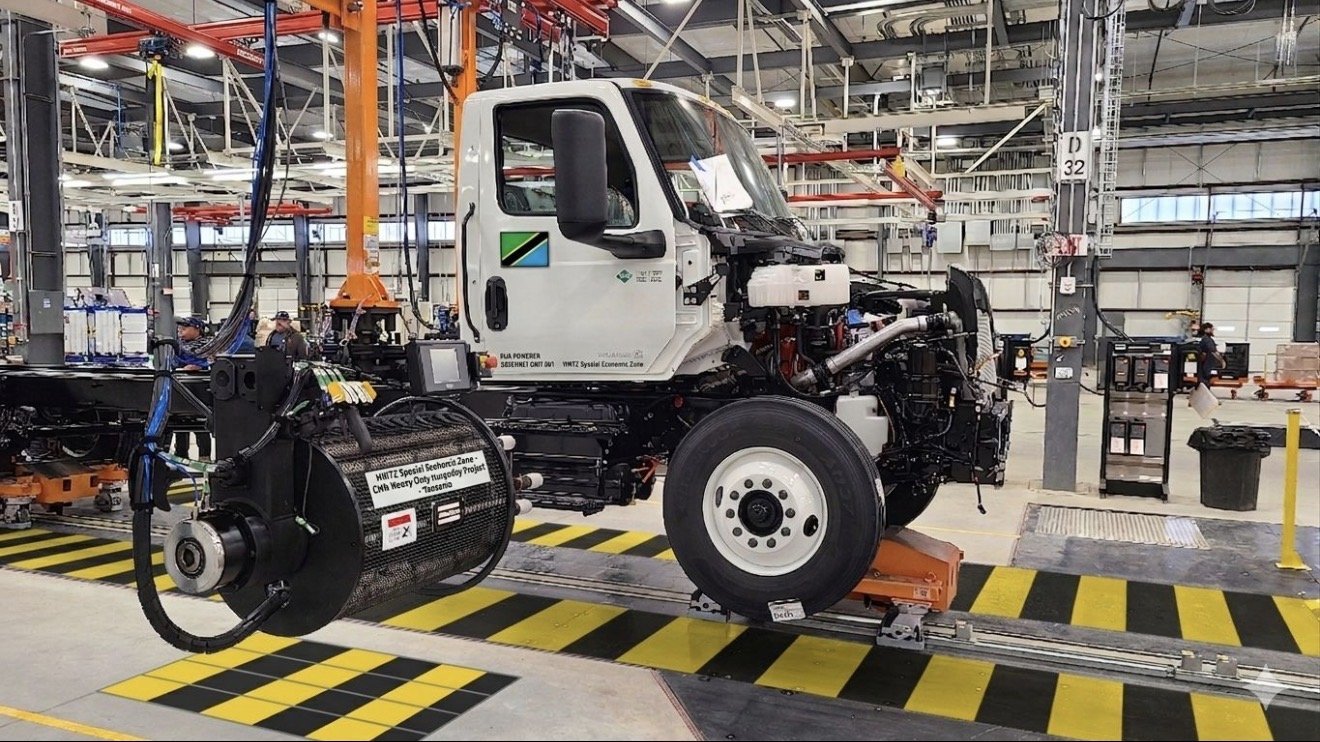
The three factories that HWTZ SEZ Limited is targeting for completion by end 2026 are a CNG-powered heavy-duty lorry assembly plant, a facility for the production of fishing boats and motorcycles, and a construction materials and metal spare parts manufacturing operation, and the combination of those three production lines within a single 500-hectare industrial complex is analytically significant because each addresses a specific import dependency in Tanzania's current economic structure while simultaneously connecting to the natural resource base and the infrastructure investment programme that the broader industrial strategy requires.
Tanzania currently imports virtually all of its heavy commercial vehicles, which are the primary mode of freight transport across the country's road network and whose import cost represents a sustained foreign exchange outflow that grows proportionally with economic activity, meaning that the gap between Tanzania's demand for heavy freight capacity and its domestic production of that capacity is a structural drain that scales with growth rather than reducing as the economy develops. The significance of the Bagamoyo assembly plant is that it begins to close that gap domestically, not by replacing the entire imported vehicle fleet overnight but by establishing the production capability, the technical workforce, and the supply chain infrastructure that domestic assembly requires, so that the incremental growth in Tanzania's commercial vehicle fleet over the next decade is increasingly served by domestic production rather than by imports whose value entirely exits the economy at the point of purchase.
The fishing boat production line has specific significance for Tanzania's blue economy development strategy that extends beyond the direct employment it creates, because the Indian Ocean coastline and the freshwater fisheries of Lake Victoria, Lake Tanganyika, and Lake Nyasa represent productive assets that are currently underexploited partly because the fishing fleet serving them is inadequate in scale and quality, and domestic production of fishing vessels at Bagamoyo builds the marine engineering capability that Tanzania's blue economy ambitions eventually require at a more sophisticated level while simultaneously making fleet expansion more accessible to the fishing communities that the sector employs.
The Natural Gas Connection and What It Demonstrates
The CNG vehicle assembly plant's most strategically important dimension is the industrial logic it demonstrates by linking Tanzania's natural gas endowment to its manufacturing development agenda in a way that the gas export model alone does not produce, because an economy that uses its natural gas as an industrial input for domestic manufacturing captures the processing value domestically by building the industrial capacity that consumes the gas, rather than selling the resource to others who build that capacity in their own industrial systems.
The use of CNG in vehicle assembly is intended to promote the utilisation of Tanzania's domestic natural gas resources and reduce dependence on imported fuel, positioning Tanzania's first CNG-powered heavy-duty lorry for assembly at Bagamoyo by end 2026. This connection between resource endowment and industrial application is precisely the value chain integration that Tanzania's industrial strategy has described in policy language for years and that the Bagamoyo project is now demonstrating at the operational level, where the gas that Tanzania holds in its reserves becomes the fuel that powers the trucks assembled in its industrial zones rather than simply the commodity exported in its raw form to foreign industrial systems.
A commercial freight sector powered by domestically produced CNG at domestically set prices also has a measurable cost competitiveness implication for the manufacturing sector that Bagamoyo is intended to anchor, because logistics cost is one of the primary determinants of whether domestic manufacturing can compete with imported alternatives, and a CNG-powered commercial fleet with a fuel cost structure denominated in local currency and insulated from the foreign exchange volatility that diesel import dependency creates represents a genuine structural advantage for the industrial ecosystem that the Bagamoyo zone is designed to develop.
Bagamoyo as an Anchor and the Cluster Logic Behind It
The industrial cluster development logic, in which a large anchor investment attracts the component manufacturers, service providers, maintenance operations, and secondary industrial activity that collectively build an industrial ecosystem rather than an isolated facility, is the structural argument that makes the Bagamoyo investment's significance extend well beyond the three factories in the initial phase, and the evidence for that logic already materialising is visible in the investment data surrounding the project's announcement.
Six companies were granted investment licences at the Bagamoyo Eco-Maritime City in January 2026, with a combined capital commitment exceeding TZS 180 billion, covering food packaging, steel manufacturing, engineering, cashew and coffee processing, ferro-alloy production, and vehicle assembly, and TISEZA has allocated 60 additional investment plots at the zone for incoming investors. The breadth of those six concurrent licences across food processing, heavy industry, agricultural value addition, and vehicle manufacturing describes the diversified industrial base that a functioning cluster requires, where complementary industries share infrastructure, generate mutual supply chain linkages, and collectively build the technical skills pool that each individual factory draws on. This is not a projection of what Bagamoyo might become. It is a description of what is already being assembled within the zone in the first quarter of 2026.
The deep-water port that the government has identified as the future largest port in Tanzania and East Africa, whose planned construction is linked to the Bagamoyo SEZ, is the infrastructure investment that will ultimately determine the scale at which the Bagamoyo cluster can serve regional markets rather than simply domestic ones, because port access determines the logistics cost competitiveness through which domestically manufactured goods reach the EAC and SADC markets that provide the scale economics justifying the investment level the zone is attracting. The 33-year lease structure of the HWTZ agreement means that the investment timeline extends well beyond the initial factory completion, encompassing the full development arc from initial production to mature industrial cluster operation in a way that aligns investor incentives with the long-term industrial development outcome Tanzania is seeking.
The Employment and Skills Dimension
A project of this scale and technical complexity generates employment across multiple layers simultaneously, from the assembly and engineering roles within the factories themselves to the logistics, maintenance, supply chain, and technical services that the production operations create in their surrounding economy, and the nature of that employment is qualitatively significant for Tanzania's human capital development in ways that the job creation statistics alone do not fully capture.
Assembly and engineering operations in heavy vehicle production and marine vessel manufacturing require technical competencies that are currently underrepresented in Tanzania's formal workforce, where the employment analysis Uchumi360 documented found that 83.2 percent of formal sector vacancies require technical or professional qualifications that the labour market cannot currently supply at the required scale. The Bagamoyo complex is therefore not simply creating employment in the conventional sense of filling existing positions but is building the technical workforce that Tanzania's industrial ambitions require, because the engineers, the welders, the CNC operators, the quality control technicians, and the logistics managers that the complex employs develop capabilities through operational practice that formal education alone cannot produce, and those capabilities, once built in the workforce, become available to the broader industrial economy through the career mobility and knowledge diffusion that a growing manufacturing sector generates.
TISEZA Director General Gilead Teri called on Tanzanian investors to take advantage of the opportunity at Bagamoyo, noting that it is not exclusively open to foreign parties and that local investors, whether individuals or those entering into joint ventures, would be given priority for licences to establish industrial facilities within the zone. The explicit prioritisation of Tanzanian investors within the SEZ framework reflects the economic sovereignty dimension of the Bagamoyo development that distinguishes it from the historical pattern of foreign industrial investment in African economies where the employment and the production capacity are created locally but the ownership, the management, the technology, and ultimately the profit remain external. Tanzania is building an industrial zone where foreign anchor investment is welcomed and expected while Tanzanian participation in ownership, management, and secondary industrial activity is structurally incentivised rather than aspirationally mentioned.
The Regional Market and Why Bagamoyo Is Positioned for It
Tanzania's domestic market at 63 million people provides the initial demand base for Bagamoyo's production but the regional market argument is where the project's long-term commercial viability and its contribution to Tanzania's position as a manufacturing hub rather than simply a manufacturing economy becomes most analytically compelling, because the EAC's combined population of approximately 300 million people and the SADC's additional 350 million represent a market whose scale can absorb the industrial output of a mature Bagamoyo cluster at volumes that justify the investment level and generate the export revenue that structural industrial development requires.
Tanzania's 35.8 percent intra-African export share, which Uchumi360's trade map analysis positioned as one of the highest in Sub-Saharan Africa and as evidence of genuine regional economic integration rather than simply geographic proximity, means that the commercial and regulatory relationships through which Tanzanian manufactured goods reach regional buyers are more developed than in most comparable African economies, providing the market access infrastructure that Bagamoyo's production needs to reach EAC and SADC customers alongside the logistics infrastructure that the SGR and port development are building simultaneously.
Within the AfCFTA framework, domestically manufactured transport equipment, motorcycles, and marine vessels in Tanzania have access to regional markets at preferential tariff rates that imported equivalents from outside Africa do not, which creates a competitive advantage at the regional trade level that grows in value as AfCFTA implementation deepens and as the non-tariff barriers that currently limit intra-African trade are progressively reduced through the infrastructure and regulatory improvements that Tanzania's investment programme and regional trade agreements are simultaneously advancing.
What Bagamoyo Represents in Tanzania's Industrial Story
Bagamoyo is not Tanzania's first industrial zone and it will not be its last, but it represents something qualitatively different from the industrial zone investments that preceded it in Tanzania's economic history because the combination of the investment scale, the technical complexity of the production it is attracting, the explicit connection between domestic resource endowment and industrial application through the CNG specification, and the cluster development architecture that the concurrent six-company licence issuance and the 60 additional allocated plots represent collectively amounts to the most advanced expression of industrial execution that Tanzania has yet produced at a single location.
The broader investment context that Bagamoyo sits within reinforces rather than qualifies this significance, because the USD 4.6 billion that manufacturing absorbed across 417 projects in 2025 and the manufacturing sector's 44.4 percent formal employment growth documented in the CAG 2024/25 report describe an economy that is building industrial capacity across multiple locations and multiple subsectors simultaneously, with Bagamoyo serving as the most visible and most technically ambitious anchor point in an investment landscape that is generating industrial capacity more broadly across the economy than any single project statistic can represent.
Tanzania has spent decades writing the industrial policy documents that describe what a manufacturing economy should look like. Bagamoyo is one of the clearest signs yet that the writing has given way to building, and that the factories, the workforces, the supply chains, and the regional market relationships that industrial policy describes in abstract terms are taking physical form in the coastal zone north of Dar es Salaam where Tanzania is assembling its first heavy vehicle and positioning its industrial future alongside its natural gas reserves, its regional trade corridors, and its growing domestic workforce in a combination whose productive potential is now being realised rather than projected.
 Uchumi360
Business Intelligence
Uchumi360
Business Intelligence
TanzaniaInvest TISEZA Bagamoyo CNG Lorry Assembly April 2026. TISEZA Director General Gilead Teri Statement April 9, 2026. TISEZA Quarterly Investment Bulletin July to September 2025. Business Insider Tanzania Investment Moment Industries 2026. Tanzania Investment Consultant Group Manufacturing Sector Analysis 2026. Uchumi360 TISEZA Investment Surge Q1 2026 Analysis April 2026. Uchumi360 Intra-African Trade AfCFTA Analysis April 2026. Uchumi360 Employment and Structural Transformation Analysis April 2026. Uchumi360 Vision 2050 Growth Requirements Analysis April 2026.
Uchumi360 covers business, investment, and economic policy across East, Central, and Southern Africa.
For the serious reader
You read to the end. That places you in a small group.
Uchumi360 is built for readers who demand precision over speed, structure over sentiment, and analysis that holds uncomfortable conclusions rather than softening them. If this work sharpens how you think about Africa's economy, help us keep building the infrastructure behind it.
Institutional Partners
Commission intelligence. Shape the conversation.
Uchumi360 works with development finance institutions, investment firms, sovereign bodies, and strategic organisations across the coverage region. Institutional partnership unlocks:
- Commissioned sector and country intelligence reports
- Branded research series under your institution's authority
- Exclusive data briefings for internal strategy teams
- Speaking and editorial presence at Uchumi360 events
- Co-published investment outlooks for your markets
Support Our Work
Independent analysis has a cost. Help us bear it.
Uchumi360 does not carry advertising. It does not take editorial direction from sponsors. Every article is produced without commercial compromise. Your contribution funds the reporting, research, and editorial infrastructure that keeps this analysis free from influence.
Secure checkout: One-time and monthly support are processed securely.
Stay Connected
Keep up with every new insight.
Follow our latest analysis, policy coverage, and market intelligence as soon as it is published. If you need something specific, reach out directly and we will point you to the right research.
