
Why Having Access to the Ocean Is No Longer a Prerequisite for Economic Growth
Ready
Africa’s economic geography is changing. For decades, a coastline was treated as one of the strongest foundations for growth because it provided direct access to global trade. Yet Rwanda, Ethiopia and Uganda are demonstrating that being landlocked does not necessarily prevent rapid economic expansion, while coastal economies such as Tanzania, Kenya and Mozambique show that maritime access alone does not guarantee strong growth. The decisive advantage is increasingly becoming connectivity rather than geography. Countries that can efficiently connect their people, businesses, resources and industries to regional and global markets can overcome some of the limitations imposed by their physical location. The shift is particularly important for Africa because regional transport corridors, aviation, digital services, trade integration and expanding domestic markets are changing the relationship between geography and economic performance. A country does not need to own a port to participate in global trade, just as a country with a major port does not automatically capture the full economic value created by that access. The question is becoming less about who has the ocean and more about who has built the infrastructure, institutions and productive economy capable of turning connectivity into growth.
For decades, access to the ocean was treated as one of the most important geographical advantages a country could possess. A coastline provided direct access to international trade, reduced the distance between producers and global markets, allowed countries to develop ports and shipping industries, and gave coastal economies a structural advantage over countries forced to depend on their neighbours for access to maritime trade. Being landlocked was therefore widely understood as a development penalty. Yet the economic performance of several African countries is beginning to complicate that assumption. Rwanda, Ethiopia and Uganda are all landlocked, but each has recorded periods of economic growth that have exceeded those of several coastal economies in the same region. The point is not that being landlocked has suddenly become an advantage. It has not. The more important development is that the economic cost of being landlocked can increasingly be reduced by infrastructure, regional integration, aviation, technology, services, domestic markets and deliberate economic policy.
The distinction matters because access to the ocean and access to markets are no longer exactly the same thing. A coastline provides a country with a physical gateway to global markets, but the existence of that gateway does not determine how effectively the economy uses it. A country can have a major port and still struggle with expensive electricity, weak manufacturing, poor logistics beyond the port, limited industrial capacity, low productivity and inadequate investment. A landlocked country, meanwhile, can use roads, railways, dry ports, air connections, regional trade agreements and neighbouring ports to connect its economy to the same global markets. The geographical disadvantage remains, particularly for bulky and low value goods, but its effect on the broader economy can be reduced. This is why the more useful question for Africa is no longer simply which countries have access to the ocean. It is which countries have built the most efficient connections between their producers, consumers and the rest of the world.
Rwanda is challenging the traditional logic of geography
Rwanda provides perhaps the clearest example of a country overcoming a geographical constraint through policy, infrastructure and economic restructuring. It has no coastline, a relatively small domestic market and difficult terrain, yet the economy grew by 9.4 percent in 2025 according to the World Bank. The growth was supported by strong performance in services, construction, industry and agriculture, alongside a recovery in investment. The country has also increasingly positioned Kigali as a regional centre for finance, conferences, tourism, technology and business services, sectors in which proximity to a seaport is far less decisive than institutional quality, connectivity, human capital and the ability to attract international capital.
Rwanda has therefore approached its geographical disadvantage as a logistical problem that can be managed rather than as a permanent limitation on economic ambition. Its exporters still depend on corridors through neighbouring countries to reach the ocean, and this makes transportation more expensive than it would be for a comparable coastal economy. But the economy does not have to depend exclusively on commodities that must be shipped through a port. Tourism, financial services, technology, professional services, conferences and other high value activities can connect directly to international markets. Rwanda's experience suggests that when an economy changes what it produces, the significance of geography can change with it.
This is one reason the Rwandan case is particularly relevant to the wider African debate. The absence of a coastline has not disappeared, but the economy has become less dependent on the advantages that a coastline provides. That does not mean Rwanda has solved the structural challenges associated with being landlocked. It means that economic growth can increasingly come from activities for which maritime access is not the principal determinant of competitiveness.
Ethiopia shows what a large landlocked economy can achieve
Ethiopia presents an even more significant challenge to the traditional argument because of the scale of its economy and population. With more than 130 million people, Ethiopia possesses one of Africa's largest domestic markets despite having lost direct access to the sea after Eritrea's independence. The World Bank estimates that the Ethiopian economy grew by 9.2 percent in fiscal year 2024/25. That performance has been supported by agriculture, industry and services, while the government continues to pursue reforms aimed at increasing private investment and expanding productive capacity.
Ethiopia has also demonstrated that international connectivity does not necessarily have to be built around maritime infrastructure. Addis Ababa has become one of Africa's most important aviation centres, largely because Ethiopian Airlines has developed a network connecting the country to major cities across Africa, the Middle East, Asia, Europe and North America. Aviation cannot replace maritime transport for bulk commodities, but it creates another form of international connectivity that is particularly valuable for people, services, business travel and high value goods. Ethiopia has therefore been able to compensate for part of its geographical disadvantage by building an economic gateway through the air.
The country's enormous domestic market also changes the calculation. A country with more than 130 million consumers has an internal source of demand that a much smaller economy cannot easily replicate. Housing, telecommunications, financial services, construction, food production, transport, consumer goods and other sectors can grow on the basis of domestic demand even when access to international shipping is expensive. Ethiopia's geography remains a constraint, but the size and diversity of its economy allow it to pursue growth through several channels simultaneously.
Uganda is turning its landlocked position into a regional question
Uganda provides another important example because its economic future is increasingly connected to the broader Great Lakes and East African market. The country recorded economic growth of 6.3 percent in fiscal year 2024/25, with growth accelerating further in the second half of 2025. The World Bank expects stronger growth as investment increases and the country's oil industry moves towards production.
Uganda's geographical position means that it cannot think about economic connectivity within its borders alone. Its access to international markets depends on corridors through Kenya and Tanzania, while its proximity to Rwanda, South Sudan and the Democratic Republic of Congo gives it access to some of the most commercially significant markets in the region. This creates an important shift in how landlocked countries should think about geography. Uganda does not need to possess a port if it can establish efficient commercial relationships with the countries that do.
The country's oil development illustrates this clearly. Uganda's crude will be transported through the East African Crude Oil Pipeline to Tanzania's Indian Ocean coast. Uganda therefore participates in a maritime export economy without having a coastline of its own. The infrastructure connecting Uganda's oil fields to Tanzania's port is economically more important than the fact that the two countries have different geographical positions. The project demonstrates that economic infrastructure can connect two different geographical realities and allow a landlocked country to participate in an international commodity market.
The Democratic Republic of Congo shows that geography alone cannot explain growth
The Democratic Republic of Congo requires a different interpretation because it technically has a short Atlantic coastline, although much of the country is effectively separated from direct maritime access by its enormous size and weak internal transport infrastructure. The country recorded economic growth of 5.5 percent in 2025, according to the World Bank, with mining remaining the dominant driver because of its vast deposits of copper and cobalt.
The DRC demonstrates that possessing a coastline is not enough when the rest of the country is poorly connected to it. A mineral deposit in eastern or southern Congo is not meaningfully connected to the Atlantic simply because the country has a small strip of coastline hundreds or thousands of kilometres away. What matters is whether roads, railways, border crossings, energy infrastructure and trade corridors can move those resources from their point of production to international markets at a competitive cost.
This is why the DRC increasingly matters to the economic geography of Eastern and Central Africa. Its minerals can potentially move through several regional corridors, including routes connected to Tanzania, Zambia, Angola and other neighbouring countries. The competition between these corridors could eventually become one of the most important infrastructure contests in the region. The economic value will accrue not simply to countries with ports, but to countries capable of building efficient networks between production centres and those ports.
Tanzania has the coastline. The question is what it does with it
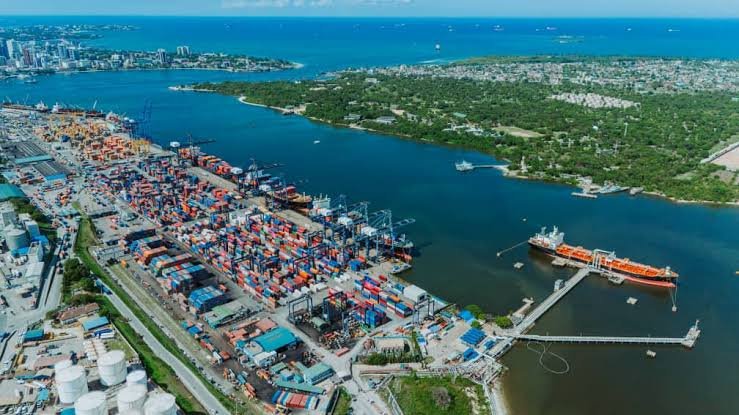
Tanzania presents the most interesting counterpoint to the landlocked examples because it possesses many of the geographical advantages that Rwanda, Uganda and Ethiopia lack. It has a long Indian Ocean coastline, major ports, substantial mineral and agricultural resources, a large population, significant tourism assets and a strategic position next to several landlocked economies. Dar es Salaam in particular is not simply a Tanzanian port. It is a gateway for trade involving Zambia, the Democratic Republic of Congo, Rwanda, Burundi, Malawi and parts of Uganda.
This gives Tanzania a geographical advantage that few countries in the region can match. But geographical advantage only becomes economic advantage when the wider economy is capable of capturing the value created by that position. Tanzania can earn revenue from handling cargo destined for neighbouring countries, but the much larger opportunity lies in building industries around those flows. The country can attract manufacturers that want proximity to the port, develop logistics and distribution centres, expand warehousing and cold storage, process agricultural commodities, provide financial services to regional traders and build industrial supply chains around the movement of goods through its territory.
This is where the debate becomes more interesting for Tanzania. The country does not need to defend the importance of its coastline. Its coastline is clearly valuable. The question is whether Tanzania is capturing enough of the economic value that its geographical position makes possible. If cargo passes through Dar es Salaam without generating significant manufacturing, processing, logistics, financial and commercial activity inside Tanzania, then the port is functioning primarily as infrastructure rather than as the foundation of a broader industrial economy.
The difference between those two outcomes is substantial. A country can be a gateway for other economies without becoming the economic centre of the region. Tanzania has the opportunity to become both.
Kenya demonstrates that the real advantage is not simply the port
Kenya's experience reinforces the same argument from another direction. Mombasa provides direct access to the Indian Ocean, but Kenya's economic strength has never depended on the port alone. Nairobi has developed into one of Africa's leading centres for finance, technology, professional services, regional headquarters, media and entrepreneurship. Kenya's position as the largest economy in East Africa has therefore been created by the combination of maritime access, private enterprise, human capital, financial infrastructure, technology and regional commercial influence.
This distinction matters because it explains why Kenya continues to occupy such an important economic position even when several neighbouring economies record faster growth rates. The country's advantage is institutional and commercial as much as geographical. Mombasa connects Kenya to international trade, while Nairobi connects businesses to capital, technology, professional services and regional markets. The economic value comes from the interaction between those assets rather than from the coastline in isolation.
Kenya's current challenges also demonstrate the limits of geography. High public debt, fiscal pressure, the cost of doing business and other structural constraints can reduce economic dynamism even when a country has excellent access to international trade. A port can lower the cost of importing and exporting goods, but it cannot by itself solve fiscal problems, create skilled workers or make domestic businesses more productive.
Mozambique provides a warning about the limits of geographical advantage
Mozambique presents perhaps the strongest warning against assuming that coastal access automatically produces development. The country has a long coastline, several strategically located ports, major natural gas reserves and substantial mineral and agricultural potential. Yet its economy contracted by 0.5 percent in 2025, according to the World Bank, amid political uncertainty, fiscal pressures, foreign exchange constraints and continuing security challenges.
Mozambique's experience illustrates the difference between possessing resources and building an economy around those resources. A coastline can facilitate exports, but it cannot determine whether investment will arrive at sufficient scale, whether infrastructure will be maintained, whether industries will emerge around natural resources or whether economic benefits will spread beyond the extractive sector.
The lesson is not that Mozambique's coastline has little value. Its ports and natural resources remain major strategic assets. The lesson is that geography creates possibilities rather than outcomes. Institutions, investment, infrastructure, human capital and economic policy determine how much of that potential becomes actual economic activity.
The rise of services is changing the value of geography
The most important structural change may be taking place outside physical trade altogether. For much of modern economic history, countries depended heavily on moving physical goods across borders, which made ports, shipping routes and proximity to maritime markets central to economic development. But services now account for an increasing share of economic activity, and many of the fastest growing services can reach international customers without requiring direct maritime access. Finance, technology, telecommunications, professional services, education, tourism, aviation and digital commerce depend much more heavily on human capital, connectivity, institutions and purchasing power than they do on proximity to a seaport.
This is particularly significant for landlocked economies because it allows them to diversify away from activities that are most exposed to transportation costs. A technology company in Kigali can sell software to a customer in London without sending anything through a port. A financial institution in Addis Ababa can provide services across borders without owning maritime infrastructure. A tourist visiting Rwanda creates foreign exchange without a container ever passing through a seaport. An international conference in Kigali generates economic activity through hotels, transport, restaurants, professional services and aviation rather than maritime trade.
The implications extend beyond Rwanda and Ethiopia. African economies are increasingly competing for investment in sectors where the decisive factors are electricity, broadband, skills, political stability, regulation, market size and access to capital. A country's ability to attract those investments can therefore become as important as its ability to move physical goods through a port. This does not eliminate the importance of maritime infrastructure because Africa will continue to depend heavily on the movement of commodities and manufactured goods. It changes the composition of the economy and therefore changes the relative importance of different geographical advantages.
Regional corridors are redefining what it means to be landlocked
The most consequential development for Eastern Africa may be the emergence of regional transport corridors that allow landlocked economies to use the infrastructure of their coastal neighbours. Uganda can reach the ocean through Kenya and Tanzania. Rwanda and Burundi can use the same corridors. Zambia can use Dar es Salaam. Parts of the DRC can connect to ports in Tanzania, Angola and Southern Africa. Ethiopia has historically depended heavily on Djibouti for maritime access.
This means that the economic geography of the region is no longer determined entirely by national borders. It is increasingly determined by corridors that connect producers and consumers across several countries. A railway, highway, border crossing or dry port can therefore have economic significance far beyond the country in which it is physically located.
For Tanzania and Kenya, this creates an opportunity as much as it creates competition. Their ports can become gateways for some of Africa's fastest growing landlocked economies. But the countries that capture the greatest value will not necessarily be those that simply move the most containers. They will be those that build industries, financial services, logistics businesses and manufacturing capacity around the movement of those goods.
The real competition is between connected and disconnected economies
The broader lesson from Rwanda, Ethiopia, Uganda, Tanzania, Kenya and Mozambique is that the old distinction between coastal and landlocked economies is becoming less useful on its own. Geography still matters, and it matters enormously for the cost of moving physical goods, but its economic consequences are increasingly shaped by infrastructure, institutions and policy.
A coastline gives a country a direct gateway to global markets. A railway can extend that gateway hundreds of kilometres inland. A modern highway can extend it further. A dry port can move customs and logistics functions away from the coast. An airport can connect people and high value goods directly to international markets. Digital infrastructure can connect service providers to customers thousands of kilometres away. Regional trade agreements can expand the effective size of a domestic market far beyond national borders.
The result is a world in which countries can increasingly compensate for geographical disadvantages and multiply geographical advantages. Rwanda can reduce the consequences of being landlocked. Ethiopia can build global connectivity through aviation. Uganda can connect its natural resources to the Indian Ocean through Tanzania. Tanzania can turn its coastline into a regional industrial gateway. Kenya can combine Mombasa with Nairobi's financial and technological capabilities. Mozambique can potentially turn its ports and natural resources into a much larger industrial economy if institutional and security constraints are addressed.
The most successful countries will therefore not necessarily be those with the best geography. They will be those that make the best use of the geography they have.
Africa's development debate needs to move beyond geography
For African policymakers, investors and businesses, this changes the question that should be asked when evaluating an economy. The first question should not be whether the country has a coastline. It should be whether the country can connect its people, businesses and productive assets to large markets at competitive cost.
That requires much more than ports. It requires reliable electricity, efficient roads and railways, functional borders, competitive telecommunications, skilled workers, predictable regulation, access to finance and institutions capable of supporting private investment. It also requires countries to decide what they want to produce and where they intend to compete.
This is why the performance of Rwanda, Ethiopia and Uganda should not be interpreted simply as evidence that landlocked countries are now better positioned than coastal countries. That would replace one form of geographical determinism with another. Their experience is more useful because it demonstrates that geography can be managed. A country without a port can still become highly connected. A country with a port can still underperform. The difference increasingly lies in what governments and businesses build around geography.
The ocean remains one of the world's most important economic assets. Ports will remain essential to African trade for generations. But the coastline is no longer the boundary of economic possibility. The countries that understand this earliest will have an advantage over those that continue to treat geography as destiny.
The future will not belong to the countries closest to the ocean. It will belong to the countries best connected to opportunity.
 Uchumi360
Business Intelligence
Uchumi360
Business Intelligence
Uchumi360 covers business, investment, and economic policy across East, Central, and Southern Africa.
For the serious reader
You read to the end. That places you in a small group.
Uchumi360 is built for readers who demand precision over speed, structure over sentiment, and analysis that holds uncomfortable conclusions rather than softening them. If this work sharpens how you think about Africa's economy, help us keep building the infrastructure behind it.
Institutional Partners
Commission intelligence. Shape the conversation.
Uchumi360 works with development finance institutions, investment firms, sovereign bodies, and strategic organisations across the coverage region. Institutional partnership unlocks:
- Commissioned sector and country intelligence reports
- Branded research series under your institution's authority
- Exclusive data briefings for internal strategy teams
- Speaking and editorial presence at Uchumi360 events
- Co-published investment outlooks for your markets
Support Our Work
Independent analysis has a cost. Help us bear it.
Uchumi360 does not carry advertising. It does not take editorial direction from sponsors. Every article is produced without commercial compromise. Your contribution funds the reporting, research, and editorial infrastructure that keeps this analysis free from influence.
Secure checkout: One-time and monthly support are processed securely. Add payment credentials to enable checkout here.
Stay Connected
Keep up with every new insight.
Follow our latest analysis, policy coverage, and market intelligence as soon as it is published. If you need something specific, reach out directly and we will point you to the right research.
