
Africa Formally Exited Colonialism Decades Ago. The Economic Structure It Left Behind Has Barely Changed.
Ready
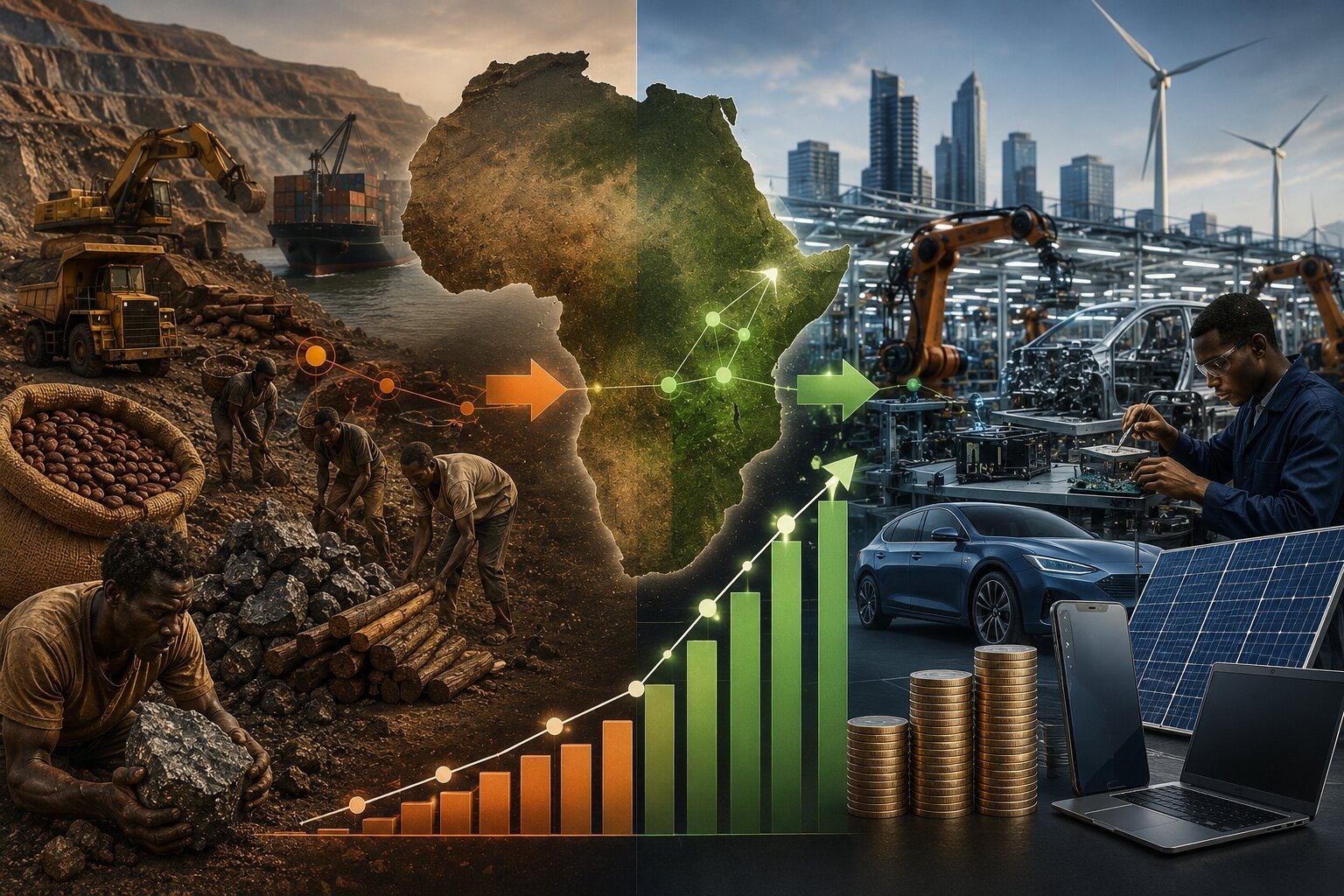
Africa formally exited colonialism decades ago and economically large parts of the structure remain remarkably familiar: the continent exports raw materials and imports finished goods manufactured elsewhere, with copper leaving and electronics returning, cocoa leaving and chocolate returning, cobalt leaving and batteries returning, lithium leaving and electric vehicles returning. According to UNCTAD and African Development Bank trade data, primary commodities still dominate export earnings across large parts of the continent while imports are concentrated around machinery, industrial equipment, pharmaceuticals, and manufactured goods. West Africa produces roughly 70% of the world's cocoa beans while Europe captures much of the chocolate industry's profits through processing, branding, and retail systems. The DRC accounts for most global cobalt production while battery manufacturing is overwhelmingly concentrated in China, South Korea, Japan, and Europe. The colonial economic structure was never only political. It was industrial. And industrial structures do not disappear because flags changed. They disappear when productive systems change underneath them. This article identifies why the structure persists, what the East Asian economies did to escape it, and what Africa's current critical minerals moment makes possible if the industrial strategy matches the geological opportunity. The most politically uncomfortable economic fact about Africa's post-independence trajectory is not that colonialism happened. It is that the economic architecture colonialism installed continues to function with remarkable fidelity decades after the flags changed.
Africa formally exited colonialism decades ago, and economically large parts of the structure that colonialism installed remain remarkably familiar in ways that the continent's development discourse has not confronted with the analytical honesty that the persistence of the pattern warrants. Copper leaves Africa and electronics return. Cocoa leaves Africa and chocolate returns. Crude oil leaves Africa and refined fuel returns. Lithium, cobalt, graphite, and rare earth minerals leave Africa and batteries, semiconductors, electric vehicles, and industrial systems return. The products being traded have changed in ways that reflect the evolution of the global economy across the post-independence period. The structure of the trade has not, and the distinction between those two observations, between the commodity's identity and the economic relationship it embeds, is the distinction that separates a superficial reading of Africa's trade data from an honest assessment of the continent's position in the global economy and of what it would actually require to change that position.
Colonialism was never simply about political control. It was fundamentally about economic organisation, and the economic organisation it imposed was designed with a clarity of purpose that its political justifications deliberately obscured: colonised territories were structured primarily as suppliers of raw materials and consumers of finished industrial products produced elsewhere. That model generated extraction outward and dependency inward, not as an accidental byproduct of administrative arrangements but as the deliberate commercial logic that made the colonial relationship profitable for the colonising economies. The infrastructure systems that colonialism built in Africa reflect this logic with geographical precision: ports connected to mines and agricultural export corridors rather than integrated internal industrial networks, railway systems designed to move raw materials from interior production zones to coastal export points rather than to connect domestic manufacturing centres to domestic consumer markets, financial systems oriented toward facilitating commodity trade flows rather than financing industrial investment, and educational systems that produced the administrators and clerks that extraction economies required faster than they produced the engineers and industrial managers that manufacturing economies need.
Why the structure survived independence
According to UNCTAD's Economic Development in Africa Report 2023, primary commodities still dominate export earnings across large parts of the continent, with oil, minerals, agricultural commodities, and raw materials remaining central to external trade structures across the majority of African economies. Imports are concentrated around machinery, industrial equipment, pharmaceuticals, refined petroleum products, chemicals, electronics, processed food, and manufactured goods whose domestic production would require the industrial capability that Africa's post-independence economic strategy has not consistently prioritised with the sustained commitment that industrial transformation demands. Africa exports what is extracted and imports what is produced, and that distinction explains more about the continent's economic position in the global income hierarchy than most political debates do, because wealth in the modern global economy is rarely concentrated in extraction alone. It accumulates most heavily in processing, manufacturing, technology, logistics systems, finance, branding, intellectual property, and industrial coordination, all of which occur in the jurisdictions that purchase Africa's raw materials and transform them into the finished goods that return to Africa at prices that reflect the productive complexity of the manufacturing economies that supplied them.
The colonial structure survived because replacing it required extraordinary state capacity, long-horizon industrial planning, manufacturing finance at tenors that commercial systems oriented toward trade and commodity flows would not provide, infrastructure expansion designed around industrial connectivity rather than export corridor efficiency, and policy discipline sustained across decades without the electoral pressure to demonstrate quick returns that democratic political systems impose on governments whose constituents want immediate improvements in living standards rather than the deferred returns that industrial capability accumulation generates. Political independence arrived faster than industrial restructuring, and the gap between political sovereignty and economic sovereignty has defined much of Africa's post-independence trajectory in ways whose consequences compound over time rather than resolving through the accumulation of independence anniversaries. The infrastructure systems designed for extraction remained largely intact because replacing them required the capital, institutional capacity, and industrial strategy that the newly independent states did not consistently possess in the immediate post-independence period and that their external creditors and development partners did not consistently provide on terms that would have facilitated industrial restructuring rather than simply refinancing the export commodity model under new flags.
The cocoa case and what it reveals about value chain position
West Africa produces roughly 70% of the world's cocoa beans, with Côte d'Ivoire and Ghana dominating global supply according to the International Cocoa Organisation's production data, making the region's position in the cocoa supply chain one of the most significant agricultural supply concentrations in the world economy. Yet Europe captures much of the chocolate industry's profits through processing, branding, retail systems, and advanced manufacturing, with Swiss, Belgian, German, and British chocolate companies commanding the consumer pricing, brand equity, and retail margin that the cocoa supply chain's total economic value distributes overwhelmingly toward the manufacturing and marketing end rather than the agricultural production end. Africa grows the raw input. Others dominate the global consumer product. The cocoa farmers in Côte d'Ivoire and Ghana whose labour produces the fundamental input for a global confectionery industry worth over USD 100 billion annually according to Statista market data receive a fraction of that industry's economic value, not because their contribution is economically marginal but because the value chain's structure places the highest-margin activities, processing, branding, distribution, and retail, in the jurisdictions that have developed the industrial and commercial capability to perform them rather than in the jurisdictions that produce the agricultural raw material.
This is not a story about fair trade or corporate exploitation in the narrow sense, though those dimensions are real and documented. It is a story about where in the value chain productive complexity accumulates and how that accumulation determines income distribution between the economies participating in the same supply chain at different stages. Every attempt to alter Côte d'Ivoire's and Ghana's position in the cocoa value chain, including the 2019 Living Income Differential mechanism that both countries jointly established to impose a floor price premium on cocoa sales, according to reporting by Reuters and the Financial Times, has encountered resistance from chocolate manufacturers and commodity traders whose commercial model depends on the continued availability of raw cocoa at commodity prices that do not reflect the full economic contribution of the agricultural production stage. The structural resistance to value chain upgrading by the commodity-producing economies is itself evidence that the current structure serves the interests of the manufacturing and processing economies whose position it protects, which is precisely why changing it requires the industrial policy determination that Ghana and Côte d'Ivoire are attempting to build through domestic processing requirements alongside the pricing mechanism.
The cobalt case and what it reveals about mineral value chain position
The DRC's cobalt position illustrates the same structural dynamic in the minerals context with a clarity that the scale of the supply concentration makes impossible to attribute to agricultural productivity or comparative advantage in the conventional trade theory sense. According to the United States Geological Survey's Mineral Commodity Summaries 2024, the DRC accounts for approximately 74% of global cobalt production, a concentration whose supply chain significance for battery manufacturing, electric vehicles, consumer electronics, and the data centre infrastructure that the AI economy depends on has never been higher and whose strategic importance has been formally recognised in the critical minerals security frameworks of the United States, the European Union, China, and Japan simultaneously. Yet battery manufacturing is overwhelmingly concentrated outside Africa, with the cell manufacturing, pack assembly, and system integration that constitute the majority of the cobalt supply chain's total economic value occurring in Chinese, South Korean, and Japanese facilities that purchase Congolese cobalt hydroxide at prices that reflect the extraction margin rather than the battery manufacturing margin whose scale is multiples larger.
According to Benchmark Mineral Intelligence's cobalt supply chain analysis, cobalt hydroxide, the partially processed form in which most DRC cobalt enters international trade, commands a price that is a fraction of the battery-grade cobalt sulphate that Chinese refiners produce from it and a smaller fraction still of the battery cell whose performance specifications the cobalt determines. The DRC holds the mineral. China holds the refinery. South Korea and Japan hold the cell manufacturing. And the electric vehicle manufacturers in Germany, the United States, and increasingly China hold the brand and the consumer relationship. The DRC's share of the total economic value generated by the cobalt that originated in its territory is the extraction margin, which is real and significant in absolute terms for a low-income economy, and which represents the smallest available share of a value chain whose total worth is determined by the battery industry rather than by the mining industry.
Why industrial systems compound in ways that extraction cannot replicate
Industrial systems compound over time through a mechanism that is absent from extraction economies and whose absence explains much of the income divergence between Africa and the East Asian economies that have closed the gap most successfully. Countries controlling manufacturing ecosystems gradually deepen capabilities across engineering, logistics, industrial finance, technical education, infrastructure, supply chains, and advanced production systems whose accumulation creates the productive knowledge that Hausmann and Hidalgo's Economic Complexity Index, documented at Harvard Growth Lab's research portal, identifies as the primary determinant of long-run income. Once these ecosystems mature, they become difficult to displace because productive knowledge itself accumulates institutionally across generations, embedding in engineering schools, in industrial supplier networks, in logistics companies whose operational knowledge reflects decades of manufacturing service, and in financial institutions whose risk assessment frameworks reflect accumulated experience with manufacturing investment rather than the commodity trade orientation that dominates African banking systems.
Extraction alone rarely creates the same compounding effects, because a mine is a point extraction operation whose productive knowledge does not naturally spill over into adjacent manufacturing activities in the way that a factory ecosystem's knowledge does. A cobalt mine generates mining engineering expertise, logistics capability for moving ore concentrates, and environmental management knowledge, all of which are valuable and none of which naturally creates the battery chemistry expertise, precision manufacturing capability, or quality management systems required for battery cell production. A graphite mine in Tanzania generates similar mining expertise without generating the chemical processing knowledge required to transform graphite flake into spherical graphite battery anode material whose value per tonne substantially exceeds the raw flake. The productive knowledge gap between extraction and manufacturing is not bridged automatically by the passage of time or by the accumulation of mining experience. It is bridged by the deliberate investment in processing and manufacturing capability that industrial policy is designed to facilitate and that market incentives alone, in developing economies whose financial systems are oriented toward extraction and trade, consistently fail to generate at the required scale and pace.
The East Asian restructuring that Africa has not yet replicated
South Korea in the 1960s was poorer than many African countries today by per capita income measures, according to World Bank historical national accounts data, and Taiwan lacked the major natural resources whose abundance is often cited as a prerequisite for development despite being conspicuously absent from the East Asian success cases. China remained overwhelmingly agrarian through much of the mid-twentieth century, with manufacturing contributing a small share of economic output before the systematic industrial policy that the reform period from 1978 onward installed began the structural transformation that eventually made China the world's largest manufacturing economy. Yet these economies deliberately built industrial capacity layer by layer, moving from textiles and basic manufacturing through steel, machinery, electronics, and shipbuilding toward semiconductors and advanced manufacturing, with each layer's capability providing the technical and institutional foundation for the next layer's development rather than each manufacturing category being pursued in isolation from the productive complexity that adjacent capabilities generate.
According to Korean Development Institute research on South Korea's structural transformation, the deliberate sequencing of industrial capability accumulation, supported by state-directed credit, import protection, export performance requirements, and the institutional infrastructure of the Korea Development Bank, produced a transformation from agrarian poverty to sophisticated industrial economy in approximately three decades that the commodity export model, which South Korea also employed in its early development phase, could not have generated independently. The East Asian economies stopped primarily exporting raw materials and started exporting increasingly sophisticated industrial products as their manufacturing capability deepened, and the income transition that followed reflected the movement up the value chain rather than simply the increase in export volumes at the same points of the value chain. That transition changed their relationship to the global economy itself, from supplier of inputs into other economies' industrial systems to designer, manufacturer, and commercial controller of the industrial systems themselves.
What Africa's current critical minerals moment makes possible
Africa possesses genuine advantages entering the next global economic cycle whose combination has not existed at comparable scale at any previous point in the post-independence period, and acknowledging those advantages is as analytically important as documenting the structural persistence of the colonial economic model. The continent holds critical minerals whose strategic importance for the global energy transition and technology economy has elevated them to the status of geopolitical assets alongside conventional energy resources, creating a demand environment in which African governments hold more negotiating leverage than they have exercised in comparable commodity cycles. According to the IEA's Critical Minerals Market Review 2023, global demand for lithium, cobalt, graphite, nickel, and rare earth elements is projected to increase by multiples of current production levels by 2040 under net-zero emissions scenarios, and the geographic concentration of reserves in Africa alongside the supply chain diversification urgency of Western industrial economies creates a window in which processing requirements and value chain integration conditions can be negotiated from a position of genuine supply scarcity rather than from the position of commodity dependence that has historically constrained African producers' negotiating leverage.
The continent has the world's youngest population, according to United Nations Population Division data, providing the demographic scale that industrial workforce development requires. Urbanisation is accelerating at rates that create the consumer market demand for manufactured goods whose domestic production would substitute for current imports. Regional integration through the African Continental Free Trade Area creates potential market scale that individual African economies cannot generate independently, providing the addressable market size that makes manufacturing investment commercially viable across a wider range of product categories than national market scale would support. Infrastructure investment is rising across transport, energy, and logistics systems, creating the physical foundation whose absence has historically constrained manufacturing investment viability.
The structural question remains unchanged despite those advantages. Will Africa continue exporting inputs into other people's industrial systems while importing finished value back at higher prices, perpetuating the economic architecture that colonialism installed and that independence did not dismantle? Or will it gradually build the industrial ecosystems capable of processing, manufacturing, and commercialising more of that value domestically, changing the economic relationship with the global economy rather than simply changing the commodity identity of the goods being traded at unchanged structural positions? The answer is not predetermined by the advantages or disadvantages Africa holds. It is determined by the industrial policy choices, the patient capital commitment, and the institutional development that convert a favourable resource position and a compelling demographic moment into the productive complexity accumulation that structural transformation requires.
Tanzania's trajectory illustrates both the possibility and the continuing gap simultaneously. The country holds graphite, nickel, helium, rare earths, gold, and 57 trillion cubic feet of natural gas whose combined strategic importance makes it one of the more significant mineral economies in East Africa, and its expanding energy capacity, Standard Gauge Railway, and port modernisation provide an infrastructure foundation whose development trajectory is more promising than its current manufacturing output reflects. The gap between Tanzania's geological endowment and its industrial development is the gap between what the colonial economic structure left behind and what the deliberate industrial transformation that its resource position now makes possible would produce. That gap is not closed by mining licences, export revenue projections, or investment approval statistics. It is closed by processing requirements, manufacturing investment, patient capital, technical workforce development, and the sustained policy commitment that industrial transformation across any comparable economy has always demanded. The colonial economic structure was never only political. Industrial structures do not disappear because flags changed. They disappear when productive systems change underneath them. That is the real transformation Africa is still trying to complete, and Tanzania's mineral wealth, its energy surplus, and its regional positioning create the conditions under which completing it is more achievable now than at any previous point in its post-independence history.
FAQ
Why does the colonial economic structure persist despite political independence? Political independence arrived faster than industrial restructuring. The infrastructure systems that colonialism built, ports connected to mines and export corridors, financial systems oriented toward commodity trade, educational systems producing administrators faster than engineers, remained largely intact because replacing them required extraordinary state capacity, long-horizon industrial planning, manufacturing finance, and policy discipline sustained across decades. According to UNCTAD's Economic Development in Africa Report 2023, primary commodities still dominate export earnings across large parts of the continent, reflecting the persistence of an economic organisation that independence changed politically without changing industrially.
What does the cocoa example reveal about Africa's value chain position? West Africa produces approximately 70% of global cocoa beans according to International Cocoa Organisation data, yet Europe captures much of the chocolate industry's profits through processing, branding, and retail systems. The farm-gate price of cocoa beans represents a fraction of the retail price of finished chocolate, with the difference reflecting the manufacturing, branding, and distribution value that occurs outside the producing region. The structural resistance to the Living Income Differential mechanism that Ghana and Côte d'Ivoire established in 2019, reported by Reuters and the Financial Times, illustrates how the current structure actively resists value chain upgrading by the commodity-producing economies because it serves the interests of the manufacturing economies whose position it protects.
How does the DRC illustrate the minerals version of the same problem? According to USGS Mineral Commodity Summaries 2024, the DRC accounts for approximately 74% of global cobalt production. According to Benchmark Mineral Intelligence analysis, battery manufacturing is overwhelmingly concentrated in China, South Korea, and Japan. The DRC's share of the total economic value generated by its own cobalt is the extraction margin, which is real but represents the smallest available share of a supply chain whose total value is determined by the battery industry rather than the mining industry. The structural gap between the DRC's resource position and its industrial development position illustrates the mechanism that persistent commodity dependency produces: resource abundance coexisting with manufacturing absence.
What did East Asian economies do differently? According to Korean Development Institute research, South Korea began with textiles and basic manufacturing in the 1960s and moved systematically through steel, machinery, electronics, and shipbuilding toward semiconductors and advanced manufacturing, with state-directed credit, import protection, and export performance requirements supporting each stage's development. China followed a comparable trajectory at larger scale. The key difference from Africa's post-independence trajectory was the deliberate investment in manufacturing capability layer by layer, changing the relationship to the global economy from supplier of inputs to designer and manufacturer of increasingly sophisticated industrial products.
What does Africa's current critical minerals moment make possible? According to the IEA's Critical Minerals Market Review 2023, global demand for lithium, cobalt, graphite, nickel, and rare earth elements is projected to increase by multiples of current production by 2040. The combination of African mineral reserve concentration and Western supply chain diversification urgency creates negotiating leverage that African mineral producers have not held in comparable commodity cycles, making it commercially feasible to attach processing requirements and value chain integration conditions to mineral licences in ways that can begin changing Africa's structural position from extraction layer to processing layer. The window in which that leverage can be exercised is the window created by current supply scarcity, not the window that will exist after alternative sources are developed.
 Uchumi360
Business Intelligence
Uchumi360
Business Intelligence
- UNCTAD, Economic Development in Africa Report 2023
- Primary commodity export dominance and manufactured goods import concentration data
- Available at unctad.org
- International Cocoa Organisation, production data
- West Africa's approximately 70% share of global cocoa production
- Specific edition requires identification before publication
- Available at icco.org
- Statista, global chocolate confectionery market size data
- USD 100 billion industry value cited as illustrative benchmark
- Reuters and Financial Times, reporting on the Living Income Differential mechanism established by Côte d'Ivoire and Ghana in 2019
- United States Geological Survey, Mineral Commodity Summaries 2024
- DRC cobalt production share
- Available at usgs.gov
- Benchmark Mineral Intelligence, cobalt supply chain and price differential analysis between cobalt hydroxide and battery-grade cobalt sulphate
- IEA, Critical Minerals Market Review 2023
- Global demand projections for lithium, cobalt, graphite, nickel, and rare earths
- Available at iea.org
- Harvard Growth Lab, Economic Complexity Index, Hausmann and Hidalgo
- Productive knowledge and income relationship
- Available at growthlab.hks.harvard.edu
- Korean Development Institute, South Korea structural transformation research
- Available at kdi.re.kr
- World Bank, historical national accounts data
- South Korea per capita income in the 1960s
- Available at data.worldbank.org
- United Nations Population Division, Africa demographic data
- Available at population.un.org
- Tanzania Petroleum Development Corporation, natural gas reserve data
- Available at tpdc.go.tz
- Standard Chartered Bank, SGR financing announcement, 28 April 2026
- Available at sc.com
Uchumi360 covers business, investment, and economic policy across East, Central, and Southern Africa.
For the serious reader
You read to the end. That places you in a small group.
Uchumi360 is built for readers who demand precision over speed, structure over sentiment, and analysis that holds uncomfortable conclusions rather than softening them. If this work sharpens how you think about Africa's economy, help us keep building the infrastructure behind it.
Institutional Partners
Commission intelligence. Shape the conversation.
Uchumi360 works with development finance institutions, investment firms, sovereign bodies, and strategic organisations across the coverage region. Institutional partnership unlocks:
- Commissioned sector and country intelligence reports
- Branded research series under your institution's authority
- Exclusive data briefings for internal strategy teams
- Speaking and editorial presence at Uchumi360 events
- Co-published investment outlooks for your markets
Support Our Work
Independent analysis has a cost. Help us bear it.
Uchumi360 does not carry advertising. It does not take editorial direction from sponsors. Every article is produced without commercial compromise. Your contribution funds the reporting, research, and editorial infrastructure that keeps this analysis free from influence.
Secure checkout: One-time and monthly support are processed securely. Add payment credentials to enable checkout here.
Stay Connected
Keep up with every new insight.
Follow our latest analysis, policy coverage, and market intelligence as soon as it is published. If you need something specific, reach out directly and we will point you to the right research.
