
Aliko Dangote Says China Dominates Africa Because It Puts Its Balance Sheet on the Table. The West Is Finally Taking Note.
Ready
Aliko Dangote, speaking with Nicolai Tangen of Norges Bank Investment Management in a podcast interview published 13 May 2026, said China dominates African business because of the absence of Western competitors and because Chinese suppliers backed by Sinosure offer four to five year financing with 20% upfront payment while European partners demand full upfront capital that constrains the cash flow industrial expansion requires. The financing mechanics Dangote describes explain how the Dangote Group's USD 45 billion investment roadmap through 2030 in refining, fertiliser, petrochemicals, and infrastructure becomes executable: leverage Chinese financing terms to preserve cash for expansion rather than concentrating capital in single transactions at Western payment terms. Dangote welcomed emerging Western competition, noting that the US Development Finance Corporation is showing renewed appetite for African infrastructure deals with a USD 28 billion deployment mandate, and challenged Japanese representatives directly to come with their balance sheets on the table. Africa, he said, now has choices. For East Africa, whose SGR, port developments, industrial parks, and energy infrastructure face identical financing realities, the competitive pressure Dangote describes between Chinese and Western capital is the most consequential development in the regional investment landscape. Countries with the negotiating capability to extract optimal terms from competing capital sources will build faster and more affordably than those still treating any available financing as a concession rather than a competitive offer. Africa is not choosing sides. It is choosing results. The power that shows up with a balance sheet rather than a lecture wins the deal. That is not a geopolitical observation. It is a procurement decision.
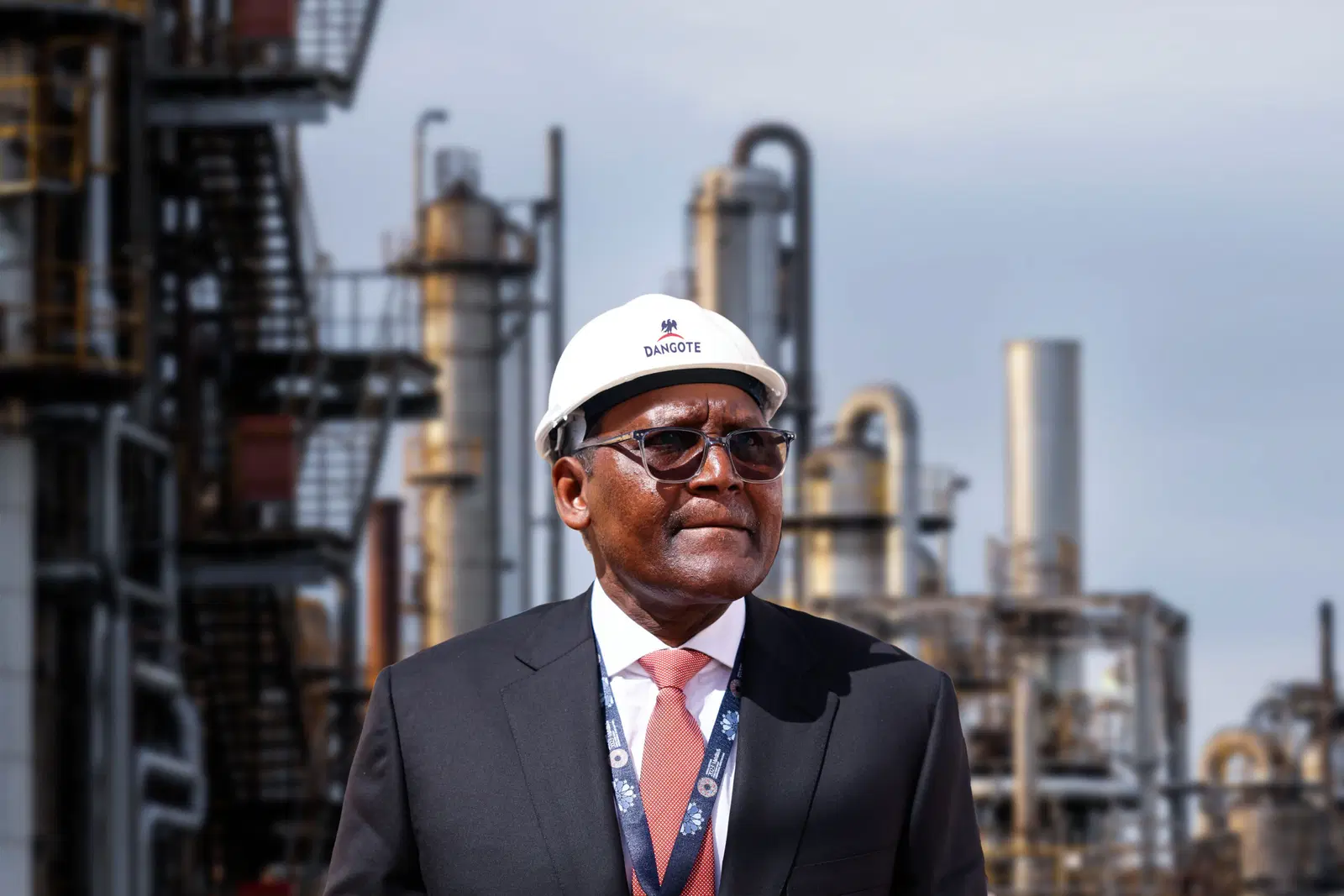
Aliko Dangote, the world's richest Black man and founder of Africa's largest industrial conglomerate, delivered the most direct public assessment of who is actually helping Africa economically in a wide-ranging interview with Nicolai Tangen, CEO of Norges Bank Investment Management, the manager of the world's largest sovereign wealth fund, published 13 May 2026.
When Tangen asked which power is helping Africa more economically, Dangote did not hedge.
"Honestly, you want me to be very open? Totally. So it's China. China really have dominated business in Africa because of the absence of the others. They put their balance sheet on the table."
The podcast episode, titled Building Africa's Industrial Future from the Ground Up, has generated widespread discussion after clips circulated across social media and business media platforms. Dangote's assessment is not a diplomatic observation. It is a procurement decision explained by someone who has executed multibillion-dollar industrial projects across 17 African countries and understands the financing mechanics whose terms determine whether projects get built or remain in feasibility studies.
The financing gap that China identified and filled
Dangote's explanation of China's dominance is mechanical rather than political. Chinese suppliers operating under Sinosure, China's export credit insurer whose support for global commercial transactions exceeds USD 1.2 trillion according to its published records, routinely offer African buyers supplier credits of four to five years with 20% upfront payment. The remaining 80% is financed over the credit period at terms that preserve the buyer's cash flow for parallel expansion rather than concentrating capital in a single transaction whose upfront cost exhausts the liquidity that industrial businesses require to operate and grow simultaneously.
The European alternative, as Dangote described from direct experience, requires full upfront capital whose absorption eliminates the cash flow flexibility that industrial expansion depends on. "For one power plant project, Italian suppliers demanded a USD 500 million cheque upfront," he said. The Chinese alternative for an equivalent or comparable system required 20% upfront with five years of financing for the balance. "Which one are you going to take if you're in my shoes? Obviously take the Chinese one, because it means that I can do more."
The commercial logic is straightforward and its implications for African infrastructure development are direct. A buyer with USD 100 million in available capital can acquire one European-financed power plant at full payment terms or can deploy USD 100 million as the 20% down payment on USD 500 million worth of Chinese-financed industrial equipment, preserving USD 80 million for operational and expansion capital while the credit facility finances the equipment balance over five years. The Chinese financing model does not require the buyer to choose between the equipment and the cash. The European model does. African governments and industrialists have been making that choice consistently in favour of the option that preserves operational flexibility, which is the financing mechanics explanation for the Chinese infrastructure dominance that Western governments have been characterising primarily as a debt trap concern rather than as a procurement rationality whose logic their own financing terms have consistently failed to match.
Why Sinosure's role matters for the East African context
Sinosure's USD 1.2 trillion in global deal support is the institutional mechanism whose existence makes Chinese supplier credit commercially viable at the terms Dangote describes. Export credit insurance removes the default risk from Chinese suppliers who would otherwise be unable to offer four to five year payment terms to African buyers whose credit profiles, sovereign ratings, and institutional track records do not support unsecured commercial credit at equivalent terms from private market lenders. The insurance transfers the default risk to the Chinese state, whose commercial interest in expanding Chinese industrial exports to African markets makes the risk transfer commercially rational for Beijing even at the concessional pricing that makes the terms attractive to African buyers.
The East African equivalent institutional mechanism, whose development would allow regional buyers to access competitive financing from multiple sources rather than remaining dependent on Chinese supplier credit as the primary available option for long-tenor industrial equipment financing, is the Development Bank of Tanzania, the East African Development Bank, and the African Development Bank's industrial lending programmes whose combined capacity has historically been insufficient to match the terms that Sinosure-backed Chinese financing provides. According to African Development Bank industrial financing research, the primary financing gap for manufacturing and industrial investment across Sub-Saharan Africa is not in the availability of capital at the continental level but in the availability of capital structured at the terms, long tenor, patient returns, and risk-sharing arrangements, that industrial investment requires. Sinosure solved that problem for Chinese exporters. The equivalent African institutional solution whose development would give African buyers the same financing flexibility with non-Chinese suppliers remains underdeveloped relative to the industrial investment demand it should be serving.
The West is finally taking note
Dangote's assessment of the Western competitive response is cautiously optimistic rather than dismissive. The US Development Finance Corporation, he noted, is showing renewed appetite for African infrastructure deals with a USD 28 billion deployment mandate whose hunger for bankable infrastructure transactions represents a meaningful shift from the previous generation of Western engagement with African capital markets.
"This time around when I went to the Development Finance Corporation of the US they just got about USD 28 billion. They are very hungry for infrastructure. They are very hungry and they are ready to lend." That readiness, if matched by the financing terms whose competitiveness with Chinese supplier credit the African buyer's procurement decision requires, changes the competitive landscape in ways whose benefit accrues to African borrowers through the pricing and conditionality competition that multiple willing lenders create.
Dangote's challenge to Japanese representatives he met was equally direct. "Japan, you have been missing for a very long time and today when you are coming make sure that you come with your own balance sheet on the table because we have choices of buying from many other countries, but if you don't really come with that support I have to go to a country that can give me that support for me to be able to leapfrog to the next level." The language of choice, used repeatedly by Dangote throughout the interview, reflects the negotiating position whose development Africa's growing strategic asset relevance is creating and whose exercise requires the institutional capacity and political will that Kagame articulated at the Africa CEO Forum in Kigali in the same week.
What this means for East Africa's infrastructure financing
For Tanzania, Kenya, Uganda, Rwanda, the DRC, Zambia, and Mozambique, the financing mechanics Dangote describes are not abstract observations about Nigerian industrial policy but direct descriptions of the capital allocation decisions whose terms determine how quickly the SGR extension gets built, how the Tanga port expansion gets financed, how the Dodoma expressway procurement gets structured, and how the Dangote Group's own USD 17 billion refinery partnership with Tanzania will be capitalised.
According to Standard Chartered Bank's official announcement of 28 April 2026, the USD 2.33 billion SGR financing for Lots 3, 4, and 5 involves Yapi Merkezi for Lots 3 and 4 and China Civil Engineering Construction Corporation for Lot 5, reflecting the same Chinese financing competitiveness that Dangote describes as the structural explanation for Chinese infrastructure dominance across the continent. The East African Crude Oil Pipeline's construction, confirmed at approximately 82% completion by official EACOP project updates, similarly reflects Chinese and international contractor participation whose financing terms shaped the competitive tender outcomes.
The competitive pressure that Dangote describes as emerging from the DFC and potentially from Japanese and European export credit agencies represents an opportunity for East African governments and industrialists whose negotiating position improves when multiple capital sources compete for the same infrastructure transactions. Tanzania's USD 42 billion LNG project negotiations with Equinor, ExxonMobil, and Shell, the Dangote refinery partnership discussions, and the ongoing SGR financing for the remaining lots toward the Kenyan border are all transactions whose terms improve when the borrower can credibly threaten to take the financing to a competing capital source whose terms are as attractive as the incumbent's.
The Dangote verdict and its regional implication
Dangote's verdict on who is helping Africa more economically is evidence-based rather than ideological, and its implications for how East African governments and industrialists should approach the capital competition that their strategic assets are now attracting are direct. Africa has choices. The power that shows up with a balance sheet rather than a lecture wins the deal. That is not a geopolitical observation whose significance depends on which side Africa chooses in the US-China strategic competition. It is a procurement decision whose execution requires the institutional capacity to evaluate competing financing offers on their commercial terms, the political will to accept the best offer regardless of its geographic origin, and the negotiating sophistication to use the existence of competing offers to improve the terms of each.
Dangote built the world's largest single-train refinery in Nigeria using African institutional capital and Chinese equipment financing when Western terms were commercially inferior. He is now bringing that capital structure logic to Tanzania, whose USD 17 billion refinery partnership discussions with President Samia and whose natural gas, electricity surplus, and SGR infrastructure create the industrial enabling conditions that the next phase of his group's USD 45 billion expansion programme requires. The financing mechanics he described to Tangen are the same mechanics whose application to the Tanzania refinery, the fertiliser plant, and the 700-truck natural gas conversion programme will determine how quickly those investments move from State House discussions to construction sites.
Africa is not choosing sides. It is choosing results. And the industrialist who has demonstrated most comprehensively what choosing results looks like across 18 businesses in 17 African countries is now in active partnership discussions with Tanzania's president. The balance sheet conversation has arrived in East Africa.
FAQ
Why does Dangote say China dominates African business? Because Chinese suppliers backed by Sinosure offer four to five year financing with 20% upfront payment while European partners demand full upfront capital. The financing terms difference is the procurement decision that explains Chinese infrastructure dominance across Africa rather than any ideological affinity or political alignment. "They put their balance sheet on the table," Dangote said. The others did not.
What is Sinosure and why does it matter? Sinosure is China's export credit insurer whose support for global commercial transactions exceeds USD 1.2 trillion according to its published records. It removes the default risk from Chinese suppliers offering long-tenor credit to African buyers, making four to five year payment terms commercially viable for Chinese exporters who could not otherwise offer them without the state-backed insurance whose risk transfer Beijing supports because expanding Chinese industrial exports to African markets serves its commercial and strategic interests simultaneously.
What is the US DFC and does it change the competitive landscape? The US International Development Finance Corporation has a USD 28 billion deployment mandate and is showing renewed appetite for African infrastructure deals according to Dangote's account of recent meetings. If the DFC matches Chinese supplier credit terms in tenor and conditionality, it creates the competitive financing landscape that improves African borrowers' negotiating position by making the Chinese offer compete rather than default. Dangote welcomed the development, noting that Africa now has choices that its earlier dependence on Chinese financing alone did not provide.
What does this mean for East African infrastructure financing specifically? For Tanzania, Kenya, Uganda, Rwanda, the DRC, Zambia, and Mozambique, the financing terms competition Dangote describes determines how quickly infrastructure projects move from feasibility to construction. The SGR financing involving Chinese and international contractors, the EACOP construction, and the proposed Dangote refinery partnership all reflect the same financing mechanics whose competitive improvement through DFC and European export credit agency participation would reduce the cost of capital for East African infrastructure investment across the board.
Is Dangote's preference for Chinese financing ideological? No. Dangote explicitly frames the preference as a procurement decision based on financing terms rather than an ideological alignment with China. "It's not about ideology but results," he said. He welcomed US DFC competition and challenged Japanese representatives to match Chinese terms. The preference changes when the terms change. Africa's negotiating position improves when multiple capital sources compete for the same transactions, and Dangote's challenge to Western lenders is to compete on commercial terms rather than on political alignment.
 Uchumi360
Business Intelligence
Uchumi360
Business Intelligence
Aliko Dangote, interview with Nicolai Tangen, CEO Norges Bank Investment Management, podcast episode titled Building Africa's Industrial Future from the Ground Up, published 13 May 2026. All direct quotations cited from this interview. Available at Norges Bank Investment Management podcast platforms.
Sinosure, China Export and Credit Insurance Corporation, global deal support figures. USD 1.2 trillion figure cited from Sinosure published records. Available at sinosure.com.cn.
US International Development Finance Corporation, USD 28 billion deployment mandate. Available at dfc.gov.
Standard Chartered Bank, SGR financing announcement, 28 April 2026. Available at sc.com.
EACOP official project updates, May 2026. Approximately 82% completion figure. Available at eacop.com.
African Development Bank, industrial financing gap research across Sub-Saharan Africa. Available at afdb.org.
State House United Republic of Tanzania, official statement on Dangote-Samia meeting, 16 May 2026. USD 17 billion refinery partnership discussions confirmed.
Tanzania Petroleum Development Corporation, natural gas reserve data. Available at tpdc.go.tz.
Tanzania Electric Supply Company, operational records. Available at tanesco.co.tz.
East African Development Bank, industrial lending capacity data. Available at eadb.org.
Premium Times Nigeria, coverage of Dangote-Tangen interview. Available at premiumtimesng.com.
Africa Business Insider, coverage of Dangote-Tangen interview. Available at africa.businessinsider.com.
Development Bank of Tanzania, mandate and lending portfolio documentation. Available at dbt.go.tz.
Zambia Statistics Agency, infrastructure financing data for regional comparative context. Available at zamstats.gov.zm.
Rwanda Development Board, infrastructure investment and financing data. Available at rdb.rw.
Uganda Bureau of Statistics, infrastructure financing and investment data. Available at ubos.org.
Uchumi360 covers business, investment, and economic policy across East, Central, and Southern Africa.
For the serious reader
You read to the end. That places you in a small group.
Uchumi360 is built for readers who demand precision over speed, structure over sentiment, and analysis that holds uncomfortable conclusions rather than softening them. If this work sharpens how you think about Africa's economy, help us keep building the infrastructure behind it.
Institutional Partners
Commission intelligence. Shape the conversation.
Uchumi360 works with development finance institutions, investment firms, sovereign bodies, and strategic organisations across the coverage region. Institutional partnership unlocks:
- Commissioned sector and country intelligence reports
- Branded research series under your institution's authority
- Exclusive data briefings for internal strategy teams
- Speaking and editorial presence at Uchumi360 events
- Co-published investment outlooks for your markets
Support Our Work
Independent analysis has a cost. Help us bear it.
Uchumi360 does not carry advertising. It does not take editorial direction from sponsors. Every article is produced without commercial compromise. Your contribution funds the reporting, research, and editorial infrastructure that keeps this analysis free from influence.
Secure checkout: One-time and monthly support are processed securely.
Stay Connected
Keep up with every new insight.
Follow our latest analysis, policy coverage, and market intelligence as soon as it is published. If you need something specific, reach out directly and we will point you to the right research.
