
Burkina Faso's Gold Nationalism Is Part of a Larger African Shift. The Continent Is Rewriting Who Controls Its Resources.
Ready
Burkina Faso's military government under President Ibrahim Traoré is restructuring the ownership architecture of the country's gold sector, with six of 15 industrial gold mines majority-owned by Burkinabe entities, three under direct state control through SOPAMIB, and domestic investors including Inoussa Kanazoe through Soleil Resources International taking significant positions, alongside a corporate localisation framework requiring companies generating more than five billion CFA francs annually to establish permanent headquarters inside Burkina Faso within defined timelines. The strategy extends beyond ownership to a sovereign investment mechanism channelling gold revenues toward industrialisation and infrastructure. Burkina Faso's model is the most ideologically explicit version of a continental trend whose parallel expressions include Tanzania's graphite and nickel governance intensification, Zambia's copper refining positioning, the DRC's cobalt value chain pressure, Zimbabwe's raw lithium export restrictions, and Namibia's national industrial strategy for uranium and green hydrogen. The driving force is arithmetic rather than ideology: traditional extractive models produced export revenues without structural transformation, and the global energy transition's elevation of critical minerals to geopolitical asset status has intensified the recognition that whoever controls processing chains, logistics systems, refining capacity, and industrial ecosystems captures the majority of long-term value. The central tension is execution: resource nationalism without institutional capacity risks reducing investment, increasing inefficiency, accelerating capital flight, and weakening competitiveness, while resource nationalism with the institutional architecture of reliable energy, transport infrastructure, domestic financial capacity, industrial processing capability, regulatory consistency, and sovereign investment discipline could become the foundation for Africa's first serious wave of resource-backed industrialisation since independence. The era when Africa merely supplied raw materials to global systems is increasingly being questioned. The next question is whether the continent can build the systems that convert resource control into permanent productive capital. Burkina Faso is the live experiment. The verdict will apply across the continent.
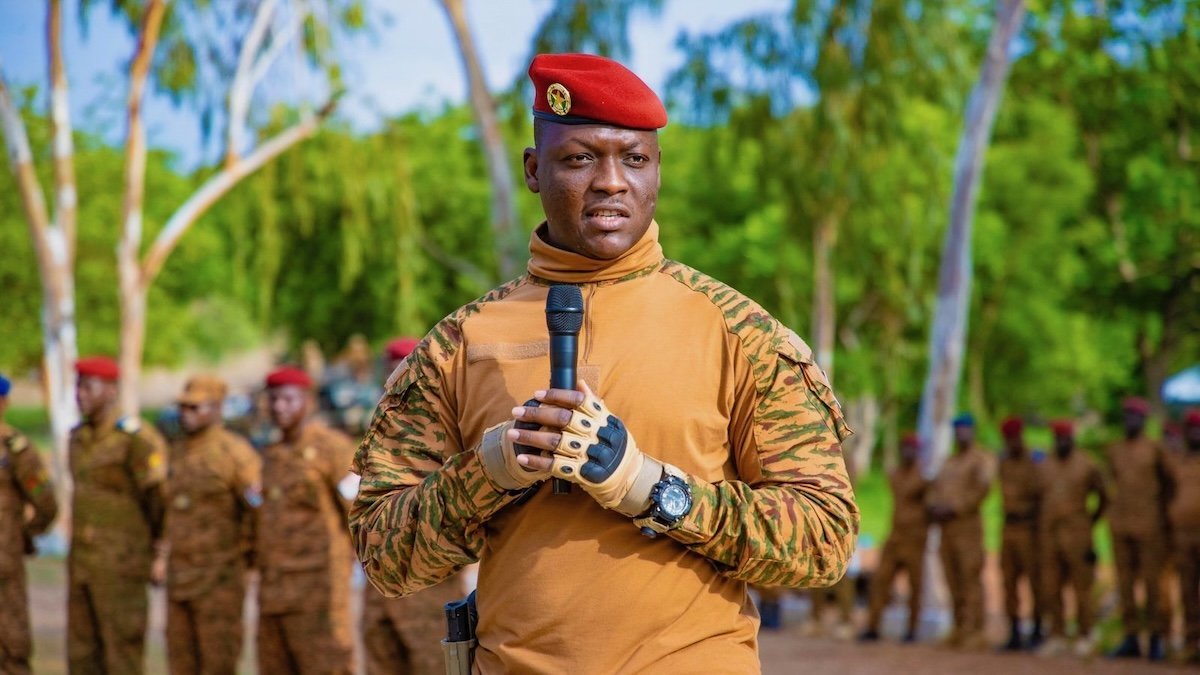
Burkina Faso's military government now controls or influences a growing share of a gold industry worth roughly USD 7 billion annually. Six of the country's 15 industrial gold mines are majority-owned by Burkinabe entities. Three are under direct state control through SOPAMIB, the state mining company whose expansion President Ibrahim Traoré's administration has accelerated as part of a deliberate effort to redesign the ownership structure of the economy itself.
What appears on the surface as mining sector reform is, at a deeper level, one of the clearest examples of Africa's accelerating shift toward resource nationalism and economic sovereignty whose political expression is becoming more explicit and whose continental pattern is becoming too consistent to treat as isolated country-level reforms.
What Burkina Faso is actually doing
The distinction that Traoré's administration's strategy requires making is between renegotiating contracts and redesigning ownership structures. Previous generations of African resource governance reform concentrated on the former: increasing royalty rates, tightening licence conditions, capturing larger fiscal shares of existing production arrangements. These reforms improved government revenues within the existing model without changing the model itself.
Burkina Faso is attempting the latter. The state's expansion through SOPAMIB combined with the rise of domestic investors such as Inoussa Kanazoe through Soleil Resources International signals a structural transition from passive regulation toward direct participation in ownership whose commercial consequence is different in kind rather than degree from royalty renegotiation. The question is not how much of the gold sector's value the government captures through taxation. It is who accumulates capital from the country's most strategic resource sector and whether that accumulation occurs inside or outside the domestic economy.
Gold sits at the centre of Burkina Faso's macroeconomic system. It generates foreign exchange, fiscal liquidity, export earnings, and political leverage in proportions that make the sector's ownership architecture a determinant of the broader economy's trajectory rather than simply a fiscal revenue source. Control over the gold sector therefore means partial control over the foreign exchange, capital accumulation, and investment capacity whose distribution shapes the economy beyond the sector itself.
The Traoré administration's corporate localisation framework makes the strategy's ambition concrete beyond ownership statistics. Companies generating more than five billion CFA francs annually must now establish permanent headquarters inside Burkina Faso, submit construction plans within six months, and complete physical office infrastructure within defined timelines. This is not symbolic politics. It is an attempt to physically anchor capital inside the domestic economy by targeting the offshore corporate architecture through which multinational firms extracted wealth from African states while maintaining operational command structures, legal headquarters, treasury systems, procurement chains, and financing arrangements outside the countries generating the raw materials themselves.
The continental pattern whose emergence Burkina Faso exemplifies
Burkina Faso's model is the most ideologically explicit version of a continental trend whose parallel expressions across the African resource economy are creating the cumulative pattern that individual country analyses miss when they treat each reform as an isolated national development rather than as part of the systemic shift whose direction the simultaneous occurrence across multiple countries and resource categories defines.
Tanzania has intensified licence enforcement, revoked dormant mining concessions, expanded local beneficiation requirements, and increasingly framed graphite, nickel, and critical minerals as strategic industrial assets rather than simple export commodities. The Ministry of Minerals' cancellation of idle exploration licences earlier in 2026, combined with the joint venture structures whose government participation the 30 May Ruangwa graphite licence agreements reflect, and the explicit value chain positioning language whose adoption in ministerial announcements marks a shift from extraction to industrial strategy, are Tanzania's version of the same ownership architecture redesign that Burkina Faso is executing more aggressively in the gold sector.
Zambia is positioning itself around copper refining, energy infrastructure, and battery supply chain integration whose commercial objective is capturing the processing margin that raw copper cathode export leaves in the refining and manufacturing economies receiving Zambian ore. The ZCCM-IH sovereign vehicle's repositioning toward active industrial strategy rather than passive royalty collection reflects the same recognition that passive extraction model reform produces revenues without structural transformation.
The Democratic Republic of Congo continues pushing for greater state leverage over cobalt and battery mineral value chains while pressuring firms toward local processing commitments whose commercial implementation faces the institutional capacity constraints that the DRC's governance environment imposes, but whose policy direction is consistent with the continental pattern regardless of execution pace. Zimbabwe's restriction of raw lithium exports attempts to force the domestic processing investment whose attraction raw material export pricing undermines by making the ore available to offshore processors at prices that leave the processing margin outside Zimbabwe's economy. Namibia is positioning uranium and green hydrogen inside a national industrial strategy rather than treating them as isolated extractive sectors, creating the integrated resource economy framework whose development the continental pattern's most institutionally sophisticated examples are beginning to demonstrate.
What is driving the shift
Resource nationalism in Africa is no longer primarily ideological, and understanding it as arithmetic rather than politics produces the more accurate analysis. African states increasingly recognise that the traditional extractive model produced growth without sufficient structural transformation, and the global energy transition has intensified that recognition by demonstrating that the minerals African states have been exporting as raw commodities are the same minerals that the industrial economies receiving them are designating as strategic assets whose processing, refining, and manufacturing value chain stages the global competition for energy transition supply chain position is most intensely contesting.
For decades, the dominant extractive model followed a familiar architecture whose commercial logic served the extracting firms and the external capital markets financing them more effectively than the hosting states whose mineral endowment was the source of the value being captured elsewhere. Foreign firms controlled production assets. Strategic decisions were made in London, Toronto, Perth, or Paris. Profits flowed outward through offshore corporate structures, management fees, procurement chains, and capital repatriation systems whose combined effect was that African states captured taxes, royalties, and limited employment generation but rarely controlled the higher-value layers of extraction, processing, financing, or ownership whose margins are multiples of the extraction royalty whose capture was treated as the resource governance success metric.
The global energy transition's elevation of critical minerals to geopolitical asset status has made the arithmetic of value chain capture visible in ways that previous commodity cycles did not create with comparable clarity. Governments now understand, through the specific evidence of the semiconductor shortage, the EV battery supply chain competition, and the US-China critical minerals rivalry whose intensity Uchumi360 has documented across its coverage, that whoever controls the processing chains, logistics systems, refining capacity, and industrial ecosystems surrounding critical minerals captures the majority of long-term value. The extraction margin is the beginning of the value chain, not its most significant stage.
According to UNCTAD's Economic Development in Africa Report, African countries have historically retained approximately 5 to 15% of the economic value generated from the mineral resources they host, with the remainder accumulating in the processing, manufacturing, logistics, and financial services stages whose geographic location outside Africa concentrates the margin in industrial economies. The resource nationalism whose continental expression Burkina Faso's gold sector redesign exemplifies is fundamentally a response to that arithmetic whose recognition the global energy transition's supply chain competition has made impossible to ignore in the policy circles whose decisions determine how Africa's minerals are governed.
The central tension between ownership ambition and execution capacity
The strategic direction is clear. The execution challenge is the variable that determines whether resource nationalism produces industrial transformation or extractive nationalism under new ownership structures, and the distinction between those two outcomes depends on the institutional capacity whose presence or absence is the decisive factor that the continental pattern's individual country variations reflect.
Resource nationalism historically carries substantial risks when institutional capacity is weak. Aggressive state intervention without operational competence can reduce investment inflows as companies assess the sovereign risk whose increase aggressive ownership restructuring creates, increase production inefficiencies as state entities without commercial operational experience manage assets whose technical complexity the previous private operator's institutional knowledge was managing, accelerate capital flight as mobile capital responds to regulatory unpredictability, and weaken long-term competitiveness as the investment reduction whose cause the ownership restructuring created reduces the exploration, development, and technology investment whose continuation productive capacity requires.
Burkina Faso itself faces the most severe version of this tension. The country's ongoing security instability and insurgency pressures across significant portions of its territory complicate industrial execution whose requirements include the physical safety of mining operations, the logistics security of ore and equipment movement, and the political stability whose presence institutional investors assess as the baseline condition for long-term capital commitment. Mining investors remain highly sensitive to regulatory unpredictability, sovereign risk, and political volatility, and Burkina Faso's current security environment creates the uncertainty premium whose cost is visible in the investment calculus of the companies whose operational presence the government's ownership expansion is simultaneously seeking to maintain and redirect.
The countries likely to succeed in converting resource nationalism into industrial transformation are not those with the largest mineral reserves or the most assertive ownership restructuring rhetoric. They are the ones capable of building the institutional architecture around those resources: reliable energy systems whose cost and reliability make industrial processing commercially viable, transport infrastructure whose connectivity reduces the logistics cost penalty that inland resource geographies impose, domestic financial capacity whose development reduces dependence on external financing whose conditionality constrains the industrial policy freedom that resource nationalism seeks to exercise, industrial processing capability whose technical development creates the human capital that value chain participation requires, regulatory consistency whose maintenance preserves the investor confidence that productive capital deployment demands, and sovereign investment discipline whose application converts resource revenues into productive capital rather than fiscal consumption.
Tanzania's infrastructure decade, whose convergence of SGR expansion, Julius Nyerere Hydropower surplus, port modernisation, and industrial park development Uchumi360 has documented as the enabling conditions for the industrial transformation that resource nationalism alone cannot produce, provides the most proximate East African example of the institutional architecture whose development alongside ownership governance creates the conditions that value chain capture requires. The graphite sector's joint venture structure, local beneficiation requirements, and idle licence enforcement reflect the governance dimension whose complement is the energy, logistics, and processing infrastructure whose physical development determines whether the governance framework's requirements can be commercially met.
Why Burkina Faso matters beyond Burkina Faso
The country is becoming a live experiment in whether African states can convert resource control into long-term economic restructuring rather than short-term political symbolism, and its outcome will be observed across the continent's resource governance community with the attention that a novel institutional experiment receives when the question it is testing is one whose answer every resource economy in Africa needs.
The experiment's most significant dimension is not the ownership percentage that SOPAMIB controls or the corporate localisation timelines that multinationals must meet. It is whether the sovereign investment mechanism whose construction the Traoré administration is pursuing alongside the ownership restructuring can channel gold revenues into the industrialisation and infrastructure development whose presence converts resource control from political achievement into economic foundation. Botswana's diamond revenue management, Norway's Government Pension Fund, and the Gulf states' sovereign wealth funds all demonstrate that the conversion of commodity revenues into permanent productive capital is institutionally achievable when the governance framework whose design makes the conversion mandatory is built before the revenue cycle whose discipline it must impose arrives. Burkina Faso is attempting to build that framework in a security environment that makes institutional construction significantly harder than the cases whose success it is attempting to replicate.
The era when Africa merely supplied raw materials to global systems is increasingly being questioned by the governments whose mineral endowment those systems depend on. The questioning is producing the ownership restructuring, value chain positioning, and sovereign investment ambition whose continental pattern Burkina Faso's gold sector exemplifies most explicitly. The next question is whether the continent can build the systems whose presence converts resource control into permanent productive capital, and whether the execution capacity whose development that conversion requires can be assembled faster than the commodity cycle whose revenues it must capture passes its peak.
That is the real test that Burkina Faso's gold nationalism is running. The verdict will apply across the continent.
FAQ
What has Burkina Faso's government done to its gold sector? President Ibrahim Traoré's administration has restructured the ownership architecture of Burkina Faso's gold industry, which is worth roughly USD 7 billion annually. Six of the country's 15 industrial gold mines are now majority-owned by Burkinabe entities and three are under direct state control through SOPAMIB. The government has also introduced a corporate localisation framework requiring companies generating more than five billion CFA francs annually to establish permanent headquarters inside Burkina Faso, and is building a sovereign investment mechanism to channel gold revenues toward industrialisation and infrastructure development.
What makes Burkina Faso's approach different from previous African mining sector reforms? Previous reforms concentrated on renegotiating extraction terms, increasing royalty rates, and improving fiscal capture within the existing model. Burkina Faso is attempting to redesign the ownership structure itself, determining who accumulates capital from the gold sector rather than how much of that capital the state captures through taxation. The corporate localisation framework whose physical headquarters requirement targets the offshore corporate architecture that allowed multinational firms to extract wealth while maintaining operational command structures outside the country reflects the distinction between passive regulation and direct participation in ownership.
What is the continental pattern that Burkina Faso exemplifies? A simultaneous shift across multiple African resource economies from passive extraction governance toward active value chain positioning. Tanzania has intensified graphite and nickel governance with local beneficiation requirements and joint venture structures. Zambia is pursuing copper refining and battery supply chain integration. The DRC is pushing for greater cobalt value chain capture. Zimbabwe has restricted raw lithium exports to force domestic processing investment. Namibia is positioning uranium and green hydrogen within a national industrial strategy. The pattern's driving force is the recognition that critical minerals are geopolitical assets whose processing, refining, and manufacturing stages capture the majority of long-term value that raw material export leaves in recipient economies.
What is the central risk that resource nationalism faces in Africa? Execution capacity. Aggressive ownership restructuring without operational competence can reduce investment inflows, increase production inefficiencies, accelerate capital flight, and weaken competitiveness. The countries likely to succeed are those building the institutional architecture around their resources: reliable energy systems, transport infrastructure, domestic financial capacity, industrial processing capability, regulatory consistency, and sovereign investment discipline. Without those systems, resource nationalism risks becoming extractive nationalism under new ownership without the industrial transformation whose realisation requires the enabling infrastructure that governance reform alone cannot provide.
Why does Burkina Faso's experiment matter for East Africa specifically? Because the ownership architecture question whose resolution Burkina Faso is testing applies directly to the graphite, nickel, cobalt, rare earth, and LNG resource decisions that Tanzania, the DRC, Uganda, and Rwanda are making simultaneously. Whether African states can convert resource control into industrial transformation rather than more sophisticated extraction is the question that determines the long-run fiscal position, industrial depth, and sovereign wealth accumulation of every resource economy across the continent. Tanzania's institutional architecture, whose energy surplus, SGR logistics, and industrial park development Uchumi360 has documented as the enabling conditions for value chain participation, represents the complement to governance reform whose combination the successful resource nationalism cases require.
 Uchumi360
Business Intelligence
Uchumi360
Business Intelligence
- Burkina Faso Ministry of Mines and Quarries, SOPAMIB operational data and mine ownership structure
- Six of 15 industrial gold mines majority Burkinabe-owned, three under direct state control
- Burkina Faso government, corporate localisation framework
- Five billion CFA francs threshold, headquarters establishment requirements and timelines
- Soleil Resources International, Inoussa Kanazoe ownership and mining operations documentation
- Specific filings require verification before publication
- UNCTAD, Economic Development in Africa Report
- African value retention from mineral resources approximately 5 to 15%
- Available at unctad.org
- Tanzania Ministry of Minerals, graphite licence and governance documentation
- Available at madini.go.tz
- Tanzania Electric Supply Company, 4,000 MW capacity operational records
- Available at tanesco.co.tz
- Standard Chartered Bank, SGR financing announcement, 28 April 2026
- Available at sc.com
- ZCCM Investments Holdings Zambia, copper refining and industrial strategy documentation
- Available at zccm-ih.com.zm
- DRC Institut National de la Statistique, cobalt and minerals data
- Available at ins-rdc.org
- Zimbabwe Ministry of Mines, raw lithium export restriction documentation
- Available at mines.gov.zw
- Namibia Investment Promotion and Development Board, uranium and green hydrogen strategy documentation
- Available at nipdb.com
- USGS, Mineral Commodity Summaries
- Critical minerals production and processing data
- Available at usgs.gov
- World Bank, Africa mineral governance and resource nationalism research
- Available at worldbank.org
- African Development Bank, African mining sector reports
- Available at afdb.org
- Natural Resource Governance Institute, Resource Governance Index
- African resource governance performance data
- Available at resourcegovernance.org
- Norges Bank Investment Management, Government Pension Fund Global documentation
- Sovereign wealth reference
- Available at nbim.no
- Rwanda Development Board, critical minerals governance comparative data
- Available at rdb.rw
- Mozambique Instituto Nacional de Estatística, graphite and minerals data
- Available at ine.gov.mz
- Malawi National Statistical Office, rare earth and minerals data
- Available at nsomalawi.mw
Uchumi360 covers business, investment, and economic policy across East, Central, and Southern Africa.
For the serious reader
You read to the end. That places you in a small group.
Uchumi360 is built for readers who demand precision over speed, structure over sentiment, and analysis that holds uncomfortable conclusions rather than softening them. If this work sharpens how you think about Africa's economy, help us keep building the infrastructure behind it.
Institutional Partners
Commission intelligence. Shape the conversation.
Uchumi360 works with development finance institutions, investment firms, sovereign bodies, and strategic organisations across the coverage region. Institutional partnership unlocks:
- Commissioned sector and country intelligence reports
- Branded research series under your institution's authority
- Exclusive data briefings for internal strategy teams
- Speaking and editorial presence at Uchumi360 events
- Co-published investment outlooks for your markets
Support Our Work
Independent analysis has a cost. Help us bear it.
Uchumi360 does not carry advertising. It does not take editorial direction from sponsors. Every article is produced without commercial compromise. Your contribution funds the reporting, research, and editorial infrastructure that keeps this analysis free from influence.
Secure checkout: One-time and monthly support are processed securely.
Stay Connected
Keep up with every new insight.
Follow our latest analysis, policy coverage, and market intelligence as soon as it is published. If you need something specific, reach out directly and we will point you to the right research.
